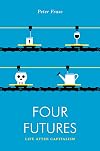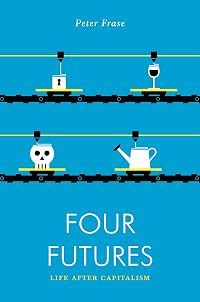
Four Futures: Life after Capitalism
by Peter Frase
On This Page
Description
Peter Frase argues that increasing automation and a growing scarcity of resources, thanks to climate change, will bring it all tumbling down. In Four Futures, Frase imagines how this post-capitalist world might look, deploying the tools of both social science and speculative fiction to explore what communism, rentism, socialism, and exterminism might actually entail. Could the current rise of real-life robocops usher in a world that resembles Ender's Game? And sure, communism will bring an show more end to material scarcities and inequalities of wealth-but there's no guarantee that social hierarchies, governed by an economy of "likes," wouldn't rise to take their place. A whirlwind tour through science fiction, social theory, and the new technologies already shaping our lives, Four Futures is a balance sheet of the socialisms we may reach if a resurgent Left is successful, and the barbarisms we may be consigned to if those movements fail. show lessTags
Recommendations














Member Reviews
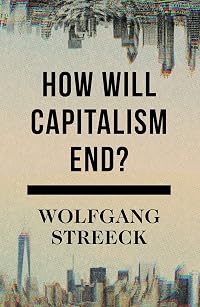
Just from looking at it, you can tell that ‘Four Futures’ will only describe each of its scenarios briefly. This a 150 page book, after all. Yet somehow the brevity disappointed me nonetheless. (It probably didn’t help that I read it in the throes of insomnia.) Not that I disagreed with what was said, nor that the choice of four options didn’t seem sensible, rather that the introduction (more than a fifth of the total page count) set up slightly unrealistic expectations. Specifically, it claimed to be ‘social science fiction’ - my absolute favourite sub-genre of fiction - rather than futurism. Then the scenarios themselves lacked the detail and colour to really live up to that. Frase was most likely trying to keep it simple, show more whereas I wanted more depth and density. That said, I really liked the up-front assumption that capitalism is destroying itself, based on this excellent Wolfgang Streek quote:
Frase cites a fairly limited selection of sci-fi novels to support each of the four futures, so the rest of this review will discuss each in turn and suggest additional relevant sci-fi references. Let’s be honest, this is one of those books that I liked although part of me was always thinking, ‘I would have written this a little differently’.
Communism
In this future of abundance and equality, sadly the least likely of the four, ubiquitous automation releases the population from unwanted work, the benefits of this are shared through a basic income, and climate change can be easily dealt with using technology. The chapter focuses on how meaning in life might be found without late capitalism’s emphasis on paid work as identity. Frase mentions pseudo-currencies online based on status and social media likes. The elision between personal identity and hierarchies of ‘esteem’ was interesting in itself. Without a job to provide a group that you’re part of (‘postdocs’ in my case), activities currently minimised as hobbies could provide similar groupings. Would they need to be hierarchical, though? I think work hierarchies are all about competition for a scarce resource: promotion to more senior, allegedly better jobs. Without that scarcity, I think the word hierarchy might be less immediately applicable. While social media esteem does involve a jockeying for popularity, there isn’t the same sense that only a strictly finite number of people can be recognised for whatever reason. Surely abundance and equality would also allow for more co-operation rather than competition.
The communist scenario reminded me of the Culture novels, especially [b:The Player of Games|18630|The Player of Games (Culture, #2)|Iain M. Banks|https://images.gr-assets.com/books/1386922873s/18630.jpg|1494157], in which games and love affairs occupy the leisurely lives of citizens. Particularly interesting to me in that novel was the discussion of Culture language, which is deliberately structured to restrict hierarchies and prevent sexual discrimination. It strikes me that a communist world would radically alter the meaning of words like value and work. I imagine such a world would also place great emphasis on experiences: travel, sports, and art in particular. I wonder what sort of literature it would produce? Unfortunately, we’re very unlikely to find out.
Rentism
This future involves abundance thanks to automation, without equal distribution of the gains involved. In such a world, a privileged elite holds the patents and extracts rents from everyone who wants a copy. Again, climate change has somehow been fixed by technology. I liked the use of Transmetropolitan and its ‘maker codes’ as an example here. I was also reminded of a totally OTT cyberpunk novel in which media piracy carried the death penalty. This was applied in a darkly absurd fashion by the inevitable cyberpunk hired killer, who executed the offender than used some of their brain matter to improve the performance of coaxial cables in his stereo system. (I’m pretty sure that’s a real book and I didn’t just dream it. Can't remember the title for the life of me, though.) Cyberpunk as a sub-genre is predicated on ubiquitous computing with strongly-enforced corporate gatekeeping.
Rentism has the plausibility of already being visible everywhere. The most valuable corporate assets these days are forms of intellectual capital, not machines or buildings but algorithms, designs, DNA, and databases of personal information. The extent to which this undermines the operation of capitalism is the theme of Paul Mason’s [b:Postcapitalism: A Guide to Our Future|24878857|Postcapitalism A Guide to Our Future|Paul Mason|https://images.gr-assets.com/books/1437580637s/24878857.jpg|44526761] and should be obvious to any A-level economics student. If the supply of a good is infinite, because it can be copied at effectively zero cost, the price falls to zero. Free market economics cuts its own throat! Only monopolism, a so-called market failure, prevents this. According to Mason, and in my view as well, this situation is inherently unstable due to the difficulty of preventing piracy.
Socialism
Now we come to the futures in which climate change cannot be handily swept aside by technology. In the socialist scenario, there is scarcity but relative equality thanks to government intervention and planning. This calls to mind several sci-fi novels that I have known and loved. Gwyneth Jones’ [b:Bold as Love|1118463|Bold as Love (Bold as Love, #1)|Gwyneth Jones|https://images.gr-assets.com/books/1327928608s/1118463.jpg|1105495] series, in which an anarchic government of rockstars steers England through economic and environmental collapse. Ken McLeod’s [b:Intrusion|13189396|Intrusion|Ken MacLeod|https://images.gr-assets.com/books/1329901274s/13189396.jpg|18370451] and Julie Zeh’s [b:Corpus Delicti: Ein Prozess|6309229|Corpus Delicti. Ein Prozess|Juli Zeh|https://images.gr-assets.com/books/1329245089s/6309229.jpg|6494357], both of which explore how interventionist governments that deal effectively with environmental collapse can also take an unnecessary level of interest in women’s bodies. The former series is hopeful to a point, the latter two are less willing to put their faith in governments. [b:Intrusion|13189396|Intrusion|Ken MacLeod|https://images.gr-assets.com/books/1329901274s/13189396.jpg|18370451] is very much a Labour utopia/dystopia, which encouraged me to compare it with the Conservative austerity and privatisation that happened instead. If your freedom is constrained, do you prefer it to be for a greater public good or for higher shareholder returns?
I was a little surprised that the socialism chapter didn’t mention carbon rationing, which was briefly discussed as a potential (Labour) government policy back in the halcyon days of 2008. [b:The Carbon Diaries 2015|4935015|The Carbon Diaries 2015 (Carbon Diaries, #1)|Saci Lloyd|https://images.gr-assets.com/books/1273722854s/4935015.jpg|5000676] and sequel spin out the consequences of such a policy. It did, however, talk about economic planning in Francis Spufford’s fascinating book [b:Red Plenty: Inside the Fifties' Soviet Dream|6481280|Red Plenty Inside the Fifties' Soviet Dream|Francis Spufford|https://images.gr-assets.com/books/1328267463s/6481280.jpg|6672528]. Could supercomputers plan the economy for us? I would hope they could at least monitor environmental limits and warn against activities that would cross them - a carbon cap and trade scheme would obviously require automated monitoring and control. Frase’s take on cap and trade was interesting: that if the government controls the price mechanism then it’s not a capitalist market per se. To my mind, the truly subversive and anti-capitalist element of cap and trade is placing a hard quantitative limit on carbon emissions, production of some good, or whatever. This is antithetical to the magical thinking in free market economics that wealth can increase infinitely and that the Earth will costlessly absorb infinite pollution forever.
Of the four futures, I think socialism is the best we can now hope for. I believe that we’ve missed our chance for a smooth, technology-led climate change mitigation. If that was ever possible (and there are structural reasons why not cf [b:Fossil Capital: The Rise of Steam Power and the Roots of Global Warming|25614450|Fossil Capital The Rise of Steam Power and the Roots of Global Warming|Andreas Malm|https://images.gr-assets.com/books/1449996772s/25614450.jpg|44301257]), it certainly seems too late now. A world in which everyone has a basic income and carbon ration, however, looks vanishingly distant, simply because it would require a reckoning with the tiny elite who control a disproportionate share of global wealth.
Exterminism
The final and most plausible future is one in which climate change causes scarcity and the wealthy retreat to their citadels, while everyone else struggles to survive. Unfortunately this can already been observed in the horrific and inhumane treatment of refugees in America, Europe, Australia, et al. At a national level, racism and xenophobia allow rich countries to turn a blind eye to the suffering and death of refugees. At an international level, the richest insulate themselves further by building bunkers and retreats in New Zealand. (If you feel like being incandescently angry, read this very long New Yorker piece on super-rich survivalists. These people seem unwilling or unable to face the fact that they caused, and are still causing, the instability that they fear. Their greed for wealth and privilege has undermined the social contract and faith in politics. Their lifestyles are changing the climate. Their espousal of neoliberalism has split society, undermined trust, and depleted the public realm. And now they want to buy their way out of the country, indeed the world, that they've wrecked for short term gains!)
Anyway, Frase’s first sci-fi example in this chapter is the film Elysium, which he admits has a political economy that is ‘somewhat difficult to extract’. I found it a rather unsatisfactory dystopia, in which the shock was that a white American guy had to deal with a similar daily life to a developing-world slum inhabitant. The plot's focus was on getting healthcare for the underclass, without any explanation of why it was so scarce in the first place given total automation. Why aren’t the elite extracting rents on the technology? Anyway, the film's resolution seemed to me like a metaphor for Obamacare: now you can get basic healthcare, no need to concern yourselves with all the other problems caused by structural inequality. A more apposite example of a rich elite quite actively trying to kill off an unemployed underclass can be found in [b:The Ballad of Halo Jones|59710|The Ballad of Halo Jones|Alan Moore|https://images.gr-assets.com/books/1388293260s/59710.jpg|1884159]. The main character lives in an overcrowded and dangerous ghetto for the unemployed, until in desperation she signs up for the army as a way to escape. The war she joins is brutal and pointless, quite possibly only happening as a way to simulate production of weapons and kill off the unemployed. That seems to me the most likely form more active exterminism would take: fomenting wars. Actually, this also a theme in the last novel I read, [b:S. N. U. F. F.|13191456|S. N. U. F. F.|Victor Pelevin|https://images.gr-assets.com/books/1347532677s/13191456.jpg|18426168]. Given the resource shortages that climate change will continue to cause, it probably won’t take much encouragement.
The most depressing thing about ‘Four Futures’ is that it was published in 2016, yet since it was written the world has moved significantly closer to an exterminist future thanks to Brexit and Trump. I don’t think that’s just the sleeplessness talking. Still, a thought-provoking book that provides a tidy taxonomy for life after capitalism. I just wish it had been at least twice as long. show less
The image I have of the end of capitalism - and end that I believe is already underway - is one of a social system in chronic disrepair, for reasons of its own and regardless of the absence of a viable alternative. While we cannot know when and how exactly capitalism will disappear and that will succeed it, what matters is that no force is on hand that can be expected to reverse the three downward trends in economic growth, social equality, and financial stability and end their mutual reinforcement.
Frase cites a fairly limited selection of sci-fi novels to support each of the four futures, so the rest of this review will discuss each in turn and suggest additional relevant sci-fi references. Let’s be honest, this is one of those books that I liked although part of me was always thinking, ‘I would have written this a little differently’.
Communism
In this future of abundance and equality, sadly the least likely of the four, ubiquitous automation releases the population from unwanted work, the benefits of this are shared through a basic income, and climate change can be easily dealt with using technology. The chapter focuses on how meaning in life might be found without late capitalism’s emphasis on paid work as identity. Frase mentions pseudo-currencies online based on status and social media likes. The elision between personal identity and hierarchies of ‘esteem’ was interesting in itself. Without a job to provide a group that you’re part of (‘postdocs’ in my case), activities currently minimised as hobbies could provide similar groupings. Would they need to be hierarchical, though? I think work hierarchies are all about competition for a scarce resource: promotion to more senior, allegedly better jobs. Without that scarcity, I think the word hierarchy might be less immediately applicable. While social media esteem does involve a jockeying for popularity, there isn’t the same sense that only a strictly finite number of people can be recognised for whatever reason. Surely abundance and equality would also allow for more co-operation rather than competition.
The communist scenario reminded me of the Culture novels, especially [b:The Player of Games|18630|The Player of Games (Culture, #2)|Iain M. Banks|https://images.gr-assets.com/books/1386922873s/18630.jpg|1494157], in which games and love affairs occupy the leisurely lives of citizens. Particularly interesting to me in that novel was the discussion of Culture language, which is deliberately structured to restrict hierarchies and prevent sexual discrimination. It strikes me that a communist world would radically alter the meaning of words like value and work. I imagine such a world would also place great emphasis on experiences: travel, sports, and art in particular. I wonder what sort of literature it would produce? Unfortunately, we’re very unlikely to find out.
Rentism
This future involves abundance thanks to automation, without equal distribution of the gains involved. In such a world, a privileged elite holds the patents and extracts rents from everyone who wants a copy. Again, climate change has somehow been fixed by technology. I liked the use of Transmetropolitan and its ‘maker codes’ as an example here. I was also reminded of a totally OTT cyberpunk novel in which media piracy carried the death penalty. This was applied in a darkly absurd fashion by the inevitable cyberpunk hired killer, who executed the offender than used some of their brain matter to improve the performance of coaxial cables in his stereo system. (I’m pretty sure that’s a real book and I didn’t just dream it. Can't remember the title for the life of me, though.) Cyberpunk as a sub-genre is predicated on ubiquitous computing with strongly-enforced corporate gatekeeping.
Rentism has the plausibility of already being visible everywhere. The most valuable corporate assets these days are forms of intellectual capital, not machines or buildings but algorithms, designs, DNA, and databases of personal information. The extent to which this undermines the operation of capitalism is the theme of Paul Mason’s [b:Postcapitalism: A Guide to Our Future|24878857|Postcapitalism A Guide to Our Future|Paul Mason|https://images.gr-assets.com/books/1437580637s/24878857.jpg|44526761] and should be obvious to any A-level economics student. If the supply of a good is infinite, because it can be copied at effectively zero cost, the price falls to zero. Free market economics cuts its own throat! Only monopolism, a so-called market failure, prevents this. According to Mason, and in my view as well, this situation is inherently unstable due to the difficulty of preventing piracy.
Socialism
Now we come to the futures in which climate change cannot be handily swept aside by technology. In the socialist scenario, there is scarcity but relative equality thanks to government intervention and planning. This calls to mind several sci-fi novels that I have known and loved. Gwyneth Jones’ [b:Bold as Love|1118463|Bold as Love (Bold as Love, #1)|Gwyneth Jones|https://images.gr-assets.com/books/1327928608s/1118463.jpg|1105495] series, in which an anarchic government of rockstars steers England through economic and environmental collapse. Ken McLeod’s [b:Intrusion|13189396|Intrusion|Ken MacLeod|https://images.gr-assets.com/books/1329901274s/13189396.jpg|18370451] and Julie Zeh’s [b:Corpus Delicti: Ein Prozess|6309229|Corpus Delicti. Ein Prozess|Juli Zeh|https://images.gr-assets.com/books/1329245089s/6309229.jpg|6494357], both of which explore how interventionist governments that deal effectively with environmental collapse can also take an unnecessary level of interest in women’s bodies. The former series is hopeful to a point, the latter two are less willing to put their faith in governments. [b:Intrusion|13189396|Intrusion|Ken MacLeod|https://images.gr-assets.com/books/1329901274s/13189396.jpg|18370451] is very much a Labour utopia/dystopia, which encouraged me to compare it with the Conservative austerity and privatisation that happened instead. If your freedom is constrained, do you prefer it to be for a greater public good or for higher shareholder returns?
I was a little surprised that the socialism chapter didn’t mention carbon rationing, which was briefly discussed as a potential (Labour) government policy back in the halcyon days of 2008. [b:The Carbon Diaries 2015|4935015|The Carbon Diaries 2015 (Carbon Diaries, #1)|Saci Lloyd|https://images.gr-assets.com/books/1273722854s/4935015.jpg|5000676] and sequel spin out the consequences of such a policy. It did, however, talk about economic planning in Francis Spufford’s fascinating book [b:Red Plenty: Inside the Fifties' Soviet Dream|6481280|Red Plenty Inside the Fifties' Soviet Dream|Francis Spufford|https://images.gr-assets.com/books/1328267463s/6481280.jpg|6672528]. Could supercomputers plan the economy for us? I would hope they could at least monitor environmental limits and warn against activities that would cross them - a carbon cap and trade scheme would obviously require automated monitoring and control. Frase’s take on cap and trade was interesting: that if the government controls the price mechanism then it’s not a capitalist market per se. To my mind, the truly subversive and anti-capitalist element of cap and trade is placing a hard quantitative limit on carbon emissions, production of some good, or whatever. This is antithetical to the magical thinking in free market economics that wealth can increase infinitely and that the Earth will costlessly absorb infinite pollution forever.
Of the four futures, I think socialism is the best we can now hope for. I believe that we’ve missed our chance for a smooth, technology-led climate change mitigation. If that was ever possible (and there are structural reasons why not cf [b:Fossil Capital: The Rise of Steam Power and the Roots of Global Warming|25614450|Fossil Capital The Rise of Steam Power and the Roots of Global Warming|Andreas Malm|https://images.gr-assets.com/books/1449996772s/25614450.jpg|44301257]), it certainly seems too late now. A world in which everyone has a basic income and carbon ration, however, looks vanishingly distant, simply because it would require a reckoning with the tiny elite who control a disproportionate share of global wealth.
Exterminism
The final and most plausible future is one in which climate change causes scarcity and the wealthy retreat to their citadels, while everyone else struggles to survive. Unfortunately this can already been observed in the horrific and inhumane treatment of refugees in America, Europe, Australia, et al. At a national level, racism and xenophobia allow rich countries to turn a blind eye to the suffering and death of refugees. At an international level, the richest insulate themselves further by building bunkers and retreats in New Zealand. (If you feel like being incandescently angry, read this very long New Yorker piece on super-rich survivalists. These people seem unwilling or unable to face the fact that they caused, and are still causing, the instability that they fear. Their greed for wealth and privilege has undermined the social contract and faith in politics. Their lifestyles are changing the climate. Their espousal of neoliberalism has split society, undermined trust, and depleted the public realm. And now they want to buy their way out of the country, indeed the world, that they've wrecked for short term gains!)
Anyway, Frase’s first sci-fi example in this chapter is the film Elysium, which he admits has a political economy that is ‘somewhat difficult to extract’. I found it a rather unsatisfactory dystopia, in which the shock was that a white American guy had to deal with a similar daily life to a developing-world slum inhabitant. The plot's focus was on getting healthcare for the underclass, without any explanation of why it was so scarce in the first place given total automation. Why aren’t the elite extracting rents on the technology? Anyway, the film's resolution seemed to me like a metaphor for Obamacare: now you can get basic healthcare, no need to concern yourselves with all the other problems caused by structural inequality. A more apposite example of a rich elite quite actively trying to kill off an unemployed underclass can be found in [b:The Ballad of Halo Jones|59710|The Ballad of Halo Jones|Alan Moore|https://images.gr-assets.com/books/1388293260s/59710.jpg|1884159]. The main character lives in an overcrowded and dangerous ghetto for the unemployed, until in desperation she signs up for the army as a way to escape. The war she joins is brutal and pointless, quite possibly only happening as a way to simulate production of weapons and kill off the unemployed. That seems to me the most likely form more active exterminism would take: fomenting wars. Actually, this also a theme in the last novel I read, [b:S. N. U. F. F.|13191456|S. N. U. F. F.|Victor Pelevin|https://images.gr-assets.com/books/1347532677s/13191456.jpg|18426168]. Given the resource shortages that climate change will continue to cause, it probably won’t take much encouragement.
The most depressing thing about ‘Four Futures’ is that it was published in 2016, yet since it was written the world has moved significantly closer to an exterminist future thanks to Brexit and Trump. I don’t think that’s just the sleeplessness talking. Still, a thought-provoking book that provides a tidy taxonomy for life after capitalism. I just wish it had been at least twice as long. show less
As current events continue to instill a sense of impending doom over our contemporary lives, seeming to grow every year, I found Peter Frase’s book length essay, Four Futures: Life After Capitalism to be a fascinating and edifying read. In Four Futures, Frase describes the “two specters … haunting Earth in the twenty-first century: the specters of ecological catastrophe and automation,” which while “in many ways diametrical opposites,” exemplify our historic moment, “volatile and uncertain, full of both promise and danger.” A fascinating discussion, in the book Frase attempts to use the “tools of social science” as well as speculative fiction to examine how we imagation our future possibilities and conflicts.
Frase, show more in the end, envisions four options for the future of our society and uses popular culture as a lens to sketch out how they may operate, to paraphrase a quote Frase includes from Rosa Luxembourg’s 1915 statement regarding the fate of Bourgeois society, “two socialisms and two barbarisms.” Communism, which indicates an abundance of resources thanks to technological advances coupled with a broad equality, Rentism, in which those same technological advances exist but stay shackled to our current economic inequality, Socialism, in which scarcity remains a obstacle but equality maintains society fairly, and Exterminationism, in which the elite finally decide the majority of humanity need no longer exist. All in all this is, I feel, a useful way to look at discussions of imagined futures, and I will be referring back to these “four futures” in my own readings of pop culture dystopias/utopias.
I discuss Four Futures and other books in my latest entry of Harris' Tome Corner, The Anxiety of the Future #1, https://medium.com/@burk0277/anxiety-of-the-future-1-a-future-for-good-or-ill-fb... show less
Frase, show more in the end, envisions four options for the future of our society and uses popular culture as a lens to sketch out how they may operate, to paraphrase a quote Frase includes from Rosa Luxembourg’s 1915 statement regarding the fate of Bourgeois society, “two socialisms and two barbarisms.” Communism, which indicates an abundance of resources thanks to technological advances coupled with a broad equality, Rentism, in which those same technological advances exist but stay shackled to our current economic inequality, Socialism, in which scarcity remains a obstacle but equality maintains society fairly, and Exterminationism, in which the elite finally decide the majority of humanity need no longer exist. All in all this is, I feel, a useful way to look at discussions of imagined futures, and I will be referring back to these “four futures” in my own readings of pop culture dystopias/utopias.
I discuss Four Futures and other books in my latest entry of Harris' Tome Corner, The Anxiety of the Future #1, https://medium.com/@burk0277/anxiety-of-the-future-1-a-future-for-good-or-ill-fb... show less
One thing about the future – it is universally grim. I have yet to see a book where it is bright, inviting or even comfortable. But Peter Frase’s is the fairest assessment I have yet encountered. He has created a matrix of possible outcomes, and examines the four of them as chapters in Four Futures. They are all plausible, all arguable, and all to be avoided.
The four scenarios include aspects of socialism, communism and extermism, in which the rich annihilate the poor in a society where the poor are no longer necessary for anything. Machines do all the labor, from picking fruit to guarding fortress homes. If the planet has been destroyed environmentally, the rich will escape to orbiting luxury space stations. But the most show more frightening one to me was also the most possible – the rentier future. In this scenario, there are no more factories, no more developments or mines. Instead, the rich own all the intellectual property, and rent it out. No one actually owns anything; they must pay continuously to license and operate it. We already see this in software, music, TV, games, phones, in agricultural seeds, and of course in living quarters. Everything in Western life is being converted to subscription, with payment removed directly from bank accounts. John Deere claims you never own your tractor – you merely license it while you use it, despite having paid to own it. So tampering with the motor or the electronics makes you a criminal. That is a horrifying future to me. It is well underway and is every startup’s dream business model.
The only thing certain is that we can’t go back to an industrial revolution civilization. Factories are going away. The gig economy keeps the 99% on the prowl to scratch together a living. 3-D printing is on its way in (though you won’t own the printer or the product codes, and there will severe restrictions on what you can produce with one), providing a kind of Star-Trek “Replicator” future. So depending on how we occupy our plentiful time, how much abundance there is versus scarcity, and how powerful the rich become, one of Frase’s scenarios is likely.
Naturally, these are not prescriptive choices; there is no pure vision or outcome. They can and will have elements of each other, and Frase points out several crossovers along the way. Mostly, Four Futures is an intellectual challenge. It is a very fast read, couched in the pop culture visions of sci-fi writers and dystopian-future films, things that are very easy to relate to. It is a pleasure to be so challenged, even if the result is less than heartwarming.
David Wineberg show less
The four scenarios include aspects of socialism, communism and extermism, in which the rich annihilate the poor in a society where the poor are no longer necessary for anything. Machines do all the labor, from picking fruit to guarding fortress homes. If the planet has been destroyed environmentally, the rich will escape to orbiting luxury space stations. But the most show more frightening one to me was also the most possible – the rentier future. In this scenario, there are no more factories, no more developments or mines. Instead, the rich own all the intellectual property, and rent it out. No one actually owns anything; they must pay continuously to license and operate it. We already see this in software, music, TV, games, phones, in agricultural seeds, and of course in living quarters. Everything in Western life is being converted to subscription, with payment removed directly from bank accounts. John Deere claims you never own your tractor – you merely license it while you use it, despite having paid to own it. So tampering with the motor or the electronics makes you a criminal. That is a horrifying future to me. It is well underway and is every startup’s dream business model.
The only thing certain is that we can’t go back to an industrial revolution civilization. Factories are going away. The gig economy keeps the 99% on the prowl to scratch together a living. 3-D printing is on its way in (though you won’t own the printer or the product codes, and there will severe restrictions on what you can produce with one), providing a kind of Star-Trek “Replicator” future. So depending on how we occupy our plentiful time, how much abundance there is versus scarcity, and how powerful the rich become, one of Frase’s scenarios is likely.
Naturally, these are not prescriptive choices; there is no pure vision or outcome. They can and will have elements of each other, and Frase points out several crossovers along the way. Mostly, Four Futures is an intellectual challenge. It is a very fast read, couched in the pop culture visions of sci-fi writers and dystopian-future films, things that are very easy to relate to. It is a pleasure to be so challenged, even if the result is less than heartwarming.
David Wineberg show less
Super super short. So there's a lot of places where Frase simplifies or skips things, not least in the framing of "there are Two Crises, automation and climate change, and I'm gonna analyze them along these two axes." But given the limitations/focus I think this book does a pretty good job of imagining and contrasting different societies we could be living in.
Some of the key assumptions that the book rests on:
- automation will dramatically reduce the need for human labor
- capitalism will end, in the sense that it will stop being the basis for a functional society
Which I find mostly compelling, though I'm not sure how much our automation trajectory will be affected by ecological collapse (which are two crises he treats as show more orthogonal).
There's also some pretty fun stuff that's basically like, "hey, realistically we are kind of far away from seizing the state & the means of production. So in the meantime we can build strength by 'building alternatives to capitalism' and help people exist without depending quite so much on wage labor." Which is a kind of hopeful message, I think. In addition to avoiding the trap of "all we need is revolution," he also avoids a few others:
- ending capitalism will end sexism & racism
- ending capitalism will end hierarchies in general
- automation will mean people work less
And one final note: the four futures he envisions aren't end-points but different states that we can transition between. One could imagine a "rentist" future, with abundance and hierarchy, sliding into an "exterminist" future which then eventually transitions into "communism" for the surviving elite. Room for hope...? show less
Some of the key assumptions that the book rests on:
- automation will dramatically reduce the need for human labor
- capitalism will end, in the sense that it will stop being the basis for a functional society
Which I find mostly compelling, though I'm not sure how much our automation trajectory will be affected by ecological collapse (which are two crises he treats as show more orthogonal).
There's also some pretty fun stuff that's basically like, "hey, realistically we are kind of far away from seizing the state & the means of production. So in the meantime we can build strength by 'building alternatives to capitalism' and help people exist without depending quite so much on wage labor." Which is a kind of hopeful message, I think. In addition to avoiding the trap of "all we need is revolution," he also avoids a few others:
- ending capitalism will end sexism & racism
- ending capitalism will end hierarchies in general
- automation will mean people work less
And one final note: the four futures he envisions aren't end-points but different states that we can transition between. One could imagine a "rentist" future, with abundance and hierarchy, sliding into an "exterminist" future which then eventually transitions into "communism" for the surviving elite. Room for hope...? show less
The truth about the future is that none of us really know what it holds.
The above, indisputable fact, makes most of this type of book almost not worth reading. Peter Frase has tried to overcome this problem by projecting four different perspectives: communism, rentism, socialism and exterminism. He also accepts that the 'real' future is unlikely to be a pure version of any of these alternatives but, a mixture of several.
It is easy, as I appeared to do, in the first sentence of this review, to dismiss prediction but, the alternative is to go blindly where ever life may lead. We need some form of planning and, to mash up and misuse a well known phrase, a one eyed man is a better guide than a blind one.
This book is only 150 pages long and show more has been written in a style accessible to the common reader (and I should know: there's few commoner). As with any book of this type, one doesn't read it for all the answers, but to obtain a better grasp of all the questions and, Mr Frase does a very good job of that. Well worth a read. show less
The above, indisputable fact, makes most of this type of book almost not worth reading. Peter Frase has tried to overcome this problem by projecting four different perspectives: communism, rentism, socialism and exterminism. He also accepts that the 'real' future is unlikely to be a pure version of any of these alternatives but, a mixture of several.
It is easy, as I appeared to do, in the first sentence of this review, to dismiss prediction but, the alternative is to go blindly where ever life may lead. We need some form of planning and, to mash up and misuse a well known phrase, a one eyed man is a better guide than a blind one.
This book is only 150 pages long and show more has been written in a style accessible to the common reader (and I should know: there's few commoner). As with any book of this type, one doesn't read it for all the answers, but to obtain a better grasp of all the questions and, Mr Frase does a very good job of that. Well worth a read. show less
Smart, thought-provoking look at the political economic paths we might take. The author is a Marxist, and some of his sections make or are based on assumptions I don't share (and sometimes find naive or somewhat inconsistent). But this short, crisp work is very useful for anyone looking for frameworks for better understanding the current moment and where we might be headed.
Filled with disclaimers about not being a work of futurism, this is nevertheless a nice piece of speculative fiction (or "speculative social science," to use the Frase phrase). A simple two axes do the job of postulating future political economies: scarcity v. abundance, hierarchy v. egalitarianism. Combining pairs serve to illustrate everything from a Star Trek-style communist utopia of plenty to an immiserated, "exterminist" world of rich enclaves and mass suffering.
Obviously, this isn't meant to be a comprehensive future analysis, but as a starting point for trying to build a better world, it's pretty good.
Obviously, this isn't meant to be a comprehensive future analysis, but as a starting point for trying to build a better world, it's pretty good.
Members
- Recently Added By
Lists

Speculative non-fiction
25 works; 2 members
Author Information
Some Editions
Awards and Honors
Distinctions
The Guardian Book of the Day (2016-11-24)
Series
Belongs to Publisher Series
Common Knowledge
- Canonical title
- Four Futures: Life after Capitalism
- Original title
- Four Futures: Life after Capitalism
- Original publication date
- 2016-10-04
- Canonical DDC/MDS
- 330
Classifications
Statistics
- Members
- 492
- Popularity
- 61,629
- Reviews
- 14
- Rating
- (3.72)
- Languages
- 6 — English, Italian, Polish, Spanish, Swedish, Turkish
- Media
- Paper, Audiobook, Ebook
- ISBNs
- 11
- ASINs
- 5