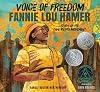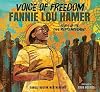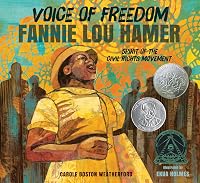
Voice of Freedom: Fannie Lou Hamer: The Spirit of the Civil Rights Movement
by Carole Boston Weatherford
On This Page
Description
Presents a collage-illustrated treasury of poems and spirituals inspired by the life and work of civil rights advocate Fannie Lou Hamer.Tags
Recommendations

























Member Reviews
Voice of Freedom is the true and extremely personal story of Fannie Lou Hammer. This contextual biography is lyrically rich, told in verse, using a first-person narrative that is spoken from Hamer's own life experiences. Oppression and accomplishment can be felt throughout the book, as the illustrations by Ekua Holmes set the tone beautifully using color, depth, texture, and tone through collage art. Examples like the bright colors used in “Africa” against the dark tones of “The Beating”.
22 poems capture a lifetime, each being an honest and authentic portrayal that captures the brutality of the conditions in which African Americans were forced to endure during that time.
“Motherhood” and “The Beating” are painful to show more read, but must be read! show less
22 poems capture a lifetime, each being an honest and authentic portrayal that captures the brutality of the conditions in which African Americans were forced to endure during that time.
“Motherhood” and “The Beating” are painful to show more read, but must be read! show less
"A welcome addition to civil rights literature for children.
Ask American children to recall a book on Martin Luther King Jr. or Rosa Parks, and most can. Fannie Lou Hamer? They will likely come up short. This expansive, richly illustrated biography about the “voice of the civil rights movement” recounts Hamer’s humble and poverty-stricken beginnings in 1917 as the 20th child of Mississippi sharecroppers through her struggle to fight for the rights of black people on local, regional, and national levels. Hamer’s quotes appear frequently in Weatherford’s free-verse poetry, giving readers a sense of how and what she spoke: “Black people work so hard, and we ain’t got nothin’ / to show for it.” The author also includes show more painful truths, describing the “night riders’ ” pursuit of Hamer after she attempted to register to vote and a brutal beating at the hands of police following her arrest, from which she suffered lifetime injuries. Hamer’s determination, perseverance, and unwavering resolve come through on every page. Holmes’ quiltlike collage illustrations emphasize the importance Hamer placed on community among African-Americans. Young readers who open this book with just a vague notion of who Fannie Lou Hamer was will wonder no more after absorbing this striking portrait of the singer and activist.
Bold, honest, informative, and unforgettable. (author’s note, timeline, source notes, bibliography) (Picture book/poetry/biography. 10-14)" A Kirkus Starred review, www.kirkusreviews.com show less
Ask American children to recall a book on Martin Luther King Jr. or Rosa Parks, and most can. Fannie Lou Hamer? They will likely come up short. This expansive, richly illustrated biography about the “voice of the civil rights movement” recounts Hamer’s humble and poverty-stricken beginnings in 1917 as the 20th child of Mississippi sharecroppers through her struggle to fight for the rights of black people on local, regional, and national levels. Hamer’s quotes appear frequently in Weatherford’s free-verse poetry, giving readers a sense of how and what she spoke: “Black people work so hard, and we ain’t got nothin’ / to show for it.” The author also includes show more painful truths, describing the “night riders’ ” pursuit of Hamer after she attempted to register to vote and a brutal beating at the hands of police following her arrest, from which she suffered lifetime injuries. Hamer’s determination, perseverance, and unwavering resolve come through on every page. Holmes’ quiltlike collage illustrations emphasize the importance Hamer placed on community among African-Americans. Young readers who open this book with just a vague notion of who Fannie Lou Hamer was will wonder no more after absorbing this striking portrait of the singer and activist.
Bold, honest, informative, and unforgettable. (author’s note, timeline, source notes, bibliography) (Picture book/poetry/biography. 10-14)" A Kirkus Starred review, www.kirkusreviews.com show less
This much-awarded book is told in the voice of Fannie Lou Hamer herself in a free verse format that includes many actual quotes from Hamer. Most of these quotations come from “An Oral History With Fannie Lou Hamer;” her biography; and her speeches. [The text of many of her speeches can be found here.] As the author explains in a Note at the end of the book, Fannie Lou Hamer was considered “the spirit, or the voice, of the civil rights movement.”
Fannie Lou Hamer (nee Townsend) was born in Mississippi. She came from a family of poor sharecroppers, the youngest of twenty children, and often had to wear rags tied around her feet instead of shoes. In the book, she explains why there were so many kids:
“When I was born, on October 6, show more 1917, the plantation owner
paid my mother fifty dollars for producing a future field hand.
The money helped my family through the winter.
Chile, I am proof that the Delta birthed the blues.”
Her mother was a strong woman, and taught her daughter that black was beautiful and she deserved respect. She said: “If you respect yourself enough, other people will have to respect you.” Fannie bore this out later in her own life.
In the 1940s she met her husband, Perry "Pap" Hamer, who worked on a neighboring plantation, where they then worked together for eighteen years until she was fired for trying to vote.
In 1961 she went into a hospital to have a small uterine tumor removed; without her knowledge or consent, she was sterilized by a white doctor as a part of the state of Mississippi's plan to reduce the number of poor blacks in the state. [Forced sterilization was so common among African-American women in those days that it became known as a “Mississippi appendectomy.”]
On August 23, 1962, Hamer attended a sermon by Rev. James Bevel, an organizer for the Student Nonviolent Coordinating Committee (SNCC), who ended his talk with an appeal to those assembled to register to vote.
At the time, only six percent of eligible black citizens in Mississippi were registered. They knew that to register was to place at risk to their job security, personal safety and even their lives.
Nevertheless, Hamer was the first volunteer to register. She later said:
"I guess if I'd had any sense, I'd have been a little scared - but what was the point of being scared? The only thing they could do was kill me, and it kinda seemed like they'd been trying to do that a little bit at a time since I could remember.”
On August 31, 1962, she traveled on a rented bus with other attendees of Bevel's sermon to Indianola, Mississippi, to register. People in the group were scared, and Hamer began to sing hymns to boost their morale. Ms. Hamer failed the test and lost her job for trying. But she discovered her passion, and became a leader and public figure in the civil rights movement. As Mississippi History Now observed:
"Prospective black voters inevitably failed the test, whether they were well-educated or not. Even after several years of effort in Sunflower County, by the spring of 1965 only 155 black people — 1.1 percent of those eligible to vote — were registered, while more than 7,000 whites were registered, or 80 percent of those eligible to vote."
(She studied hard and passed the test the next year, making her one of 28,000 blacks registered in Mississippi out of a total of 422,256 eligible black voters.)
Hamer came to the attention of SNCC organizer Bob Moses, who dispatched someone from the organization with instructions to find "the lady who sings the hymns.” Hamer was recruited by SNCC, and she began traveling around the South doing activist work for the organization. In the book she reports:
“I toured the South with words from my heart
and spirituals I learned at my mother’s knee.
I fired up many a rally.”
On June 9, 1963, Hamer was on her way back from Charleston, South Carolina with other activists from a literacy workshop, and the group was stopped in Winona, Mississippi and arrested on a false charge. In jail, Hamer and her colleagues were beaten savagely by the police, almost to the point of death. It took Hamer over a month to recover from the beating.
Again, she was not deterred nor did she become discouraged or cynical. As Fannie later said, and included as a quote by the author:
“I have lived long enough to know
that no race has a corner on decency.
I feel sorry for anybody that could let hate wrap them up.
Ain’t no such thing as I can hate anybody
and hope to see God’s face.
Out of one blood God made all nations.”
She returned to Mississippi to organize voter registration drives. In the summer of 1964 she helped found the Mississippi Freedom Democratic Party, or MFDP, organized to challenge Mississippi's all-white and anti-civil rights delegation to the Democratic National Convention. Hamer was elected Vice-Chair.
In Washington, D.C., President Lyndon Johnson was so reportedly so fearful of the power of Hamer's testimony on live television that he called an “emergency” press conference in an effort to divert press coverage from Hamer. But all he did on it was to announce the nine-month anniversary of the shooting of Texas governor, John Connally, during the assassination of John F. Kennedy. Many television networks then ran Hamer's unedited speech anyway on their late news programs. The Credentials Committee received thousands of calls and letters in support of the “Freedom Democrats.”
Johnson dispatched several Democratic Party operatives to negotiate with the Freedom Democrats, including Senator Hubert Humphrey, to suggest a “compromise” giving the MFDP two non-voting seats in exchange for other concessions. But when Humphrey outlined the compromise to the Credentials Committee, saying that his position on the ticket was at stake, Hamer sharply rebuked him:
"Do you mean to tell me that your position is more important than four hundred thousand black people's lives? Senator Humphrey, I know lots of people in Mississippi who have lost their jobs trying to register to vote. I had to leave the plantation where I worked in Sunflower County, Mississippi. Now if you lose this job of Vice-President because you do what is right, because you help the MFDP, everything will be all right. God will take care of you. But if you take [the nomination] this way, why, you will never be able to do any good for civil rights, for poor people, for peace, or any of those things you talk about. Senator Humphrey, I'm going to pray to Jesus for you."
Hamer's speech to the Committee brought many to tears, and gained her national attention.
At the next convention in 1968, Hamer became the first African American delegate since the post-Civil War Reconstruction period and the first-ever woman delegate from Mississippi. She was seated to a thunderous ovation.
Hamer continued to work for Civil Rights, for women’s rights, and to help feed the poor until she died of complications of heart disease and breast cancer on March 14, 1977. She is buried in her hometown of Ruleville, Mississippi, where her tombstone reads one of her famous quotes, "I am sick and tired of being sick and tired.”
In this book for children, Ekua Holmes does an exceptional job at illustrating this story with colorful textured collages reminiscent of quilts.
Evaluation: Hamer’s amazing courage and persistence in the face of very real and dangerous obstacles will impress and inspire readers who are unaware that as recently as the 1960’s, you could be signing your own death sentence in the South if you even tried to vote. She is a genuine American hero who should not be forgotten. I am so glad to see her story told for children.
Recommended age range: 10-14 show less
Fannie Lou Hamer (nee Townsend) was born in Mississippi. She came from a family of poor sharecroppers, the youngest of twenty children, and often had to wear rags tied around her feet instead of shoes. In the book, she explains why there were so many kids:
“When I was born, on October 6, show more 1917, the plantation owner
paid my mother fifty dollars for producing a future field hand.
The money helped my family through the winter.
Chile, I am proof that the Delta birthed the blues.”
Her mother was a strong woman, and taught her daughter that black was beautiful and she deserved respect. She said: “If you respect yourself enough, other people will have to respect you.” Fannie bore this out later in her own life.
In the 1940s she met her husband, Perry "Pap" Hamer, who worked on a neighboring plantation, where they then worked together for eighteen years until she was fired for trying to vote.
In 1961 she went into a hospital to have a small uterine tumor removed; without her knowledge or consent, she was sterilized by a white doctor as a part of the state of Mississippi's plan to reduce the number of poor blacks in the state. [Forced sterilization was so common among African-American women in those days that it became known as a “Mississippi appendectomy.”]
On August 23, 1962, Hamer attended a sermon by Rev. James Bevel, an organizer for the Student Nonviolent Coordinating Committee (SNCC), who ended his talk with an appeal to those assembled to register to vote.
At the time, only six percent of eligible black citizens in Mississippi were registered. They knew that to register was to place at risk to their job security, personal safety and even their lives.
Nevertheless, Hamer was the first volunteer to register. She later said:
"I guess if I'd had any sense, I'd have been a little scared - but what was the point of being scared? The only thing they could do was kill me, and it kinda seemed like they'd been trying to do that a little bit at a time since I could remember.”
On August 31, 1962, she traveled on a rented bus with other attendees of Bevel's sermon to Indianola, Mississippi, to register. People in the group were scared, and Hamer began to sing hymns to boost their morale. Ms. Hamer failed the test and lost her job for trying. But she discovered her passion, and became a leader and public figure in the civil rights movement. As Mississippi History Now observed:
"Prospective black voters inevitably failed the test, whether they were well-educated or not. Even after several years of effort in Sunflower County, by the spring of 1965 only 155 black people — 1.1 percent of those eligible to vote — were registered, while more than 7,000 whites were registered, or 80 percent of those eligible to vote."
(She studied hard and passed the test the next year, making her one of 28,000 blacks registered in Mississippi out of a total of 422,256 eligible black voters.)
Hamer came to the attention of SNCC organizer Bob Moses, who dispatched someone from the organization with instructions to find "the lady who sings the hymns.” Hamer was recruited by SNCC, and she began traveling around the South doing activist work for the organization. In the book she reports:
“I toured the South with words from my heart
and spirituals I learned at my mother’s knee.
I fired up many a rally.”
On June 9, 1963, Hamer was on her way back from Charleston, South Carolina with other activists from a literacy workshop, and the group was stopped in Winona, Mississippi and arrested on a false charge. In jail, Hamer and her colleagues were beaten savagely by the police, almost to the point of death. It took Hamer over a month to recover from the beating.
Again, she was not deterred nor did she become discouraged or cynical. As Fannie later said, and included as a quote by the author:
“I have lived long enough to know
that no race has a corner on decency.
I feel sorry for anybody that could let hate wrap them up.
Ain’t no such thing as I can hate anybody
and hope to see God’s face.
Out of one blood God made all nations.”
She returned to Mississippi to organize voter registration drives. In the summer of 1964 she helped found the Mississippi Freedom Democratic Party, or MFDP, organized to challenge Mississippi's all-white and anti-civil rights delegation to the Democratic National Convention. Hamer was elected Vice-Chair.
In Washington, D.C., President Lyndon Johnson was so reportedly so fearful of the power of Hamer's testimony on live television that he called an “emergency” press conference in an effort to divert press coverage from Hamer. But all he did on it was to announce the nine-month anniversary of the shooting of Texas governor, John Connally, during the assassination of John F. Kennedy. Many television networks then ran Hamer's unedited speech anyway on their late news programs. The Credentials Committee received thousands of calls and letters in support of the “Freedom Democrats.”
Johnson dispatched several Democratic Party operatives to negotiate with the Freedom Democrats, including Senator Hubert Humphrey, to suggest a “compromise” giving the MFDP two non-voting seats in exchange for other concessions. But when Humphrey outlined the compromise to the Credentials Committee, saying that his position on the ticket was at stake, Hamer sharply rebuked him:
"Do you mean to tell me that your position is more important than four hundred thousand black people's lives? Senator Humphrey, I know lots of people in Mississippi who have lost their jobs trying to register to vote. I had to leave the plantation where I worked in Sunflower County, Mississippi. Now if you lose this job of Vice-President because you do what is right, because you help the MFDP, everything will be all right. God will take care of you. But if you take [the nomination] this way, why, you will never be able to do any good for civil rights, for poor people, for peace, or any of those things you talk about. Senator Humphrey, I'm going to pray to Jesus for you."
Hamer's speech to the Committee brought many to tears, and gained her national attention.
At the next convention in 1968, Hamer became the first African American delegate since the post-Civil War Reconstruction period and the first-ever woman delegate from Mississippi. She was seated to a thunderous ovation.
Hamer continued to work for Civil Rights, for women’s rights, and to help feed the poor until she died of complications of heart disease and breast cancer on March 14, 1977. She is buried in her hometown of Ruleville, Mississippi, where her tombstone reads one of her famous quotes, "I am sick and tired of being sick and tired.”
In this book for children, Ekua Holmes does an exceptional job at illustrating this story with colorful textured collages reminiscent of quilts.
Evaluation: Hamer’s amazing courage and persistence in the face of very real and dangerous obstacles will impress and inspire readers who are unaware that as recently as the 1960’s, you could be signing your own death sentence in the South if you even tried to vote. She is a genuine American hero who should not be forgotten. I am so glad to see her story told for children.
Recommended age range: 10-14 show less
Telling Fannie Lou Hamer’s life story in a series of poems through the eyes of the civil rights activist, Carole Boston Weatherford captures Hamer’s down-to-earth, spirited nature. One of twenty children, born in 1917, Hamer was raised in Mississippi by strong parents who gave her a strong sense of self. Early memories bring her back to backbreaking labor as sharecroppers, powerfully conveyed as “slavery by a gentler name.” Each poem unfolds harsh aspects of Black lives in the 20th century that led Hamer to her activism. Ekua’s vibrant collage and painted illustrations, for which she earned the John Steptoe New Talent Award, are as big, bold, and spirited as Fannie Lou Hamer, and together, the verbal and visual images pack an show more emotional punch. show less
In my opinion, this is a phenomenal book. I liked it for three reasons. First, the book pushes the reader to think about tough issues and broadens perspectives on the conditions African Americans faced during the Civil Rights Movement. The text says, “Not much food ever and rarely meat on our table…We had no electricity, heat or plumbing, and no money for a doctor.” From this, the reader will imagine the conditions Fannie Lou Hamer and other African Americans went through, appreciate the struggles people in the past faced in order to get freedom, and reflect on own life and become grateful. Second, the language in the book is descriptive. The text incorporates numerous similes as it states, “…where the soil was as rich as show more black folks was poor, where cotton was king and Jim Crow the law.” The figurative language in the book makes the writing engaging, resulting in motivation for the reader to finish the story. It also provides the reader with a greater comprehension of the text. Third, the main character in the book, Fannie Lou Hamer, is well-developed. The book sets up Fannie’s background as the text states, “Mississippi. I was born here- the youngest of twenty children… where my family- all twenty-two of us-worked in the field.” The book continues the strong development of Fannie and her character as she “fired up many a rally…began singing for freedom… and became the spirit of the civil rights movement.” This development gives the reader an opportunity to understand Fannie on a more complex level in order to grasp the importance of how her motives and beliefs allowed her to advance many lives of African Americans. Overall, the main idea of the book is that people need to fight for their rights and stand up for weaker individuals without a voice. It is important to never give up on dreams and rights regardless of the obstacles. show less
There needs to be more books like this. How awesome would it be if history textbooks were written in this format. History class would be so much more interesting and meaningful. The illustrations by Ekua Holmes are bright, beautiful, and help tell the story. Honestly, I don't think I have heard of Fannie Lou Hamer before this book- which is sad. Her story and how it's told by Weatehrford but through Hamer's perspective, makes this reality come to life. It evokes pain and anger for the injustice that sweeped the United States, and it makes you questions what injustices still go on? How can I be like a Fannie Lou of my time?
In my opinion, this is a great book. I liked it for three reasons. I thought the writing was breathtakingly beautiful, as well as incredibly engaging. I found myself riveted to the book, turning page after page because I was simply so interested in what the next page would be about. I found it interesting that the book was organized in poems, but thought it was a refreshing change of pace, and was overall very pleased at how well they flowed. I thought the character of Fannie Loue Hamer was very believable and realistic. I appreciated how well the author explained her journey to becoming the voice of the Civil Rights movement. Weatherford also did an incredible job explaining the hardships that Hamer lived in, including the fact that show more her family rarely ate meat, head little electricity, and that she was the youngest of an extremely large family. Finally, I appreciated that the author pushed the readers to think about and reflect on tough issues, such as the Civil Rights movement, in an age-appropriate way. It is very clear to the reader that standing up for what you believe in is incredibly important, and can change the world. show less
Members
- Recently Added By
Lists

Caldecott Honor Books
296 works; 23 members

Youth: BLM
265 works; 1 member

Books Read in 2023
5,547 works; 145 members

Robert F. Sibert Informational Book Medal
102 works; 1 member
Author Information

86+ Works 9,759 Members
All Editions
Awards and Honors
Awards
Distinctions
Notable Lists
Common Knowledge
- Canonical title
- Voice of Freedom: Fannie Lou Hamer: The Spirit of the Civil Rights Movement
- Original publication date
- 2015
- People/Characters
- Fannie Lou Hamer
- Important events
- Civil Rights Movement, USA
- Epigraph
- The Truest thing that we have in this country at this time is little children. . . . If they think you've made a mistake, kids speak out.
Fannie Lou Hamer - Dedication
- For my mother and daughter, fearless fighters. In memory of my father, Joseph Boston Jr., and my grandfather the Reverend Lun P. Whitten -- men of conviction.
C. B. W.
To my mother, Florence P. Holmes, who encouraged me to follow my own path, do my best work, and have faith that at the right time doors will open.
E. H. - First words
- Minister Malcolm X once called me
the country's number one freedom-fighting woman. - Last words
- (Click to show. Warning: May contain spoilers.)Maybe I had won after all.
Classifications
- Genres
- Picture Books, Tween, Nonfiction
- DDC/MDS
- 323.092 — Society, government, & culture Political science Civil Rights & Liberties/ Human Rights Civil Rights Biography And History Biography
- LCC
- E185.97 .H35 .W43 — History of the United States United States Elements in the population Afro-Americans Biography. Genealogy
- BISAC
Statistics
- Members
- 560
- Popularity
- 52,836
- Reviews
- 39
- Rating
- (4.40)
- Languages
- English
- Media
- Paper, Audiobook, Ebook
- ISBNs
- 11
- ASINs
- 4