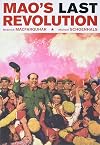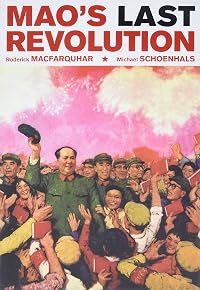
Mao's Last Revolution
by Roderick MacFarquhar, Michael Schoenhals
On This Page
Description
"The Cultural Revolution was a watershed event in the history of the People's Republic of China, the defining decade of half a century of communist rule. Before 1966, China was a typical communist state, with a command economy and a powerful party able to keep the population under control. But during the Cultural Revolution, in a move unprecedented in any communist country, Mao unleashed the Red Guards against the party. Tens of thousands of officials were humiliated, tortured, and even show more killed. Order had to be restored by the military, whose methods were often equally brutal." "Roderick MacFarquhar and Michael Schoenhals explain why Mao launched the Cultural Revolution, and show his Machiavellian role in masterminding it (which Chinese publications conceal). In often horrifying detail, they document the Hobbesian state that ensued. The movement veered out of control and terror paralyzed the country. Power struggles raged among Lin Biao, Zhou Enlai, Deng Xiaoping, and Jiang Qing - Mao's wife and leader of the Gang of Four - while Mao often played one against the other." "After Mao's death, in reaction to the killing and the chaos, Deng Xiaoping led China into a reform era in which capitalism flourishes and the party has lost its former authority. In its critical analysis of Chairman Mao and its portrait of a culture in turmoil, Mao's Last Revolution offers the most authoritative and compelling account to date of this seminal event in the history of China."--Jacket. show lessTags
Recommendations




Member Reviews
I've become a little skeptical of large and sweeping "history of everything" books as I've become older, but this work is an exception as the authors use the most current documentation to try and sort out the chaotic violence that was the Great Chinese Cultural Revolution. The vision that one comes away with is of Mao as an old bandit who could not imagine that his time was ending, and who used parasitic hacks and cronies to attack the professionals who were trying to make Chinese society work, and thus retain power just a little longer.
Most striking is that the authors can demonstrate just how much of an actual civil war had been incited by Mao, particularly during the peak of the Red Guard period; the mind boggles at the image of the show more story of two competing student groups allegedly building radiological "dirty" bombs to use against each other.
More meat is also put on the whole mystery of Lin Biao, and whether he was a traitor or not. It would appear that Mao actually made the first move, because if all power flowed from the barrel of a gun, Mao wanted to make sure it was civilian leadership that had the finger on the trigger, and setting the marshal aside was the way to try and assure an acceptable succession. This is particularly since no truly workable heir was available and that Mao had done a fine job of destroying the party to save it.
As you watch the Chinese Communist Party tie itself into knots in 2012 over installing a new government, keep in mind that this is the deep background to a damaged institution that has never really recovered since 1966. Let's say that I'm not as hopeful as the authors that liberal developments will come out of the struggle to come to grips with Mao's poisoned heritage. show less
Most striking is that the authors can demonstrate just how much of an actual civil war had been incited by Mao, particularly during the peak of the Red Guard period; the mind boggles at the image of the show more story of two competing student groups allegedly building radiological "dirty" bombs to use against each other.
More meat is also put on the whole mystery of Lin Biao, and whether he was a traitor or not. It would appear that Mao actually made the first move, because if all power flowed from the barrel of a gun, Mao wanted to make sure it was civilian leadership that had the finger on the trigger, and setting the marshal aside was the way to try and assure an acceptable succession. This is particularly since no truly workable heir was available and that Mao had done a fine job of destroying the party to save it.
As you watch the Chinese Communist Party tie itself into knots in 2012 over installing a new government, keep in mind that this is the deep background to a damaged institution that has never really recovered since 1966. Let's say that I'm not as hopeful as the authors that liberal developments will come out of the struggle to come to grips with Mao's poisoned heritage. show less
Mao's Last Revolution is a very good look at the Cultural Revolution and immediate aftermath. Mao kept control through a series of 'one liners' and pithy sayings that had little value in running a country as large as China. His subordinates spent most of their time 'brown-nosing' Mao, plotting against others, or both. The result was a country that was barely functioning with many of the more capable individuals exiled for having a hint of a spine. Had those involved in the Revolution spent as much effort in the progress of the country as they did plotting; it is hard to imagine where China would be today. The only downside to reading this book was trying to keep track of who was who.
Dense, detailed, thorough. It took me a long time to get through this book - which though written well, is not in the engaging, "popular history" style. (Note I mention this only because in the intro the author's state they are attempting to write popular history...) Similarly, the book is dominantly a chronological political history, describing the ups and downs of the various power players in the Chinese government, with little text devoted to the effect of these actions on the average Chinese citizen. As a political history, this is an excellent book on an extraordinarily interesting topic. Like most communist history, it is dominated by machinations amoung a few top players, with death as punishment for failure. If you substitute show more death for lesser punishments (job loss, out of the clique), these histories are enlightening commentaries on human nature. show less
A history of the Cultural Revolution in which the authors do a fine job navigating the labyrinth of Chinese politics. They also show how the C.R. undermined Maoist ideology and paved the way for Deng's reforms. What's missing is the impact and practice of the Cultural Revolution on Chinese society but that is outside the scope of this text.
Great. perhaps overlong in spots, but still .. .harrowing and a perpetual lesson.
Ratings
Members
- Recently Added By
Lists

All Things China
205 works; 3 members

The China Project Book List
100 works; 2 members

Books recommended in the history category on FiveBooks.com
329 works; 4 members

2024-2025 Ezra Klein Guest Recommendations
213 works; 6 members

Totalitarianism and Democratic Erosion: Essential Readings
45 works; 1 member

In Our Time books
4,934 works; 2 members
Author Information

17 Works 650 Members
Roderick Lemonde MacFarquhar was born in Lahore, India on December 2, 1930. He graduated with a degree in philosophy, politics and economics from Keble College, Oxford University, in 1953. He briefly worked at The Telegraph of London before receiving a master's degree in East Asian studies from Harvard University. In 1960, he founded The China show more Quarterly, an academic journal on Chinese politics and economics published by the University of Cambridge. He was elected to Parliament in Britain as a Labour candidate in 1974 and served for five years. He went on to teach history and political science at Harvard. He was the director of the Fairbank Center for Chinese Studies at Harvard from 1986 to 1992, and again from 2005 to 2006. He wrote several books including The Origins of the Cultural Revolution. He died from heart failure on February 10, 2019 at the age of 88. (Bowker Author Biography) show less
5 Works 270 Members
Awards and Honors
Series
Belongs to Publisher Series
Common Knowledge
- Canonical title
- Mao's Last Revolution
- Original title
- Mao's Last Revolution
- Original publication date
- 2006
- People/Characters
- Mao Zedong
- Important places
- China
- Important events
- Cultural Revolution
- Original language*
- Anglais (Etats-Unis) (Etats-Unis)
*Some information comes from Common Knowledge in other languages. Click "Edit" for more information.
Classifications
- Genres
- History, Nonfiction, General Nonfiction, Politics and Government
- DDC/MDS
- 951.05 — History & geography History of Asia East Asia: China, Taiwan, Hong Kong, Korea History 1949- (People's Republic, 20th century)
- LCC
- DS778.7 .M33 — History of Europe, Asia, Africa and Oceania Asia History of Asia China History
- BISAC
Statistics
- Members
- 229
- Popularity
- 141,945
- Reviews
- 5
- Rating
- (3.74)
- Languages
- Chinese, English, French, Spanish
- Media
- Paper, Ebook
- ISBNs
- 6
- ASINs
- 2