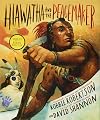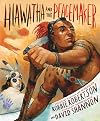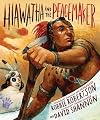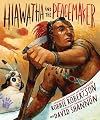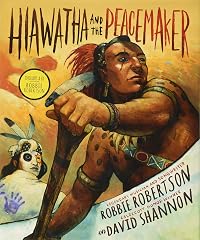
Hiawatha and the Peacemaker
by Robbie Robertson
On This Page
Description
Hiawatha, a Mohawk, is plotting revenge for the murder of his wife and daughters by the evil Onondaga Chief, Tadodaho, when he meets the Great Peacemaker, who enlists his help in bringing the nations together to share his vision of a new way of life marked by peace, love, and unity rather than war, hate, and fear. Includes historical notes.Tags
Recommendations



Member Recommendations

Member Reviews
I really loved this story--sometimes kids' books like this that are in that funny historical-mythic realm get filed under "original content by," and other times as retellings of myth, but the story of Hiawatha and the Peacemaker and how they united the nations and healed the evil Tadodaho found its way immediately into my heart as felt history, regardless of the (somewhat obscure) facts. History, but also a story about pain and forgiveness and new beginnings. Good one.
The Iroquois legend of the prophet Deganawida (the Peacemaker) and his disciple Hiawatha, who together brought unity and peace to the warring Iroquois tribes in precolonial North America, is retold for children in this beautiful picture-book from Mohawk and Cayuga-descended musician Robbie Robertson, and Caldecott Honor-winning Euro-American illustrator David Shannon. Consumed by grief and rage at the killing of his wife and children by the forces of the terrible Onondaga chief, Tadodaho, Mohawk warrior Hiawatha is set on revenge, until the arrival of the mysterious Peacemaker, a quiet man who travels in a stone canoe, and speaks of the Great Law of Peace that will unite all mankind under one tree. Won over to this new vision, Hiawatha show more becomes the Peacemaker's spokesman, and together they travel to the different Haudenosaunee (Iroquois) nations, convincing them one by one to join their new league. Eventually, only the Onondaga are left to convince, but first the snake-bedeviled Tadodaho must be cured and forgiven. When this is accomplished, the members of the new Iroquois Confederacy - Mohawk, Cayuga, Oneida, Seneca and Onondaga** - bury their weapons underneath a great pine tree, and usher in a new era of peace and cooperation...
Many readers might be familiar with the name Hiawatha from Longfellow's famous poem, The Song of Hiawatha, but the story told there is almost completely the poet's own, and bears little resemblance to the stories told by the Haudenosaunee themselves. I myself have never read the Longfellow, although I would like to at some point. I am familiar with this story however, having read the fuller, adult version in Paul A.W. Wallace's 1946 White Roots of Peace: The Iroquois Book of Life, which is cited by Robertson in his back matter as a source. I therefore went into Hiawatha and the Peacemaker already knowing the story, and curious to see how it would be retold for children. What I discovered was an absolutely beautiful book, one which retold the story in such a way as to make the Peacemaker's message most powerful. By focusing on Hiawatha, and his journey from grief and anger to acceptance and forgiveness, Robertson demonstrates how the Peacemaker's vision has both personal and political aspects to it. As I commented in my review of the Wallace retelling, "this is a story whose political and religious components are inseparable," and it is clear that although it is a tale about the founding of the Iroquois Confederacy - a powerful tribal alliance whose structure would provide inspiration to the founding fathers, in their creation of a new form of government in the American state - it is also a tale about the individual's struggle to find the right way through life. There are interesting elements of the story that have been left out - the fact that Deganawida is often thought to have been Huron, an outsider and potential enemy to the Iroquois peoples, for instance, or that some retelling claim he was (like Jesus) the product of a virgin birth - but that makes sense, as the narrative focus here is on the disciple, rather than the prophet. Although I would have liked to see more information in the afterword, about these matters, or about the eventual structure of the Iroquois Confederacy - the name Tadodaho, for instance, is used to this day for the traditional leader chosen to preside over the Grand Council of the Iroquois League - I also wasn't terribly exercised by their absence.
As poignant and powerful as Robertson's retelling is, the artwork here from Shannon is equally moving. Done in oil paint, the illustrations are vividly colorful and immensely expressive. I got a shiver down my spine, looking at the image of Hiawatha speaking, with Deganawida behind him, and am little appalled that this didn't receive a Caldecott nod. In any case, this was simply a wonderful book all around, with a fascinating story and beautiful artwork. It explores an aspect of American history - the founding of the Iroquois Confederacy - that many young people may be unaware of. It's fairly long and text-heavy for a picture-book, so I would recommend it to readers who are on the older end of the picture-book audience. Perhaps ages 7 and up.
** The Iroquois Confederacy is now also known as the Six Nations, as they were joined by their linguistically-related cousins, the Tuscarora, in 1722. show less
Many readers might be familiar with the name Hiawatha from Longfellow's famous poem, The Song of Hiawatha, but the story told there is almost completely the poet's own, and bears little resemblance to the stories told by the Haudenosaunee themselves. I myself have never read the Longfellow, although I would like to at some point. I am familiar with this story however, having read the fuller, adult version in Paul A.W. Wallace's 1946 White Roots of Peace: The Iroquois Book of Life, which is cited by Robertson in his back matter as a source. I therefore went into Hiawatha and the Peacemaker already knowing the story, and curious to see how it would be retold for children. What I discovered was an absolutely beautiful book, one which retold the story in such a way as to make the Peacemaker's message most powerful. By focusing on Hiawatha, and his journey from grief and anger to acceptance and forgiveness, Robertson demonstrates how the Peacemaker's vision has both personal and political aspects to it. As I commented in my review of the Wallace retelling, "this is a story whose political and religious components are inseparable," and it is clear that although it is a tale about the founding of the Iroquois Confederacy - a powerful tribal alliance whose structure would provide inspiration to the founding fathers, in their creation of a new form of government in the American state - it is also a tale about the individual's struggle to find the right way through life. There are interesting elements of the story that have been left out - the fact that Deganawida is often thought to have been Huron, an outsider and potential enemy to the Iroquois peoples, for instance, or that some retelling claim he was (like Jesus) the product of a virgin birth - but that makes sense, as the narrative focus here is on the disciple, rather than the prophet. Although I would have liked to see more information in the afterword, about these matters, or about the eventual structure of the Iroquois Confederacy - the name Tadodaho, for instance, is used to this day for the traditional leader chosen to preside over the Grand Council of the Iroquois League - I also wasn't terribly exercised by their absence.
As poignant and powerful as Robertson's retelling is, the artwork here from Shannon is equally moving. Done in oil paint, the illustrations are vividly colorful and immensely expressive. I got a shiver down my spine, looking at the image of Hiawatha speaking, with Deganawida behind him, and am little appalled that this didn't receive a Caldecott nod. In any case, this was simply a wonderful book all around, with a fascinating story and beautiful artwork. It explores an aspect of American history - the founding of the Iroquois Confederacy - that many young people may be unaware of. It's fairly long and text-heavy for a picture-book, so I would recommend it to readers who are on the older end of the picture-book audience. Perhaps ages 7 and up.
** The Iroquois Confederacy is now also known as the Six Nations, as they were joined by their linguistically-related cousins, the Tuscarora, in 1722. show less
Hiawatha was a strong and articulate Mohawk who was chosen to translate the Peacemaker’s message of unity for the five warring Iroquois nations during the 14th century. This message not only succeeded in uniting the tribes but also forever changed how the Iroquois governed themselves—a blueprint for democracy that would later inspire the authors of the U.S. Constitution.
Caldecott Honor–winning illustrator David Shannon brings the journey of Hiawatha and the Peacemaker to life with arresting oil paintings. Together, Robertson and Shannon have crafted a new children’s classic that will both educate and inspire readers of all ages.
Caldecott Honor–winning illustrator David Shannon brings the journey of Hiawatha and the Peacemaker to life with arresting oil paintings. Together, Robertson and Shannon have crafted a new children’s classic that will both educate and inspire readers of all ages.
Have you ever read Longfellow’s poem “Hiawatha”? If you have, you should know that it’s grossly inaccurate and highly insensitive. If you want to hear the real story of Hiawatha, I would suggest picking up this book, “Hiawatha and the Peacemaker”. It is based on Haudenosaunee (Iroquois) oral tradition and respectfully tells the story of how Hiawatha came to unite the five tribes of the Iroquois Confederacy.
When Hiawatha’s wife and three daughters are killed by the evil Onandaga chief, Tadodaho, Hiawatha is filled with anger and lust for revenge. In the midst of his pain, a quiet stranger comes to him and asks Hiawatha to help him carry a new message of healing to the peoples of the five nations. Hiawatha agrees to travel show more with the Peacemaker, but remains unconvinced that the people can be united. The Peacemaker and Hiawatha visit each of the tribes in turn, carrying the message of the Great Law and peace for all. Their last stop is the home of the Onandaga and the vicious chief, Tadodaho. Will they be able to bring peace among the five nations?
I love this book. And one of the reasons I love it is that it has so many pictures of the Bible in it. For one, Hiawatha and the Peacemaker are like Moses and Aaron. Moses, like the Peacemaker, was not a good speaker and consequently needed Aaron (Hiawatha) to speak for him. For another, Tadodaho, twisted and bent with snakes in his hair, is so much like us without Jesus. Tadodaho is also like Paul. When God saved him he was an evil persecutor of God’s people. But afterwards God used him to be the one who looked after all the children of God. I love the way healing and hope is brought to pass in this story.
[Content Warning: This book might be too scary for younger readers. The picture of Tadodaho with snakes slithering in his hair is a little frightening, and the story is a bit mature. I wouldn’t recommend the book for toddlers.]
I recommend this book. It’s a beautiful story of hope and healing, with gorgeous illustrations and wonderful correlations to the Gospel. show less
When Hiawatha’s wife and three daughters are killed by the evil Onandaga chief, Tadodaho, Hiawatha is filled with anger and lust for revenge. In the midst of his pain, a quiet stranger comes to him and asks Hiawatha to help him carry a new message of healing to the peoples of the five nations. Hiawatha agrees to travel show more with the Peacemaker, but remains unconvinced that the people can be united. The Peacemaker and Hiawatha visit each of the tribes in turn, carrying the message of the Great Law and peace for all. Their last stop is the home of the Onandaga and the vicious chief, Tadodaho. Will they be able to bring peace among the five nations?
I love this book. And one of the reasons I love it is that it has so many pictures of the Bible in it. For one, Hiawatha and the Peacemaker are like Moses and Aaron. Moses, like the Peacemaker, was not a good speaker and consequently needed Aaron (Hiawatha) to speak for him. For another, Tadodaho, twisted and bent with snakes in his hair, is so much like us without Jesus. Tadodaho is also like Paul. When God saved him he was an evil persecutor of God’s people. But afterwards God used him to be the one who looked after all the children of God. I love the way healing and hope is brought to pass in this story.
[Content Warning: This book might be too scary for younger readers. The picture of Tadodaho with snakes slithering in his hair is a little frightening, and the story is a bit mature. I wouldn’t recommend the book for toddlers.]
I recommend this book. It’s a beautiful story of hope and healing, with gorgeous illustrations and wonderful correlations to the Gospel. show less
In my opinion, this is a wonderful book for many reasons. Despite the fact that this is a children’s picture book and more geared towards students under 5th grade, the characters had a generous amount of substance to them. The main character, Hiawatha, was a warrior soul devastated over the violent death of his family. However, through the kind words of the Peacemaker, he is able to overcome his depression and find forgiveness and unity. These are strong ideas for children to discuss and think about, and the accurate historical setting and environment can open up different realms of discussion for students. The illustrations done in this book are colorful and captivating, such as the distraught and anger caught in the picture of show more Hiawatha’s eyes after he discovers another village has been destroyed by the evil chief, Tadodaho. I believe the ideas presented in this book are important for young minds in a world that can seem war-torn, even sometimes in the neighborhoods that the students may reside. The big message of this story is that forgiveness and unity is more powerful than anger and revenge. show less
After losing everything to war, Hiawatha assists the Peacemaker in delivering a message of peace and forgiveness to neighboring tribes and through his journey finds his own peace. Told from a first person perspective, Hiawatha’s tale reads aloud well and is heightened by the “together we paddled/rode/traveled” refrain in large letters, visually magnifying the progress of the story. Dark and fire-toned illustrations highlight war and anger themed passages and make way for a lighter palette when the Peacemaker is heard. Robertson’s text pairs well with Shannon’s oil paintings to deliver a complex and beautiful folk tale to a new generation. The message of peace, forgiveness, and unity applies today as much as it ever has, and is show more very much needed. The book includes a CD featuring an original song by Robertson, enclosed in a vinyl envelope on the rear endpaper. Perfect for classroom use, especially in the context of folk tales and Native American history or culture, Hiawatha and the Peacemaker is very highly recommended for ages six through ten. show less
This book was more difficult for me to read than the other books I have read this semester. I really liked the message of this book, forgiveness and peace, but I also feel that this book might be hard to digest for young children. I liked this book, but I do not know that I like it as a children's book. I loved the illustrations in this story and I think they really added to the story. Indigenous culture is not something I am very familiar with or well-versed in so I feel that having indigenous-style art added to my understanding of the story and the milieu in which it existed. I also found it interesting that David Shannon was the illustrator of this story because he also illustrated "No, David!" a very, very different story with a show more much different tone. It was cool to see the duality of this illustrator as well as being able to identify his style through the similarities between these illustrations and those in "No, David!" I also loved the character development of Hiawatha. He began angry at Tadodaho for bringing such destruction into his life and killing his family, but he learned that he had to let go of his anger to continue growing even though it was very difficult to do. The most significant revelation he had to me was when he said, "But as I spoke, I felt something come over me: Forgiveness. I had not been able to save my family, but on this journey I had been able to forgive myself." I do feel that this book pushes readers to think about tough issues because learning to forgive yourself and give yourself grace is one of the most difficult things to do, but not something that we talk about frequently. It also pushes readers to see that people are complex; even though Tadodaho caused a lot of devastation, he still deserved kindness from others and he still deserved to find peace. show less
Members
- Recently Added By
Lists

Indigenous America Reader
145 works; 12 members

VBL Picturebooks
110 works; 1 member

Beautiful Feet Books
304 works; 7 members

Native Picture Books by Native Authors
47 works; 1 member

Children's Picture Books
188 works; 1 member

Year One Books RD
8 works; 1 member
Author Information

20+ Works 907 Members
Robbie Robertson was born on July 5, 1943 in Toronto, Canada. He is most known for his work as lead guitarist for the music group "The Band", which began the Americana music genre. As a songwriter, Robertson wrote "The Night They Drove Old Dixie Down" and "Broken Arrow" among many others. His talent was recognized when he was inducted into the show more Rock and Roll Hall of Fame and the Canadian Music Hall of Fame. He also worked as a soundtrack producer and composer when he teamed up with Martin Scorsese on the fims: The Last Waltz, Raging Bull and Casino. He also became an author with his titles Testimony and Hiawatha and the Peacemaker. (Bowker Author Biography) show less
All Editions
Awards and Honors
Common Knowledge
- Original publication date
- 2015
- Dedication
- For my mother, Rosemarie Myke Crysler Robertson --R.R.
For Heidi --D.S. - Original language
- English
Classifications
Statistics
- Members
- 371
- Popularity
- 84,597
- Reviews
- 16
- Rating
- (4.07)
- Languages
- English
- Media
- Paper, Audiobook, Ebook
- ISBNs
- 11
- ASINs
- 3