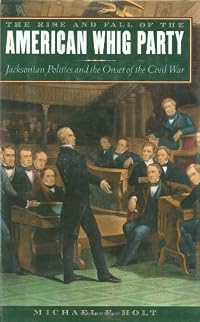
The Rise and Fall of the American Whig Party: Jacksonian Politics and the Onset of the Civil War
by Michael F. Holt
On This Page
Description
This title chronologically tells the birth, life and death of the Whigs, a major American political party that was the country's last and best hope to avert secession. The chain of political developments is reconstructed for the reader.Tags
Recommendations







Member Reviews
The antebellum period saw the formation and destruction of the second party system in U.S. politics between Andrew Jackson’s Democrats, which survived to the present, and their rivals the Whigs that did not. Michael F. Holt’s magnum opus, The Rise and Fall of the American Whig Party, details how the Whigs emerged from all the anti-Jacksonian forces to their disintegration in the mid-1850s due to the factional and sectional divisions.
Beginning in the mid-1820s, Holt explains the origins of the anti-Jacksonian groups that formed and later coalesced to form the Whig party in the winter of 1833-4 in Washington, D.C. then how it eventually branched out and formed in states. Through thorough research from the national down to the state, show more county, and local levels Holt explored how the Whig party was planted and grew throughout the country and competed against their Democratic foes. Yet this research also exposed the intraparty feuds within state parties that affected conventions on all levels, platform fights, and Election Day enthusiasm. Exploring a political relationship between state politics and national politics that is completely different than that seen in the second half of the 20th-century and early 21st, Holt shows how this different political paradigm both rose up the Whigs and eventually destroyed them.
With almost 1300 pages of text and notes, Holt thoroughly explored the 20 year history of the American Whig party from the national to the local level within every state of the Union. Throughout Holt’s assertion that the Democrats always controlled “the narrative” of the Whig’s history and how that played on the Whig intraparty feuds which eventually was one of the main three causes of the party’s disintegration. The focuses on Henry Clay, Daniel Webster, party traitor John Tyler, party destabilizer Zachary Taylor, attempted party savior Millard Fillmore, and slew of other prominent Whigs gives the stage to historical actors who shaped history. Throughout the text, the reader sees how events if changed just slightly might have allowed the Whigs to continue as a national party and the effects that might have had going forward but ultimately who personalities and how some decisions out of the party’s control resulted in fatal wounds occurring.
The Rise and Fall of the American Whig Party is not for the general history reader, this tome is for someone dedicated to an in-depth researched book that shifts from the halls of Congress to the “smoke-filled backrooms” of state conventions in states across the nation to election analysis in various congressional districts across the young republic. The work of an academic lifetime, Michael F. Holt gives insight into political party that ultimately lost in history but that still had a lasting impact to this day in modern American politics. show less
Beginning in the mid-1820s, Holt explains the origins of the anti-Jacksonian groups that formed and later coalesced to form the Whig party in the winter of 1833-4 in Washington, D.C. then how it eventually branched out and formed in states. Through thorough research from the national down to the state, show more county, and local levels Holt explored how the Whig party was planted and grew throughout the country and competed against their Democratic foes. Yet this research also exposed the intraparty feuds within state parties that affected conventions on all levels, platform fights, and Election Day enthusiasm. Exploring a political relationship between state politics and national politics that is completely different than that seen in the second half of the 20th-century and early 21st, Holt shows how this different political paradigm both rose up the Whigs and eventually destroyed them.
With almost 1300 pages of text and notes, Holt thoroughly explored the 20 year history of the American Whig party from the national to the local level within every state of the Union. Throughout Holt’s assertion that the Democrats always controlled “the narrative” of the Whig’s history and how that played on the Whig intraparty feuds which eventually was one of the main three causes of the party’s disintegration. The focuses on Henry Clay, Daniel Webster, party traitor John Tyler, party destabilizer Zachary Taylor, attempted party savior Millard Fillmore, and slew of other prominent Whigs gives the stage to historical actors who shaped history. Throughout the text, the reader sees how events if changed just slightly might have allowed the Whigs to continue as a national party and the effects that might have had going forward but ultimately who personalities and how some decisions out of the party’s control resulted in fatal wounds occurring.
The Rise and Fall of the American Whig Party is not for the general history reader, this tome is for someone dedicated to an in-depth researched book that shifts from the halls of Congress to the “smoke-filled backrooms” of state conventions in states across the nation to election analysis in various congressional districts across the young republic. The work of an academic lifetime, Michael F. Holt gives insight into political party that ultimately lost in history but that still had a lasting impact to this day in modern American politics. show less
At 1248 pages, this is not a book for the casual reader; even for someone fascinated by American political history, it is, at times, tough-going, with its state-by-state (occasionally district-by-district) dissection of election results and local politicians and office-holders. But for an understanding of the complex interactions between state politics, national figures, the increasing sectionalism caused by the anti-slavery movement, and the changing demographics of the country under massive German and Irish Catholic immigration, it is an impressive and invaluable study. There is little here about religion, but the moralizing movements: abolition, temperance, public schooling (and anti-Catholicism) are examined for their effects on show more political alliances and election outcomes.
The author corrects the common misconception that the Whig party arose from the remnants of the Federalists; he notes its evolution from divisions within the Jeffersonian Republican party and its maturation as the opposition to Jackson's centralization of power and as the leading advocate for state and federal activism in internal improvements (canals, railroads, public schools). The importance of state issues and personalities on the fortunes of the Whig party is the central theme, although the politics of major Whig figures, Clay, Webster, John Quincy Adams, Fillmore, as well as their Democratic opponents, Jackson, Van Buren, Polk, are thoroughly examined. I have revised my estimation of Fillmore, and solidified my distaste for Webster. On the whole, an indispensable work on the onset of the Civil War and on the period between 1834 and 1856. show less
The author corrects the common misconception that the Whig party arose from the remnants of the Federalists; he notes its evolution from divisions within the Jeffersonian Republican party and its maturation as the opposition to Jackson's centralization of power and as the leading advocate for state and federal activism in internal improvements (canals, railroads, public schools). The importance of state issues and personalities on the fortunes of the Whig party is the central theme, although the politics of major Whig figures, Clay, Webster, John Quincy Adams, Fillmore, as well as their Democratic opponents, Jackson, Van Buren, Polk, are thoroughly examined. I have revised my estimation of Fillmore, and solidified my distaste for Webster. On the whole, an indispensable work on the onset of the Civil War and on the period between 1834 and 1856. show less
4195 The Rise and Fall of the American Whig Party Jacksonian Politics and the Onset of the Civil War, by Michael F. Holt (read 7 Aug 2006) I have always had a high interest in American history from Jackson till the Civil War, so decided to read this book, a 1999 monumental history of the Whig Party. 985 pages of text, 93 pages of footnotes, 21 pages of bibliography. It is exhaustive on its subject, and, frankly, exhausting. Much is of interest, but while it all deals with politics (it covers minutely the events from 1832 to 1856), I must admit it was often heavy going. The author professes to admire the Whig Party, but I could not. The Party was destroyed of course by the tension between its Northern and Southern parts. Millard Fillmore show more comes out looking pretty good, but I guess I had forgotten how intense was anti-Catholic feeling in the early 1850s, so that the Know-Nothings were very powerful for a little while. The accounts of the Whig Conventions of 1836, 1840, 1844, 1848, and 1852 were of high interest, as were the accounts of the presidential campaigns of those years. But I could not get too intrigued by the state-by-state study of all the Congressional elections in those years. The research shown by this book is absolutely staggering and certainly no one today alive knows more than Holt about the Whigs. show less
Ratings
Members
- Recently Added By
Lists

r/AskHistorians' Recommended Books
1,068 works; 17 members
Author Information
8+ Works 992 Members
Michael F. Holt, a leading authority on nineteenth-century American politics, is Langbourne M. Williams Professor of American History at the University of Virginia
Awards and Honors
Awards
Common Knowledge
- People/Characters
- Henry Clay; Millard Fillmore; Zachary Taylor; John Tyler; Daniel Webster; George E. Badger (show all 26); John Bell; Thomas Hart Benton; John M. Berrien; John C. Calhoun; Lewis Cass; John M. Clayton; James M. Cooper; Thomas Corwin; John J. Crittenden; Daniel S. Dickinson; Stephen A. Douglas; Thomas Ewing; Horace Greeley; William F. Johnston; Willie P. Mangum; William Henry Seward; Robert Toombs; Martin van Buren; Thurlow Weed; Robert C. Winthrop
- Important places
- USA
- Important events
- Compromise of 1850; United States presidential election (1840, 1844, 1848, 1852); Fugitive Slave Act; Kansas-Nebraska Act; Mexican-American War (1846 | 1848); Wilmot Proviso (1846)
- Dedication
- For my students, 1965-1998
- First words
- Preface -- This is a history of a nineteenth-century American political party.
- Original language
- English
Classifications
- Genres
- History, Nonfiction, General Nonfiction, Politics and Government
- DDC/MDS
- 324.2732 — Society, Government, and Culture Political science Politics & Elections Political parties North America United States
- LCC
- JK2331 .H63 — Political Science Political institutions and public administration (United States) Political institutions and public administration United States Political parties
- BISAC
Statistics
- Members
- 396
- Popularity
- 78,386
- Reviews
- 3
- Rating
- (4.00)
- Languages
- English
- Media
- Paper, Ebook
- ISBNs
- 4
- ASINs
- 2