A Woman of No Importance
by Oscar Wilde 
On This Page
Description
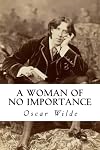
Though he is now best remembered for his fiction, famed wit and bon vivant Oscar Wilde also dabbled in drama over the course of his long and varied literary career. A Woman of No Importance is a darkly comedic play about a group of aristocrats whose prim adherence to decorum hides a bevy of scandalous secrets..
Tags
Recommendations












Member Reviews
This play may not be as dramatic and engaging as others of Wilde's, but ooh that final line! Again Wilde tackles the subject of gender equality, this time through the conceit of a reunited pair of former lovers and an unbeknownst son. It's actually rather ridiculous that Victorian society treated jilted women in such a way, but interesting that Wilde gave his character a believable success story and an ultimate revenge on the man who mistreated her! I wonder if after the story ends the ne'er do well man actually disappears as he's been made to do, but even more importantly if the woman and her son (and presumably daughter-in-law) will go to America and live far away from the trite scandals of England. This being the second play I've show more read of Wilde's which emphasizes the benefits of American society over English, I am starting to detect a theme and Wilde has revealed his obvious disdain for England. Interesting for a man so wrapped up in its society... show less
A display of a handful of Oscar Wilde's strengths as a writer, but unfortunately also of even more of his weaknesses. The first part of the play consists of the characters lobbing glib witticisms at one another in a fairly disconnected manner; it then descends into fairly mawkish sentimentality. I give Wilde kudos for pushing back against some contemporary social mores, but I don't think A Woman of No Importance is particularly successful.
I was only reading it for dialogue models, but I got caught up in the story. I thought the way all the characters made their turns from a simplistic view of the world to a more complex and merciful one was very elegantly achieved.
https://donut-donut.dreamwidth.org/883636.html
https://donut-donut.dreamwidth.org/883636.html
A young heiress from America is visiting the English countryside where she is shocked by what she witnesses. The society of her hosts seems frivolous and shamefully wanton. But a chance meeting at the party between an infamous cad and a woman from another era brings about startling results. Here is the woman he abandoned rather than marry. And more shockingly, his long lost son by her.
A charming and thought-provoking play about the oldest double-standard in social history.
A charming and thought-provoking play about the oldest double-standard in social history.
Read as part of my omnibus "The Plays of Oscar Wilde" while listening to the BBC Radio 4X radio drama (http://www.bbc.co.uk/programmes/b007jr48).
This play, while containing some excellent quips includingthe famous exchange Lord Illingworth: "All women become like their mothers. That is their tragedy." Mrs. Allonby: "No man does. That is his." , lacks the lightness of touch that characterizes "An Ideal Husband" and "Lady Windemere's Fan". Instead, Wilde seems almost to pound home his point about the unfairness of society's judgement that when a couple sins, it is the woman who gets punished while the scandal barely affects the man at all.
The BBC Radio drama stars Diana Rigg as Mrs Arbuthnot, Martin Jarvis as Lord Illingworth, Annette show more Crosbie as Lady Hunstanton and Sir Michael Hordern as Sir Charles Crawford. As might be expected with this cast, it was a treat to listen to these actors. I did regret a few of the cuts that the adaptor made but they were all well chosen in the sense of not disrupting the flow of the talk. Here is one snippet that got cut which as an American I particularly like:
Lady Hunstanton: ... Well, from whatever source her large fortune came, I have a great esteem for Miss Worsley. She dresses exceedingly well. All Americans do dress well. They get their clothes in Paris.
Mrs. Allonby: They say, Lady Hunstanton, that when good Americans die they go to Paris.
Lady H: Indeed? And when bad Americans die, where do they go?
Lord Illingworth: Oh, they go to America. show less
This play, while containing some excellent quips including
The BBC Radio drama stars Diana Rigg as Mrs Arbuthnot, Martin Jarvis as Lord Illingworth, Annette show more Crosbie as Lady Hunstanton and Sir Michael Hordern as Sir Charles Crawford. As might be expected with this cast, it was a treat to listen to these actors. I did regret a few of the cuts that the adaptor made but they were all well chosen in the sense of not disrupting the flow of the talk. Here is one snippet that got cut which as an American I particularly like:
Lady Hunstanton: ... Well, from whatever source her large fortune came, I have a great esteem for Miss Worsley. She dresses exceedingly well. All Americans do dress well. They get their clothes in Paris.
Mrs. Allonby: They say, Lady Hunstanton, that when good Americans die they go to Paris.
Lady H: Indeed? And when bad Americans die, where do they go?
Lord Illingworth: Oh, they go to America. show less
A small gem of a drama. Oscar Wilde's perfect t use of language makes this play both witty and stinging. A mother maintains her dignity in the face of disgrace, and endears herself to her son while deflating his natural father's haughty condescension. Excellent!
The title says it all. A condemnation of a society in which mistakes are never forgiven, in which souls are lost forever, for youthful indiscretion and surrender to one's emotions.
Members
- Recently Added By
Lists

Books Read in 2023
5,547 works; 145 members

My Play Collection
769 works; 3 members
Author Information

1,783+ Works 121,194 Members
Flamboyant man-about-town, Oscar Wilde had a reputation that preceded him, especially in his early career. He was born to a middle-class Irish family (his father was a surgeon) and was trained as a scholarship boy at Trinity College, Dublin. He subsequently won a scholarship to Magdalen College, Oxford, where he was heavily influenced by John show more Ruskin and Walter Pater, whose aestheticism was taken to its radical extreme in Wilde's work. By 1879 he was already known as a wit and a dandy; soon after, in fact, he was satirized in Gilbert and Sullivan's Patience. Largely on the strength of his public persona, Wilde undertook a lecture tour to the United States in 1882, where he saw his play Vera open---unsuccessfully---in New York. His first published volume, Poems, which met with some degree of approbation, appeared at this time. In 1884 he married Constance Lloyd, the daughter of an Irish lawyer, and within two years they had two sons. During this period he wrote, among others, The Picture of Dorian Gray (1891), his only novel, which scandalized many readers and was widely denounced as immoral. Wilde simultaneously dismissed and encouraged such criticism with his statement in the preface, "There is no such thing as a moral or an immoral book. Books are well written or badly written. That is all." In 1891 Wilde published A House of Pomegranates, a collection of fantasy tales, and in 1892 gained commercial and critical success with his play, Lady Windermere's Fan He followed this comedy with A Woman of No Importance (1893), An Ideal Husband (1895), and his most famous play, The Importance of Being Earnest (1895). During this period he also wrote Salome, in French, but was unable to obtain a license for it in England. Performed in Paris in 1896, the play was translated and published in England in 1894 by Lord Alfred Douglas and was illustrated by Aubrey Beardsley. Lord Alfred was the son of the Marquess of Queensbury, who objected to his son's spending so much time with Wilde because of Wilde's flamboyant behavior and homosexual relationships. In 1895, after being publicly insulted by the marquess, Wilde brought an unsuccessful slander suit against the peer. The result of his inability to prove slander was his own trial on charges of sodomy, of which he was found guilty and sentenced to two years of hard labor. During his time in prison, he wrote a scathing rebuke to Lord Alfred, published in 1905 as De Profundis. In it he argues that his conduct was a result of his standing "in symbolic relations to the art and culture" of his time. After his release, Wilde left England for Paris, where he wrote what may be his most famous poem, The Ballad of Reading Gaol (1898), drawn from his prison experiences. Among his other notable writing is The Soul of Man under Socialism (1891), which argues for individualism and freedom of artistic expression. There has been a revived interest in Wilde's work; among the best recent volumes are Richard Ellmann's, Oscar Wilde and Regenia Gagnier's Idylls of the Marketplace , two works that vary widely in their critical assumptions and approach to Wilde but that offer rich insights into his complex character. (Bowker Author Biography) show less
Oscar Wilde has a Legacy Library. Legacy libraries are the personal libraries of famous readers, entered by LibraryThing members from the Legacy Libraries group.
Series
Belongs to Publisher Series
Work Relationships
Is contained in
The Importance of Being Earnest / Lady Windermere's Fan / A Woman of No Importance / An Ideal Husband / Salomé by Oscar Wilde
Oscar Wilde in 3-Vol Box Set (Stories, Plays, Poems, Essays, Letters) [Folio Society 1993] by Oscar Wilde
A szent kurtizán vagy A drágaköves asszony : színműtöredék ; A jelentéktelen asszony : színmű négy felvonásban by Oscar Wilde
Has as a student's study guide
Common Knowledge
- Canonical title
- A Woman of No Importance
- Original publication date
- 1893
- People/Characters
- Lord Illingworth; Lady Hunstanton; Sir John Pontefract; Lady Caroline Pontefract; Lord Alfred Rufford; Lady Stutfield (show all 11); Mr Kelvil; Mrs. Allonby; The Ven. Archdeacon Daubeny; Miss Hester Worsley; Gerald Arbuthnot
- First words
- Lawn in front of the terrace at Hunstanton Chase.
- Quotations
- The secret of life is to appreciate the pleasure of being terribly, terribly deceived.
- Last words
- (Click to show. Warning: May contain spoilers.)A man of no importance.
- Original language
- English
Classifications
Statistics
- Members
- 737
- Popularity
- 38,313
- Reviews
- 16
- Rating
- (3.61)
- Languages
- 8 — Chinese, English, German, Greek, Italian, Portuguese, Spanish, Swedish
- Media
- Paper, Audiobook, Ebook
- ISBNs
- 112
- UPCs
- 1
- ASINs
- 20