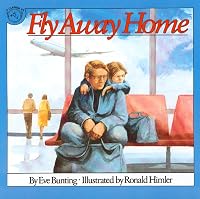
Fly Away Home
by Eve Bunting
On This Page
Description
A homeless boy who lives in an airport with his father, moving from terminal to terminal and trying not to be noticed, is given hope when he sees a trapped bird find its freedom.Tags
Recommendations







Member Reviews
I absolutely loved this book for a few reasons. Firstly, I enjoyed that this book is told from the viewpoint of Andrew, the little boy in the story. Because it is told from a child’s perspective, it also has the syntax and sentence structure of how a child would think or talk. For example, “Then he goes to the phones. When he comes back he looks sad. Sad and angry”, depicts how a child would describe how someone looks. I believe this truly puts the reader into Andrew’s shoes. The child’s perspective on this situation also provides a new insight I have never thought of before. Andrew and his father are homeless and survive by living at the airport. They live each day by carrying their things around and pretending to be boarding show more planes, and avoid being kicked out of the airport. This book sheds light on how hard it may be for a child to cope or grasp with the concept of being homeless.
I also enjoyed the deep topics that are discussed in this book. Most children’s books consist of simple and straight-forward lessons about character. However, Eve Bunting chooses to discuss the struggle that children face when not having their mothers present in their lives as well as not having a welcoming home to call their own. Bunting does not shy away from this topic, and demonstrates how a child may deal with these issues. In the first sentence of the book it says, “My dad and I live in an airport. That’s because we don’t have a home and the airport is better than the streets.” This sentence immediately impacts me and sets the tone of the story. I believe that because Bunting chose to directly bring attention to the issue of homelessness for kids, she made a stand and it deeply affects each reader who picks up her book.
The main idea of this story is to showcase how homelessness affects children and their families. It is a real problem that sadly occurs too often in the United States. Andrew and his father struggle to stay hidden and not be kicked out of the airport. If they were to be caught one day, Andrew and his father would not have a roof over their heads. Homelessness can devastate families and Eve Bunting draws attention to this issue in a creative and magnificent way. show less
I also enjoyed the deep topics that are discussed in this book. Most children’s books consist of simple and straight-forward lessons about character. However, Eve Bunting chooses to discuss the struggle that children face when not having their mothers present in their lives as well as not having a welcoming home to call their own. Bunting does not shy away from this topic, and demonstrates how a child may deal with these issues. In the first sentence of the book it says, “My dad and I live in an airport. That’s because we don’t have a home and the airport is better than the streets.” This sentence immediately impacts me and sets the tone of the story. I believe that because Bunting chose to directly bring attention to the issue of homelessness for kids, she made a stand and it deeply affects each reader who picks up her book.
The main idea of this story is to showcase how homelessness affects children and their families. It is a real problem that sadly occurs too often in the United States. Andrew and his father struggle to stay hidden and not be kicked out of the airport. If they were to be caught one day, Andrew and his father would not have a roof over their heads. Homelessness can devastate families and Eve Bunting draws attention to this issue in a creative and magnificent way. show less
The story of Fly Away Home covers a few days in the life of a young boy and his father. They are homeless and live in an airport secretly. The family is struggling to survive and not get caught while staying at the airport. It details how they have to bathe in the bathroom sink, switch terminals daily so they do not get caught, separate to stay low key and live off of minimal amounts of food. This story could gives new perspective and helps readers understand how some people live. The entire story goes through the daily routine of the child and father. It includes harsh truths like how they must sleep sitting up, that is no environment for a child to live. I liked that the story was from the little boy's point of view. Often when we show more think of homelessness we think of adults, many do not consider the thought of children struggling to survive on the streets. It pushes readers to consider tough issues and broaden their perspectives. show less
Eve Bunting is an author who does not shy away from difficult subjects. She writes with a depth of feeling while handling subjects many auhtors of children's books might not want to cover.
In this book, the author writes a story about homelessness, and grief. Written from a young boy's perspective, he grieves the loss of his mother, and the loss of the home his family lived in. Now, he and his father live in an airport. Spending time trying not to be found, they have a system that works well for hiding from the security guards while looking busy.
During the day, his father found another homeless family to look out for the boy. The boys collect luggage carts that people left outside and return them for .50 cents each. If crowds are busy show more and safe, the boys offer to carry heavy bags for women. If they are fortunate, they receive tips. The money is kept in their shoes.
The meals are standard: a container of milk and a donut for breakfast. When his father returns from his work, he buys hamburgers for them, and also for the family that helps watch him during the day.
Longing for a home like it was when his mother was alive, sometimes the boy shares his feelings with his father. His father reminds him they are safe and warm. The sadness sets in when he watches people greet each other after their flight lands. He tries to fight back tears when he questions why those people are more lucky than them.
The author does a wonderful job of writing about difficult subjects told from the perspective of a young boy. When the boy saw a bird who was inside the terminal and tried to fly away, hitting the glass, it fell and harmed its wing. Then, one day the sliding door opened and the bird flew away. The young boy knew that even though he could not hear the bird, it was singing when it flew home.
Excellently written with illustrations that follow this heart-wrenching story. show less
In this book, the author writes a story about homelessness, and grief. Written from a young boy's perspective, he grieves the loss of his mother, and the loss of the home his family lived in. Now, he and his father live in an airport. Spending time trying not to be found, they have a system that works well for hiding from the security guards while looking busy.
During the day, his father found another homeless family to look out for the boy. The boys collect luggage carts that people left outside and return them for .50 cents each. If crowds are busy show more and safe, the boys offer to carry heavy bags for women. If they are fortunate, they receive tips. The money is kept in their shoes.
The meals are standard: a container of milk and a donut for breakfast. When his father returns from his work, he buys hamburgers for them, and also for the family that helps watch him during the day.
Longing for a home like it was when his mother was alive, sometimes the boy shares his feelings with his father. His father reminds him they are safe and warm. The sadness sets in when he watches people greet each other after their flight lands. He tries to fight back tears when he questions why those people are more lucky than them.
The author does a wonderful job of writing about difficult subjects told from the perspective of a young boy. When the boy saw a bird who was inside the terminal and tried to fly away, hitting the glass, it fell and harmed its wing. Then, one day the sliding door opened and the bird flew away. The young boy knew that even though he could not hear the bird, it was singing when it flew home.
Excellently written with illustrations that follow this heart-wrenching story. show less
I really loved this story and almost cried while reading it because it was so powerful. One reason I loved this book was the fact that it touched upon the difficult topic of homelessness in a picture book format. Homeless families are not a common subject for a children's book, but many children are in similar situations so they need a book to relate to. I also really liked the symbolism of the bird in the story. The little bird can not escape from the terminal and flutters against the window for a while. However, eventually the bird breaks free and flys away into the sky. The boy brings up the bird's escape again at the end after stating that "sometimes I just want to cry. I think Dad and I will be here forever." He mentions that the show more bird was able to fly away even though it took a while and that it was probably singing as it did so. Despite the heavy emotion in this book, it ends on a hopeful note because of the bird. The main idea of this story is that there are many different kinds of families, including those that live in the airport, but we can never lose hope however rough our situation may seem. show less
The main idea of this book is to show the lives, feelings, and dreams of a homeless father and son.
I loved this book for many reasons. I loved that Eve Bunting challenges her readers to look at a tough issue. Homelessness is a difficult experience that takes place in our society and is often difficult to talk about. However, it is important to address homelessness because many children are experiencing it and all students should be exposed to it in a gentle way (such as through a picture book). Even if children are not experiencing homelessness, they may be able to relate to the experiences of the little boy. For example, one page explains how the little boy lives his life trying not to be noticed: "He and I wear blue jeans and blue show more T-shirts and blue jackets. We each have a blue zippered bag with a change of blue clothes. Not to be noticed is to look like nobody at all." Text like this introduces the topic of homelessness in a gentle way and also shows children that they can relate to the child's experience in other ways as well.
I also loved this book because of the symbolism of the little bird as a symbol of hope and freedom. The little boy notices a bird who gets trapped in the airport and tries desperately to free himself. It "threw itself at the glass, fell panting on the floor, flew to a tall, metal girder, and perched there, exhausted." After they boy encourages the bird, it finally frees itself. The boy reflects, "Though I couldn't hear it, I knew it was singing. Nothing made me as happy as that bird." At the end of the book when the boy is feeling downhearted because he wants to have his own home again, he thinks of the bird: "It took awhile, but a door opened. And when the bird left, when it flew free, I know it was singing." This is not only a beautiful example of symbolism, but also gives the book a hopeful ending for the little boy. show less
I loved this book for many reasons. I loved that Eve Bunting challenges her readers to look at a tough issue. Homelessness is a difficult experience that takes place in our society and is often difficult to talk about. However, it is important to address homelessness because many children are experiencing it and all students should be exposed to it in a gentle way (such as through a picture book). Even if children are not experiencing homelessness, they may be able to relate to the experiences of the little boy. For example, one page explains how the little boy lives his life trying not to be noticed: "He and I wear blue jeans and blue show more T-shirts and blue jackets. We each have a blue zippered bag with a change of blue clothes. Not to be noticed is to look like nobody at all." Text like this introduces the topic of homelessness in a gentle way and also shows children that they can relate to the child's experience in other ways as well.
I also loved this book because of the symbolism of the little bird as a symbol of hope and freedom. The little boy notices a bird who gets trapped in the airport and tries desperately to free himself. It "threw itself at the glass, fell panting on the floor, flew to a tall, metal girder, and perched there, exhausted." After they boy encourages the bird, it finally frees itself. The boy reflects, "Though I couldn't hear it, I knew it was singing. Nothing made me as happy as that bird." At the end of the book when the boy is feeling downhearted because he wants to have his own home again, he thinks of the bird: "It took awhile, but a door opened. And when the bird left, when it flew free, I know it was singing." This is not only a beautiful example of symbolism, but also gives the book a hopeful ending for the little boy. show less
Wonderful entry point into addressing the stereotypes of what homelessness and poverty look like. Story would be a good tool as a conversation starter/discussions for younger readers about viewing the issue of poverty/homelessness from different perspectives as well as helping children developing empathy. The book highlights many of the struggles that the homeless face. Appreciate that the text ends with hope - that things can and will improve.
A homeless boy, Andrew, lives in an airport with his father. They move from terminal to terminal trying not to be noticed. Andrew connects and relates to a trapped bird at the airport that eventually finds its freedom.
A homeless boy, Andrew, lives in an airport with his father. They move from terminal to terminal trying not to be noticed. Andrew connects and relates to a trapped bird at the airport that eventually finds its freedom.
I had mixed feelings about Fly Away Home after reading it. I liked the book because it was a simple story that conveyed a powerful message. However, young readers may not be able to capture the feeling behind it, unless they can directly relate. The story was about a young boy named Andrew and his father. They were homeless and lived in an airport. I liked all the descriptive details about living in an airport throughout the story. However, I feel that many children would not pick up on the fact that Andrew and his father were homeless, and they didn't just live in an airport. Despite the fact that I have never been or known anyone who is homeless, this book really took a toll on my emotions. At one point in the story, Andrew became show more upset with the travelers in the airport because they had a place to go to that they called “home” after they left the airport. He displayed a lot of frustration because his dad could not afford a home after his mother passed away. While reading this story, I thought it was very saddening to realize that families like Andrew’s really do exist. However, this book had somewhat of a happy ending because Andrew remembered the bird he saw trapped in the airport. He knew that the bird would find its way out and be able to go home. Even though Andrew was sad that he didn't have a real home, he related his situation to the bird's and that someday he would be able to "fly away" back home. In the end, the message I got from the book is that when times get tough, you have to keep believing there is a light at the end of the tunnel. show less
Members
- Recently Added By
Lists

Scholastic 100 Best Read-Aloud Books
100 works; 8 members

75 Books for Literacy Block: Fall 2016
75 works; 2 members
Author Information

276+ Works 51,893 Members
Eve Bunting was born in 1928 in Maghera, Ireland, as Anne Evelyn Bunting. She graduated from Northern Ireland's Methodist College in Belfast in 1945 and then studied at Belfast's Queen's College. She emigrated with her family in 1958 to California, and became a naturalized citizen in 1969. That same year, she began her writing career, and in 1972, show more her first book, "The Two Giants" was published. In 1976, "One More Flight" won the Golden Kite Medal, and in 1978, "Ghost of Summer" won the Southern California's Council on Literature for Children and Young People's Award for fiction. "Smokey Night" won the American Library Association's Randolph Caldecott Medal in 1995 and "Winter's Coming" was voted one of the 10 Best Books of 1977 by the New York Times. Bunting is involved in many writer's organizations such as P.E.N., The Authors Guild, the California Writer's Guild and the Society of Children's Book Writers. She has published stories in both Cricket, and Jack and Jill Magazines, and has written over 150 books in various genres such as children's books, contemporary, historic and realistic fiction, poetry, nonfiction and humor. (Bowker Author Biography) show less
All Editions
Awards and Honors
Awards
Distinctions
Notable Lists
Common Knowledge
- Related movies
- Fly Away Home (1996 | IMDb)
Classifications
- Genre
- Children's Books
- DDC/MDS
- 362.56 — Society, government, & culture Social problems and social services Social Welfare Poor (from social service perspectives)
- LCC
- PZ7 .B91527 .F — Language and Literature Fiction and juvenile belles lettres Fiction and juvenile belles lettres Juvenile belles lettres
- BISAC
Statistics
- Members
- 1,897
- Popularity
- 11,327
- Reviews
- 171
- Rating
- (4.44)
- Languages
- English
- Media
- Paper
- ISBNs
- 14
- UPCs
- 4
- ASINs
- 4