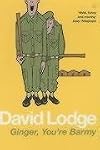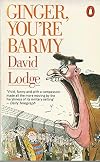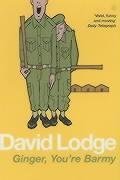
Ginger, You're Barmy
by David Lodge
On This Page
Description
A funny, shocking novel about the trials and traumas of British post-war National Service When it isn't prison, it's hell.Or at least that's the heartfelt belief of conscripts Jonathan Browne and Mike 'Ginger' Brady. For this is the British Army in the days of National Service, a grimy deposit of post-war gloom. An endless round of kit layout, square-bashing, shepherd's pie 'made with real shepherds' and drills are relieved only by the occasional lecture on firearms or V.D. The reckless, show more impulsive Mike and the more pragmatic Jonathan adopt radically different attitudes to survive this two-year confiscation of their freedom, with dramatic consequences show lessTags
Recommendations




























Member Recommendations


Member Reviews
This was Lodge's second novel, drawing on his experience of National Service in the late fifties (but written when he was safely out of the clutches of the army again and conscription itself was being wound down). It tells the story of two young men who do their military service after studying English at London University. Mike ("Ginger") is a rebel, Catholic, red-haired, of Irish descent and always ready to challenge authority, whilst Jonathan, the narrator, is more of a survivor, an agnostic who is ready to learn to compromise his principles a bit to get what he wants from life. He's got a First where the cleverer Mike messed up his degree, and we soon realise that he's also ended up with Mike's girl.
The army is predictably awful, show more with a basic training programme at Catterick that focuses on breaking the spirit of the conscripts and occupying them with mindless and pointless tasks, mainly involving cleaning and polishing their equipment. The classic example are the boots, supplied by the manufacturer with a matt, waterproof finish that has presumably been specified for practical reasons by the army itself, but which have to be polished to a high-gloss finish to pass kit inspections. Naturally, the polishing process requires the soldiers to maltreat the leather in ways that destroy the waterproofing and ruin the boots for actual use. There is only the most minimal attention to actual military training, and everything takes at least three times as long as it needs to.
Graduates or school-leavers going on to university (for some reason, those going to Oxford and Cambridge do their military service beforehand, others go to university first) are automatically flagged as "potential officers", which means going into a selection process where they have to compete to show "leadership" Whatever this mysterious quality might be, I was fairly certain that I did not possess it. At Wozbee it was apparently assessed by one’s ability to handle a knife and fork and to cross a seven-foot ditch with two three-foot planks. I did not see myself excelling in either of these tests. Mike and Jonathan make a minor gesture of rebellion by asking not to be considered for this process. For Mike this is the first of a series of acts that will get him into more and more trouble with the authorities and eventually mess up his life completely; for Jonathan it marks the start of his recognition that army life is something one can survive, if one searches out the most comfortable path through it: All human activity was useless, but some kinds were more pleasant than others. The Army had taught me that much philosophy.
The book seems to be largely a response to the politician quoted in the last chapter extolling the virtues of National Service just as it is being wound down "National Service has done much to teach the younger generation independence, initiative, responsibility,—qualities which have stood this country in good stead in two World Wars." For Lodge, as for most of his contemporaries who actually did National Service in peacetime, what the army taught them was how to look busy while avoiding actual work as far as possible, and how to keep their heads down and stay out of trouble. If they came from an upper-class background, it taught them that arrogant self-assurance will get you everywhere; if they did not, it taught them that most people in positions of in authority were arrogant, brainless incompetents. And that you were free to think what you liked of them, as long as you saluted and said "Yes, sir!"
A book that is tilting against a long-dead institution, and with a certain period quaintness (in his afterword, Lodge is visibly amused at the way the publishers of this 1980s reissue have "restored" the pre-Chatterley bowdlerising of swearwords of the first edition — "fugg" and "c—t", etc. — which the 1970s edition had happily turned back into the real swearwords they were meant for). But very interesting. show less
The army is predictably awful, show more with a basic training programme at Catterick that focuses on breaking the spirit of the conscripts and occupying them with mindless and pointless tasks, mainly involving cleaning and polishing their equipment. The classic example are the boots, supplied by the manufacturer with a matt, waterproof finish that has presumably been specified for practical reasons by the army itself, but which have to be polished to a high-gloss finish to pass kit inspections. Naturally, the polishing process requires the soldiers to maltreat the leather in ways that destroy the waterproofing and ruin the boots for actual use. There is only the most minimal attention to actual military training, and everything takes at least three times as long as it needs to.
Graduates or school-leavers going on to university (for some reason, those going to Oxford and Cambridge do their military service beforehand, others go to university first) are automatically flagged as "potential officers", which means going into a selection process where they have to compete to show "leadership" Whatever this mysterious quality might be, I was fairly certain that I did not possess it. At Wozbee it was apparently assessed by one’s ability to handle a knife and fork and to cross a seven-foot ditch with two three-foot planks. I did not see myself excelling in either of these tests. Mike and Jonathan make a minor gesture of rebellion by asking not to be considered for this process. For Mike this is the first of a series of acts that will get him into more and more trouble with the authorities and eventually mess up his life completely; for Jonathan it marks the start of his recognition that army life is something one can survive, if one searches out the most comfortable path through it: All human activity was useless, but some kinds were more pleasant than others. The Army had taught me that much philosophy.
The book seems to be largely a response to the politician quoted in the last chapter extolling the virtues of National Service just as it is being wound down "National Service has done much to teach the younger generation independence, initiative, responsibility,—qualities which have stood this country in good stead in two World Wars." For Lodge, as for most of his contemporaries who actually did National Service in peacetime, what the army taught them was how to look busy while avoiding actual work as far as possible, and how to keep their heads down and stay out of trouble. If they came from an upper-class background, it taught them that arrogant self-assurance will get you everywhere; if they did not, it taught them that most people in positions of in authority were arrogant, brainless incompetents. And that you were free to think what you liked of them, as long as you saluted and said "Yes, sir!"
A book that is tilting against a long-dead institution, and with a certain period quaintness (in his afterword, Lodge is visibly amused at the way the publishers of this 1980s reissue have "restored" the pre-Chatterley bowdlerising of swearwords of the first edition — "fugg" and "c—t", etc. — which the 1970s edition had happily turned back into the real swearwords they were meant for). But very interesting. show less
A David Lodge book. An early one. I didn’t realize how early until i began looking for the ISBN and saw that the original publication date was 1962! The exact edition i was reading was from 1987 but the cover is not the same at that listed in GoodReads under that ISBN. o well.
I read a bit of this. A bit less than half, to be exact, and i just found myself not caring. Don’t get me wrong, it isn’t badly written or without depth but i just couldn’t find interest in what was going on. I usually like Lodge when he is being quirky and odd but i didn’t find that in this book. I found a regular tale of young men in England doing their perfunctory military duty in the mid-20th century before such mandatory duties were scrapped. If you show more are interested in such thing then this is the book for you. For me? I’m abandoning it for something more my taste. sorry, Mr. Lodge, maybe the next one. show less
I read a bit of this. A bit less than half, to be exact, and i just found myself not caring. Don’t get me wrong, it isn’t badly written or without depth but i just couldn’t find interest in what was going on. I usually like Lodge when he is being quirky and odd but i didn’t find that in this book. I found a regular tale of young men in England doing their perfunctory military duty in the mid-20th century before such mandatory duties were scrapped. If you show more are interested in such thing then this is the book for you. For me? I’m abandoning it for something more my taste. sorry, Mr. Lodge, maybe the next one. show less
From the author’s afterword
Ginger, You’re Barmy is ‘about’ peacetime National Service, as an institution and as an experience. I was drafted into the Royal Armoured Corps shortly after obtaining my B.A. in English Language and Literature. I received my Basic Training and Trade Training at Catterick Camp and was subsequently posted to the permanent staff of the R.A.C.’s Driving and Maintenance School at Bovington Camp where I worked as a clerk until my release in August 1957. The last National Servicemen were called up in 1960. There is scarcely a minor character or illustrative incident or detail of setting that is not drawn from the life.
“Hamilton was a rather pathetic little man with the ugliest countenance I had ever show more seen. His mouth was obscenely crowded with teeth – when he drew back his melon-slice mouth to smile you could count hundreds of them – and their luxuriant growth had even given him a deformed jaw which projected into space like some craggy promontory.”
An extremely entertaining, interesting and informative read. show less
Ginger, You’re Barmy is ‘about’ peacetime National Service, as an institution and as an experience. I was drafted into the Royal Armoured Corps shortly after obtaining my B.A. in English Language and Literature. I received my Basic Training and Trade Training at Catterick Camp and was subsequently posted to the permanent staff of the R.A.C.’s Driving and Maintenance School at Bovington Camp where I worked as a clerk until my release in August 1957. The last National Servicemen were called up in 1960. There is scarcely a minor character or illustrative incident or detail of setting that is not drawn from the life.
“Hamilton was a rather pathetic little man with the ugliest countenance I had ever show more seen. His mouth was obscenely crowded with teeth – when he drew back his melon-slice mouth to smile you could count hundreds of them – and their luxuriant growth had even given him a deformed jaw which projected into space like some craggy promontory.”
An extremely entertaining, interesting and informative read. show less
Ratings
Members
- Recently Added By
Author Information

55+ Works 19,256 Members
Work Relationships
Common Knowledge
- Original title
- Ginger, You're Barmy
- Original publication date
- 1962 (MacGibbon & Kee) (MacGibbon & Kee); 1982 (Secker & Warburg) (Secker & Warburg)
- Epigraph
- Ginger, you're barmy,
You'll never join the Army,
You'll never be a scout,
With your shirt hanging out,
Ginger, you're barmy - Dedication
- For Mary
- First words
- Prologue. It is strange to read what I wrote three years ago.
'I feel worn out. I think I'll get ready for bed', said Pauline. - Last words
- (Click to show. Warning: May contain spoilers.)Twelve o'clock striking. I must put a clean nappy on Michael, lay the table, and get out the cider. And the Guinness.
Classifications
Statistics
- Members
- 287
- Popularity
- 111,380
- Reviews
- 3
- Rating
- (3.36)
- Languages
- 6 — Chinese, Czech, English, Polish, Portuguese, Romanian
- Media
- Paper, Ebook
- ISBNs
- 10
- ASINs
- 5