On This Page
Description
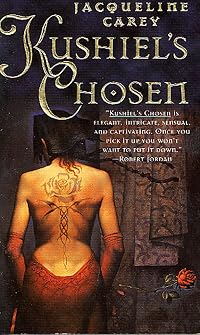
Mighty Kushiel, of rod and wealLate of the brazen portalsWith blood-tipp'd dart a wound unhealedPricks the eyen of chosen mortals.The land of Terre d'Ange is a place of unsurpassed beauty and grace. The inhabiting race rose from the seed of angels and men, and they live by one simple rule: Love as thou wilt.Phèdre nó Delaunay was sold into indentured servitude as a child. Her bond was purchased by a nobleman, the first to recognize that she is one pricked by Kushiel's Dart, chosen to show more forever experience pain and pleasure as one. He trained Phèdre in the courtly arts and the talents of the bedchamber-and, above all, the ability to observe, remember, and analyze.When she stumbled upon a plot that threatened the very foundations of her homeland, she gave up almost everything she held dear to save it. She survived, and lived to have others tell her story, and if they embellished the tale with fabric of mythical splendor, they weren't far off the mark.The hands of the gods weigh heavily upon Phèdre's brow, and they are not finished with her. While the young queen who sits upon the throne is well loved by the people, there are those who believe another should wear the those who escaped the wrath of the mighty are not yet done with their schemes for power and revenge. show lessTags
Recommendations










Member Reviews
Note: It is possible to read this book as a stand alone as relevant events from Book 1 are reflected upon in enough detail for a reader of Book 2 to grasp the point. However, I highly recommend reading Book 1 as it is just so damn good!
We return once again to the alternate history of Terre D’Ange (France) and the surrounding lands. Book 2 picks up several months after Book 1 ended. Melisande Sharhizai is still at large. However, very early in Book 2 our heroine Phedre receives a challenge of sorts from Melisande – her sangoire cloak is returned to her via a carrier from Caerdicca Unitas (Italy) and more specifically La Serenissima (Venice). Phedre truly believes that Terre D’Ange and the queen (Ysandre) are in danger so long as show more Melisande is free. The challenge sets in motion events that will change Phedre’s life forever.
Here we have another masterfully crafted book from Jacqueline Carey. Sometimes sequels aren’t near as good as the first in the series but this series holds it’s own weight as it progresses. I have read this book several times now and this is my second time listening to it. First, I love how the characters continue to grow and how the world continues to expand as Phedre’s travels take her further afield. Second, Melisande continues to make a most worthy opponent. Phedre definitely has her work cut out for her in this book!
Once again, we are told the story through Phedre’s eyes. She was raised in the Court of the Night Blooming flowers and being subservient and unseen (expect maybe as a pretty plaything) comes easily to her. She polished off her training in Anafiel Delaunay’s house where she learned history, politics, languages, and how to think in a rational manner. Both served her well in Book 1 and they do so again in Book 2. Yet this journey she comes to understand her powers a bit more – her will power to live, her ability to forgive, her strength to deny Melisande. That which yields, is not always weak (a quote from Kushiel’s Dart).
There were two interesting themes that twined throughout the novel: loyalty and grief. Again and again, we see Phedre and other characters having to figure out where their loyalties really lie – with queen and country? To the deities they serve? To family? I think Joscelin struggled the most with this one. Grief made an interesting thread throughout the book. What is a mortal’s grief compared to the grief of a goddess? How do you mourn the passing of something not of a physical nature, such as friendship or love? These were some big ideas to contemplate even as my mind was fully engaged in the day to day decisions of the characters.
This time through, I listened to the book as part of a read along. It was a great experience and let me see things about the book I had not seen before. For instance, I had not really noticed before that Phedre is, on occasion, a little bit of a snob. Now I see it in small things and I see how it ties to her upbringing and culture. This in turn let’s me see it in other Terre D’Ange characters. And this leads to a nuanced part of the plot of this book – how Terre D’Ange has been a bit xenophobic towards other cultures for too long and it has cost them in the larger arena of politics. This book (and the entire series) is awesome because you can reread it and take something new away each time.
As with Kushiel’s Dart, there is also plenty of sex and it is told in just as much detail as the rest of the story. You may blush a bit. The sex scenes serve to show certain aspects of the characters involved or to move the plot forward. I never feel that space is wasted on these scenes. Plus, some of them are rather educational in and of themselves. ;)
As with Book 1, I was completely swept up into Phedre’s world once again. Jacqueline Carey makes great use of languages to round out a culture. If you’re a bit of a linguistics geek, you will love this aspect of the series. It’s a rich world, a devilishly intriguing plot, and characters you will never forget. Reading it the 7th time was just as good as reading it the first time.
The Narration: Anne Flosnik is once again the voice of Phedre, and a great fit she is too! Phedre’s voice is how we experience the story and, hence, Phedre’s emotions come through the loudest. Flosnik did a great job imbuing the characters with emotions, but especially, Phedre. My heart broke and soared for her multiple times throughout the tale! The linguistics keep piling up in this series and Flosnik met the challenge magnificnetly. show less
We return once again to the alternate history of Terre D’Ange (France) and the surrounding lands. Book 2 picks up several months after Book 1 ended. Melisande Sharhizai is still at large. However, very early in Book 2 our heroine Phedre receives a challenge of sorts from Melisande – her sangoire cloak is returned to her via a carrier from Caerdicca Unitas (Italy) and more specifically La Serenissima (Venice). Phedre truly believes that Terre D’Ange and the queen (Ysandre) are in danger so long as show more Melisande is free. The challenge sets in motion events that will change Phedre’s life forever.
Here we have another masterfully crafted book from Jacqueline Carey. Sometimes sequels aren’t near as good as the first in the series but this series holds it’s own weight as it progresses. I have read this book several times now and this is my second time listening to it. First, I love how the characters continue to grow and how the world continues to expand as Phedre’s travels take her further afield. Second, Melisande continues to make a most worthy opponent. Phedre definitely has her work cut out for her in this book!
Once again, we are told the story through Phedre’s eyes. She was raised in the Court of the Night Blooming flowers and being subservient and unseen (expect maybe as a pretty plaything) comes easily to her. She polished off her training in Anafiel Delaunay’s house where she learned history, politics, languages, and how to think in a rational manner. Both served her well in Book 1 and they do so again in Book 2. Yet this journey she comes to understand her powers a bit more – her will power to live, her ability to forgive, her strength to deny Melisande. That which yields, is not always weak (a quote from Kushiel’s Dart).
There were two interesting themes that twined throughout the novel: loyalty and grief. Again and again, we see Phedre and other characters having to figure out where their loyalties really lie – with queen and country? To the deities they serve? To family? I think Joscelin struggled the most with this one. Grief made an interesting thread throughout the book. What is a mortal’s grief compared to the grief of a goddess? How do you mourn the passing of something not of a physical nature, such as friendship or love? These were some big ideas to contemplate even as my mind was fully engaged in the day to day decisions of the characters.
This time through, I listened to the book as part of a read along. It was a great experience and let me see things about the book I had not seen before. For instance, I had not really noticed before that Phedre is, on occasion, a little bit of a snob. Now I see it in small things and I see how it ties to her upbringing and culture. This in turn let’s me see it in other Terre D’Ange characters. And this leads to a nuanced part of the plot of this book – how Terre D’Ange has been a bit xenophobic towards other cultures for too long and it has cost them in the larger arena of politics. This book (and the entire series) is awesome because you can reread it and take something new away each time.
As with Kushiel’s Dart, there is also plenty of sex and it is told in just as much detail as the rest of the story. You may blush a bit. The sex scenes serve to show certain aspects of the characters involved or to move the plot forward. I never feel that space is wasted on these scenes. Plus, some of them are rather educational in and of themselves. ;)
As with Book 1, I was completely swept up into Phedre’s world once again. Jacqueline Carey makes great use of languages to round out a culture. If you’re a bit of a linguistics geek, you will love this aspect of the series. It’s a rich world, a devilishly intriguing plot, and characters you will never forget. Reading it the 7th time was just as good as reading it the first time.
The Narration: Anne Flosnik is once again the voice of Phedre, and a great fit she is too! Phedre’s voice is how we experience the story and, hence, Phedre’s emotions come through the loudest. Flosnik did a great job imbuing the characters with emotions, but especially, Phedre. My heart broke and soared for her multiple times throughout the tale! The linguistics keep piling up in this series and Flosnik met the challenge magnificnetly. show less
According to Tor, Carey's first book Kushiel's Dart is one of the best fantasy novels of the last decade.
Frankly speaking, I agree. I've never read anything quite like that before. Kushiel's Dart blew me away, and Kushiel's Chosen with its 700 pages was not far behind. It's extremely intricate, intense, darkly erotic and has layers upon layers of meaning. It celebrates feminine strength, because most of the main players in this series be that villains or heroes are women.
Book #2 starts a year and a half after the end of book #1 (if I'm not mistaken). Phedre had time to recuperate from her ordeal, and she receives a disturbing gift from her archenemy, Melisande, which makes her decide to leave her country estate and test the dangerous show more waters of capital of Terre D'Ange again as a courtesan and a spy.
While she uncovers more and more evidence that Melisande is still alive and extremely dangerous and while her beloved Josselin becomes more and more unhappy with her service as Kushiel's Chosen, the trail leads her to La Serenissima (an equivalent of Renaissance Venice) where she promptly gets trapped in such a dangerous and grandiose plot, that she would need to travel through half of the world, if she has any chance to thwart her enemy and save her queen again.
The adventures she is going through are incredible, the tension and the feeling of time running out is palpable. This was such a wild ride I again stayed awake until the early hours of the morning (which happened to book #1 too) to finish Kushiel's Chosen.
I have only one word for this series, and it's EPIC. show less
Frankly speaking, I agree. I've never read anything quite like that before. Kushiel's Dart blew me away, and Kushiel's Chosen with its 700 pages was not far behind. It's extremely intricate, intense, darkly erotic and has layers upon layers of meaning. It celebrates feminine strength, because most of the main players in this series be that villains or heroes are women.
Book #2 starts a year and a half after the end of book #1 (if I'm not mistaken). Phedre had time to recuperate from her ordeal, and she receives a disturbing gift from her archenemy, Melisande, which makes her decide to leave her country estate and test the dangerous show more waters of capital of Terre D'Ange again as a courtesan and a spy.
While she uncovers more and more evidence that Melisande is still alive and extremely dangerous and while her beloved Josselin becomes more and more unhappy with her service as Kushiel's Chosen, the trail leads her to La Serenissima (an equivalent of Renaissance Venice) where she promptly gets trapped in such a dangerous and grandiose plot, that she would need to travel through half of the world, if she has any chance to thwart her enemy and save her queen again.
The adventures she is going through are incredible, the tension and the feeling of time running out is palpable. This was such a wild ride I again stayed awake until the early hours of the morning (which happened to book #1 too) to finish Kushiel's Chosen.
I have only one word for this series, and it's EPIC. show less
Summary: Phèdre nó Delaunay helped save her beloved homeland of Terre d'Ange from a barbarian invasion, and now Ysandre de la Courcel is safe on the throne. Phèdre has been adjusting to life as the Comtesse de Montrève, but when a mysterious package arrives from the city of La Serenissima, she knows that her brief respite is at an end. Because the barbarian invasion was defeated, but Melisande, its mastermind, escaped from custody... which means that there is a traitor in the very highest echelons of the government, and Ysandre's throne may not be secure after all. In order to find out, Phèdre must re-enter Namaah's service - something that does not sit well with Joscelin, her loyal yet conflicted guard and sometime lover. But even show more as Phèdre's decision drives them apart, it will take her deep within the politics not only of Terre d'Ange, but La Serenissima as well.
Review: Oooooh, these books are so good! I didn't love this one *quite* as much as I loved Kushiel's Dart (for reasons I'll get to in a minute), but overall: SO GOOD. These books are big and fat and totally absorbing, drawing me into the story even when I'm scatter-brained and otherwise short of attention. They have a good mix of sexytimes and scheming and action. Phèdre's voice is wonderful and rich and evocative, even more so the more I read. Carey's writing continues to be wonderful, and there are these little sparkling lines or moments or scenes that are simply perfection. The books manage to be epic in scope and yet very immediate in feeling and detail. The characters are absolutely wonderful, completely winning me over and then breaking my heart, again and again. In short, every wonderful thing I said about Kushiel's Dart applies here, just as much.
So why dock it a half-star? Joscelin. Or rather, the lack of Joscelin. I understand the narrative reasons why Phèdre and Joscelin had to spend most of this book apart, but I got surprisingly attached to him by the end of Kushiel's Dart, so it felt like the story was missing that little spark when it was just Phèdre by herself. I also thought the subplot with the Yeshuites (i.e. what Joscelin was doing in the meantime) was not as well developed as it could have been, although I don't know that I would have been completely happy with any explanation.
Even so, I loved the pants off this book, and can't wait to dive into the third one in the series. 4.5 out of 5 stars.
Recommendation: Oh my goodness, yes, highly recommended to people who like epic fantasy. Read this book. Well, read Kushiel's Dart, since they are not at all stand-alone, and then you will be totally hooked like I was, and not need my advice to read this one too. show less
Review: Oooooh, these books are so good! I didn't love this one *quite* as much as I loved Kushiel's Dart (for reasons I'll get to in a minute), but overall: SO GOOD. These books are big and fat and totally absorbing, drawing me into the story even when I'm scatter-brained and otherwise short of attention. They have a good mix of sexytimes and scheming and action. Phèdre's voice is wonderful and rich and evocative, even more so the more I read. Carey's writing continues to be wonderful, and there are these little sparkling lines or moments or scenes that are simply perfection. The books manage to be epic in scope and yet very immediate in feeling and detail. The characters are absolutely wonderful, completely winning me over and then breaking my heart, again and again. In short, every wonderful thing I said about Kushiel's Dart applies here, just as much.
So why dock it a half-star? Joscelin. Or rather, the lack of Joscelin. I understand the narrative reasons why Phèdre and Joscelin had to spend most of this book apart, but I got surprisingly attached to him by the end of Kushiel's Dart, so it felt like the story was missing that little spark when it was just Phèdre by herself. I also thought the subplot with the Yeshuites (i.e. what Joscelin was doing in the meantime) was not as well developed as it could have been, although I don't know that I would have been completely happy with any explanation.
Even so, I loved the pants off this book, and can't wait to dive into the third one in the series. 4.5 out of 5 stars.
Recommendation: Oh my goodness, yes, highly recommended to people who like epic fantasy. Read this book. Well, read Kushiel's Dart, since they are not at all stand-alone, and then you will be totally hooked like I was, and not need my advice to read this one too. show less
La Prescelta e l'Erede. Iniziato e finito in tre giorni. 700 pagine di puro fantasy adult assolutamente avvincente.
La Carey ha sostanzialemente rimarcato lo stesso profilo del primo libro reinventandosi, però, complutamente in modo assolutamente magistrale. Affasciante, erotico e coivolgente.
Queato secondo libro è, se possibile, ancora meglio del primo. Credo che ciò sia dovuto principalmente alla facilità con la quale sono riuscita ad addentrarmi nella trama mentre, nel primo libro, avevo faticato un po' per ricordare tutti i nomi dei molteplici personaggi.
Avevo capito fin da metà del primo libro che tutto sarebbe ruotato intorno all'assurdo amore/odio (nel vero senso della parola) fra Phèdre e Melisande. Assolutamente geniale show more giocare con l'eroina e la sua dbolezza più grande. Stupendo. Sinceramente il "grande enigma" io l'ho svelato a metà libro, durante la bella passeggiata che Phèdre fra nei giardini di corte. Altrettando ovviamente ho ammirato la genialità della scrittrice quando alla fine mi ha spiegato la mia stessa intuizione. Stupendo!
In questo libro prende maggiormente piede l'elemento psicologico e la crescita di Phèdre. Nel primo abbiamo visto una ragazza diventare "adulta" e ci siamo confrontati maggiormente con il suo lato anguissette. Nel secondo, invece, vediamo come quella ragazza diventa, finalmente, donna. In questo libro è la crescita emotiva di Phèdre a fare da padrona, vediamo la nostra eroina finalmente delineare ed accorgersi realmente dei suoi errori e prendere consapevolezza di sè stessa.
Come dice a Melisande... Prima era una ragazzina, ora è una donna. Il prezzo è aumentato.
Ho apprezzato, seppur con qualche riserva il tormento interiore del Cassiliano. O meglio, posso aver compreso il suo punto di vista, sul serio, ma meno il suo modo di affrontare le cose. Snervante dire, ma perfettamente umano e plausibile. Bravissima la scrittrice che non è caduta nella trappola dei "protagonisti perfetti" (altrimenti detti Mery Sue e Gary Stue).
Un libro fatto di paradossi e di grandi lezioni di vita. Assolutamente da leggere. show less
La Carey ha sostanzialemente rimarcato lo stesso profilo del primo libro reinventandosi, però, complutamente in modo assolutamente magistrale. Affasciante, erotico e coivolgente.
Queato secondo libro è, se possibile, ancora meglio del primo. Credo che ciò sia dovuto principalmente alla facilità con la quale sono riuscita ad addentrarmi nella trama mentre, nel primo libro, avevo faticato un po' per ricordare tutti i nomi dei molteplici personaggi.
Avevo capito fin da metà del primo libro che tutto sarebbe ruotato intorno all'assurdo amore/odio (nel vero senso della parola) fra Phèdre e Melisande. Assolutamente geniale show more giocare con l'eroina e la sua dbolezza più grande. Stupendo. Sinceramente il "grande enigma" io l'ho svelato a metà libro, durante la bella passeggiata che Phèdre fra nei giardini di corte. Altrettando ovviamente ho ammirato la genialità della scrittrice quando alla fine mi ha spiegato la mia stessa intuizione. Stupendo!
In questo libro prende maggiormente piede l'elemento psicologico e la crescita di Phèdre. Nel primo abbiamo visto una ragazza diventare "adulta" e ci siamo confrontati maggiormente con il suo lato anguissette. Nel secondo, invece, vediamo come quella ragazza diventa, finalmente, donna. In questo libro è la crescita emotiva di Phèdre a fare da padrona, vediamo la nostra eroina finalmente delineare ed accorgersi realmente dei suoi errori e prendere consapevolezza di sè stessa.
Come dice a Melisande... Prima era una ragazzina, ora è una donna. Il prezzo è aumentato.
Ho apprezzato, seppur con qualche riserva il tormento interiore del Cassiliano. O meglio, posso aver compreso il suo punto di vista, sul serio, ma meno il suo modo di affrontare le cose. Snervante dire, ma perfettamente umano e plausibile. Bravissima la scrittrice che non è caduta nella trappola dei "protagonisti perfetti" (altrimenti detti Mery Sue e Gary Stue).
Un libro fatto di paradossi e di grandi lezioni di vita. Assolutamente da leggere. show less
Kushiel’s Chosen being the second book by Carey that I’ve read, I guess
you can say that I’m slowly getting accustomed to her style and characters. For one
thing, it felt relaxing going back to characters I’d grown to appreciate in the first book,
namely Phèdre and Joscelin but also Ysandre and Drustan.
The question as to how Melisande had managed to escape from her cell was the
main question throughout the first pages as well as to her current whereabouts.
The writing is as in the previous book excellent, you always this impression of clear
water flowing out of a fountain even in the most awful moments. The main plot is
cleverly woven and is smartly intertwined with several subplots. Plan within plans as
Phèdre points out. The show more political intrigues of both the court of Terre d’Ange and that of
La Serenissima are a delight to those who enjoy such things in a novel, I know I do.
Characterization is at its best. It’s nice to see Ysandre bloom in her role as queen
and wife and we just wish the heroin could find a similar balance in her life. Joscelin
and Phèdre split up in the first few pages, once she announces that she wishes to
return to the service of Namaah… can hardly blame to poor fellow but then, these
D’Angelines always have a surprising way of seeing things.
Gods whether they be D’Angelines (Namaah, Kushiel and Cassiel) or foreign
(Asherat of the sea) are omnipresent as Phèdre often claims that she is guided by
them and it’s hard to believe she would ever have succeeded all that she has
managed to without a little divine help. This only adds a touch of originality to the
whole trilogy as religion is very little often treated in the way Carey treats it in other
fantasy novels.
One main criticism that I wish to mention however, would be the same as the one for
previous book and more than likely will one in the third and final book of this
trilogy, namely, the length of each tome. While I am never truly bored while reading
Carey’s books and never finding any real flaws in her writing or plotting, I still find her
books are a bit too long for comfort… perhaps some of the subplots weren’t quite
necessary. I’m sure that after everything that Phèdre’s gone through, the reader
wouldn’t have mind a bit less vicissitudes but then, that’s just my personal advice and
it’s but a minor one… really. show less
you can say that I’m slowly getting accustomed to her style and characters. For one
thing, it felt relaxing going back to characters I’d grown to appreciate in the first book,
namely Phèdre and Joscelin but also Ysandre and Drustan.
The question as to how Melisande had managed to escape from her cell was the
main question throughout the first pages as well as to her current whereabouts.
The writing is as in the previous book excellent, you always this impression of clear
water flowing out of a fountain even in the most awful moments. The main plot is
cleverly woven and is smartly intertwined with several subplots. Plan within plans as
Phèdre points out. The show more political intrigues of both the court of Terre d’Ange and that of
La Serenissima are a delight to those who enjoy such things in a novel, I know I do.
Characterization is at its best. It’s nice to see Ysandre bloom in her role as queen
and wife and we just wish the heroin could find a similar balance in her life. Joscelin
and Phèdre split up in the first few pages, once she announces that she wishes to
return to the service of Namaah… can hardly blame to poor fellow but then, these
D’Angelines always have a surprising way of seeing things.
Gods whether they be D’Angelines (Namaah, Kushiel and Cassiel) or foreign
(Asherat of the sea) are omnipresent as Phèdre often claims that she is guided by
them and it’s hard to believe she would ever have succeeded all that she has
managed to without a little divine help. This only adds a touch of originality to the
whole trilogy as religion is very little often treated in the way Carey treats it in other
fantasy novels.
One main criticism that I wish to mention however, would be the same as the one for
previous book and more than likely will one in the third and final book of this
trilogy, namely, the length of each tome. While I am never truly bored while reading
Carey’s books and never finding any real flaws in her writing or plotting, I still find her
books are a bit too long for comfort… perhaps some of the subplots weren’t quite
necessary. I’m sure that after everything that Phèdre’s gone through, the reader
wouldn’t have mind a bit less vicissitudes but then, that’s just my personal advice and
it’s but a minor one… really. show less
A sequel to Kushiel's Dart, wherein Phèdre attempts to find out what happened to the beautiful traitress Melisande Shahrizai. The search brings her to the republic of La Serenissima, to the terrible prison island of La Dolorosa, to the archipelagoes of Illyria, and to the brink of madness and death...
The book starts off well, but a little more than 200 pages in I got stuck for over a month. For nearly a hundred pages, the only thing that really happened was a lot of scheming in Serenissiman politics, a young Serenissiman (one-quarter D'Angeline) nobleman unsuccessfully wooing Phèdre, and Phèdre and Joscelin quarrelling, which bored me stiff in the long run and almost killed my desire to finish the bloody thing.
Once I got through that show more part, the pace picked up again, and it took me only a few days to finish the rest. Overall, I'm not too displeased, but those 100-ish pages were almost too much by being too little, as it were. show less
The book starts off well, but a little more than 200 pages in I got stuck for over a month. For nearly a hundred pages, the only thing that really happened was a lot of scheming in Serenissiman politics, a young Serenissiman (one-quarter D'Angeline) nobleman unsuccessfully wooing Phèdre, and Phèdre and Joscelin quarrelling, which bored me stiff in the long run and almost killed my desire to finish the bloody thing.
Once I got through that show more part, the pace picked up again, and it took me only a few days to finish the rest. Overall, I'm not too displeased, but those 100-ish pages were almost too much by being too little, as it were. show less
In the second installment of the Kushiel’s Legacy trilogy, Phèdre travels to La Serenissima in search of Melisande.
I found Kushiel’s Dart rather disappointing, given all the hype, but I figured I’d try at least one more volume. I’m very glad I did; I loved this! It’s exactly what I’d hoped the series would be like.
I found the story much more personal this time around. My largest complaint with the first book was that it was rarely Phèdre’s story. Things happened around her, not to her. Here, she has a much larger stake in the action, mainly because of how each development impacts her relationship with Joscelin. I could really feel the tension between them, and it made all the difference. I’ll admit that I’m a sucker show more for a good love story, and this one made an excellent book of what would otherwise have been simply a good one.
The character interaction isn’t the only thing that’s improved this time around. The pacing is also better; there are some truly exciting moments here, though I found that the story lagged a little near the end. The intrigue is top notch and cleverly plotted. I was often hard-pressed to put the book down, I was so involved with what was going on.
I still found fault with a few aspects. Once again, the multiple changes of scenery seemed a little superfluous; it was almost as though Carey just wanted to show off this (admittedly fascinating) alternate world of hers. While one particularly vital thing happens on Kriti, I have to wonder if it was worth the long, less intense build-up.
But regardless, this is definitely worth reading. Highly recommended, though it’s probably best if you read Kushiel’s Dart first so you know where everyone’s coming from here. show less
I found Kushiel’s Dart rather disappointing, given all the hype, but I figured I’d try at least one more volume. I’m very glad I did; I loved this! It’s exactly what I’d hoped the series would be like.
I found the story much more personal this time around. My largest complaint with the first book was that it was rarely Phèdre’s story. Things happened around her, not to her. Here, she has a much larger stake in the action, mainly because of how each development impacts her relationship with Joscelin. I could really feel the tension between them, and it made all the difference. I’ll admit that I’m a sucker show more for a good love story, and this one made an excellent book of what would otherwise have been simply a good one.
The character interaction isn’t the only thing that’s improved this time around. The pacing is also better; there are some truly exciting moments here, though I found that the story lagged a little near the end. The intrigue is top notch and cleverly plotted. I was often hard-pressed to put the book down, I was so involved with what was going on.
I still found fault with a few aspects. Once again, the multiple changes of scenery seemed a little superfluous; it was almost as though Carey just wanted to show off this (admittedly fascinating) alternate world of hers. While one particularly vital thing happens on Kriti, I have to wonder if it was worth the long, less intense build-up.
But regardless, this is definitely worth reading. Highly recommended, though it’s probably best if you read Kushiel’s Dart first so you know where everyone’s coming from here. show less
Members
- Recently Added By
Lists

NPRs your picks: top 100 Sci-Fi/Fantasy books
297 works; 80 members

Female Protagonist
1,056 works; 57 members

Unread books
1,063 works; 87 members
Author Information

52+ Works 33,969 Members
Jacqueline Carey was born in 1964 in Highland Park, Illinois. After receiving B.A. degrees in psychology and English literature from Lake Forest College, she spent six months working in a bookstore in London. Upon returning to the U.S., she began her writing career while working at a local college. Her debut novel, Kushiel's Dart, was published in show more 2001 and won the 2002 Locus Award for Best First Novel. Her other works include the Kushiel's Legacy series, the Naamah series, the Sundering series, and Santa Olivia series. (Bowker Author Biography) show less
Some Editions
Awards and Honors
Awards
Distinctions
Series


Belongs to Publisher Series
Gallimard, Folio SF (710)
Work Relationships
Common Knowledge
- Canonical title
- Kushiel's Chosen
- Original title
- Kushiëls Chosen
- Original publication date
- 2002-04-06
- People/Characters
- Phèdre nó Delaunay; Joscelin Verreuil; Melisande Shahrizai; Remy; Fortun; Ti-Philippe (show all 9); Benedicte de la Courcel; Ysandre de la Courcel; Percy de Somerville
- Important places
- Terre D'Ange; La Serenissima; Kriti; Illyria
- Dedication
- DANKBETUIGING
Aan al mijn vrienden, familie of niet, ver weg en nabij, om hun begrip voor mijn worsteling, hun vergeving van mijn gebrek aan tijd, de ruimte en vrijheid die ze me gaven, de vreugde (en joie... (show all)>) die ze met me deelden, het vragen, het luisteren, de geschreven en toegestuurde notities, de avonden op de veranda, de gedronken champagne en uitgesproken heilwensen, voor het lezen, voor het laten uitwieken van de vleugels van het verhaal, voor het doorvertellen: bedankt. Duizendmaal bedankt! - First words
- No one would deny that I have known hardship in my time, brief though it has been for all that I have done in it.
- Quotations
- A steady breeze blew at our backs, and the ships leapt forward like winged creatures, plunging buoyantly over the deep-blue waves.
- Last words
- (Click to show. Warning: May contain spoilers.)Drustan mab Necthana laughed, and the Queen of Terre d'Ange raised her eyebrows. "It's about time."
Classifications
Statistics
- Members
- 4,746
- Popularity
- 3,030
- Reviews
- 74
- Rating
- (4.22)
- Languages
- 7 — Czech, Dutch, English, French, German, Italian, Polish
- Media
- Paper, Audiobook, Ebook
- ISBNs
- 33
- ASINs
- 15