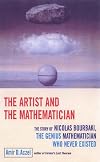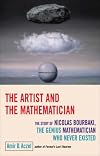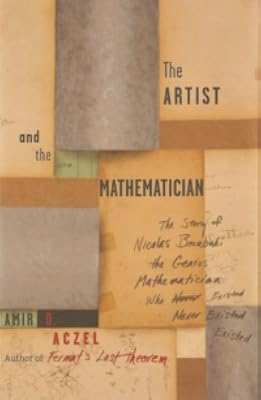
The Artist and the Mathematician: The Story of Nicolas Bourbaki, the Genius Mathematician Who Never Existed
by Amir D. Aczel
On This Page
Description
"A real-life mathematical mystery Nicolas Bourbaki was perhaps the greatest mathematician of the twentieth century. Responsible for the emergence of the "new math" that swept through American and foreign education systems in the middle of the century, Bourbaki originated the modern concept of the mathematical proof and is credited with the introduction of rigor into the discipline. It can be said that no working mathematician in the world today is free of the influence of Nicolas Bourbaki's show more seminal work." "This is the story of both Bourbaki and the world that created him. And it is the story of an elaborate intellectual joke - because Bourbaki, the author of dozens of acclaimed papers and one of the foremost mathematicians of his day - never existed."--Jacket. show lessTags
Recommendations




















Member Reviews
Summary: The story of the Bourbaki, named after the greatest mathematician who never existed, who led a revolution in the emergence of the “new math,” introducing a new rigor into the field.
When I was in middle school, we were introduced to “the new math.” One of the things I was always curious about was why the first thing we did was learn about sets. I was reminded of this when I read this book, which explained why sets were foundational to the approach.
This is the story of Nicolas Bourbaki, who convened a group of mostly French mathematicians around him, creating a tremendously productive group that in its day revolutionized the practice and teaching of math. Aczel introduces us to the key figures in this group–Andrew Weil show more (who later solved Fermat’s Last Theorem and brother of philosopher Simone Weil), Laurent Swartz, Henri Cartan, Claude Chevally, Jean Delsarte and Jean Dieudonne. We are also introduced to Alexandre Grothendieck, perhaps the most brilliant and also eccentric of them.
The most striking thing we learn is that the group formed around a mathematical joke upon which Weil built. Nicolas Bourbaki never existed except as a made up identity that reflected the collective effort of this group to rehabilitate and revolutionize mathematics in France that had fallen into the backwaters of German mathematics and science. These mathematicians met regularly and forged a consensus on how math would be practiced and taught in France that resulted in the prolific production of texts, revolutionized not only math education throughout the world, but touched a variety of other disciplines. Their approach was founded on set theory. They emphasized math in the abstract, focusing on mathematical proofs and rigor.
They were trying to articulate the structure of mathematics and this led to interesting interactions with pioneering anthropologist Claude Levi-Strauss, child psychologist Jean Piaget, linguistic theorists, and even writers including Italo Calvino. Aczel traces how structuralism for a time replaced existentialism in philosophy until the turn to the post-modern.
During the war Weil fled to America and stayed there, and gradually, his influence in Bourbaki waned. In the early 1950’s Alexandre Grothendieck joined for a time. His brilliance both stimulated the work of the Bourbaki and led to his departure as he recognized the weakness of set theory as a basis for Bourbaki, trying and failing to convince them of the idea of categories. Grothendieck differed from the Bourbaki, preferring to work alone.
The parting spelled a turning point for both. While Bourbaki continued to have a spreading influence for a time, it was more on the basis of past work. Grothendieck went on to do innovative work for a time, and directing students into significant problems. He held a position at the IHES, a French version of the Institute for Advance Study. Then he became more engaged in political and environmental causes, and when his efforts failed in these areas, he retreated to the Pyrenees, where his whereabouts remained unknown. After this work was published, he died in 2014 in Saint-Girons, Ariège.
The title of this work is a bit of a puzzle. Apart from a chapter on cubism, Braque, and Picasso, and its connections to antecedents to the Bourbaki, this is not a book about artists, unless this is a contrasting reference to Grothendieck and Weil, which was opaque to this reader. I found the organization of the book a bit labyrinthine. Nevertheless, it was an intriguing account of a movement in mathematics I’d never heard of. It was fascinating to see how productive this group was for a period and yet how significant the human factors were in the ultimate fate of Bourbaki. show less
When I was in middle school, we were introduced to “the new math.” One of the things I was always curious about was why the first thing we did was learn about sets. I was reminded of this when I read this book, which explained why sets were foundational to the approach.
This is the story of Nicolas Bourbaki, who convened a group of mostly French mathematicians around him, creating a tremendously productive group that in its day revolutionized the practice and teaching of math. Aczel introduces us to the key figures in this group–Andrew Weil show more (who later solved Fermat’s Last Theorem and brother of philosopher Simone Weil), Laurent Swartz, Henri Cartan, Claude Chevally, Jean Delsarte and Jean Dieudonne. We are also introduced to Alexandre Grothendieck, perhaps the most brilliant and also eccentric of them.
The most striking thing we learn is that the group formed around a mathematical joke upon which Weil built. Nicolas Bourbaki never existed except as a made up identity that reflected the collective effort of this group to rehabilitate and revolutionize mathematics in France that had fallen into the backwaters of German mathematics and science. These mathematicians met regularly and forged a consensus on how math would be practiced and taught in France that resulted in the prolific production of texts, revolutionized not only math education throughout the world, but touched a variety of other disciplines. Their approach was founded on set theory. They emphasized math in the abstract, focusing on mathematical proofs and rigor.
They were trying to articulate the structure of mathematics and this led to interesting interactions with pioneering anthropologist Claude Levi-Strauss, child psychologist Jean Piaget, linguistic theorists, and even writers including Italo Calvino. Aczel traces how structuralism for a time replaced existentialism in philosophy until the turn to the post-modern.
During the war Weil fled to America and stayed there, and gradually, his influence in Bourbaki waned. In the early 1950’s Alexandre Grothendieck joined for a time. His brilliance both stimulated the work of the Bourbaki and led to his departure as he recognized the weakness of set theory as a basis for Bourbaki, trying and failing to convince them of the idea of categories. Grothendieck differed from the Bourbaki, preferring to work alone.
The parting spelled a turning point for both. While Bourbaki continued to have a spreading influence for a time, it was more on the basis of past work. Grothendieck went on to do innovative work for a time, and directing students into significant problems. He held a position at the IHES, a French version of the Institute for Advance Study. Then he became more engaged in political and environmental causes, and when his efforts failed in these areas, he retreated to the Pyrenees, where his whereabouts remained unknown. After this work was published, he died in 2014 in Saint-Girons, Ariège.
The title of this work is a bit of a puzzle. Apart from a chapter on cubism, Braque, and Picasso, and its connections to antecedents to the Bourbaki, this is not a book about artists, unless this is a contrasting reference to Grothendieck and Weil, which was opaque to this reader. I found the organization of the book a bit labyrinthine. Nevertheless, it was an intriguing account of a movement in mathematics I’d never heard of. It was fascinating to see how productive this group was for a period and yet how significant the human factors were in the ultimate fate of Bourbaki. show less
Amir Aczel is as frustrating an author as you will find anywhere. The man is bright, no question about it. He also has impeccable taste when it comes to interesting subjects to investiagte. He has written books on various mathematical subjects: Fermat's Last Theorem, Descarte, and now Nicolas Bourbaki. Yet his followthrough and his writing habits are infuriatingly inconsistent and shows signs of discordant chaos in his reasoning. He also has a disconcerting proclivity towards doing a hack job on a subject to get paid and then moving on to better things.
The story of Bourbaki is a fascinating one, so I was eager to read this book. The miniscule size of this book should have been a red flag, Aczel's reputation, at least in my head, should show more have been another, but I proceeded to buy it because I am an eternal optimist and I believe that people can and will surprise me and change my preconceived notions.
It didn't work this time, nor any other times when I placed my faith in Aczel. So where to begin?
1) As the previous reviewers had stated, there are no math in this book. No explanation of what Bourbaki was up to. How do you write a book on mathematicians without writing about mathematics? I understand that one does not wish to populate the book with excesive mathematical details but the power of math is in its compact notations. He does try to explain things in general terms, but a few figures and a few lines of math would have done wonders to his narrative.
2) Not enough back ground material was covered. When Aczel is trying to explain the application of structuralism in linguistics and in psychology, he was doing some extremely fine narration of extremely dense and abstract ideas and putting them into the context of what Levi-Strauss and others are trying to do, but he was not consistent in narrating the other parts of the book, he did a lot of hand waving and hot air generating.
3) As an author writing about people, one can definitely become enamoured with certain people and grow to dislike certain others. Aczel definitely fell in love with Alexander Grothendieck's story and disliked Andre and Simohne Weil. It is irresponsible, however, for Aczel come out and say that the reason for the demise of Bourbaki is because Grothendieck left the group without explaining fully WHY category theory is a more reasonable foundation. It is equally irresponsible for the ad hominem attacks on Andre Weil's character without citing specific instances of his behavior.
4) The book reads like a very bad draft, there is no continuity to the history and the book is not built around mathematical logic nor is it based on chronological order, it is as if Aczel decided to put all these bits of stories and mathematics together haphazardously. The writing is very jagged. Reading and making sense of the story is extremely fatiguing because the author made every effort to confuse the reader. Many anecdotes are repeated for no apparent reason and they are repeated without qualifiers or additional information.
5) There does not seem to be any care taken to build a case for or against anything. The author just scattered facts and his own opinions out and it was up to the readers to figure out a logic for themselves.
6) As in his previous books, the author seem to be building toward a conclusion, a crescendo in the narrative, yet after the build up, there is no crescendo, nor a diminuendo, there is just a monotone white noise in the background.
Like I said, this is a massively wasted effort towards a very interesting subject. The only thing that I have gotten from this book is the germination of various subjects that the author mentioned in passing, so thank you Amir Aczel for your bibliography and a desultory book report. show less
The story of Bourbaki is a fascinating one, so I was eager to read this book. The miniscule size of this book should have been a red flag, Aczel's reputation, at least in my head, should show more have been another, but I proceeded to buy it because I am an eternal optimist and I believe that people can and will surprise me and change my preconceived notions.
It didn't work this time, nor any other times when I placed my faith in Aczel. So where to begin?
1) As the previous reviewers had stated, there are no math in this book. No explanation of what Bourbaki was up to. How do you write a book on mathematicians without writing about mathematics? I understand that one does not wish to populate the book with excesive mathematical details but the power of math is in its compact notations. He does try to explain things in general terms, but a few figures and a few lines of math would have done wonders to his narrative.
2) Not enough back ground material was covered. When Aczel is trying to explain the application of structuralism in linguistics and in psychology, he was doing some extremely fine narration of extremely dense and abstract ideas and putting them into the context of what Levi-Strauss and others are trying to do, but he was not consistent in narrating the other parts of the book, he did a lot of hand waving and hot air generating.
3) As an author writing about people, one can definitely become enamoured with certain people and grow to dislike certain others. Aczel definitely fell in love with Alexander Grothendieck's story and disliked Andre and Simohne Weil. It is irresponsible, however, for Aczel come out and say that the reason for the demise of Bourbaki is because Grothendieck left the group without explaining fully WHY category theory is a more reasonable foundation. It is equally irresponsible for the ad hominem attacks on Andre Weil's character without citing specific instances of his behavior.
4) The book reads like a very bad draft, there is no continuity to the history and the book is not built around mathematical logic nor is it based on chronological order, it is as if Aczel decided to put all these bits of stories and mathematics together haphazardously. The writing is very jagged. Reading and making sense of the story is extremely fatiguing because the author made every effort to confuse the reader. Many anecdotes are repeated for no apparent reason and they are repeated without qualifiers or additional information.
5) There does not seem to be any care taken to build a case for or against anything. The author just scattered facts and his own opinions out and it was up to the readers to figure out a logic for themselves.
6) As in his previous books, the author seem to be building toward a conclusion, a crescendo in the narrative, yet after the build up, there is no crescendo, nor a diminuendo, there is just a monotone white noise in the background.
Like I said, this is a massively wasted effort towards a very interesting subject. The only thing that I have gotten from this book is the germination of various subjects that the author mentioned in passing, so thank you Amir Aczel for your bibliography and a desultory book report. show less
I was really looking forward to reading this book -- I'd read other books by Aczel and enjoyed them, I wanted to know more about the fictional mathematician Nicolas Bourbaki, and the title intrigued me. What could be more interesting to a math geek than a 'biography' of a fictional mathematician who shaped 20th century mathematics?
Unfortunately, I was very disappointed in this book for many reasons. Here are several of the reasons:
1) There are sections that seem totally unedited. The same ideas are repeated over and over, as if the author was trying to perfect the sentence structure. No new material is added -- just variations on the basic sentences.
2) I still have no clear idea what Bourbaki did for the math world. The author, for show more example, asserts that Bourbaki was responsible for the New Math ideas which influenced teaching of math in the US, but that is, honestly, as much detail as the author gives.
3) There are several sections which deal with structuralism in linguistics, psychology, anthropology, and even economics. Fine, but these sections were not linked to the topic of Bourbaki.
4) While the math that Bourbaki did change is fairly complex and abstract, the author made no attempt to explain mathematically the changes Bourbaki wrought.
5) The author was fascinated by the life and mathematics of Alexandre Grothendieck. In some ways, he was the primary focus of the book, and perhaps, the author should have written a biography of him and not Bourbaki.
This book frustrated me and left me sorely disappointed. show less
Unfortunately, I was very disappointed in this book for many reasons. Here are several of the reasons:
1) There are sections that seem totally unedited. The same ideas are repeated over and over, as if the author was trying to perfect the sentence structure. No new material is added -- just variations on the basic sentences.
2) I still have no clear idea what Bourbaki did for the math world. The author, for show more example, asserts that Bourbaki was responsible for the New Math ideas which influenced teaching of math in the US, but that is, honestly, as much detail as the author gives.
3) There are several sections which deal with structuralism in linguistics, psychology, anthropology, and even economics. Fine, but these sections were not linked to the topic of Bourbaki.
4) While the math that Bourbaki did change is fairly complex and abstract, the author made no attempt to explain mathematically the changes Bourbaki wrought.
5) The author was fascinated by the life and mathematics of Alexandre Grothendieck. In some ways, he was the primary focus of the book, and perhaps, the author should have written a biography of him and not Bourbaki.
This book frustrated me and left me sorely disappointed. show less
Interesting subject, irritating writing style, no math.
As has been pointed out by other people here, this book is a wasted opportunity. There is a good story in the Bourbaki mathematical collective and a very good story in Alexandre Grothendieck. But he leaves out or butchers so much!
1) there's no attempt at explaining any mathematical idea that I noticed;
2) if he attempts to explain how the Bourbaki idea of a structure differs from a common-sense one it passed me by;
3) whenever a new person is introduced, we get a new paragraph and 'X was born in [YEAR]...'--no variation at all!;
4) in skimming over Oulipo, he completely fails to mention Georges Perec--whose biography in many ways mirrors Grothendieck's--a great writer who produced genuine masterpieces on the basis of some show more unpromising-sounding procedures;
5) while I know a certain amount about linguistics and mathematics, I certainly didn't glean a decent idea of what structuralism is or was from this book;
6) I'm not too sure about the bibliography either: the 'Essays on General Linguistics' attributed to Jakobson is unknown to both Amazon and Bookfinder;
7) there is no attempt to assess whether Bourbaki was a good or bad thing--in fact, I've never met anyone (including mathematicians trained in France) who thought their influence was other than negative;
8) similarly, it *should* be easy enough to chart the rise and fall of Bourbaki's influence in terms of sales, citations, etc rather than just relying on unsupported assertions;
9) who is the artist of the title?
Tsk, tsk! show less
1) there's no attempt at explaining any mathematical idea that I noticed;
2) if he attempts to explain how the Bourbaki idea of a structure differs from a common-sense one it passed me by;
3) whenever a new person is introduced, we get a new paragraph and 'X was born in [YEAR]...'--no variation at all!;
4) in skimming over Oulipo, he completely fails to mention Georges Perec--whose biography in many ways mirrors Grothendieck's--a great writer who produced genuine masterpieces on the basis of some show more unpromising-sounding procedures;
5) while I know a certain amount about linguistics and mathematics, I certainly didn't glean a decent idea of what structuralism is or was from this book;
6) I'm not too sure about the bibliography either: the 'Essays on General Linguistics' attributed to Jakobson is unknown to both Amazon and Bookfinder;
7) there is no attempt to assess whether Bourbaki was a good or bad thing--in fact, I've never met anyone (including mathematicians trained in France) who thought their influence was other than negative;
8) similarly, it *should* be easy enough to chart the rise and fall of Bourbaki's influence in terms of sales, citations, etc rather than just relying on unsupported assertions;
9) who is the artist of the title?
Tsk, tsk! show less
C'était une lecture entendue. La lecture d'Impératif catégorique de Jacques Roubaud m'a replongé dans une époque où l'appréhension structurelle des mathématiques était ma vie, une période où Bourbaki était encore au centre des développements de cette science.
Nicolas Bourbaki, membre éminent de l'Académie des sciences de Poldévie, n'a, en effet, jamais existé. Il est le nom emprunté, sur la base d'un canular, par un groupe de mathématiciens français regroupés autour d'Henri Cartan, Claude Chevalley, Jean Dieudonné et André Weil (frère de la philosophe Simone Weil). Cette association des amis de Nicolas Bourbaki, à laquelle se sont joints plusieurs autres mathématiciens influents, a été le phare de show more l'organisation rigoureuse des mathématiques pendant le XXe siècle. La publication, sous le nom de Nicolas Bourbaki, des différents volumes de l'œuvre collective que constitue les Éléments de mathématique a marqué l'évolution, l'organisation, le développement ainsi que l'enseignement des mathématiques jusqu'au début des années soixante-dix et même au-delà.
Comme mathématicien, j'étais bien conscient de cette prépondérance bourbakiste dans le développement structurel des mathématiques du XXe siècle. Ce que je connaissais moins et que cette lecture m'a fait découvrir, c'est la place que Bourbaki a occupé dans la naissance du structuralisme.
Je ne savais pas que le structuralisme trouvait son origine en linguistique, que c'est Saussure et Jakobson (dans les années trente) qui avaient délimité les principes fondateurs de la linguistique structurale, que cette linguistique structurale s'exprime par la prééminence de la structure dans l'étude d'une langue [nos linguistes me corrigeront, j'espère]. J'ai appris que l'utilisation que Lévi-Strauss a fait du concept en anthropologie résidait en partie sur un lien qu'il avait établi avec André Weil (de Bourbaki) et que c'est l'application de la théorie des groupes à un problème proposé par Lévi-Strauss qui initie le mouvement structuraliste à l'extérieur de la sphère linguistique.
Finalement, cet ouvrage m'aura permis de constater les liens multiples entre un groupe de mathématiciens, la notion de structures en mathématiques et la ramification de l'influence structuraliste dans des domaines aussi divers que la psychologie avec Piaget, la psychiatrie et la psychanalyse avec Lacan, l'économie avec Leontief, ... et la littérature avec l'Oulipo, l'Ouvroir de littérature potentielle (eh oui). La boucle est donc bouclée.
[http://rivesderives.blogspot.ca/2009/08/nicolas-bourbaki-histoire-dun-genie-des.html] show less
Nicolas Bourbaki, membre éminent de l'Académie des sciences de Poldévie, n'a, en effet, jamais existé. Il est le nom emprunté, sur la base d'un canular, par un groupe de mathématiciens français regroupés autour d'Henri Cartan, Claude Chevalley, Jean Dieudonné et André Weil (frère de la philosophe Simone Weil). Cette association des amis de Nicolas Bourbaki, à laquelle se sont joints plusieurs autres mathématiciens influents, a été le phare de show more l'organisation rigoureuse des mathématiques pendant le XXe siècle. La publication, sous le nom de Nicolas Bourbaki, des différents volumes de l'œuvre collective que constitue les Éléments de mathématique a marqué l'évolution, l'organisation, le développement ainsi que l'enseignement des mathématiques jusqu'au début des années soixante-dix et même au-delà.
Comme mathématicien, j'étais bien conscient de cette prépondérance bourbakiste dans le développement structurel des mathématiques du XXe siècle. Ce que je connaissais moins et que cette lecture m'a fait découvrir, c'est la place que Bourbaki a occupé dans la naissance du structuralisme.
Je ne savais pas que le structuralisme trouvait son origine en linguistique, que c'est Saussure et Jakobson (dans les années trente) qui avaient délimité les principes fondateurs de la linguistique structurale, que cette linguistique structurale s'exprime par la prééminence de la structure dans l'étude d'une langue [nos linguistes me corrigeront, j'espère]. J'ai appris que l'utilisation que Lévi-Strauss a fait du concept en anthropologie résidait en partie sur un lien qu'il avait établi avec André Weil (de Bourbaki) et que c'est l'application de la théorie des groupes à un problème proposé par Lévi-Strauss qui initie le mouvement structuraliste à l'extérieur de la sphère linguistique.
Finalement, cet ouvrage m'aura permis de constater les liens multiples entre un groupe de mathématiciens, la notion de structures en mathématiques et la ramification de l'influence structuraliste dans des domaines aussi divers que la psychologie avec Piaget, la psychiatrie et la psychanalyse avec Lacan, l'économie avec Leontief, ... et la littérature avec l'Oulipo, l'Ouvroir de littérature potentielle (eh oui). La boucle est donc bouclée.
[http://rivesderives.blogspot.ca/2009/08/nicolas-bourbaki-histoire-dun-genie-des.html] show less
Mar 3, 2015French
Nicolas Bourbaki fue el nombre que un grupo de matemáticos usó para reescribir los libros de texto de su tiempo y para desarrollar una serie de innovadoras propuestas teóricas que tuvieron repercusiones importantes en los campos de la sociología, el arte y la filosofía. Este libro nos presenta esta historia singular y vincula algunos de sus protagonistas: Pablo Picasso, Claude Lévi-Strauss y Simone Weil.
Jun 26, 2010Spanish
Members
- Recently Added By
Author Information

25 Works 5,276 Members
Amir D. Aczel was born in Haifa, Israel on November 6, 1950. He received bachelor's and master's degrees in mathematics from the University of California, Berkeley and a doctorate in decision sciences from the business school at the University of Oregon. He taught at several universities during his lifetime including the University of Alaska and show more Bentley College. His first book, Complete Business Statistics, was published in 1989 and went through eight editions. His other books include How to Beat the I.R.S. at Its Own Game: Strategies to Avoid - and Fight - an Audit; Fermat's Last Theorem: Unlocking the Secret of an Ancient Mathematical Problem; The Mystery of the Aleph: Mathematics, the Kabbalah, and the Search for Infinity; The Riddle of the Compass: The Invention That Changed the World; Entanglement: The Greatest Mystery in Physics; and Finding Zero: A Mathematician's Odyssey to Uncover the Origins of Numbers. He died from cancer on November 26, 2015 at the age of 65. (Bowker Author Biography) show less
Some Editions
Common Knowledge
- Canonical title*
- ブルバキとグロタンディーク
- People/Characters
- Nicolas Bourbaki
*Some information comes from Common Knowledge in other languages. Click "Edit" for more information.
Classifications
Statistics
- Members
- 209
- Popularity
- 157,047
- Reviews
- 7
- Rating
- (2.88)
- Languages
- 5 — Czech, English, French, Japanese, Spanish
- Media
- Paper, Ebook
- ISBNs
- 9
- ASINs
- 3