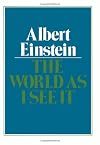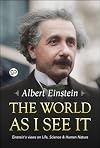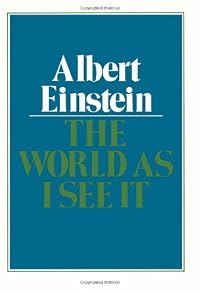
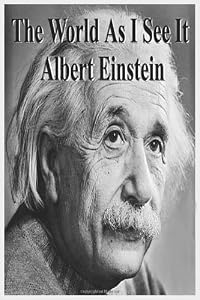
The World As I See It (Abridged)
by Albert Einstein
On This Page
Description
In a group of essays, letters, and speeches, Einstein relates his views on politics, religion, morality, and the place of science in the modern world.Tags
Recommendations












Member Reviews
This is a collection of inconsistently-dated letters, speeches, and other communications by Einstein over a period spanning maybe 30 years. Largely goes into his feelings outside of science, on nationalism, pacifism, zionism, Jewish identity, minority vs. majority rights in nations, etc.
On the ideas themselves: certainly Einstein is one of the most accomplished scientific minds of all time. I wouldn't say his political or philosophical writings (at least here) are particularly exceptional -- they're somewhat well developed, but even-for-the-time mainstream. I disagree with a lot of his thoughts on ceding control to supra-national entities, his belief that independent nations are inherently bad, etc., but obviously agree with him show more (particularly with the benefit of history) about the dark trends brewing in the 20s and 30s, particularly in Europe and with respect to minority rights. If this book had been by a random person, though, it would be inconsequential.
On the other hand, as a book about Einstein's beliefs this is pretty horribly presented -- it's essentially random communications on various topics lacking context. Overall, unless you're deeply interested in reading randomly-selected Einstein writings, I'd skip it. show less
On the ideas themselves: certainly Einstein is one of the most accomplished scientific minds of all time. I wouldn't say his political or philosophical writings (at least here) are particularly exceptional -- they're somewhat well developed, but even-for-the-time mainstream. I disagree with a lot of his thoughts on ceding control to supra-national entities, his belief that independent nations are inherently bad, etc., but obviously agree with him show more (particularly with the benefit of history) about the dark trends brewing in the 20s and 30s, particularly in Europe and with respect to minority rights. If this book had been by a random person, though, it would be inconsequential.
On the other hand, as a book about Einstein's beliefs this is pretty horribly presented -- it's essentially random communications on various topics lacking context. Overall, unless you're deeply interested in reading randomly-selected Einstein writings, I'd skip it. show less
I thought it was boring. It seems like the sort of thing you'd be required to read in college as part of an ethics class, and in that capacity it would be fine because nobody expects to like class readings.
Albert Einstein was a man of such clarity of vision and a nearly prophetic sense of humanity. A much misunderstood genius.
Updated version of a classic book by Einstein..as he saw it.
Ratings
Members
- Recently Added By
Author Information

363+ Works 16,362 Members
Albert Einstein was born on March 14, 1879 in Ulm. He spent his childhood in Munich where his family owned a small machine shop. By the age of twelve, Einstein had taught himself Euclidean Geometry. His family moved to Milan, where he stayed for a year, and he used it as an excuse to drop out of school, which bored him. He finished secondary show more school in Aarau, Switzerland and entered the Swiss Federal Institute of Technology in Zurich. Einstein graduated in 1900, by studying the notes of a classmate since he did not attend his classes out of boredom, again. His teachers did not like him and would not recomend him for a position in the University. For two years, Einstein worked as a substitute teacher and a tutor before getting a job, in 1902, as an examiner for a Swiss patent office in Bern. In 1905, he received his doctorate from the University of Zurich for a theoretical dissertation on the dimension of molecules. Einstein also published three theoretical papers of central importance to the development of 20th Century physics. The first was entitled "Brownian Motion," and the second "Photoelectric Effort," which was a revolutionary way of thinking and contradicted tradition. No one accepted the proposals of the first two papers. Then the third one was published in 1905 and called "On the Electrodynamics of Moving Bodies." Einstein's words became what is known today as the special theory of relativity and said that the physical laws are the same in all inertial reference systems and that the speed of light in a vacuum is a universal constant. Virtually no one understood or supported Einstein's argument. Einstein left the patent office in 1907 and received his first academic appointment at the University of Zurich in 1909. In 1911, he moved to a German speaking university in Prague, but returned to Swiss National Polytechnic in Zurich in 1912. By 1914, Einstein was appointed director of the Kaiser Wilhelm Institute of Physics in Berlin. His chief patron in those early days was German physicist Max Planck and lent much credibility to Einstein's work. Einstein began working on generalizing and extending his theory of relativity, but the full general theory was not published until 1916. In 1919, he predicted that starlight would bend in the vicinity of a massive body, such as the sun. This theory was confirmed during a solar eclipse and cause Einstein to become world renowned after the phenomenon. Einstein received be Nobel Prize in Physics in 1921. With his new fame, Einstein attempted to further his own political and social views. He supported pacifism and Zionism and opposed Germany's involvement in World War I. His support of Zionism earned him attacks from both Anti-Semitic and right wing groups in Germany. Einstein left Germany for the United States when Hitler came into power, taking a position at the Institute for Advanced Study in Princeton, New Jersey. Once there, he renounced his stand on pacifism in the face of Nazi rising power. In 1939 he collaborated with other physicists in writing a letter to President Franklin D. Roosevelt informing him of the possibility that the Nazis may in fact be attempting to create an atomic bomb. The letter bore only Einstein's signature but lent credence to the letter and spurred the U.S. race to create the bomb first. Einstein became an American citizen in 1940. After the war, Einstein was active in international disarmament as well as world government. He was offered the position of President of Israel but turned the honor down. Albert Einstein died on April 18, 1955 in Princeton, New Jersey. (Bowker Author Biography) show less
Common Knowledge
- Canonical title
- The World As I See It (Abridged) (Abridged)
Classifications
- Genres
- Nonfiction, Science & Nature, Biography & Memoir, Philosophy, General Nonfiction, History, Religion & Spirituality
- DDC/MDS
- 081 — Computer science, information & general works Anthologies and Quotations General collections in American English
- LCC
- AC35 .E528 — General Works Collections. Series. Collected works Collections. Series. Collected works Collections of monographs, essays, etc. Other languages
- BISAC
Statistics
- Members
- 278
- Popularity
- 115,997
- Reviews
- 4
- Rating
- (3.56)
- Languages
- English
- Media
- Paper, Audiobook, Ebook
- ISBNs
- 9
- ASINs
- 1