
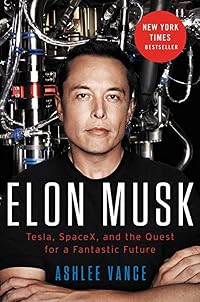
Elon Musk: Tesla, SpaceX, and the Quest for a Fantastic Future
by Ashlee Vance
On This Page
Description
An authorized portrait of one of Silicon Valley's most dynamic entrepreneurs evaluates his role in the successes of such innovations as Tesla and Space X while evaluating America's technological competitiveness.Tags
Recommendations





Member Recommendations
themulhern Dollops of mild obscenity and no eloquence, but a technologically interesting story.
Member Reviews
This is Elon Musk's first official biography. Musk rejected other authors who wanted to tell his story - how Vance came to be chosen is described in the opening chapter (in short: persistence). Given the gossip and legends over the years it's hard to know what is true. Nevertheless Vance does an excellent job of presenting a fair and balanced perspective while debunking and clarifying. If Vance's account suffers it's only because it's a first biography and most of the events in the book are at most 15 years old. Vance struggles to place Musk in historical context, suggesting he is a more significant business leader then Steve Jobs or Gates. Musk is still mid-career and his companies need another 10+ years to fully execute on their goals show more of changing the world. A lot remains to be seen but reading this you come away with a sense if anyone can do it, Musk can. I was sorry when it ended as I enjoyed being around Musk, his outlook and passion, the highs and lows of his risk taking, the technology. This book will be influential with entrepreneurs, investors and consumers of his products and vision. People who bought into Apple were buying into a consumer-goods level change - it was world-changing at a certain level. Musk is seeking nothing less than being the savior of the human race, to colonize Mars and thus protect it from an existential event. There is no one else operating at that level in the business world, the audacity of his starry-eyed vision has created many detractors but this book is a detailed accounting of the reality of his execution which is evidently undeniable. show less
Summary: A biography of the brilliant and flawed tech entrepreneur involved with SpaceX, Tesla, and his visions for the future of humanity.
He created software that anticipated modern mapping apps. He helped launch Paypal, and then was forced out, accruing the fortune that funded the beginnings of SpaceX and Tesla. He has proposed high speed travel via the “hyperloop” between cities, a proposal serious enough that my city is vying to be one of those linked by this new technology. He is the visionary who believes that we must colonize Mars for the human species to survive. Yet he has sounded the alarm against Artificial Intelligence and an apocalypse of intelligent machines (anybody want to be a robot pet?).
This biography traces the show more life of this tech entrepreneur from his precocious childhood in South Africa that subjected him to bullying, his sale of a video game called Blaster at age 12, his move to Canada, education at Penn State (degrees in physics and business). His first start-up venture, with brother Kimball was Zip2, a kind of online city guide that included mapping functions, eventually sold to Compaq. He used funds from this to start X.com, which through mergers eventually morphed into PayPal. He was ousted from the company but came away with $180 million.
Musk used this to fund two ventures. SpaceX was his vision to privatize space travel, developing a model commercial space transport. Tesla was originally formed not by Musk but by Martin Eberhard and Marc Tarpenning to manufacture all-electric cars. Musk came in as an investor and spent most of that fortune on the two companies, both of which nearly went belly up. Much of the book is about the technological and financial challenges Musk faced, but also, in the case of Tesla, conflicts with the first founders. It’s a story of Musk’s relentless drive to succeed, that drove others (or drove them out). Along the way, we learn of Musk’s peculiar kind of brilliance that masters the highly technological details of rocketry, car manufacturing, and eventually, solar power.
While Musk can certainly turn on the charm, whether in wooing his second wife or wooing prospective Tesla buyers, it is clear that this is not a nice person, and all of this is justified by the relentless pursuit of visionary goals. The book is laced with the f-bomb, Musk’s favorite curse word. He divorced his first wife Justine, and divorced, remarried, and divorced again second wife Talulah Riley. The challenge seems to have been finding time for them in his high pressure life, and not just as attractive accessories to his public persona.
The book concludes with Musk’s visionary perspective with its focus on Mars space travel, but also of a commercially viable private space industry, a totally different approach to the automobile and widely-accessible solar power. One is left wondering if it is possible to be brilliant, visionary, successful–and good. Some would say, three out of four isn’t bad, and point to the people around Musk who share his vision and goals, and consider pursuing them with him a life well-lived. I suspect Musk would say that his personal morality is less in question than the flourishing of the human species, perhaps as a multi-planetary race. It’s an “ends justifies means” argument. The question remains, “what kind of people will make up the human community in Musk’s fantastic future?” It’s a question I wonder if he’s thought about. Have we? show less
He created software that anticipated modern mapping apps. He helped launch Paypal, and then was forced out, accruing the fortune that funded the beginnings of SpaceX and Tesla. He has proposed high speed travel via the “hyperloop” between cities, a proposal serious enough that my city is vying to be one of those linked by this new technology. He is the visionary who believes that we must colonize Mars for the human species to survive. Yet he has sounded the alarm against Artificial Intelligence and an apocalypse of intelligent machines (anybody want to be a robot pet?).
This biography traces the show more life of this tech entrepreneur from his precocious childhood in South Africa that subjected him to bullying, his sale of a video game called Blaster at age 12, his move to Canada, education at Penn State (degrees in physics and business). His first start-up venture, with brother Kimball was Zip2, a kind of online city guide that included mapping functions, eventually sold to Compaq. He used funds from this to start X.com, which through mergers eventually morphed into PayPal. He was ousted from the company but came away with $180 million.
Musk used this to fund two ventures. SpaceX was his vision to privatize space travel, developing a model commercial space transport. Tesla was originally formed not by Musk but by Martin Eberhard and Marc Tarpenning to manufacture all-electric cars. Musk came in as an investor and spent most of that fortune on the two companies, both of which nearly went belly up. Much of the book is about the technological and financial challenges Musk faced, but also, in the case of Tesla, conflicts with the first founders. It’s a story of Musk’s relentless drive to succeed, that drove others (or drove them out). Along the way, we learn of Musk’s peculiar kind of brilliance that masters the highly technological details of rocketry, car manufacturing, and eventually, solar power.
While Musk can certainly turn on the charm, whether in wooing his second wife or wooing prospective Tesla buyers, it is clear that this is not a nice person, and all of this is justified by the relentless pursuit of visionary goals. The book is laced with the f-bomb, Musk’s favorite curse word. He divorced his first wife Justine, and divorced, remarried, and divorced again second wife Talulah Riley. The challenge seems to have been finding time for them in his high pressure life, and not just as attractive accessories to his public persona.
The book concludes with Musk’s visionary perspective with its focus on Mars space travel, but also of a commercially viable private space industry, a totally different approach to the automobile and widely-accessible solar power. One is left wondering if it is possible to be brilliant, visionary, successful–and good. Some would say, three out of four isn’t bad, and point to the people around Musk who share his vision and goals, and consider pursuing them with him a life well-lived. I suspect Musk would say that his personal morality is less in question than the flourishing of the human species, perhaps as a multi-planetary race. It’s an “ends justifies means” argument. The question remains, “what kind of people will make up the human community in Musk’s fantastic future?” It’s a question I wonder if he’s thought about. Have we? show less
If you are informed, your investment strategy is to buy real-estate because "it's the best investment." If you're better informed, your investment strategy is to put all your money in ETFs because "nobody can't beat the market in the long-run." But if you're Elon Musk, you invest all of your money into yourself---often to the brink of bankruptcy---and it keeps paying off.
Holy shit is this ever an inspiring book. Musk is doing disruptive innovation in like what, five?, distinct industries right now, and he somehow continues to keep hitting them out of the park. At this point I'm not sure even the biggest cynic can put that down to luck.
While Musk is clearly a bright dude, he doesn't come off as having superhuman intelligence. His show more comparative advantages seem to be WORKING REALLY HARD and BEING COMPLETELY FEARLESS. The book presents a narrative of Musk as being this guy who doesn't have much trouble raising money, and so he's never afraid to just spend all of it trying to make things happen---critics be damned. My takeaway is that whoever cares most wins, and that if you're capable and smart, investing everything you've got in yourself is probably the best strategy you can ever play. show less
Holy shit is this ever an inspiring book. Musk is doing disruptive innovation in like what, five?, distinct industries right now, and he somehow continues to keep hitting them out of the park. At this point I'm not sure even the biggest cynic can put that down to luck.
While Musk is clearly a bright dude, he doesn't come off as having superhuman intelligence. His show more comparative advantages seem to be WORKING REALLY HARD and BEING COMPLETELY FEARLESS. The book presents a narrative of Musk as being this guy who doesn't have much trouble raising money, and so he's never afraid to just spend all of it trying to make things happen---critics be damned. My takeaway is that whoever cares most wins, and that if you're capable and smart, investing everything you've got in yourself is probably the best strategy you can ever play. show less
There are few people outside of the fiction world that I truly admire, but barring some unseen or future tragedy, I think Musk might well be on the way to becoming my hero.
If I didn't know any better, I might be looking at all his stated claims and seeing all the echoes of Asimov and Heinlein being dragged out of the page and brought to life.
Skip the whole Iron Man image for a second.
Let's talk about Ayn Rand.
Musk is John Galt. As in Atlas Shrugged.
Sure, he's also Dagney, too, or perhaps more like Dagney in that he's unwilling to let humanity roll around in the mud despite all the backstabbing and idiocracy, in that he hasn't said, "enough is enough". But the day is young. Wait until we get to Mars. Wait until we really take the man of show more genius and effort for granted. And THEN we'll see what we'll miss once it is taken away.
Ahhh, I don't want to see this man out of classic SF heroes become anything other than his stated goals.
I'll be honest here. He's giving me real hope for humanity. Maybe optimism *isn't* unfounded after all.
This biography tells me one hell of a great narrative. Is it life imitating art? The best ideals from the grandmasters? Who knows. But right now, I have real hope. I'm holding on to it for my very soul. :)
Let's MAKE the future we wanted. Let's NOT let anything stand in our way!
HELL YAH! show less
If I didn't know any better, I might be looking at all his stated claims and seeing all the echoes of Asimov and Heinlein being dragged out of the page and brought to life.
Skip the whole Iron Man image for a second.
Let's talk about Ayn Rand.
Musk is John Galt. As in Atlas Shrugged.
Sure, he's also Dagney, too, or perhaps more like Dagney in that he's unwilling to let humanity roll around in the mud despite all the backstabbing and idiocracy, in that he hasn't said, "enough is enough". But the day is young. Wait until we get to Mars. Wait until we really take the man of show more genius and effort for granted. And THEN we'll see what we'll miss once it is taken away.
Ahhh, I don't want to see this man out of classic SF heroes become anything other than his stated goals.
I'll be honest here. He's giving me real hope for humanity. Maybe optimism *isn't* unfounded after all.
This biography tells me one hell of a great narrative. Is it life imitating art? The best ideals from the grandmasters? Who knows. But right now, I have real hope. I'm holding on to it for my very soul. :)
Let's MAKE the future we wanted. Let's NOT let anything stand in our way!
HELL YAH! show less
Now that Musk is the wealthiest person in the world, I'm sure many people are reading this book. That said, I picked it up for a different reason—that I'm President of the Board of a visionary startup.
Last year I read Isaacson's biography of Jobs, and learned a lot about the business culture of Apple. This book does the same for Zip2, X.com, SpaceX, and Tesla. It also was published at an ideal time in Musk's trajectory; after he'd established all of his major enterprises, but before he's come into quite the limelight he's in now. So although Tesla and SpaceX have come a long ways since this book was published, Vance accurately predicted this course.
Like Jobs, Musk is not a caring person. Some say that the media was unduly harsh to show more Musk's enterprises in their early days, and yet I think this is a direct result of Musk's personal characteristics. He isn't the kind of person that you wish well for; he has bad karma. His relentlessness and rationalism detract from his ability to be a humanist. Musk has accomplished a lot, and it has come with massive interpersonal and cultural debts. To use the language of Tyson Yunkaporta, Musk is a narcissist, in that he believes that his conviction and vision for the future is more important than those around him. This ties in perfectly with the superhero inventor ethos of the USA—an ethos I have by no means entirely escaped—and, we should have the cultural humility to recognize that it is because of this narcissism that we have condemned the earth.
To take this from another perspective, Musk's vision of Mars as a "backup plan" for humanities belies his subconscious understanding that humanity is failing to live up to its responsibility to be a steward of planet earth. As the carbon market Nori has spoken to, this creates massive moral hazard. The big banks took so many risks in the 2000s in part because they knew that the federal government would bail them out if they failed. Mars creates the same risk here. Sometimes it is better to "burn the ships" as Cortez is lored to have done, as it creates a commitment that is impossible when we have the option to eject.
In the language of Greg Grandin, Musk is the epitome of the colonial frontiersman, the contemporary poster boy of Manifest Destiny. Musk's vision to colonize Mars is no different than the European vision of colonizing the America's; and history will someday see Musk as just as much a villain as Columbus. In the ebullience of the moment, in the midst of all this shiny technology, it is easy to dismiss Musk's compromised ethos, and I'll step into some of that attitude for the remainder of this post.
The engineer in me has an admiration for Musk's inventiveness and aesthetic. After exiting Zip2, Musk bought a McLaren F1—one of the most iconic supercars of all time, and a decade ahead of everything else of its era.
What are the management pointers can we learn from Musk?
- Speed creates exponential advantage
- Dominance in a resegmented market is based upon low prices
- Vertical and horizontal integration support with both of these factors show less
Last year I read Isaacson's biography of Jobs, and learned a lot about the business culture of Apple. This book does the same for Zip2, X.com, SpaceX, and Tesla. It also was published at an ideal time in Musk's trajectory; after he'd established all of his major enterprises, but before he's come into quite the limelight he's in now. So although Tesla and SpaceX have come a long ways since this book was published, Vance accurately predicted this course.
Like Jobs, Musk is not a caring person. Some say that the media was unduly harsh to show more Musk's enterprises in their early days, and yet I think this is a direct result of Musk's personal characteristics. He isn't the kind of person that you wish well for; he has bad karma. His relentlessness and rationalism detract from his ability to be a humanist. Musk has accomplished a lot, and it has come with massive interpersonal and cultural debts. To use the language of Tyson Yunkaporta, Musk is a narcissist, in that he believes that his conviction and vision for the future is more important than those around him. This ties in perfectly with the superhero inventor ethos of the USA—an ethos I have by no means entirely escaped—and, we should have the cultural humility to recognize that it is because of this narcissism that we have condemned the earth.
To take this from another perspective, Musk's vision of Mars as a "backup plan" for humanities belies his subconscious understanding that humanity is failing to live up to its responsibility to be a steward of planet earth. As the carbon market Nori has spoken to, this creates massive moral hazard. The big banks took so many risks in the 2000s in part because they knew that the federal government would bail them out if they failed. Mars creates the same risk here. Sometimes it is better to "burn the ships" as Cortez is lored to have done, as it creates a commitment that is impossible when we have the option to eject.
In the language of Greg Grandin, Musk is the epitome of the colonial frontiersman, the contemporary poster boy of Manifest Destiny. Musk's vision to colonize Mars is no different than the European vision of colonizing the America's; and history will someday see Musk as just as much a villain as Columbus. In the ebullience of the moment, in the midst of all this shiny technology, it is easy to dismiss Musk's compromised ethos, and I'll step into some of that attitude for the remainder of this post.
The engineer in me has an admiration for Musk's inventiveness and aesthetic. After exiting Zip2, Musk bought a McLaren F1—one of the most iconic supercars of all time, and a decade ahead of everything else of its era.
What are the management pointers can we learn from Musk?
- Speed creates exponential advantage
- Dominance in a resegmented market is based upon low prices
- Vertical and horizontal integration support with both of these factors show less
I've been fascinated by Musk for quite a while. I even entertained thoughts he might be some sort of space alien hybrid, helping us develop new technologies. I wondered where this guy came from and where he got all that money. I wondered why his new technologies, which are a threat to industries which have been known to resort to rather nasty tactics to suppress such competition, seemed to have no power to do so in his case. This book certainly answered all my questions and then some. I had no idea he was one of those dot-com millionaires, starting with his connection with PayPal. Explaining where his money came from certainly clarified quite a lot. His personality explained the rest.
As someone who worked as a NASA contractor for over show more twenty years, I can especially appreciate what he has done with Space-X. While some accuse him, and rightfully so, of being a workaholic and expecting the same from his employees, you have to admit that his system of finding the best and brightest and luring them to work for him works. Musk doesn't suffer fools. You disagree with him or goof up and you're gone. In today's world of tolerance and dumbing down the general population via our pathetic education system, this certainly goes against the grain. But it gets things done.
I saw so much mediocrity at NASA it was pathetic. But it was only part of the problem as far as advances were concerned. I remember seeing an invoice one time for a metal plate with a part number on it costing thousands of dollars. I mean, really. How ridiculous is that? But that's how government contracting works. Musk, on the other hand, emphasized efficiency. It was his money, so he pushed for keeping costs down. Rather than buy from a manufacturer on the other side of the world, he would develop facilities himself. He demanded perfection and refused to give up.
One philosophy I always liked and employed as a manager myself was "If you're not part of the solution, you're part of the problem." Clearly he had the same attitude. His employees knew better than to simply complain about something being an obstacle. They needed to contribute to a solution or get slam-dunked.
There was so much about his management style that I admired. In most cases in today's world, his tactics will either get you sued for harassment and/or fired. Which explains a lot. But if you want something considered impossible done correctly, that's what it takes. The results of Musk's methods speak for themselves. He does what he says he'll do and is a force to be reckoned with. He's not been suppressed by existing industries since he has the money to proceed on his own, unlike most inventors who depend on selling their patents. In that case, they're typically bought up by competitors, their ideas left to rot somewhere in a file cabinet to assure the status quo.
Along those lines, Tesla is another awesome success story, a venture that was more than once on the brink of failure. But Musk persevered, his vision and intentions a testimony to those who promote such tactics for manifesting what you want. I loved the part where Tesla acquired a former GM plant in Fremont, California (not too far from where I lived many years ago) virtually for free. Tesla is driving conventional car makers crazy. The cars are kicking butt in all areas from safety to speed to virtually "free" fuel as he builds recharging stations. He's out to change the world and making steady progress doing so, specifically in previously troubled industries collapsing under their own weight.
His personal life was certainly interesting as well. Did you realize he has 5 boys, i.e. a set of twins and a set of triplets from his first wife, Justine? Or that as a child he was bullied, in some cases brutally enough to land him in the hospital. His photographic memory has served him well, his intelligence and scientific understanding off the scale. If someone tells him something can't be done, he usually fires them and does it himself. I find that inspiring, not obnoxious.
The author did a great job of providing a glimpse of what this guy is like, not only as a slave-driving manager, but as a person. I admire much of what he stands for and stands up for. I loved the author's candid writing style, often imbued with humor that had me laughing out loud. I don't doubt that I will eventually read this book again. It's inspirational to see what one determined man can accomplish when he sets his mind to what needs to be done, then commandeers the help and talent he needs to get there, leaving naysayers in the dust. His self-imposed mission is to save the world from itself and so far it looks as if he might do just that. It won't surprise me one bit if he's the one who gets us to Mars. If you have any doubts, then you should read this book. It made a believer out of me and restored my faith in old-fashioned hard work and ingenuity, which has somehow gotten lost in our crazy world.
This book convinced me, more than ever, that it's people like Musk who should be considered heroes in today's world. Not obnoxious sports figures, crooked politicians, and those who want to be taken care of at others' expense. It's time that we return a strong work ethic and intelligence to the status it deserves for making this a better world.
I highly recommend this book as an example of what one determined man can accomplish. I also recommend sharing it with your kids, but this one has lots of f-bombs. Fortunately, there's a cleaned up version suitable for kids. show less
As someone who worked as a NASA contractor for over show more twenty years, I can especially appreciate what he has done with Space-X. While some accuse him, and rightfully so, of being a workaholic and expecting the same from his employees, you have to admit that his system of finding the best and brightest and luring them to work for him works. Musk doesn't suffer fools. You disagree with him or goof up and you're gone. In today's world of tolerance and dumbing down the general population via our pathetic education system, this certainly goes against the grain. But it gets things done.
I saw so much mediocrity at NASA it was pathetic. But it was only part of the problem as far as advances were concerned. I remember seeing an invoice one time for a metal plate with a part number on it costing thousands of dollars. I mean, really. How ridiculous is that? But that's how government contracting works. Musk, on the other hand, emphasized efficiency. It was his money, so he pushed for keeping costs down. Rather than buy from a manufacturer on the other side of the world, he would develop facilities himself. He demanded perfection and refused to give up.
One philosophy I always liked and employed as a manager myself was "If you're not part of the solution, you're part of the problem." Clearly he had the same attitude. His employees knew better than to simply complain about something being an obstacle. They needed to contribute to a solution or get slam-dunked.
There was so much about his management style that I admired. In most cases in today's world, his tactics will either get you sued for harassment and/or fired. Which explains a lot. But if you want something considered impossible done correctly, that's what it takes. The results of Musk's methods speak for themselves. He does what he says he'll do and is a force to be reckoned with. He's not been suppressed by existing industries since he has the money to proceed on his own, unlike most inventors who depend on selling their patents. In that case, they're typically bought up by competitors, their ideas left to rot somewhere in a file cabinet to assure the status quo.
Along those lines, Tesla is another awesome success story, a venture that was more than once on the brink of failure. But Musk persevered, his vision and intentions a testimony to those who promote such tactics for manifesting what you want. I loved the part where Tesla acquired a former GM plant in Fremont, California (not too far from where I lived many years ago) virtually for free. Tesla is driving conventional car makers crazy. The cars are kicking butt in all areas from safety to speed to virtually "free" fuel as he builds recharging stations. He's out to change the world and making steady progress doing so, specifically in previously troubled industries collapsing under their own weight.
His personal life was certainly interesting as well. Did you realize he has 5 boys, i.e. a set of twins and a set of triplets from his first wife, Justine? Or that as a child he was bullied, in some cases brutally enough to land him in the hospital. His photographic memory has served him well, his intelligence and scientific understanding off the scale. If someone tells him something can't be done, he usually fires them and does it himself. I find that inspiring, not obnoxious.
The author did a great job of providing a glimpse of what this guy is like, not only as a slave-driving manager, but as a person. I admire much of what he stands for and stands up for. I loved the author's candid writing style, often imbued with humor that had me laughing out loud. I don't doubt that I will eventually read this book again. It's inspirational to see what one determined man can accomplish when he sets his mind to what needs to be done, then commandeers the help and talent he needs to get there, leaving naysayers in the dust. His self-imposed mission is to save the world from itself and so far it looks as if he might do just that. It won't surprise me one bit if he's the one who gets us to Mars. If you have any doubts, then you should read this book. It made a believer out of me and restored my faith in old-fashioned hard work and ingenuity, which has somehow gotten lost in our crazy world.
This book convinced me, more than ever, that it's people like Musk who should be considered heroes in today's world. Not obnoxious sports figures, crooked politicians, and those who want to be taken care of at others' expense. It's time that we return a strong work ethic and intelligence to the status it deserves for making this a better world.
I highly recommend this book as an example of what one determined man can accomplish. I also recommend sharing it with your kids, but this one has lots of f-bombs. Fortunately, there's a cleaned up version suitable for kids. show less
Disclaimer: I'm a fan of Musk's envelope-pushing ideology.
I loved this extraordinary read and appreciated Vance's ability to put Musk's contributions into perspective. After all, like him or hate him, Elon Musk has been behind transformative/disruptive changes not only in the automotive industry (Tesla), and the aeronautics sector (SpaceX), but also the solar industry too (Solar City). I appreciated how Vance introduced and repeated a few times (in measured words) the insane-sounding but very sincere motivation behind Musk's efforts: Elon Musk is determined to colonize Mars and save humans from extinction. Vance not only wrote about it, he then probed that motivation from a purely scientific/fact-based vantage point without writing it show more off out of hand or sounding snarky. And even offered supporting words from Musk colleagues and peers.
I won't try to sell naysayers on Musk, as he's definitely got his flaws and history will be the ultimate judge. But on Vance's book I'll say this: after reading Walter Isaacson's Jobs and Einstein biographies, I found Vance's organized, well-reasoned approach and style every bit as good as Isaacson's on a subject that is as enigmatic and provocative as those other individuals. If you buy into climate change and appreciate futuristic thinking, this may be something you'll enjoy. show less
I loved this extraordinary read and appreciated Vance's ability to put Musk's contributions into perspective. After all, like him or hate him, Elon Musk has been behind transformative/disruptive changes not only in the automotive industry (Tesla), and the aeronautics sector (SpaceX), but also the solar industry too (Solar City). I appreciated how Vance introduced and repeated a few times (in measured words) the insane-sounding but very sincere motivation behind Musk's efforts: Elon Musk is determined to colonize Mars and save humans from extinction. Vance not only wrote about it, he then probed that motivation from a purely scientific/fact-based vantage point without writing it show more off out of hand or sounding snarky. And even offered supporting words from Musk colleagues and peers.
I won't try to sell naysayers on Musk, as he's definitely got his flaws and history will be the ultimate judge. But on Vance's book I'll say this: after reading Walter Isaacson's Jobs and Einstein biographies, I found Vance's organized, well-reasoned approach and style every bit as good as Isaacson's on a subject that is as enigmatic and provocative as those other individuals. If you buy into climate change and appreciate futuristic thinking, this may be something you'll enjoy. show less
Members
- Recently Added By
Lists

Top Five Books of 2016
795 works; 229 members

Club Read's Recommended Nonfiction Written by Women
618 works; 30 members
Author Information

6 Works 2,976 Members
Ashlee Vange is an international bestselling author and the host of Hello World-a technology travel television show. He's also a feature writer Bloomberg Businessweek and a former reporter the New York Times and The Register. Vance was born in South Africa, grew up in Texas, and now lives near San Francisco with his wife and two boys. You can see show more his work online at ashleevance.com. show less
Some Editions
Awards and Honors
Awards
Distinctions
Notable Lists
Work Relationships
Has the adaptation
Common Knowledge
- Canonical title
- Elon Musk: Tesla, SpaceX, and the Quest for a Fantastic Future
- Original title
- Elon Musk: Tesla, SpaceX, and the Quest for a Fantastic Future
- Alternate titles
- Elon Musk: How the Billionaire CEO of SpaceX and Tesla Is Shaping Our Future (UK) (UK); Elon Musk: Tesla, SpaceX, and the Quest for a Fantastic Future (US) (US)
- Original publication date
- 2015
- People/Characters
- Elon Musk
- Epigraph*
- /
- Dedication
- For Mum and Dad. Thanks for Everything.
- First words
- "Do you think I'm insane?"
- Quotations
- He was not hardwired to have empathy. Or, to put it in less technical terms, he could be an asshole.
- Last words
- (Click to show. Warning: May contain spoilers.)And it may well be the case that this is exactly the type of person it takes to make a freaking space Internet real.
- Original language*
- Français
*Some information comes from Common Knowledge in other languages. Click "Edit" for more information.
Classifications
Statistics
- Members
- 2,750
- Popularity
- 6,671
- Reviews
- 75
- Rating
- (4.09)
- Languages
- 19 — Bulgarian, Czech, Danish, Dutch, English, Estonian, Finnish, French, German, Greek, Hungarian, Italian, Japanese, Marathi, Polish, Portuguese, Russian, Spanish, Swedish
- Media
- Paper, Audiobook, Ebook
- ISBNs
- 85
- UPCs
- 1
- ASINs
- 20