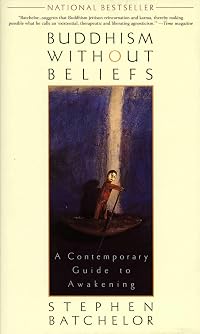
Buddhism Without Beliefs: A Contemporary Guide to Awakening
by Stephen Batchelor
On This Page
Description
A national bestseller and acclaimed guide to Buddhism for beginners and practitioners alikeIn this simple but important volume, Stephen Batchelor reminds us that the Buddha was not a mystic who claimed privileged, esoteric knowledge of the universe, but a man who challenged us to understand the nature of anguish, let go of its origins, and bring into being a way of life that is available to us all. The concepts and practices of Buddhism, says Batchelor, are not something to believe in but show more something to do—and as he explains clearly and compellingly, it is a practice that we can engage in, regardless of our background or beliefs, as we live every day on the path to spiritual enlightenment.
. show less
Tags
Recommendations






Member Recommendations
by kxlly
Member Reviews
Batchelor consciously re-envisions Buddhism for the modern West, stripping it of the religious and cultural relics of the places where Buddhism has flourished and refocusing on its core messages and the needs of the West. Toward the end, Batchelor explains his view that Buddhism has been crystallized for each new civilization and historical period through the genius and imagination of a small number of people -- which is exactly what Batchelor does in this book.
Rather than on the exegesis, I want to riff for a moment on the prescience of worrying in 1997 that dharma practice "could end up being swallowed by something else, such as psychotherapy or contemplative Christianity". I find the clinicalization example particularly fraught, as show more mindfulness is a go-to treatment for anxiety, depression, and stress and a new corporate buzzword. Since much of the interest in (and trendiness of) those practices is completely divorced from wider persistent practice, I worry they will flare up and then be exhausted without the community aspect that is core to social cohesion and happiness. This book is situated around core truths -- mixing non-Buddhist ones with Buddhism -- and has lasting power because of it.
So, recommended. This is a thin book with an enormous purpose. show less
Rather than on the exegesis, I want to riff for a moment on the prescience of worrying in 1997 that dharma practice "could end up being swallowed by something else, such as psychotherapy or contemplative Christianity". I find the clinicalization example particularly fraught, as show more mindfulness is a go-to treatment for anxiety, depression, and stress and a new corporate buzzword. Since much of the interest in (and trendiness of) those practices is completely divorced from wider persistent practice, I worry they will flare up and then be exhausted without the community aspect that is core to social cohesion and happiness. This book is situated around core truths -- mixing non-Buddhist ones with Buddhism -- and has lasting power because of it.
So, recommended. This is a thin book with an enormous purpose. show less
"In this simple but important volume, Stephen Batchelor reminds us that the Buddha was not a mystic who claimed privileged, esoteric knowledge of the universe, but a man who challenged us to understand the nature of anguish, let go of its origins, and bring into being a way of life that is available to us all. What Buddha taught, says Batchelor, is not something to believe in, but something do -- and as he explains clearly and compellingly, it is a practice that we can engage in, regardless of our background or beliefs, as we live every day on the path to awakening."
~~back cover
I have been reading about the different styles or systems of Buddhism, and although I was intrigued, somehow I didn't get the resonance I was looking for. This show more book provided that resonance. the author strips away the various different belief systems within Buddhism and goes straight to the foundation: understanding the nature of anguish, learning to let go of the origins of anguish, and learning to live with the space of "I don't know." This make so much more sense to me -- a belief in the nature of humans to cling to their perception of reality which leads inevitably to anguish, and a way to unlearn that perception. No belief system, no holy beings, just a way of learning to understand. So simple, yet so difficult. show less
~~back cover
I have been reading about the different styles or systems of Buddhism, and although I was intrigued, somehow I didn't get the resonance I was looking for. This show more book provided that resonance. the author strips away the various different belief systems within Buddhism and goes straight to the foundation: understanding the nature of anguish, learning to let go of the origins of anguish, and learning to live with the space of "I don't know." This make so much more sense to me -- a belief in the nature of humans to cling to their perception of reality which leads inevitably to anguish, and a way to unlearn that perception. No belief system, no holy beings, just a way of learning to understand. So simple, yet so difficult. show less
It's a good book, and I generally like Stephen Batchelor. But I have two main problems with this book: 1) he tends let his poetic flourishes -- which I usually love -- get away from him, sometimes making his prose seem a bit empty. Words for the sake of words. I don't that's actually a fair assessment of the book -- it's just how I felt while reading it. And 2) -- and MUCH more importantly -- I was expecting a book on how one doesn't need to embrace Buddhism as a religion, by faith alone, but, while he does deliver on that score (and sometimes beautifully), he tends to take an all-or-nothing antagonistic approach to all belief systems whatsoever. So not only does he come off sounding like he's attacking all faith-based religions, he show more also winds up conflating "faith" with "belief," which I think is a mistake. A "belief," I was taught in all my (non-religious) philosophy classes, was something you had determined to be true through logical deduction; it is mutable, because if, through logical challenge, that belief gets proven untrue, you change the belief, but it still is rooted in whatever logic you have access to at the time you adopted the belief. That is NOT the same thing as faith, which, as anyone who's seen Miracle on 34th Street can tell you, is believing in something IN THE ABSENCE of critical thinking and logical analysis. That Batchelor is attacking any approach to Buddhism seems a bit strange to me, but I get why -- he's acting as a kind of "wrathful deity" lashing out at misguided beliefs, as any good philosopher would do. What Batchelor intends to attack in this book is lay Buddhism's evolution into exactly the kind of blind faith-based religion the historical Buddha was trying to move away from, full of "magic" ritual and authoritarian dogma. But what he winds up attacking is any sense of believing in anything; his approach is a stark, almost angry agnosticism. And what I keep wondering is, if we can't take anything on authority -- from the teachings, say, or from the teachers -- then what do we mean when we say we take refuge in the Buddha, the Dharma, and the Sangha? What is refuge if not a kind of belief?
So, the book is fascinating to read and terrific fodder for hard thinking, but ultimately, it kind of falls flat for me. I miss the poetic language of his other books, where he seems almost in love with Buddhism. show less
So, the book is fascinating to read and terrific fodder for hard thinking, but ultimately, it kind of falls flat for me. I miss the poetic language of his other books, where he seems almost in love with Buddhism. show less
In this simple but important volume, Stephen Batchelor reminds us that the Buddha was not a mystic who claimed privileged, esoteric knowledge of the universe, but a man who challenged us to understand the nature of anguish, let go of its origins, and bring into being a way of life that is available to us all. The concepts and practices of Buddhism, says Batchelor, are not something to believe in but something to do—and as he explains clearly and compellingly, it is a practice that we can engage in, regardless of our background or beliefs, as we live every day on the path to spiritual enlightenment.
Very good introduction to the four golden truths of Buddhism: that suffering is universal, that suffering can be understood, that suffering can end, and that there is a practice that can guide us to the end of suffering. He explains the teachings clearly and with modern examples from our daily, Western lives. He bogs down, however, whenever he talks about Buddhism as a religion or its place in modern society. Those parts are boring and opinionated - mercifully short, though. The whole book is short, a good intro into mindfulness practices and Buddhism without religion.
Eastern religions have always had a certain appeal to me, a way of getting a fresh take on the big questions, something I lost growing up in a fundamentalist church. I had to break away from that, but the big questions remained. I studied Eastern religions only to find them equally laden with dogma. Many years later, I visited a Quaker meeting hall, where friends worshipped in silence. No one preached. No one spoke for an hour of worship. To be honest, I cried a little. I was home. When the talking stopped, there was truth. I am not a Quaker by membership but they have it right with silent worship, and it is a good fit with Buddhism, especially when Buddhism is relieved of the weight of its dogma. It was with some excitement that I show more discovered the title, Buddhism Without Beliefs. I was not disappointed.
Batchelor goes back to the source, to the teaching of Siddharta Gautama, the Buddha. Buddha grew up sheltered from suffering, then left home to become an ascetic. After living those two extremes, he sat under a tree, and awoke. The truth Buddha taught was fairly simple: desire is the cause of suffering, and desire is caused by a belief in an unchanging self or soul. Giving up this belief awakens one to the reality in front of one’s nose — the ordinary is extraordinary. Buddha was not interested in elaborate systems of theology; he never appointed a successor. Much of what has become Buddhism was developed by followers over the centuries, often motivated by a desire to maintain power.
Batchelor revives the authentic spirit of Buddhism, asserting that the more fantastic claims about reincarnation and karma can be unloaded for greater insight. Reincarnation is the belief that after life, a person comes back to live another life. Karma is the belief that one’s actions in past lives affect one’s present life. Both ideas assume a connection between lives, a soul. Personally, I can accept a variant of reincarnation. There was a time I did not exist. For the moment, there is this being that has this sense of me-ness. After that being has gone to fertilize the earth, a time could come again, where there is a being with that same sense of me-ness. But there is no connection between the two. As for karma, clearly my past actions in this life affect my present, but I do not believe there is a connection with future lives. Like Batchelor, I will not insist that the traditional Buddhist beliefs are wrong, I just don’t have anything to corroborate them. As Wittgenstein said of metaphysics, “Whereof one cannot speak, thereof one must be silent.” Relieved of its theology, Buddhism provides a simple compelling truth that fits well with my Quaker views.
The intellectually compelling aspects of Batchelor’s book — that of Buddhism without reincarnation and karma — tap out fairly early, and rightly so. Most of the book is a refreshing retake on Buddhism, free of jargon and ideology. The text is a meditation that I enjoyed reading in small, thoughtful portions over several days, a highlight of this summer.
http://johnmiedema.ca/2008/07/27/buddhism-without-beliefs-by-stephen-batchelor-b... show less
Batchelor goes back to the source, to the teaching of Siddharta Gautama, the Buddha. Buddha grew up sheltered from suffering, then left home to become an ascetic. After living those two extremes, he sat under a tree, and awoke. The truth Buddha taught was fairly simple: desire is the cause of suffering, and desire is caused by a belief in an unchanging self or soul. Giving up this belief awakens one to the reality in front of one’s nose — the ordinary is extraordinary. Buddha was not interested in elaborate systems of theology; he never appointed a successor. Much of what has become Buddhism was developed by followers over the centuries, often motivated by a desire to maintain power.
Batchelor revives the authentic spirit of Buddhism, asserting that the more fantastic claims about reincarnation and karma can be unloaded for greater insight. Reincarnation is the belief that after life, a person comes back to live another life. Karma is the belief that one’s actions in past lives affect one’s present life. Both ideas assume a connection between lives, a soul. Personally, I can accept a variant of reincarnation. There was a time I did not exist. For the moment, there is this being that has this sense of me-ness. After that being has gone to fertilize the earth, a time could come again, where there is a being with that same sense of me-ness. But there is no connection between the two. As for karma, clearly my past actions in this life affect my present, but I do not believe there is a connection with future lives. Like Batchelor, I will not insist that the traditional Buddhist beliefs are wrong, I just don’t have anything to corroborate them. As Wittgenstein said of metaphysics, “Whereof one cannot speak, thereof one must be silent.” Relieved of its theology, Buddhism provides a simple compelling truth that fits well with my Quaker views.
The intellectually compelling aspects of Batchelor’s book — that of Buddhism without reincarnation and karma — tap out fairly early, and rightly so. Most of the book is a refreshing retake on Buddhism, free of jargon and ideology. The text is a meditation that I enjoyed reading in small, thoughtful portions over several days, a highlight of this summer.
http://johnmiedema.ca/2008/07/27/buddhism-without-beliefs-by-stephen-batchelor-b... show less
I found this an absolutely compelling book. In addition to a concise and accessible introduction to the basic tenets of Buddhism, Batchelor provides an argument for a skeptical, agnostic, and psychological, rather than spiritual, approach to Buddhism: dharma practice, as opposed to another church. This work gave me plenty to ponder, and presented it in an engaging and moving fashion.
Members
- Recently Added By
Lists

Buddhism, books there in
23 works; 4 members

Recommend the 20 best books you've read in the last five years
2,168 works; 601 members
Author Information

19+ Works 3,958 Members
A former Buddhist monk, Stephen Batchelor has written several books attempting to make Buddhist accessible and understandable to the Western reader. These books include The Awakening of the West: The Encounter of Buddhist and Western Culture, and Buddhism Without Beliefs: A Contemporary Guide to Awakening. (Bowker Author Biography)
Common Knowledge
- Canonical title
- Buddhism Without Beliefs: A Contemporary Guide to Awakening
- Original publication date
- 1998
- People/Characters
- Stephen Batchelor
- Dedication
- In memory of
Osbert Moore (Ñāṇamoli Thera) 1905-1960
and Harold Musson (Ñāṇavīra Thera) 1920-1965 - Blurbers
- Hijuelos, Oscar; Epstein, Mark; Wheeler, Kate
Classifications
Statistics
- Members
- 1,651
- Popularity
- 13,577
- Reviews
- 33
- Rating
- (4.01)
- Languages
- 8 — Dutch, English, French, German, Italian, Polish, Portuguese, Spanish
- Media
- Paper, Audiobook, Ebook
- ISBNs
- 19
- ASINs
- 5