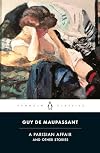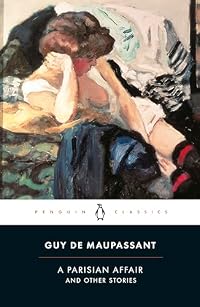
A Parisian Affair and Other Stories
by Guy de Maupassant
On This Page
Description
Set in the Paris of society women, prostitutes and small-minded bourgeousie, and the isolated villages of rural Normandy that de Maupassant knew as a child, the thirty-three tales in this volume are among the most darkly humorous and brilliant short stories in nineteenth-century literature. They focus on the relationships between men and women, as in the poignant fantasy of 'A Parisian Affair', between brothers and sisters, and between masters and servants. Through these relationships, show more Maupassant explores the dualistic nature of the human character and his stories reveal both nobility, civility and generosity, and, in stories such as 'At Sea' and 'Boule de Suif', vanity, greed and hypocrisy. Maupassant's stories repeatedly lay humanity bare with deft wit and devastating honesty. show lessTags
Recommendations












Member Reviews
The recent Penguin Pocket Classics series is good. This is the second of the French authors I have read in the series (there are six). I was struck by Maupassant's range of topics and how he waxes and wanes through tragedy and comedy but always with a clear picture of human imperfections and the challenges we, as humans, deal with on a daily basis. I couldn't help but think of Hemingway and how he draws out a particular human condition and builds a tragic story around it. I wanted to find out more about the influence of Maupassant on Hemingway so I read the introduction to Stoltzfus' (2012) Hemingway and French Writers where he states that Pierre Drieu La Rochelle, in his foreword to a French translation of A Farewell to Arms, compares show more Hemingway to Maupassant. A little further reading led me to an article by Jean-Paul Sartre in the August 1946 edition of The Atlantic entitled "American Novelists in French Eyes". Although Sartre does not make the direct comparison à la Rochelle, it is clear that Hemingway was influenced by the French authors Maupassant and Zola (even if Sartre and Hemingway weren't quite the fans of fascism that Rochelle was to become). In the book, Maupassant's stories are supported by comprehensive notes that I will return to time and again, either for details of authors, artists and playwrights, or for the descriptions of places, architecture, variants of horse-drawn vehicles, and trains. It took me some time to get through the book, not because it was tedious, but because it deserves to be slow-read. show less
A solid if unspectacular collection by Maupassant. Some stories stand out more than others (ranging from the more comic Cockcrow to the more sinister La Horla) but there are no real stunners in this collection either. Nothing quite so perfect as what Chekhov wrote or as emotive as anything by Carver - but that's tough company to hang with!
There is something very "modern" about these short stories though. Maupassant's prose is wonderfully clear and direct and It is impressive that he managed to write so many short stories, of good quality, in such a condensed amount of time. It's tough to nudge this book up to four stars however, because he made many of the points raised in this collection with much more force in his novels.
Thus, this show more is a collection worth reading but it's not amongst the great short story compilations and nor does it contain the author's best pieces of writing - read his longer fiction for that. show less
There is something very "modern" about these short stories though. Maupassant's prose is wonderfully clear and direct and It is impressive that he managed to write so many short stories, of good quality, in such a condensed amount of time. It's tough to nudge this book up to four stars however, because he made many of the points raised in this collection with much more force in his novels.
Thus, this show more is a collection worth reading but it's not amongst the great short story compilations and nor does it contain the author's best pieces of writing - read his longer fiction for that. show less
Some stories were beautiful, others were incredibly sad (cause people suck), and the rest were just "meh."
Ratings
Members
- Recently Added By
Lists

Recommend the 20 best books you've read in the last five years
2,168 works; 606 members
Author Information

2,544+ Works 26,604 Members
Henry-René-Albert-Guy de Maupassant was born on August 5, 1850 in France. He was schooled at a seminary in Yvetot and Le Harve. He fought in the Franco-German War, then held civil service posts with the Ministry of the Navy and the Ministry of Public Instruction. He also worked with Gustave Flaubert, who helped him develop his writing talent and show more introduced him to many literary greats. During his lifetime, he wrote six novels, three travel books, one book of verse, and over 300 short stories. He is considered one of the fathers of the modern short story. His works include The Necklace, A Piece of String, Mademoiselle Fifi, Miss Harriet, My Uncle Jules, Found on a Drowned Man, and The Wreck. He suffered from mental illness in his later years and attempted suicide on January 2, 1892. He was committed to a private asylum in Paris, where he died on July 6, 1893. (Bowker Author Biography) show less
Series
Belongs to Publisher Series
Common Knowledge
- Disambiguation notice
- This is a collection of short stories including "A Parisian Affair" (Une aventure parisienne) released in 2004 by Penguin Classics and republished in 2016 by Pocket Penguins.
Classifications
Statistics
- Members
- 233
- Popularity
- 139,246
- Reviews
- 3
- Rating
- (4.15)
- Languages
- English
- Media
- Paper, Ebook
- ISBNs
- 5
- ASINs
- 2