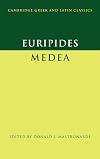
Euripides: Medea [Ancient Greek]
by Euripides
On This Page
Description
This up-to-date edition makes Euripides' most famous and influential play accessible to students of Greek reading their first tragedy as well as to more advanced students. The introduction analyzes Medea as a revenge-plot, evaluates the strands of motivation that lead to her tragic insistence on killing her own children, and assesses the potential sympathy of a Greek audience for a character triply marked as other (barbarian, witch, woman). A unique feature of this book is the introduction show more to tragic language and style. The text, revised for this edition, is accompanied by an abbreviated critical apparatus. The commentary provides morphological and syntactic help for inexperienced students and more advanced observations on vocabulary, rhetoric, dramatic techniques, stage action, and details of interpretation, from the famous debate of Medea and Jason to the 'unmotivated' entrance of Aegeus and the controversial monologue of Medea. show lessTags
Recommendations










































Member Reviews
The things women will do for love. The things men will do for greed. Medea's father, King Aeetes had possession of the Golden Fleece. Jason of the Argonauts wanted it. Medea, seduced by Jason, went to great lengths to prove her love. How else to explain murdering her own brother and scattering his body parts over the ocean; making her father slow his fleet to collect them for burial? How else to explain getting Jason's cousins to poison their father in an effort to bring back his youth? In the end, Jason marries a different princess because Medea is too dangerous. Go figure. Medea starts with Medea seeking revenge. Next on her killing list is Jason's new wife, Glauce. She gets even more evil from there. She would make a good candidate show more for that Deadly Women show... show less
Ratings
Members
- Recently Added By
Author Information

1,345+ Works 34,154 Members
Euripides was born in Attica, Greece probably in 480 B.C. He was the youngest of the three principal fifth-century tragic poets. In his youth he cultivated gymnastic pursuits and studied philosophy and rhetoric. Soon after he received recognition for a play that he had written, Euripides left Athens for the court of Archelaus, king of Macedonia. show more Fragments of about fifty-five plays survive. Among his best-known plays are Alcestis, Medea and Philoctetes, Electra, Iphigenia in Tauris, The Trojan Women, and Iphigenia in Aulis Iphigenia. He died in Athens in 406 B.C. (Bowker Author Biography) show less
Some Editions
Series
Belongs to Publisher Series
Work Relationships
Inspired
Common Knowledge
- Canonical title
- Euripides: Medea [Ancient Greek]
- Original title
- Μήδεια
- Original publication date
- 431 BCE
- Original language
- Ancient Greek
- Disambiguation notice
- This is Euripides' play Medea in the Classical Greek text. Please do not combine with the edition of the play in modern translation.
Classifications
- Genre
- Fiction and Literature
- DDC/MDS
- 882.01 — Literature & rhetoric Classical & modern Greek literatures Classical Greek dramatic poetry and drama standard subdivisions; collections; history, description, critical appraisal; Specific periods Ancient period to ca. 499
- LCC
- PA3973 .M4 — Language and Literature Greek language and literature. Latin language and literature Greek literature Individual authors Euripedes
- BISAC
Statistics
- Members
- 383
- Popularity
- 81,640
- Reviews
- 1
- Rating
- (4.13)
- Languages
- 7 — English, Finnish, French, Greek (Ancient), Greek, Italian, Latin
- Media
- Paper
- ISBNs
- 11
- ASINs
- 8