On This Page
Description
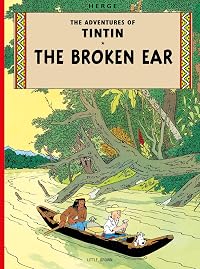
Determined to recover an Indian fetish stolen from the Museum of Ethnography, Tintin and Snowy follow a curious trail that leads to South America, revolution, and hostile jungle Indians.Tags
Recommendations










Member Reviews
A tribal fetish is stolen from a museum and Tintin is embroiled in a plot to recover it and discover its secret, for which men have been variously bribed, kidnapped and murdered.
Tintin follows his leads to South America, where a small country is in the midst of a revolution. Hergé shows in this part of the story how US and British commercial interests in the oil reserves of the area exploit the corrupt regime to foment war with a neighbouring country, to further their own interests and those of European arms manufacturers. Fairly heavy stuff for a children's story from the 1930s, but handled well.
Thomson and Thompson make only a perfunctory appearance in this story, but humour is provided by a truculent parrot and Hergé's seeming show more obsession with mutilating Snowy's tail! show less
Tintin follows his leads to South America, where a small country is in the midst of a revolution. Hergé shows in this part of the story how US and British commercial interests in the oil reserves of the area exploit the corrupt regime to foment war with a neighbouring country, to further their own interests and those of European arms manufacturers. Fairly heavy stuff for a children's story from the 1930s, but handled well.
Thomson and Thompson make only a perfunctory appearance in this story, but humour is provided by a truculent parrot and Hergé's seeming show more obsession with mutilating Snowy's tail! show less
This is one of the earlier Tintin albums before Herge had developed his full cast of characters (though this cast was regularly being added to with every album released). So far, the only regulars that appear (other than a couple of brief appearances by the Thompson Twins) are Tintin and Snowy, and even here Snowy doesn't seem to talk all that much. However, this is also the first appearance of the South American tinpot dictator General Alcazar and his South American country San Theodoros.
The story revolves around a small statue from a South American tribe that mysteriously disappears from a museum only to be replaced with a fake. It is easily seen that the statuette is a fake because the original has a broken ear (thus the title of show more this comic). Tintin's investigation into the theft takes him to San Theodoros where he gets himself arrested, but before he is executed, there are a series of revolutions and while drunk and screaming out 'Long live General Alcazar' he is adopted into the regime as the aide-de-camp to General Alcazar.
This begins the rather interesting series of events in this obscure South American country since Herge seems to be suggesting that revolutions occur every other day here, and this does not end until the final album Tintin and the Picaros. Obviously there is some commentary on the nature of many of these South American countries in that they tend to be politically unstable and generally change rulers at the shot of a gun. While it is exaggerated (a lot) it still reflects the instability of the region continent (though one can argue that there are external forces that are actively creating this instability).
Then we have the oil companies who side up with a certain dictator to attempt to squeeze concessions out of them. In this particular comic, there is believed to be oil straddling San Theodoros and its neighbour, and two companies are urging both countries to go to war so as they can gain concessions over the whole region. This is another interesting thing that Herge raises: a lot of modern wars seem to be instigated by corporate interests and it is the profit motives that drive them rather than any noble or just idea. We also see the arms dealer, working for Korupt Arms GMBH (a German company) who goes to the rulers of both countries to sell weapons to them. This stood out to me because shortly Herge was to end up living in Nazi occupied Belgium, and this suggests that the Nazi's were never really into reading because albums such as this could have certainly raised the hackles of Belgium's World War II masters.
This is an okay comic, certainly not one of his best, but then it is still early days in the development of the series. The two gangsters in this comic are actually a couple of nit-wits, they simply have no clue and are bumbling around attempting to find the statuette (and failing abysmally) and to add to this is the colonel turned insurgent that simply cannot seem to do anything right, let alone blow up General Alcazar. show less
The story revolves around a small statue from a South American tribe that mysteriously disappears from a museum only to be replaced with a fake. It is easily seen that the statuette is a fake because the original has a broken ear (thus the title of show more this comic). Tintin's investigation into the theft takes him to San Theodoros where he gets himself arrested, but before he is executed, there are a series of revolutions and while drunk and screaming out 'Long live General Alcazar' he is adopted into the regime as the aide-de-camp to General Alcazar.
This begins the rather interesting series of events in this obscure South American country since Herge seems to be suggesting that revolutions occur every other day here, and this does not end until the final album Tintin and the Picaros. Obviously there is some commentary on the nature of many of these South American countries in that they tend to be politically unstable and generally change rulers at the shot of a gun. While it is exaggerated (a lot) it still reflects the instability of the region continent (though one can argue that there are external forces that are actively creating this instability).
Then we have the oil companies who side up with a certain dictator to attempt to squeeze concessions out of them. In this particular comic, there is believed to be oil straddling San Theodoros and its neighbour, and two companies are urging both countries to go to war so as they can gain concessions over the whole region. This is another interesting thing that Herge raises: a lot of modern wars seem to be instigated by corporate interests and it is the profit motives that drive them rather than any noble or just idea. We also see the arms dealer, working for Korupt Arms GMBH (a German company) who goes to the rulers of both countries to sell weapons to them. This stood out to me because shortly Herge was to end up living in Nazi occupied Belgium, and this suggests that the Nazi's were never really into reading because albums such as this could have certainly raised the hackles of Belgium's World War II masters.
This is an okay comic, certainly not one of his best, but then it is still early days in the development of the series. The two gangsters in this comic are actually a couple of nit-wits, they simply have no clue and are bumbling around attempting to find the statuette (and failing abysmally) and to add to this is the colonel turned insurgent that simply cannot seem to do anything right, let alone blow up General Alcazar. show less
Having been to the United States, Egypt, India, China, and in an episode we'd rather forget, sub-Saharan Africa, it is time for Tintin to go somewhere new: South America. This time, Tintin sets off hot on the trail of a stolen fetish statue and winds up in the middle of a revolution followed by a war manufactured by American oil interests. And in a twist new for the series, Tintin starts his adventure by going out in search of a newspaper story to write. This marks the first time that Tintin has (a) actively taken the initiative at the outset of his adventure to set the ball rolling, and (b) actually done something related to his supposed job as a journalist. Despite his short-lived devotion to his job, Tintin doesn't really do much of show more anything to gather a story during the events of the book, despite being embroiled neck deep in what should have been a half dozen or more major scoops, reverting back to his established pattern of not reporting on anything.
The story opens up with us finding Tintin at home, which is the first time in the series that we have seen Tintin at home, where he is exercising and taking a bath. He hears about a mysterious robbery at the Museum of Ethnography, in which a sacred tribal fetish is stolen and in a burst of journalistic exuberance decides to go investigate if there is a story to be found there. At the museum, he runs across Thompson and Thomson who are investigating the robbery with their usual blend of incompetence and mangled language. The next day the case seems to solve itself as the statue is apparently returned to the museum, and everyone but Tintin is satisfied. Tintin, having done a few hours of research at the local library, notices what the director of the museum does not: the returned fetish does not have a tell-tale "broken ear" like the fetish that Tintin saw in a book (as Tintin had never seen the real fetish before the supposed fake one was returned). On the one hand, this is moderately silly insofar as Tintin seems to be the only person who notices that the rare item stolen and returned appears to be a forgery. On the other hand, it is a welcome development for the series to have Tintin actually engage in some actual investigation in an effort to solve a mystery.
After tying some very thin threads together, Tintin tangles with Alsonso and Ramon, a pair of criminals who have very think Spanish accents (or what are supposed to be very thick Spanish accents), vying with them for possession of a dead man's parrot, a competition that places Tintin's life in jeopardy more than once and turns out to be a more or less pointless exercise, as Tintin figures out where the crooks are headed despite being unable to keep hold of the parrot. This sends Tintin on a voyage to South America - no specific country is mentioned, just "South America", although the country is eventually revealed to be "San Teodoro" with the neighboring country being "Nuevo-Rico". After a couple of attempts on his life on board ship, Tintin works with the crew to arrest the criminals just before the ship reaches their destination. With the pair of criminals apparently well in hand, Tintin goes ashore to figure out what happened to the real stolen fetish and is immediately framed for terrorism, arrested, and condemned to be executed by firing squad. Tintin is quite put out by this, but given that this is the third time in three books that he has been scheduled to go before a firing squad, and in the book previous to that he was strung up by a lynch mob one would think that he would be used to it by now.
At this point the book switches from a strange crime caper involving the theft of an object with no discernible value to some social commentary on the nature of the governments of South American nations. While standing before the firing squad, Tintin is apparently saved by a coup d'etat that replaces General Tapioca with General Alcazar granting Tintin a reprieve. But just as quickly General Alcazar is replaced by General Tapioca again, putting Tintin back on death row. After getting drunk with the firing squad commander, Tintin sings the praises of General Alcazar while facing execution, just in time for the tables to turn yet again and Tapioca to be deposed in favor of Alcazar, making Tintin into a hero of the revolution. Before Tintin wakes up from his drunken stupor he finds himself appointed colonel and then aide-de-camp to General Alcazar himself and is up to his neck in San Teodoran politics. Of course, this being the section in which Hergé indulges himself in some social commentary, San Teodoran politics for Tintin mostly consists of mollifying General Alcazar by playing chess with him every day while an ex-colonel fails to kill the head of state in in humorous ways.
Tintin's new found power doesn't stop Alonso and Ramon from trying to kidnap and kill him in an effort to get their hands on the missing tribal idol. Their efforts, however, pale in comparison to the dangers Tintin faces dealing with San Teodoran politics. After lampooning Banana Republic style politics, Hergé turns to satirizing the involvement of unscrupulous U.S. corporate interests in South American politics when a corrupt oil executive offers Tintin a bribe in an effort to get him to persuade General Alcazar to go to war with neighboring Nuevo-Rico. Tintin, being an overgrown Boy Scout, tosses the oil executive on his ear, a decision that is both morally correct and incredibly foolish. Hergé uses this story line to attack both war profiteering and corporate meddling in South American politics as well as set Tintin back on the trail of the missing tribal idol.
Once accusations of espionage have relieved Tintin of his responsibilities as colonel (and after Tintin escapes imminent execution yet again), the story goes from an exploration of Hergé's idea of Latin American politics to a jungle exploration story. After heading down a jungle river in search of the dreaded Arambaya tribe and clues as to why Alonso and Ramon have such an intense interest in a supposedly intrinsically valueless tribal fetish. In short order Tintin comes across the long-lost explorer Ridgewell who has been adopted into the Arumbaya tribe, and with his knack for finding trouble, also finds the Rumbaba's, the sworn enemies of the Arumbayas. After Tintin, Ridgewell, and Snowy get into and out of some scrapes, Ridgewell has a fit of exposition and reveals to Tintin that the fetish may have had a large diamond hidden inside of it. Granted, diamonds are treated as valuable, but one has to wonder if a single diamond could possibly be worth the effort Alonso and Ramon have put into recovering it (not to mention the amount of money they must have invested into their quest).
Now that he has wound his way to all the pieces of the puzzle, Tintin runs across Alonso and Ramon again and ends up having to walk back to civilization. Once Tintin makes his way out of the jungle, things begin to wrap up quickly: the oil field that San Teodoro and Nuevo-Rico went to war over turns out to have no oil, a discovery that causes peace to break out. Tintin returns home and finds dozens of statues that look like the missing fetish, leading him to track down the whereabouts of the original, a discovery that makes the entire trip to South America more or less moot. As one would expect, in the end, Tintin unravels the mystery, the villains get their just desserts, and the fetish is returned to its proper place albeit somewhat worse for wear. Oddly, despite showing up at the outset of the story, Thompson and Thomson don't play any part in tracking down the villains at the end, an absence that seems somewhat glaring. But despite the fact that this was the first story in which Tintin does any real investigating and problem solving, the story of the missing fetish with a broken ear is mostly just a framing device to poke fun at the chaotic nature of South American politics and the venality of corporate interests that was the root cause of a good sized chunk of that chaos.
The Broken Ear continues the upward trend in the quality of the storytelling in The Adventures of Tintin, as not only does the book now contain a complete story, but Tintin has become a more active protagonist, both taking the initiative to instigate the story and actually collecting and stringing together clues to unravel the mystery. One step back is the artwork, as this volume lacks any of half page or full page illustrations of the type seen in The Blue Lotus, reverting back to the straightforward conversion of what had been a newspaper comic into book form. But in addition to the improved storytelling, The Broken Ear also includes a healthy helping of social and political satire. Despite what might be considered an offensive portrayal of South American politics, Hergé comes down strongly against the influence of corrupt corporate imperialism. Although the Tintin series has not yet fully matured, this volume is yet another building block in the steady improvement of the series, and definitely a book worth reading.
This review has also been posted to my blog Dreaming About Other Worlds. show less
The story opens up with us finding Tintin at home, which is the first time in the series that we have seen Tintin at home, where he is exercising and taking a bath. He hears about a mysterious robbery at the Museum of Ethnography, in which a sacred tribal fetish is stolen and in a burst of journalistic exuberance decides to go investigate if there is a story to be found there. At the museum, he runs across Thompson and Thomson who are investigating the robbery with their usual blend of incompetence and mangled language. The next day the case seems to solve itself as the statue is apparently returned to the museum, and everyone but Tintin is satisfied. Tintin, having done a few hours of research at the local library, notices what the director of the museum does not: the returned fetish does not have a tell-tale "broken ear" like the fetish that Tintin saw in a book (as Tintin had never seen the real fetish before the supposed fake one was returned). On the one hand, this is moderately silly insofar as Tintin seems to be the only person who notices that the rare item stolen and returned appears to be a forgery. On the other hand, it is a welcome development for the series to have Tintin actually engage in some actual investigation in an effort to solve a mystery.
After tying some very thin threads together, Tintin tangles with Alsonso and Ramon, a pair of criminals who have very think Spanish accents (or what are supposed to be very thick Spanish accents), vying with them for possession of a dead man's parrot, a competition that places Tintin's life in jeopardy more than once and turns out to be a more or less pointless exercise, as Tintin figures out where the crooks are headed despite being unable to keep hold of the parrot. This sends Tintin on a voyage to South America - no specific country is mentioned, just "South America", although the country is eventually revealed to be "San Teodoro" with the neighboring country being "Nuevo-Rico". After a couple of attempts on his life on board ship, Tintin works with the crew to arrest the criminals just before the ship reaches their destination. With the pair of criminals apparently well in hand, Tintin goes ashore to figure out what happened to the real stolen fetish and is immediately framed for terrorism, arrested, and condemned to be executed by firing squad. Tintin is quite put out by this, but given that this is the third time in three books that he has been scheduled to go before a firing squad, and in the book previous to that he was strung up by a lynch mob one would think that he would be used to it by now.
At this point the book switches from a strange crime caper involving the theft of an object with no discernible value to some social commentary on the nature of the governments of South American nations. While standing before the firing squad, Tintin is apparently saved by a coup d'etat that replaces General Tapioca with General Alcazar granting Tintin a reprieve. But just as quickly General Alcazar is replaced by General Tapioca again, putting Tintin back on death row. After getting drunk with the firing squad commander, Tintin sings the praises of General Alcazar while facing execution, just in time for the tables to turn yet again and Tapioca to be deposed in favor of Alcazar, making Tintin into a hero of the revolution. Before Tintin wakes up from his drunken stupor he finds himself appointed colonel and then aide-de-camp to General Alcazar himself and is up to his neck in San Teodoran politics. Of course, this being the section in which Hergé indulges himself in some social commentary, San Teodoran politics for Tintin mostly consists of mollifying General Alcazar by playing chess with him every day while an ex-colonel fails to kill the head of state in in humorous ways.
Tintin's new found power doesn't stop Alonso and Ramon from trying to kidnap and kill him in an effort to get their hands on the missing tribal idol. Their efforts, however, pale in comparison to the dangers Tintin faces dealing with San Teodoran politics. After lampooning Banana Republic style politics, Hergé turns to satirizing the involvement of unscrupulous U.S. corporate interests in South American politics when a corrupt oil executive offers Tintin a bribe in an effort to get him to persuade General Alcazar to go to war with neighboring Nuevo-Rico. Tintin, being an overgrown Boy Scout, tosses the oil executive on his ear, a decision that is both morally correct and incredibly foolish. Hergé uses this story line to attack both war profiteering and corporate meddling in South American politics as well as set Tintin back on the trail of the missing tribal idol.
Once accusations of espionage have relieved Tintin of his responsibilities as colonel (and after Tintin escapes imminent execution yet again), the story goes from an exploration of Hergé's idea of Latin American politics to a jungle exploration story. After heading down a jungle river in search of the dreaded Arambaya tribe and clues as to why Alonso and Ramon have such an intense interest in a supposedly intrinsically valueless tribal fetish. In short order Tintin comes across the long-lost explorer Ridgewell who has been adopted into the Arumbaya tribe, and with his knack for finding trouble, also finds the Rumbaba's, the sworn enemies of the Arumbayas. After Tintin, Ridgewell, and Snowy get into and out of some scrapes, Ridgewell has a fit of exposition and reveals to Tintin that the fetish may have had a large diamond hidden inside of it. Granted, diamonds are treated as valuable, but one has to wonder if a single diamond could possibly be worth the effort Alonso and Ramon have put into recovering it (not to mention the amount of money they must have invested into their quest).
Now that he has wound his way to all the pieces of the puzzle, Tintin runs across Alonso and Ramon again and ends up having to walk back to civilization. Once Tintin makes his way out of the jungle, things begin to wrap up quickly: the oil field that San Teodoro and Nuevo-Rico went to war over turns out to have no oil, a discovery that causes peace to break out. Tintin returns home and finds dozens of statues that look like the missing fetish, leading him to track down the whereabouts of the original, a discovery that makes the entire trip to South America more or less moot. As one would expect, in the end, Tintin unravels the mystery, the villains get their just desserts, and the fetish is returned to its proper place albeit somewhat worse for wear. Oddly, despite showing up at the outset of the story, Thompson and Thomson don't play any part in tracking down the villains at the end, an absence that seems somewhat glaring. But despite the fact that this was the first story in which Tintin does any real investigating and problem solving, the story of the missing fetish with a broken ear is mostly just a framing device to poke fun at the chaotic nature of South American politics and the venality of corporate interests that was the root cause of a good sized chunk of that chaos.
The Broken Ear continues the upward trend in the quality of the storytelling in The Adventures of Tintin, as not only does the book now contain a complete story, but Tintin has become a more active protagonist, both taking the initiative to instigate the story and actually collecting and stringing together clues to unravel the mystery. One step back is the artwork, as this volume lacks any of half page or full page illustrations of the type seen in The Blue Lotus, reverting back to the straightforward conversion of what had been a newspaper comic into book form. But in addition to the improved storytelling, The Broken Ear also includes a healthy helping of social and political satire. Despite what might be considered an offensive portrayal of South American politics, Hergé comes down strongly against the influence of corrupt corporate imperialism. Although the Tintin series has not yet fully matured, this volume is yet another building block in the steady improvement of the series, and definitely a book worth reading.
This review has also been posted to my blog Dreaming About Other Worlds. show less
This was one of my favorite Tintin books growing up, and I still love it (much like I, frankly, do every other Tintin book). I love the cleverness of the translators in using a slowed-down, pseudo-Cockney English for the Arumbayas’ native language. I love the introduction of General Alcazar. I love the humor. I could go on. Point being, it’s a great book with great illustrations, and shows some of Herge’s humor and wit at its finest.
My review, as posted in Tintin Books
For his sixth "Tintin" work, Hergé continued his character's trips to far-flung societies, in this case South America. As with Tintin in America and The Blue Lotus, Herge sought to incorporate thinly-veiled political tensions. As such, San Theodoros is at war partly due to the machinations of big oil companies from superpower nations.
The story remains picaresque, leading Tintin through several smaller episodes which are tied together by an overarching plot, but is much more controlled and tightly plotted than anything Herge had done previously. The treasure hunt plot, beginning with an item whose significance is far from obvious, echoes that which will be used in later stories such as The Secret of show more the Unicorn. Although the atmosphere wasn't as praised as that of "The Blue Lotus", "The Broken Ear" is a fun and exhilirating adventure.
On a personal level, I find a lot to love in this album, with its speedy feel which doesn't sacrifice plot. A lot of the native culture, and Herge's grim satire on big oil and Western countries exploiting second-world combats for their gain, is quite mature. However, there are some negative elements: for instance, Tintin still finds himself in a lot of situations (several firing squads, for instance) where he is saved by blind chance rather than through innovation, wilfulness or anything more clever. (It's the difference between "Buffy" and "Veronica Mars", too, if you want my opinion...) show less
For his sixth "Tintin" work, Hergé continued his character's trips to far-flung societies, in this case South America. As with Tintin in America and The Blue Lotus, Herge sought to incorporate thinly-veiled political tensions. As such, San Theodoros is at war partly due to the machinations of big oil companies from superpower nations.
The story remains picaresque, leading Tintin through several smaller episodes which are tied together by an overarching plot, but is much more controlled and tightly plotted than anything Herge had done previously. The treasure hunt plot, beginning with an item whose significance is far from obvious, echoes that which will be used in later stories such as The Secret of show more the Unicorn. Although the atmosphere wasn't as praised as that of "The Blue Lotus", "The Broken Ear" is a fun and exhilirating adventure.
On a personal level, I find a lot to love in this album, with its speedy feel which doesn't sacrifice plot. A lot of the native culture, and Herge's grim satire on big oil and Western countries exploiting second-world combats for their gain, is quite mature. However, there are some negative elements: for instance, Tintin still finds himself in a lot of situations (several firing squads, for instance) where he is saved by blind chance rather than through innovation, wilfulness or anything more clever. (It's the difference between "Buffy" and "Veronica Mars", too, if you want my opinion...) show less
It's weird reading the stuff of my childhood and discovering just how farcically stupid some cultures are portrayed as being. Granted, I'm reading the English translation of a French series, but I rather doubt is that far off - and it while I still enjoy the humorous elements that aren't treating other cultures as purely stupid, it's an uncomfortable experience.
The Broken Ear is the sixth chronological volume in the Tintin series by Herge. As usual, Tintin is investigating a crime and starts following a trail of clues which lead him on an international goose chase. As to be expected, being written in 1945, there are portrayals of non-Belgian people which would not be considered sensitive enough by today's standards, but to it's credit The Broken Ear does highlight corruption in some of the military dictatorships in South America during the time. Also, in a round about way, the whole plot of The Broken Ear is a critique of cultural exploitation of indigenous peoples. Now that I have given the standard apology for Herge, I will note that all the usual dangerously fun things about Tintin are show more present in this volume: gun fights, white water boat collisions, espionage, botched executions, high speed car chases and accidents, prison break via farm tractor, animal sacrifice rituals, and of course death by piranhas! Snowy's tail get's injured seven times, poor guy.
The line work, ballooning, and coloring are classic as always and quite eye catching. Sometimes, I conduct a little experiment with Tintin books. I will leave one out in the living room or my office and see how long it takes for a guest to pick it up and flip through it. It's usually not too long. There is something about the bold colors and promise of adventure about each cover that is quite hard to deny. Next up, it looks like Tintin is going to Scotland in The Black Island! Dun..dun...Dun! show less
The line work, ballooning, and coloring are classic as always and quite eye catching. Sometimes, I conduct a little experiment with Tintin books. I will leave one out in the living room or my office and see how long it takes for a guest to pick it up and flip through it. It's usually not too long. There is something about the bold colors and promise of adventure about each cover that is quite hard to deny. Next up, it looks like Tintin is going to Scotland in The Black Island! Dun..dun...Dun! show less
Members
- Recently Added By
Lists

Evan's Reading List 2021
16 works; 1 member

Favorite Childhood Books
1,651 works; 515 members
Author Information

'Hergé' was born Georges Remi on 22 May, 1907 in Etterbeek, a suburb of Brussels, in Belgium. After leaving school, he worked for the daily newspaper, Le XXe Siècle (The 20th Century). He was responsibe the for the section of the newspaper designed for children. Tintin, the main character in his works, was introduced on January 10, 1929 in a show more story entitled 'Tintin in the Land of the Soviets.' Each story ran as a comic strip in the newspaper and then was published as a book. Some of these books were adapted for the small screen including The Crab With The Golden Claws, Star of Mystery, Red Rakham's Treasure, Black Island, Objective Moon and The Calculus Affair. French TV produced longer versions of twenty of the books in 1992, which have been broadcast in over fifty countries. On 3 March, 1983, he died in Brussels. At the time of his death, he was working on Tintin and the Alpha-Art, which was published in an unfinished form. (Bowker Author Biography) show less
Some Editions
Awards and Honors
Notable Lists
Series

Work Relationships
Is contained in
Is a retelling of
Has the adaptation
Is expanded in
Common Knowledge
- Canonical title
- The Broken Ear
- Original title
- L'Oreille cassée
- Alternate titles*
- Tintin : L'oreille cassée
- Original publication date
- 1943 (Color) (Color)
- People/Characters
- Tintin; General Alcázar; Alonso Perez; Ramon Bada; Ridgewell; Snowy (show all 23); Jacob Balthazar; Samuel Goldbarr; Ernestine; Colonel Jiminez; Captain Maldemer; Avakuki; Rodrigo Tortilla; General Tapioca; Colonel Diaz; Colonel Fernandez; R. W. Trickler; Basil Bazarov; General Mogador; Don Jose Trujillo; Caraco; Walker; Karamelo
- Important places
- San Theodoros (fictional place); Nuevo Rico (fictional place); Belgium; Los Dopicos (fictional place); San Facion (fictional place)
- First words
- "Closing time!"
- Last words
- (Click to show. Warning: May contain spoilers.)"Toreador, on guard now! Toreador! Toreador!"
- Original language
- French
- Disambiguation notice
- This is the 1943 redrawn and colourised version of The Broken Ear (L'Oreille cassée). Please, do not combine it with the 1937 original black and white version.
At least one of the works has mismatched title and ISBN. Attempted to separate and recombine, but it's still a bit of a mess, I'm afraid.
*Some information comes from Common Knowledge in other languages. Click "Edit" for more information.
Classifications
- Genre
- Graphic Novels & Comics
- DDC/MDS
- 741.59493 — Arts & recreation Drawing & decorative arts Drawing Comic books, graphic novels, fotonovelas, cartoons, caricatures, comic strips History, geographic treatment, biography European Other European Belgium & Luxembourg
- LCC
- PN6790 .B44 .T5513 — Language and Literature Literature (General) Literature (General) Collections of general literature Comic books, strips, etc.
- BISAC
Statistics
- Members
- 1,950
- Popularity
- 10,948
- Reviews
- 21
- Rating
- (3.76)
- Languages
- 26 — Afrikaans, Bengali, Catalan, Chinese, Czech, Danish, Dutch, English, Finnish, French, German, Galician, Greek, Hindi, Italian, Korean, Norwegian (Bokmål), Norwegian, Romanian, Serbian, Croatian, Spanish, Swedish, Turkish, Welsh, Portuguese (Portugal)
- Media
- Paper, Ebook
- ISBNs
- 83
- ASINs
- 9