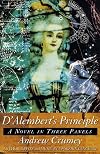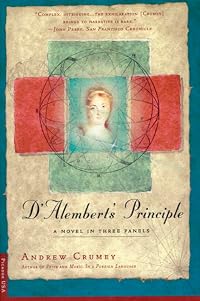
D'Alembert's Principle
by Andrew Crumey
On This Page
Description
As the scientist D'Alembert nears the end of his life, he looks back on his friendships with Jean-Jacques Rousseau and Denis Diderot and mourns his unrequited love for a woman who spent years deceiving him. At the same time, an exiled Jacobite dreams of journeying to the planets, and in a prison cell two unlikely captives discuss love, language, and fate. Meticulously crafted, D'Alembert's Principle is a fascinating historical triptych about memory, reason, and imagination set in the rich show more and lavish world of eighteenth-century Europe. show lessTags
Recommendations





































Member Reviews
I found this book marked down to £3 in a post-Christmas sale, and picked it up just because it looked interestingly challenging. I found it a fascinating blend of philosophy, fantasy and history, but the games Crumey plays with form, ideas and his own characters are dizzying and at times difficult to follow.
The first and longest of the three sections is the most straightforward - an exploration of the life and times of the eighteenth century scientist and philosopher D'Alembert, who worked on Diderot's encyclopedia and believed that the ultimate aim of science was to produce a simple universal model that everything else would follow from. The entertainment is provided by the exploration of his milieu and his unrequited love for a woman show more who humours him while betraying him.
In the short second part a fictitious Scottish philosopher imagines a dream journey to various planets all of which cause him to come back to fundamental Cartesian questions about his own existence, and the history and provenance of his supposed works is also explored in a playful way.
The third part Tales from Rreinnstadt is apparently linked to, and quotes from, Crumey's previous novel Pfitz. It is a loosely linked set of rather Borgesian philosophical fables exploring the nature of imagination and infinity, gently ridiculing D'Alembert's world view.
This is not a book I would recommend to the casual reader, but it would probably reward a more detailed study, and certainly left me with plenty of interesting questions to ponder. show less
The first and longest of the three sections is the most straightforward - an exploration of the life and times of the eighteenth century scientist and philosopher D'Alembert, who worked on Diderot's encyclopedia and believed that the ultimate aim of science was to produce a simple universal model that everything else would follow from. The entertainment is provided by the exploration of his milieu and his unrequited love for a woman show more who humours him while betraying him.
In the short second part a fictitious Scottish philosopher imagines a dream journey to various planets all of which cause him to come back to fundamental Cartesian questions about his own existence, and the history and provenance of his supposed works is also explored in a playful way.
The third part Tales from Rreinnstadt is apparently linked to, and quotes from, Crumey's previous novel Pfitz. It is a loosely linked set of rather Borgesian philosophical fables exploring the nature of imagination and infinity, gently ridiculing D'Alembert's world view.
This is not a book I would recommend to the casual reader, but it would probably reward a more detailed study, and certainly left me with plenty of interesting questions to ponder. show less
Imagine a puddle of water as a form of alien life - how would that life form think? What would they make of us humans? How would they communicate? These are just a few of the philosophical queries propounded by Andrew Crumey's characters as he re-works the the lives and imagines the conversations of the famous French philosophers - D'Alembert, Diderot and Julie de Lespinasse. It made my head hurt when I first read it, but the questions, answers and characters kept me coming back time after time; this book is a conundrum and a delight to read.
Crumey produced another great reading, reminescent of Borges, witty, and enthralling.
Half a rather dull historical novel stuck together with some silly 90s postmodernism. Probably clever when he wrote it, but 15 years on it just seems a bit past its read-by date.
Ratings
Members
- Recently Added By
Author Information
10+ Works 1,016 Members
Common Knowledge
- Canonical title
- D'Alembert's Principle
- People/Characters
- Jean Le Rond d'Alembert; Denis Diderot; Julie de Lespinasse; Rousseau, Jean-Jacques, 1712-1778
Classifications
Statistics
- Members
- 101
- Popularity
- 318,837
- Reviews
- 4
- Rating
- (3.85)
- Languages
- English, Russian, Spanish
- Media
- Paper, Ebook
- ISBNs
- 6
- ASINs
- 2