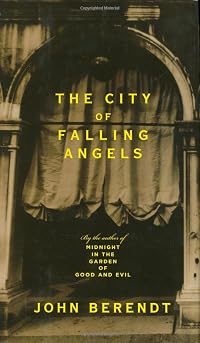
The City of Falling Angels
by John Berendt
On This Page
Description
Venice, a city steeped in a thousand years of history, art and architecture, teeters in precarious balance between endurance and decay. Its architectural treasures crumble--foundations shift, marble ornaments fall--even as efforts to preserve them are underway. This book opens in 1996, when a dramatic fire destroys the historic Fenice opera house, a catastrophe for Venetians. Arriving three days after the fire, Berendt becomes a kind of detective--inquiring into the nature of life in this show more remarkable museum-city--while gradually revealing the truth about the fire. He introduces us to a rich cast of characters, Venetian and expatriate, in a tale full of atmosphere and surprise which reveals a world as finely drawn as a still-life painting. The fire and its aftermath serve as a leitmotif, adding elements of chaos, corruption, and crime and contributing to the ever-mounting suspense.--From publisher description. show lessTags
Recommendations











Member Recommendations
Member Reviews
From the moment I started reading this book I was hooked, and it was all I could do to stop myself booking a plane ticket and departing for Venice there and then. Many, many books have been written about Venice, or are set in Venice, from travelogues, serious tomes on Venitian art and architecture, history, as well as crime, romantic and literary fiction. Berendt has written a very different book. He writes -with a light gossipy style- about the Venetians, and through them the reader gets a wonderful portrait of this magical city at the beginning of the 21stC. He has used the burning of La Fenice, Venice's famous opera theatre, the criminal investigations which followed the fire, the convoluted machinations between various groups to get show more the theatre rebuilt, and the rebuilding itself as the backbone of his book. Woven around that strand are encounters with an amazing cast of characters, The Rat Man, Count Volpi, Olga Rudge (Ezra Pound's widow, the feuding brothers, and any number of Contessas and Marcheses, not to mention the English and American expats who have made Venice their home.
His descriptions are so vivid that you can smell the damp,the hot chocolate at Florians, the sewers. You can see the hoards of tourists who are the life-blood of the Venetian economy and paradoxically are destroying the city by their very numbers. You watch with amazed amusement as the various "Save" Venice organisations jockey for pre-eminance and prestige.
This is a wonderful book, and I had to keep reminding myself that it is Non-Fiction, and that ALL the characters are real people and use their real names. If you are going to visit Venice for the first time, read this book; if you already know and love Venice, read this book; if you are an armchair traveller, read this book. You WILL enjoy it! show less
His descriptions are so vivid that you can smell the damp,the hot chocolate at Florians, the sewers. You can see the hoards of tourists who are the life-blood of the Venetian economy and paradoxically are destroying the city by their very numbers. You watch with amazed amusement as the various "Save" Venice organisations jockey for pre-eminance and prestige.
This is a wonderful book, and I had to keep reminding myself that it is Non-Fiction, and that ALL the characters are real people and use their real names. If you are going to visit Venice for the first time, read this book; if you already know and love Venice, read this book; if you are an armchair traveller, read this book. You WILL enjoy it! show less
Absolutely fascinating. Each chapter was devoted to a specific person or event, like the burning of the Fenice or the glassblower’s family war. Every person who appeared was interesting and had something to say. The part where the Rat Man talked about why his poison was so successful was weirdly fascinating. As was the Plant Man; because of the profound lack of soil and open space in Venice, practically no one understands how to grow plants, even indoors. So the Plant Man must come to their rescue. It’s probably the only place on earth that would need his services so completely.
One thing that struck me, and it could have been Berendt’s telling and not fact, was the hard-headedness of the bureaucracy of Venice. They choked show more themselves with so many rules and petty slights that no wonder there’s no progress to speak of there. It seems to be backwards for backwards’ sake. I would lose patience in about 5 seconds I imagine.
The part about the curators of the Guggenheim was fascinating; the plotting calculation of the wife and the utter degradation of the husband. Ruthless and transparently so, but successful despite that. The same woman seems to have positively and completely stolen the papers of the widow of Ezra Pound.
But the ruthlessness and backstabbing aren’t limited to just that story. The Save Venice Foundations was/is equally rife. What a load of snarling bitches. Privilege breeds this kind of contempt and self-adulation I suppose, but it seemed really petty and stupid. Fun to read though.
Even though it will probably be another 10 years before we have another from Berendt, I can’t wait. show less
One thing that struck me, and it could have been Berendt’s telling and not fact, was the hard-headedness of the bureaucracy of Venice. They choked show more themselves with so many rules and petty slights that no wonder there’s no progress to speak of there. It seems to be backwards for backwards’ sake. I would lose patience in about 5 seconds I imagine.
The part about the curators of the Guggenheim was fascinating; the plotting calculation of the wife and the utter degradation of the husband. Ruthless and transparently so, but successful despite that. The same woman seems to have positively and completely stolen the papers of the widow of Ezra Pound.
But the ruthlessness and backstabbing aren’t limited to just that story. The Save Venice Foundations was/is equally rife. What a load of snarling bitches. Privilege breeds this kind of contempt and self-adulation I suppose, but it seemed really petty and stupid. Fun to read though.
Even though it will probably be another 10 years before we have another from Berendt, I can’t wait. show less
The City of Falling Angels is Venice. In this book, published in 2005, John Berendt gives Venice the same basic treatment he gave Savannah in a previous book, Midnight in the Garden of Good and Evil. He has a framework and a construction formula. Select a very interesting city, focus on a calamity there that engages all the wits and gossips, draws all the sidewalk (in this case, canal) superintendents. As the details of the calamity and its aftermath trickle out, Berendt fleshes out his tale with what amount to sidebars on ancillary characters and conflicts and entertainments.
Here his main event is a disastrous fire than destroys the Fenice Opera House in January 1996. The Fenice is hundreds of years old. Because the canal adjacent to show more the structure has been drained for needed repairs and renovation, firefighters can't quickly deluge the blaze. They have to jerry-rig hose-lines through walkways and even through some buildings. In the aftermath, new threads develop, following investigations into the cause, following various plans for reconstruction, following competition for the reconstruction contract. The ornate structure's been expanded, renovated and its interior altered over the years, of course, but the archive of architectural plans, of construction plans, is spotty. Recent photos of the interior spaces are nonexistent.
As this tale unfolds, Berendt intersperses it with sidebars.
• Archimede Seguso, whose apartment is across the canal from the theater is stupified by the inferno, sitting in a chair by a window, watching the fire all night, ignoring pleas from fire officials, his wife, his son to vacate to safety. He is, we learn, a master glassblower, active for 75 years, and now in his late 80s is the patriarch of one of Venice's most significant firms. Berendt recounts the story of glass making in Venice, of family feuds that threaten the creative and business integrity of the firms, and how Signor Seguso energized by the fire.
• A group of wealthy Americans are gathering in Venice, when the fire explodes. These men and women are the leaders of Save Venice, a New York-based charity that funds repairs and restorations. Several own palatial residences bordering the Grand Canal and other waterways. Some represent inherited wealth, while others built their own fortunes. As time passes, these powerful folks get to squabbling amongst themselves. Berendt tells pretty much of it.
• Ezra Pound was long a resident of Venice, where he lived with his mistress of 50 years, Olga Rudge. When Pound, then his widow, died in the early 1970s, Olga was left in possession of their house and several large chests with the poet and editor's papers. Berendt is drawn to the end-of-life machinations to gain control of those papers and the house. (Now I have to read Pound and about Pound!)
Oh, there's a lot more. Anecdotes about daily life in a city without cars. Profiles on the rich, the aristocratic, the political, even ordinary mortals. Can you tell that I really enjoyed this book?
What's missing? Photos and drawings. How can you tell about this unique city and its artistic and architectural wonders, about a devastating fire and an enormously complicated construction without SHOWING at least a handful of pictures. The endpapers are printed with a marvellous bird-eye view of the city with many buildings highlighted. But it isn't enough. Check Google Maps as you read. show less
Here his main event is a disastrous fire than destroys the Fenice Opera House in January 1996. The Fenice is hundreds of years old. Because the canal adjacent to show more the structure has been drained for needed repairs and renovation, firefighters can't quickly deluge the blaze. They have to jerry-rig hose-lines through walkways and even through some buildings. In the aftermath, new threads develop, following investigations into the cause, following various plans for reconstruction, following competition for the reconstruction contract. The ornate structure's been expanded, renovated and its interior altered over the years, of course, but the archive of architectural plans, of construction plans, is spotty. Recent photos of the interior spaces are nonexistent.
As this tale unfolds, Berendt intersperses it with sidebars.
• Archimede Seguso, whose apartment is across the canal from the theater is stupified by the inferno, sitting in a chair by a window, watching the fire all night, ignoring pleas from fire officials, his wife, his son to vacate to safety. He is, we learn, a master glassblower, active for 75 years, and now in his late 80s is the patriarch of one of Venice's most significant firms. Berendt recounts the story of glass making in Venice, of family feuds that threaten the creative and business integrity of the firms, and how Signor Seguso energized by the fire.
• A group of wealthy Americans are gathering in Venice, when the fire explodes. These men and women are the leaders of Save Venice, a New York-based charity that funds repairs and restorations. Several own palatial residences bordering the Grand Canal and other waterways. Some represent inherited wealth, while others built their own fortunes. As time passes, these powerful folks get to squabbling amongst themselves. Berendt tells pretty much of it.
• Ezra Pound was long a resident of Venice, where he lived with his mistress of 50 years, Olga Rudge. When Pound, then his widow, died in the early 1970s, Olga was left in possession of their house and several large chests with the poet and editor's papers. Berendt is drawn to the end-of-life machinations to gain control of those papers and the house. (Now I have to read Pound and about Pound!)
Oh, there's a lot more. Anecdotes about daily life in a city without cars. Profiles on the rich, the aristocratic, the political, even ordinary mortals. Can you tell that I really enjoyed this book?
What's missing? Photos and drawings. How can you tell about this unique city and its artistic and architectural wonders, about a devastating fire and an enormously complicated construction without SHOWING at least a handful of pictures. The endpapers are printed with a marvellous bird-eye view of the city with many buildings highlighted. But it isn't enough. Check Google Maps as you read. show less
Oh, poor John Berendt. He went to Savannah and got an absolutely spectacular book out of it (MIDNIGHT IN THE GARDEN OF GOOD AND EVIL). But how often do you become good friends with a murder suspect who is rich and decadent? What could you write next that wouldn't be completely anticlimactic?
I guess you go to Venice, try to meet well-connected people, gossip a bit, and write a rather lengthy anticlimax. Alas, that's what CITY OF FALLEN ANGELS is. Next time, John, head for the Caribbean and hunt up another voodoo queen. Or you could always try New Orleans - plenty of drama there.
I guess you go to Venice, try to meet well-connected people, gossip a bit, and write a rather lengthy anticlimax. Alas, that's what CITY OF FALLEN ANGELS is. Next time, John, head for the Caribbean and hunt up another voodoo queen. Or you could always try New Orleans - plenty of drama there.
This book produced the same sensation in me as a reader as Berendt's previous work, Midnight in the Garden of Good and Evil did, which is make me desperately desire to travel to the city in question. Berendt has a true talent for making a place come alive through both description of setting and introduction of character.
The nominal main story of this work revolves around a destructive fire at the Fenice Theater in 1996. Berendt introduces us to the investigators of the disaster, possible suspects and also important bystanders and witnesses.
In addition to this theme, there are a couple of sub-plots, one involving the late mistress of Ezra Pound and a shady-seeming couple who befriend her and pretty much steal all of the memorabilia of show more her relationship with Pound as well as other important ephemera she has in her possession at the time of her death as well as the last years of her life. This couple also seems to have had a suspicious relationship with Peggy Guggenheim at the end of her life.
The other subplot regards a fight for prominency amongst the leadership of the Save Venice charitable organization. There is quite a bit of name-dropping throughout.
Berendt is thorough in tracking down witnesses and others who might have information regarding any of these plot points and seems to have spent years investigating and collecting material for this book. In fact, the last pages deal with the reopening of the Fenice after 8 years of reconstruction, in 2004.
Unfortunately, the City of Venice did not have a pleasant reaction to the publication of this book, characterizing it as 'nasty gossip', since many of its prominent citizens are painted rather uncharitably, and unlike Savannah has no need of an American book to make it a popular tourist destination, it has and will continue nevertheless to see visitors inspired by their perusal of this work. show less
The nominal main story of this work revolves around a destructive fire at the Fenice Theater in 1996. Berendt introduces us to the investigators of the disaster, possible suspects and also important bystanders and witnesses.
In addition to this theme, there are a couple of sub-plots, one involving the late mistress of Ezra Pound and a shady-seeming couple who befriend her and pretty much steal all of the memorabilia of show more her relationship with Pound as well as other important ephemera she has in her possession at the time of her death as well as the last years of her life. This couple also seems to have had a suspicious relationship with Peggy Guggenheim at the end of her life.
The other subplot regards a fight for prominency amongst the leadership of the Save Venice charitable organization. There is quite a bit of name-dropping throughout.
Berendt is thorough in tracking down witnesses and others who might have information regarding any of these plot points and seems to have spent years investigating and collecting material for this book. In fact, the last pages deal with the reopening of the Fenice after 8 years of reconstruction, in 2004.
Unfortunately, the City of Venice did not have a pleasant reaction to the publication of this book, characterizing it as 'nasty gossip', since many of its prominent citizens are painted rather uncharitably, and unlike Savannah has no need of an American book to make it a popular tourist destination, it has and will continue nevertheless to see visitors inspired by their perusal of this work. show less
At first, I wasn't too sure about reading this book. So, the opera house in Venice burned down. Always sad to lose an historic building, but really, did I care enough to read 398 pages? But it wasn't long before I was hooked. The book uses the fire as a backdrop to the stories of many interesting Venetians that the author encounters while living in that city. Some are more interesting than others -- like Ralph Curtis who requires an imprint of your big toe if you wish to visit his home, or the Rat Man or the poet Mario Stefani who dies in mysterious circumstances. I was sorry to come to the end of this totally captivating portrait of life in Venice.
John Berendt, what a genius! He makes his nonfiction more compelling than the vast majority of novels! Here Berendt takes us on a visit to Venice — not the Venice of gawking tourists but the Venice of residents whose Venetian bona fides go back centuries. The story begins in 1996, when Venice’s renowned opera house La Fenice burns down. The book ends in 2003 when La Fenice arises from the ashes like its namesake phoenix. In between, readers are treated to an insider’s view to a city where almost nothing resembles the tourist’s version of Venice. I wish I could give it more than five stars!
Members
- Recently Added By
Lists

Books Set in Italy
167 works; 19 members

Biggest Disappointments
606 works; 168 members

Italian adventures
21 works; 1 member
Author Information

6+ Works 22,168 Members
John Berendt (born December 5, 1939) is an American author, known for writing the bestselling nonfiction book Midnight in the Garden of Good and Evil, which was a finalist for the 1995 Pulitzer Prize in General Nonfiction. He grew up in Syracuse, New York and majored in English at Harvard University. Berendt was once the editor of New York show more Magazine, and he also made a living by writing and editing for several magazines, with a regular column in Esquire. Berendt began traveling frequently experiencing his first trip to Savannah in 1982. After several return trips, he made Savannah his primary home. The best selling novel Midnight in the Garden of Good and Evil is Berendt's account of living in Savannah with the mix of people ranging from well-bred socialites to outrageous black drag queens. One morning, Berendt was informed that Jim Williams, an antique dealer and owner of the Mercer House, had shot his housemate Danny Hansford. The story centers around the murder and the bizarre events following the shooting that led to Williams' four murder trials, a Georgia record. Berendt is also the author of The City of Fallen Angels, which is set in Venice. (Bowker Author Biography) show less
Some Editions
Awards and Honors
Distinctions
Common Knowledge
- Canonical title
- The City of Falling Angels
- Original publication date
- 2005
- People/Characters
- Isabella Stewart Gardner; Ezra Pound; Count Girolamo Marcello; Archimede Seguso; Count Giovanni Volpi; Count Giuseppe Volpi (show all 14); Felice Casson; Massimo Cacciari; Gladio; Massimo Donadon; Daniel Curtis; Ariana Curtis; Palazzo Barbaro; The Barbaro Project
- Important places
- Venice, Veneto, Italy; La Fenice Opera House; Veneto, Italy
- Important events
- the Fenice fire (1996)
- Epigraph
- BEWARE OF FALLING ANGELS - Sign posted outside the Santa Maria della Salute Church in the early 1970s, before restoration of its marble ornaments
- Dedication
- For Harold Hayes and Clay Felker
- First words
- "Everyone in Venice is acting," Count Girolamo Marcello told me.
- Last words
- (Click to show. Warning: May contain spoilers.)Until a court could decide their fate, those creations of love and fire would remain locked in a storeroom at the glassworks--seen by no one, gathering dust.
- Original language
- English
Classifications
Statistics
- Members
- 4,483
- Popularity
- 3,313
- Reviews
- 100
- Rating
- (3.55)
- Languages
- 10 — Dutch, English, Estonian, Finnish, French, German, Italian, Portuguese, Spanish, Swedish
- Media
- Paper, Audiobook, Ebook
- ISBNs
- 50
- ASINs
- 14