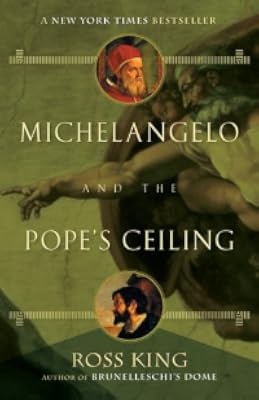
Michelangelo and the Pope's Ceiling
by Ross King
On This Page
Description
In 1508, despite strong advice to the contrary, the powerful Pope Julius II commissioned Michelangelo to paint the ceiling of the newly restored Sistine Chapel. With little experience as a painter (though famed for his sculpture David), Michelangelo was reluctant to begin the massive project.Michelangelo and the Pope's Ceiling recounts the four extraordinary years Michelangelo spent laboring over the vast ceiling while the power politics and personal rivalries that abounded in Rome swirled show more around him. Battling against ill health, financial difficulties, domestic problems, the pope's impatience, and a bitter rivalry with the brilliant young painter Raphael, Michelangelo created scenes so beautiful that they are considered one of the greatest masterpieces of all time. A panorama of illustrious figures converged around the creation of this great work-from the great Dutch scholar Desiderius Erasmus to the young Martin Luther-and Ross King skillfully weaves them through his compelling historical narrative, offering uncommon insight into the intersection of art and history. show lessTags
Recommendations

















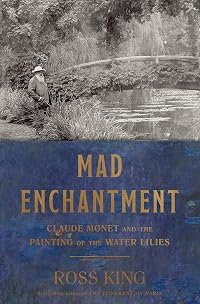

Member Recommendations
Member Reviews
Michelangelo was a grumpy and admittedly ugly man who was so talented it’s almost unreal. A sculptor, he reluctantly accepted the commission to paint the Sistine Chapel with almost no knowledge of how to paint alfresco, much less of painting the correct dimensions of humans or anything else on curved surfaces that would look normal while standing 60 feet below. And yet he did, creating a monumental work of art I simply cannot wait to see. This book was an intimate look at Michelangelo, his relationships with Pope Julius II, his family, his assistants, and with the famed artists at the time: Rafael and DaVinci. We hear his words in his poems and letters to his father and brothers, who probably did indeed take advantage of show more Michelangelo’s hard-earned money. show less
Now THIS is how it's done! In addition to a close view of Michelangelo at work, we get fascinating profiles of a cast of characters including ferocious Pope Julius II and man-about-town Raphael, as well as accounts of the violent events that were occurring while the Sistine Chapel was being painted. I can't wait for the release of Ross King's upcoming "Leonardo and the Last Supper."
I think Ross King has got it just about right. He tells the story of how and why Michelangelo painted the frescoes on the Sistine chapel in the Vatican city and he also tells us why they are a masterpiece of Renaissance art. The book would appeal to the more casual reader, but still holds plenty of interest for readers more widely read on the Italian Renaissance.
The story is told in linear fashion and so we witness the struggles of Michelangelo as he spends four years of his life working and figuring on a scaffold just below the Sistine chapel ceiling. His story is placed in context of a master craftsman working to earn his living in the city states of the IIalian renaissance. For a proven artist as Michelangelo was when Pope Julius II show more awarded him the contract it was still a risk to undertake such a venture. A work of such magnitude presented it’s own problems and Michelangelo had to solve them as he went along, always aware that competition among the elite artists was fierce and there was no room for failure. Ross KIng manages to bring his characters to life and at the same time sketch in the historical events around them. His view of life in Renaissance Italy has enough substance to make this reader feel like he has created the right atmosphere and explains why the characters acted in ways that might be puzzling to modern readers. For example even an artist as well known as Michelangelo was forced to work and live in cramped and dirty conditions being forced to share his bed with two of his fellow artists.
Ross King is an art historian and so he understands the techniques involved in frescoing a renaissance ceiling, and in this book he is able to make this subject an integral part of the story without sounding dry and over scholarly. As a reader I could appreciate the problems and marvel at the way an artist of the calibre of Michelangelo was able to solve them. Life gets in the way of art and Pope Julius’ war mongering with the French and the Venetians was always likely to derail Michelangelo’s work as were problems within his own family, but Michelangelo was something of a workaholic as well as being proud and stubborn and so although at times tested to his limits we could understand how he succeeded.
While Michelangelo was employed in the Sistine chapel, Raphael another great artist of the period was frescoing the walls of Pope Julius’ Library and Ross King uses these two very different character to point up the differences between them, so much so that the book becomes a story of both of these artists with King able to compare and contrast their different painting style as well as their life styles. Raphael was young, good looking, charming to all those around him. Michelangelo was not. King sums up the differences in their painting styles like this:
” One way to understand the differing styles of the two artists is through a pair of aesthetic categories developed two and a half centuries later by the Irish statesman and writer Edmund Burke……… For Burke those things we call beautiful have the properties of smoothness, delicacy, softness of colour and elegance of movement. The sublime, on the other hand comprehends the vast, the obscure, the powerful, the rugged, the difficult attributes which produce in the spectator a kind of astonished wonder and even terror. For the people of Rome in 1511, Raphael was beautiful but Michelangelo was sublime.
Of course King dispels the popular myths about Michelangelo and the Sistine chapel: he did not paint it single handedly (he had a whole team of painters working with him) and he didn’t paint it lying on his back on the scaffold.
King for the most part uses secondary sources; of which there are many, but he uses the material to bring the story into the reach of many more people. Not an original history or an imaginative historical novel, but a solid piece of writing that will inform and entertain many readers who give it their attention and so for me A four star read. show less
The story is told in linear fashion and so we witness the struggles of Michelangelo as he spends four years of his life working and figuring on a scaffold just below the Sistine chapel ceiling. His story is placed in context of a master craftsman working to earn his living in the city states of the IIalian renaissance. For a proven artist as Michelangelo was when Pope Julius II show more awarded him the contract it was still a risk to undertake such a venture. A work of such magnitude presented it’s own problems and Michelangelo had to solve them as he went along, always aware that competition among the elite artists was fierce and there was no room for failure. Ross KIng manages to bring his characters to life and at the same time sketch in the historical events around them. His view of life in Renaissance Italy has enough substance to make this reader feel like he has created the right atmosphere and explains why the characters acted in ways that might be puzzling to modern readers. For example even an artist as well known as Michelangelo was forced to work and live in cramped and dirty conditions being forced to share his bed with two of his fellow artists.
Ross King is an art historian and so he understands the techniques involved in frescoing a renaissance ceiling, and in this book he is able to make this subject an integral part of the story without sounding dry and over scholarly. As a reader I could appreciate the problems and marvel at the way an artist of the calibre of Michelangelo was able to solve them. Life gets in the way of art and Pope Julius’ war mongering with the French and the Venetians was always likely to derail Michelangelo’s work as were problems within his own family, but Michelangelo was something of a workaholic as well as being proud and stubborn and so although at times tested to his limits we could understand how he succeeded.
While Michelangelo was employed in the Sistine chapel, Raphael another great artist of the period was frescoing the walls of Pope Julius’ Library and Ross King uses these two very different character to point up the differences between them, so much so that the book becomes a story of both of these artists with King able to compare and contrast their different painting style as well as their life styles. Raphael was young, good looking, charming to all those around him. Michelangelo was not. King sums up the differences in their painting styles like this:
” One way to understand the differing styles of the two artists is through a pair of aesthetic categories developed two and a half centuries later by the Irish statesman and writer Edmund Burke……… For Burke those things we call beautiful have the properties of smoothness, delicacy, softness of colour and elegance of movement. The sublime, on the other hand comprehends the vast, the obscure, the powerful, the rugged, the difficult attributes which produce in the spectator a kind of astonished wonder and even terror. For the people of Rome in 1511, Raphael was beautiful but Michelangelo was sublime.
Of course King dispels the popular myths about Michelangelo and the Sistine chapel: he did not paint it single handedly (he had a whole team of painters working with him) and he didn’t paint it lying on his back on the scaffold.
King for the most part uses secondary sources; of which there are many, but he uses the material to bring the story into the reach of many more people. Not an original history or an imaginative historical novel, but a solid piece of writing that will inform and entertain many readers who give it their attention and so for me A four star read. show less
As an art history buff, I gravitate towards topics like this one -- in this case, this is the story of how Pope Julius II commissioned Michelangelo to paint the ceiling of the Sistine Chapel. Sometimes, though, art historians can be dull in their presentation -- in full or in part. Not so with Ross King, author of "Michelangelo and the Pope's Ceiling". I found this fascinating from beginning to end and learned a lot in the process of reading this book.
Michelangelo considered himself a sculptor, first and foremost, and it was with great reluctance that he obeyed Pope Julius II's order to come to Rome and spend several years working on, and supervising, the now-iconic Sistine Chapel ceiling. Not only did I learn in detail more about the show more process of fresco and more about the art world at the time (Leonardo da Vinci and Raphael were contemporaries), I also learned more about the intricacies of papal rule and its importance to artists for their survival. Nothing that I was completely clueless about, due to my interest in art history, but definitely did fill in my knowledge.
I also learned interesting tidbits such as:
--The Sistine Chapel got its name from Pope Sixtus IV, who had it built in the 15th century. (p. 23)
-- "Any one lucky enough to be the nephew of a pope could usually count on rapid promotion. The word nepotism comes in fact, from nipote, Italian for nephew" (p. 28).
-- Michelangelo's first attempts at large-scale compositions during his work on the chapel were due to his thinking more as a sculptor. (p. 151).
I am delighted to learn that Ross King has written several more books that reflect on art history. It's hard for me to decide what I'd want to read next -- perhaps "The Judgment of Paris" (about the birth of impressionism) or "Defiant Spirits" (about the Modernist Revolution). Or should I start more at the beginning with his first, "Brunelleschi's Dome"? Most likely it'll be whichever one I come across first in a bookstore. show less
Michelangelo considered himself a sculptor, first and foremost, and it was with great reluctance that he obeyed Pope Julius II's order to come to Rome and spend several years working on, and supervising, the now-iconic Sistine Chapel ceiling. Not only did I learn in detail more about the show more process of fresco and more about the art world at the time (Leonardo da Vinci and Raphael were contemporaries), I also learned more about the intricacies of papal rule and its importance to artists for their survival. Nothing that I was completely clueless about, due to my interest in art history, but definitely did fill in my knowledge.
I also learned interesting tidbits such as:
--The Sistine Chapel got its name from Pope Sixtus IV, who had it built in the 15th century. (p. 23)
-- "Any one lucky enough to be the nephew of a pope could usually count on rapid promotion. The word nepotism comes in fact, from nipote, Italian for nephew" (p. 28).
-- Michelangelo's first attempts at large-scale compositions during his work on the chapel were due to his thinking more as a sculptor. (p. 151).
I am delighted to learn that Ross King has written several more books that reflect on art history. It's hard for me to decide what I'd want to read next -- perhaps "The Judgment of Paris" (about the birth of impressionism) or "Defiant Spirits" (about the Modernist Revolution). Or should I start more at the beginning with his first, "Brunelleschi's Dome"? Most likely it'll be whichever one I come across first in a bookstore. show less
What a brilliant traipse through history. King's depiction of Michelangelo brought the man alive to me. The frustrations he felt having to put aside his first love of sculpting to paint commissions by the Pope and his struggles in getting them to pay him his dues were painful.
It was really interesting to read about how he would paint the ceiling of the Sistine Chapel in a medium in which he was originally unfamiliar and clearly not his forte but the strength of his belief in himself and of course his genius enabled him to create one of the most amazing masterpieces of art.
It was really interesting to read about how he would paint the ceiling of the Sistine Chapel in a medium in which he was originally unfamiliar and clearly not his forte but the strength of his belief in himself and of course his genius enabled him to create one of the most amazing masterpieces of art.
I love this s***. Simple as that. and Ross has that flair of a good writer. Well documented, very organized, he can get you through a boring intensive recap of warring nations with the placement of a well-timed joke. An interesting perspective on Michelangelo (many sources are letters to and from the great artist). A reminder of how religion have their paws in everything (in this case, the roman catholic juggernaut) and how artists can make it or break it.
A fascinating chronology of Michelangelo's achievement. It feels like outside, life in 16th Century Rome was largely like a Monty Python setting rude poverty and soggy mess. Rivalry with Raphael & Da Vinci is highlighted as well as the terminology and techniques of frescoes. It was a particularly stressful period for the artist working under the warrior Pope Julius II while admiring the radical criticism of Savonarola in the Rome that so appalled Luther.
Members
- Recently Added By
Lists

Best Biographies
216 works; 26 members

Eton's list - the books every bright 16 year-old should read
40 works; 6 members

al.vick-parents books
301 works; 1 member

In Our Time books
4,934 works; 2 members
Author Information

16+ Works 11,122 Members
Ross King is the award-winning and bestselling author of Brunelleschi's Dome, Michelangelo and the Popes Ceiling, The Judgment of Paris, Mad Enchantment, Leonardo and the Last Supper, and Machiavelli: Philosopher of Power, among other books. He and his wife live in Woodstock, Great Britain.
Awards and Honors
Common Knowledge
- Canonical title
- Michelangelo and the Pope's Ceiling
- Original publication date
- 2003
- People/Characters
- Michelangelo Buonarroti; Julius II, Pope (Giuliano della Rovere, 1443-1513); Raphael, artist
- Important places
- Vatican City; Rome, Italy
- Dedication
- For Melanie
- First words
- The Piazza Rusticucci was not one of Rome's most prestigious addresses. Though only a short walk from the Vatican, the square was humble and nondescript, part of a maze of narrow streets and densely packed shops and houses t... (show all)hat ran west from where the Ponte Sant'Angelo crossed the Tiber River.
- Last words
- (Click to show. Warning: May contain spoilers.)But for the millions of visitors who negotiate the labyrinth of the Vatican's galleries and corridors to enter the chapel and seat themselves on its rows of wooden benches, staring upward in unwitting imitation of the prophet Jonah, the vision that rises above their heads is no less spectacular.
Classifications
Statistics
- Members
- 2,861
- Popularity
- 6,364
- Reviews
- 32
- Rating
- (3.90)
- Languages
- 7 — Dutch, English, German, Hungarian, Italian, Portuguese, Swedish
- Media
- Paper, Audiobook, Ebook
- ISBNs
- 27
- ASINs
- 12