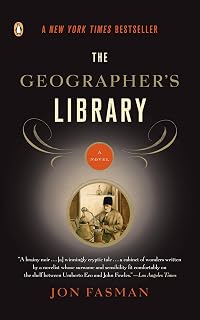
The Geographer's Library
by Jon Fasman
On This Page
Description
Expecting to cover zoning meetings and school plays, Paul Tomm signs on as a cub reporter with a small-town paper near his Connecticut alma mater. When Jaan Puhapaev, a professor doing his research on the ancient art of alchemy, dies under suspicious circumstances, Paul is called back to the campus to write an obituary. But Puhapaev had no family or friends, and the only person who seems to have known anything about him is the beautiful next-door neighbor, Hannah Rowe. When the coroner show more working on Puhapaev's autopsy is killed, Tomm teams up with two detectives and Hannah, with whom he has fallen in love, to discover what happened to both men. But the more he gets acquainted with the professor's story, the stranger it gets. What did Puhapaev know about the fourteen charmed, cursed talismans that could turn not only base metal into gold but also old age into youth? show lessTags
Recommendations


Member Recommendations
Member Reviews
Organized in chapters alternating between a small-town journalist's investigation of a college professor's murder and a multitude of cloak-and-dagger dealings in the Near East involving centuries-old artifacts, "The Geographer's Library" is an original and challenging mystery. Jon Fasman's vividly imagined descriptions of the artifacts themselves, together with his use of well-researched historical settings to bring the unsavory dealings surrounding them to life, reminded me at times of Michael Chabon's "The Amazing Adventures of Kavalier & Clay." By the middle of the book, however, the "artifact chapters" became somewhat tedious and predictable, and I found myself fighting the urge to rush through them to get to the next present-day show more chapter. I also found the resolution of the plot less effective than it could have been, as many aspects of this fascinating mystery, and the alchemy underlying it, became somewhat superfluous when the alternating narratives finally came together. Perhaps this minor shortcoming could have been avoided if Fasman had used a third-person narrator to tell the entire tale, rather than the first-person journalist narrator whose limited knowledge base (even with the assistance of a friendly professor and police officer) only allowed him to scratch the surface of the relics' saga. Still, in its sheer originality and beautiful writing style, this book is a highly recommended departure from many of the dumbed-down thrillers that litter our bookstores.
-Kevin Joseph, author of "The Champion Maker" show less
-Kevin Joseph, author of "The Champion Maker" show less
The Geographer’s Library by Jon Fasman, a recent read for my book club, got off to a slow start, but it gradually gathered some substance and proved to be an interesting and entertaining read.
Paul Tomm, a recent graduate of Wickenden College in Connecticut, has returned to the town of his alma mater to take a job at a local newspaper. He writes a few pieces about local events, and then his editor assigns him to write an obituary for a former professor. Paul discovers few people know anything about Professor Jaan Pühapäev – not even his age or date of birth. Then the coroner who examined the body dies after a hit and run accident. Paul is a rather naïve young man, who seems to lack some pretty basic knowledge for a college grad. show more For example, he does not know the meaning of the word “caduceus.” The lure of interest in the story by an editor at a large Boston daily paper drives Paul to dig into the case.
This novel is a really quick read. It also has an interesting structure. At the root of the murders is a collection of mysterious alchemical items – stolen from the library of a prominent philosopher, geographer, and alchemist in the 12th century. Persons unknown are collecting the items, which have been scattered around the world. Interspersed between the chapters Fasman has inserted line drawings and catalogue descriptions of the items. For example, Fasman writes, “Item 1: An alembic is the top part of an apparatus used for distilling. This one is made of sturdy green glass, 36 centimeters tall, 18 centimeters around at the widest point of the base. The top part of the vessel is narrow and fluted, and turns sharply to the right; alembics are set over a still to collect and carry vapors to another vessel” (18). This information is followed by date and name of manufacturer, place of origin, last known owner, and estimated value (18-19). Each of these items figures in the story of the murders and the shadow characters trying to sell or acquire these items.
Fasman also has a nice eye for description and details. He describes a train ride for one item sought after in Siberia by some corrupt Soviet officials. Fasman writes, “As soon as the train’s chuffing settled into a regular rhythm, Yuri fell into a boozy and heavy-headed sleep. When he awoke, the familiar chaotic Moscow vista – squat brick factories either half built or half ruined, birch trees stationed haphazardly in front of massive apartment blocks, wires and streets radiating outward from the tracks into the city’s heart – had given way to endless pine forests punctuated once in a rare while by villages consisting of little more than a few dirt roads and twelve to fifteen tiny dachas, aglow from the inside, nestled close together like gossiping smokers in a tavern” (70). He also has some rather clever sentences. For example, “mountains poking through the snow like crumpled birds spanned the other bank, stretching and rising all the way to the Tien Shan Mountains in the distance” (75).
For mystery fans, the connection among these characters and items is not easily apparent. My hope is that a sequel to The Geographer's Library is in the works to tie up many of the loose ends. 3 stars
--Jim, 9/21/14 show less
Paul Tomm, a recent graduate of Wickenden College in Connecticut, has returned to the town of his alma mater to take a job at a local newspaper. He writes a few pieces about local events, and then his editor assigns him to write an obituary for a former professor. Paul discovers few people know anything about Professor Jaan Pühapäev – not even his age or date of birth. Then the coroner who examined the body dies after a hit and run accident. Paul is a rather naïve young man, who seems to lack some pretty basic knowledge for a college grad. show more For example, he does not know the meaning of the word “caduceus.” The lure of interest in the story by an editor at a large Boston daily paper drives Paul to dig into the case.
This novel is a really quick read. It also has an interesting structure. At the root of the murders is a collection of mysterious alchemical items – stolen from the library of a prominent philosopher, geographer, and alchemist in the 12th century. Persons unknown are collecting the items, which have been scattered around the world. Interspersed between the chapters Fasman has inserted line drawings and catalogue descriptions of the items. For example, Fasman writes, “Item 1: An alembic is the top part of an apparatus used for distilling. This one is made of sturdy green glass, 36 centimeters tall, 18 centimeters around at the widest point of the base. The top part of the vessel is narrow and fluted, and turns sharply to the right; alembics are set over a still to collect and carry vapors to another vessel” (18). This information is followed by date and name of manufacturer, place of origin, last known owner, and estimated value (18-19). Each of these items figures in the story of the murders and the shadow characters trying to sell or acquire these items.
Fasman also has a nice eye for description and details. He describes a train ride for one item sought after in Siberia by some corrupt Soviet officials. Fasman writes, “As soon as the train’s chuffing settled into a regular rhythm, Yuri fell into a boozy and heavy-headed sleep. When he awoke, the familiar chaotic Moscow vista – squat brick factories either half built or half ruined, birch trees stationed haphazardly in front of massive apartment blocks, wires and streets radiating outward from the tracks into the city’s heart – had given way to endless pine forests punctuated once in a rare while by villages consisting of little more than a few dirt roads and twelve to fifteen tiny dachas, aglow from the inside, nestled close together like gossiping smokers in a tavern” (70). He also has some rather clever sentences. For example, “mountains poking through the snow like crumpled birds spanned the other bank, stretching and rising all the way to the Tien Shan Mountains in the distance” (75).
For mystery fans, the connection among these characters and items is not easily apparent. My hope is that a sequel to The Geographer's Library is in the works to tie up many of the loose ends. 3 stars
--Jim, 9/21/14 show less
A really good literary mystery, with murder, betrayal, and alchemy. In part, it reminded me a bit of [People of the Book], as we are given chapters on various objects throughout the centuries. But the main part of the book is a contemporary mystery about a young newspaper reporter and the seemingly mysterious death of a local professor. I found the ending a bit hard to follow, but I loved the journey getting there.
4.25 stars
4.25 stars
Paul Tomm is a smart but somewhat aimless college grad who lands a reporter job at a weekly newspaper in the tiny town of Lincoln, Connecticut. When a professor from his alma mater dies, he is assigned the obituary, but soon finds that there is more to this quiet professor than meets the eye. Soon he is swept up in an unusual tale of murder, greed, and alchemy. A collection of alchemical objects are described in alternating chapters, and their sordid histories are almost as engaging as the main plot. And while the story itself was a very enjoyable read, what really drew me in was my empathy with Paul. His observations and reactions are so familiar to me. It really helped me feel like part of the story. I'll definitely be on the lookout show more for Fasman's other works. show less
C'è stato un periodo, che spero sia definitivamente tramontato, in cui andava di moda scrivere libri tra passato e presente. Voglio dire, non libri in cui un mistero del passato influenza il presente, ma che sono scritti tutti nel presente, e nemmeno libri storici, ma proprio libri che hano capitolo nel presente, capitoli nel passato, storie che si intrecciano e personaggi che si influenzano anche se apparentemente non hanno nulla a che vedere l'uno con l'altro.
Detta così sembrerebbe una figata, se non che nella gran parte dei casi ne sono usciti fuori pasticci innominabili.
La biblioteca dell'alchimista è esattamente uno di questi libri, che svariona via tra arabi in visita ai re danesi, il KGB e un giornalista americano che non si show more capisce bene che cosa vuole dalla vita.
Micidiale. show less
Detta così sembrerebbe una figata, se non che nella gran parte dei casi ne sono usciti fuori pasticci innominabili.
La biblioteca dell'alchimista è esattamente uno di questi libri, che svariona via tra arabi in visita ai re danesi, il KGB e un giornalista americano che non si show more capisce bene che cosa vuole dalla vita.
Micidiale. show less
This was potentially a great book, until the end, which disappointed me. There are multiple stories bound together by the amateur investigation into a mysterious death in a liberal New England college. Alchemy gets in there, and a lot of intrigue over valuable arcane objects (including, perhaps,The Emerald Tablet itself) that once were part of a single collection and now have been gathered together again by deadly ruthless hands from their scattered locations around the world. Each object is treated individually, with a story line explaining how it was "liberated" from its last known owner. The modern story line, which is the weakness of this novel, involves an incredibly innocent young reporter who gets caught up in this murky show more undertaking totally by chance. It is slightly reminiscent of The Da Vinci Code, although the ancient "secrets" of that book were all fairly well-known to me when I read it. Violating one of my rules, Fasman told us, rather than showing us, how everything fit together at the end, and some of it was a bit much, thank you. When I got to the end, in fact, I thought I must have missed something fairly significant along the way, because I had that "up in the air" feeling. I had almost determined to go back to the beginning and read through it again. But I read some reviews on Amazon and this site, most of which noted all the same flaws, so I decided against spending any more precious reading time on it. I enjoyed the 15 vignettes devoted to the far-flung objects, as they were fascinating, and very well written. But ultimately, the whole was LESS than the sum of its parts. As this was Fasman's first novel, I will keep him in mind; he may improve with practice. show less
liked it but not as much as I had expected. Enjoyed the objects and the story in the past, but the present was less convincing
Members
- Recently Added By
Author Information

3 Works 2,294 Members
Common Knowledge
- Original title
- The geographer's library
- Original publication date
- 2005
- People/Characters
- Paul Thomm; Hanna Rowe; Anton Jabib; Joe Jabib; Tonu; Jaan Puhapaev (show all 7); Art Rolens
- Important places
- Lincoln, Connecticut, USA; Wickenden College; Sicily, Italy
- Epigraph
- I find myself always torn between two beliefs: the belief that life should be better than it is and the belief that when it appears better it really is worse.
Graham Greene, Journey Without Maps - Dedication
- For Alissa.
- First words
- For a journalist at a weekly paper, especially one as small as the Carrier, The Day the Paper Comes Out is a day of rest.
- Last words
- (Click to show. Warning: May contain spoilers.)They are only feelings, and I let them pass.
- Blurbers
- Furst, Alan
Classifications
Statistics
- Members
- 2,158
- Popularity
- 9,494
- Reviews
- 65
- Rating
- (3.07)
- Languages
- 13 — Dutch, English, Estonian, French, German, Italian, Lithuanian, Norwegian (Bokmål), Norwegian, Portuguese, Spanish, Swedish, Turkish
- Media
- Paper, Audiobook, Ebook
- ISBNs
- 34
- UPCs
- 1
- ASINs
- 14