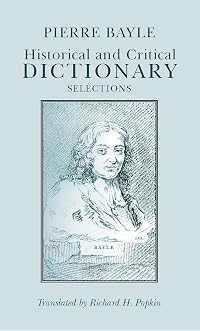
Historical and Critical Dictionary: Selections (Hackett Classics)
by Pierre Bayle
On This Page
Description
Richard Popkin's meticulous translation--the most complete since the eighteenth century--contains selections from thirty-nine articles, as well as from Bayle's four Clarifications. The bulk of the major articles of philosophical and theological interest--those that influenced Leibniz, Berkeley, Hume, and Voltaire and formed the basis for so many eighteenth-century discussions--are present, including David, Manicheans,Paulicians,Pyrrho,Rorarius,Simonides,Spinoza, and Zeno of Elea.Tags
Recommendations















Member Reviews
Pierre Bayle (1647-1706), French philosophe and reviewer. After moving to Rotterdam, he devoted himself to writing this biographical and historical "dictionary", a seminal work appearing in parts in Europe. Bayle fought for religious tolerance in the face of persecution. He also showed, repeatedly, that atheist objections to theological claims could not be answered.
His discussion of Spinoza was controversial, and as translated here, does not appear to do much. But in its day, it inspired incendiary reaction by both Protestant and Catholic factions. He discusses the injustice of classes, the hypocrisy of the pious, the physical annihilation of the Manicheans without disposing of their arguments, and the fact that those who can show more successfully oppose the arguments of the Manicheans find themselves to be Unitarians.(!) [418-19]
Includes the biography of "Ariosta", the concubine whose faithfulness and political skills so nicely coupled with great beauty. Bayle notes that from her eleven children comes a titled House of Este, which still exists in the branch of Modena and of Rhegio. That Ariosta gave more honor to her family than she took from it. [21] He discusses the "singular efficacy" of marriage, which changes the nature of three kinds of time:
"The past is no less free from its influences than is the present or the future." He acknowledges the force, the irresistable authority, of custom.
Bayle keenly scrutinizes how women are treated, exposing its badly baud. [22, 23]
With detailed Index. show less
His discussion of Spinoza was controversial, and as translated here, does not appear to do much. But in its day, it inspired incendiary reaction by both Protestant and Catholic factions. He discusses the injustice of classes, the hypocrisy of the pious, the physical annihilation of the Manicheans without disposing of their arguments, and the fact that those who can show more successfully oppose the arguments of the Manicheans find themselves to be Unitarians.(!) [418-19]
Includes the biography of "Ariosta", the concubine whose faithfulness and political skills so nicely coupled with great beauty. Bayle notes that from her eleven children comes a titled House of Este, which still exists in the branch of Modena and of Rhegio. That Ariosta gave more honor to her family than she took from it. [21] He discusses the "singular efficacy" of marriage, which changes the nature of three kinds of time:
"The past is no less free from its influences than is the present or the future." He acknowledges the force, the irresistable authority, of custom.
Bayle keenly scrutinizes how women are treated, exposing its badly baud. [22, 23]
With detailed Index. show less
Ratings
Members
- Recently Added By
Author Information

92+ Works 526 Members
Born at Carla-le-Comte (now Carla-Bayle) in southern France, Pierre Bayle was the son of a French Protestant minister. Because of the persecution of the Huguenots in France, Bayle was forced to flee to Holland in 1681 where he lived the rest of his life. Bayle wrote a large number of works attacking all kinds of theological and philosophical show more theories and opposing all kinds of intolerance; he also edited one of the first major philosophical journals. Bayle's most widely known work is his immense four-folio Historical and Critical Dictionary (1697-1702), in which he developed a complete skepticism about everything that is said and everything that is done. Considered the Arsenal of the Enlightenment, the work greatly influenced Berkeley, Hume, and Voltaire. (Bowker Author Biography) show less
Some Editions
Series
Belongs to Publisher Series
Classifications
- Genres
- Nonfiction, Reference, Philosophy, History, Biography & Memoir, General Nonfiction
- DDC/MDS
- 190 — Philosophy & psychology Modern western philosophy Modern western and other noneastern philosophy
- LCC
- B1825 .D53213 .B39 — Philosophy, Psychology and Religion Philosophy (General) By period Modern By region or country
- BISAC
Statistics
- Members
- 157
- Popularity
- 209,112
- Reviews
- 1
- Rating
- (3.61)
- Languages
- English, French, German, Spanish
- Media
- Paper
- ISBNs
- 8
- ASINs
- 1