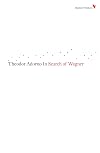
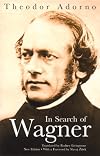
In Search of Wagner
by Theodor Adorno
On This Page
Description
Analyzes Wagner's music and compositional techniques, discusses his character, and examines the ideological tendencies of his approach to art.Tags
Recommendations







Member Reviews
I'm not sure if Adorno likes any music, at all. Also suspicious that he allows Strauss to do so much of his intellectual labor. But the chapters about color, myth, and phantasmagoria are amazing. Suggested to me by Dominic Coles.
My copy of this book is unique. Adorno was searching for the meaning of Wagner. I am searching for meaning in Adorno. Someone who came before me was doing one or the other, or perhaps both. Whoever it was left behind traces of their search: underlinings, sometimes lasting for several pages; marginal notes; graphics. There are even two pencilled epigraphs: [1] "the mixture of D. Michael Quinn and cyberpunk", and [2] "Come Again to the Healing Waters -- Liszt." Now, D. Michael Quinn could either be: (a) a Mormon historian fixated on polygamy and homosexuality, or (b) an orthopedic surgeon practicing in Bloomfield, Michigan. Liszt is, presumably, Wagner's piano-playing father-in-law. Now, mormonism has a somewhat conflicted view of Jews show more and Judaism, considering Native Americans to be both (1) the lost tribe of Israel, hence blessed by God as the Chosen People and (2) cursed by God with a red skin as a result of their antagonism to the Sons of Nephi. And, of course, we know about Wagner's anti-semitism, although some of his best friends and benefactors were Jews. How Bloomfield, Michigan comes into it, I don't know. The search continues... show less
It always strikes me as strange when people use Adorno's musical works as the basis for their interpretation of Adorno, and now I've read this it seems even stranger. There's very little here that you can't find more clearly expressed in shorter programmatic essays, or essays on literary figures.The meat here comes in the form of sentences wedged into paragraphs which are incomprehensible to me, and I assume to most of the rest of the world, since they deal with details of the plot or the musical structure of Wagner's operas. I got very little out of it, to be honest, either for Adorno or for Wagner. If you're looking for an 'easy' way in, you should try 'Critical Models,' or the first few essays in 'Notes to Literature' instead. Unless show more you're a music buff, in which case this might make more sense to you. show less
Ratings
Members
- Recently Added By
Author Information

323+ Works 14,270 Members
Theodor W. Adorno is the progenitor of critical theory, a central figure in aesthetics, and the century's foremost philosopher of music. He was born and educated in Frankfurt, Germany. After completing his Ph.D. in philosophy, he went to Vienna, where he studied composition with Alban Berg. He soon was bitterly disappointed with his own lack of show more talent and turned to musicology. In 1928 Adorno returned to Frankfurt to join the Institute for Social Research, commonly known as The Frankfurt School. At first a privately endowed center for Marxist studies, the school was merged with Frankfort's university under Adorno's directorship in the 1950s. As a refugee from Nazi Germany during World War II, Adorno lived for several years in Los Angeles before returning to Frankfurt. Much of his most significant work was produced at that time. Critics find Adorno's aesthetics to be rich in insight, even when they disagree with its broad conclusions. Although Adorno was hostile to jazz and popular music, he advanced the cause of contemporary music by writing seminal studies of many key composers. To the distress of some of his admirers, he remained pessimistic about the prospects for art in mass society. Adorno was a neo-Marxist who believed that the only hope for democracy was to be found in an interpretation of Marxism opposed to both positivism and dogmatic materialism. His opposition to positivisim and advocacy of a method of dialectics grounded in critical rationalism propelled him into intellectual conflict with Georg Hegel, Martin Heidegger, and Heideggerian hermeneutics. (Bowker Author Biography) show less
Some Editions
Series
Belongs to Publisher Series
Radical Thinkers (37 - Set 4(1))
Work Relationships
Is contained in
Common Knowledge
- Original title
- Versuch uber Wagner
- Original publication date
- 1952
- People/Characters
- Richard Wagner
Classifications
- Genres
- Music, Nonfiction, Philosophy, Economics, Literature Studies and Criticism, Biography & Memoir
- DDC/MDS
- 782.1092 — Arts & recreation Music Vocal Music, Singing Operas and related dramatic vocal forms; concert versions modified standard subdivisions History, geographic treatment, biography Biography
- LCC
- ML410 .W1 .A5953 — Music Literature on music Literature on music History and criticism Biography
- BISAC
Statistics
- Members
- 200
- Popularity
- 163,266
- Reviews
- 3
- Rating
- (3.17)
- Languages
- 7 — Danish, English, French, German, Italian, Spanish, Swedish
- Media
- Paper, Ebook
- ISBNs
- 15
- ASINs
- 2