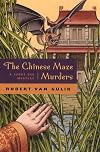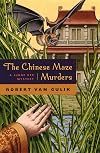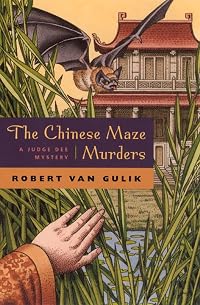
The Chinese Maze Murders
by Robert van Gulik
Judge Dee: Publication order (1), Judge Dee: Chronological order (10)
On This Page
Description
Poisoned plums, a cryptic scroll picture, passionate love letters, and a hidden murderer with a penchant for torturing and killing women lead Judge Dee to the heart of the Governor's garden maze and the answers to three interwoven mysteries. The Chinese Maze Murders represents Robert van Gulik's first venture into writing suspense novels after the success of Dee Gong An, his translation of an anonymous Chinese detective novel from the sixteenth century.Tags
Recommendations




























Member Reviews
Who knew 7th century China could provide such fertile source material for mysteries? And who knew that it would take a Dutch diplomat to share the style with the West? Not me. The descriptions don't quite do it justice, and the explanation behind the stories usually add another layer of interest. In this one, Van Gulik regains some of the needed pacing and action of The Chinese Gold Murders, and had me intrigued from chapter one.
Judge Dee has a new post, a border city under periodic threat from the Uyghur tribes. His entourage feels it might be more than a bit rural and possibly a step down in prestige. Their opinion seems confirmed by the populace, who takes no notice of their new judge, leaving only an old, dissatisfied servant to show more welcome them to dusty and ill-used quarters. Within a day of arrival, the Judge has the story: the town is under the thumb of a thug, albeit a very rich one, who is prone to beating those who can't come up a bit of coin or free labor. A distraught father beseeches him to find his missing daughter, a son requests Judge Dee to arrest his father's would-be-murderer, and a disowned widow needs aid in recovering part of her husband's estate for her son.
Apparently, traditional stories often had multiple cases going at once--much like real life--and I enjoyed the Judge's logical and organized approach to tackling the issues he faces, as well as the shenanigans by his merry band of misfits. His loyal servants, technically 'reformed,' included a clever thief, Tao Gan, and two former highwaymen from The Chinese Gold Murders, Ma Joong and Chiao Tai.
Done in semi-traditional style and based on a legendary figure, Judge Dee, these stories feel somewhat like The Brothers Grimm starring Agatha Christie's Hercule Poirot. Like Grimm, the story can be a bit bloody, as traditional Chinese mysteries included punishment of the villain. I'll also note that some of his stories might have a sexual fetish involved as part of a motivation; I'd have to say the Chinese must have been far more liberal about this than the English reading public.
Overall, this one regained my faith in the series after the lackluster [b:The Chinese Maze Murders|1055477|The Chinese Maze Murders|Robert van Gulik|https://images.gr-assets.com/books/1375808499s/1055477.jpg|1042028]. Recommended to those in the mood for some 7th century mysteries. show less
Judge Dee has a new post, a border city under periodic threat from the Uyghur tribes. His entourage feels it might be more than a bit rural and possibly a step down in prestige. Their opinion seems confirmed by the populace, who takes no notice of their new judge, leaving only an old, dissatisfied servant to show more welcome them to dusty and ill-used quarters. Within a day of arrival, the Judge has the story: the town is under the thumb of a thug, albeit a very rich one, who is prone to beating those who can't come up a bit of coin or free labor. A distraught father beseeches him to find his missing daughter, a son requests Judge Dee to arrest his father's would-be-murderer, and a disowned widow needs aid in recovering part of her husband's estate for her son.
Apparently, traditional stories often had multiple cases going at once--much like real life--and I enjoyed the Judge's logical and organized approach to tackling the issues he faces, as well as the shenanigans by his merry band of misfits. His loyal servants, technically 'reformed,' included a clever thief, Tao Gan, and two former highwaymen from The Chinese Gold Murders, Ma Joong and Chiao Tai.
Done in semi-traditional style and based on a legendary figure, Judge Dee, these stories feel somewhat like The Brothers Grimm starring Agatha Christie's Hercule Poirot. Like Grimm, the story can be a bit bloody, as traditional Chinese mysteries included punishment of the villain. I'll also note that some of his stories might have a sexual fetish involved as part of a motivation; I'd have to say the Chinese must have been far more liberal about this than the English reading public.
Overall, this one regained my faith in the series after the lackluster [b:The Chinese Maze Murders|1055477|The Chinese Maze Murders|Robert van Gulik|https://images.gr-assets.com/books/1375808499s/1055477.jpg|1042028]. Recommended to those in the mood for some 7th century mysteries. show less
Judge Dee takes up a new post in Lan-fang where he has to face not only the usual baffling cases but also the threat of a barbarian incursion from across China's Western border, which may be aided by Chinese traitors from within the city.
I'm not sure I fully followed how the Judge solved the case of the maze but was willing to chalk it up to not really paying enough attention to the scroll painting. I assume the portrayal of lesbians was authentic to the time and place of the original narratives rather than imported by the author's own biases, which became obvious in the afterword, and so just has to be accepted as how life was then.
I'm not sure I fully followed how the Judge solved the case of the maze but was willing to chalk it up to not really paying enough attention to the scroll painting. I assume the portrayal of lesbians was authentic to the time and place of the original narratives rather than imported by the author's own biases, which became obvious in the afterword, and so just has to be accepted as how life was then.
I am a long-time fan of Robert van Gulik's Judge Dee series of mysteries. Van Gulik, a celebrated Orientalist and linguist and the Dutch ambassador to Japan, was fluent in Mandarin, among other Asian languages; his first Judge Dee book, Celebrated Cases of Judge Dee, was actually a translation of the cases of an actual Tang Dynasty magistrate and statesman by the name of Dee Goong An (sometimes transliterated as Dee Jen-Djieh and Dí Rénjié). Van Gulik realized that, if he recast the case files as mysteries by withholding the solution, these true-life investigations and court cases would make find mysteries. And so they do!
The Chinese Maze Murders marks one of the first of 16 novels, novellas, and short-story collections in which Van show more Gulik, inspired by court cases and his own imagination, actually penned the plots. (The Chinese Maze Murders was the first of Van Gulik's own Judge Dee tomes published, but it ranks third chronologically after The Chinese Gold Murders, my favorite Judge Dee book, and The Chinese Bell Murders.) The writing style is a bit formal, as you'd expect from books written 40 to 60 years ago. (Although himself Dutch, Van Gulik wrote these novels in English, which may also account for the formal phrasing.) However, the plots are very enjoyable, and the books act as a window into a far-off time and a very different sensibility. Van Gulik tried to retain the ancient Chinese flavor of the stories, and you'll find omens, luck, ghosts, and other supernatural phenomena play a part in some of the stories -- as they would have when recounted and transcribed more than 1,300 years ago. They also, as according to Chinese custom at the time, usually involve three intertwined cases. (So that isn't an over-the-top touch, but an homage to the original authors/scribes.)
Adventurous readers interested in something unlike anything else they'd read or those who have an interest in Ancient China will devour these books, as I have. The plots are quite clever, and Judge Dee's henchman -- in particular, his brawny lieutenant Ma Joong -- frequently add humor to the tales. I can particularly recommend the first book, The Celebrated Cases of Judge Dee, and Van Gulik's own The Chinese Bell Murders, The Haunted Monastery, The Emperor's Pearl, The Red Pavilion, and the short-story collection Judge Dee at Work: Eight Chinese Detective Stories. show less
The Chinese Maze Murders marks one of the first of 16 novels, novellas, and short-story collections in which Van show more Gulik, inspired by court cases and his own imagination, actually penned the plots. (The Chinese Maze Murders was the first of Van Gulik's own Judge Dee tomes published, but it ranks third chronologically after The Chinese Gold Murders, my favorite Judge Dee book, and The Chinese Bell Murders.) The writing style is a bit formal, as you'd expect from books written 40 to 60 years ago. (Although himself Dutch, Van Gulik wrote these novels in English, which may also account for the formal phrasing.) However, the plots are very enjoyable, and the books act as a window into a far-off time and a very different sensibility. Van Gulik tried to retain the ancient Chinese flavor of the stories, and you'll find omens, luck, ghosts, and other supernatural phenomena play a part in some of the stories -- as they would have when recounted and transcribed more than 1,300 years ago. They also, as according to Chinese custom at the time, usually involve three intertwined cases. (So that isn't an over-the-top touch, but an homage to the original authors/scribes.)
Adventurous readers interested in something unlike anything else they'd read or those who have an interest in Ancient China will devour these books, as I have. The plots are quite clever, and Judge Dee's henchman -- in particular, his brawny lieutenant Ma Joong -- frequently add humor to the tales. I can particularly recommend the first book, The Celebrated Cases of Judge Dee, and Van Gulik's own The Chinese Bell Murders, The Haunted Monastery, The Emperor's Pearl, The Red Pavilion, and the short-story collection Judge Dee at Work: Eight Chinese Detective Stories. show less
I had read this before--decades ago as a teen and can't say even after reading it again I could say I remembered it--which is a point against it. It's a historical mystery set in China's Tang Dynasty around 700 AD and featuring Judge Dee. He's a historical figure with the kind of legendary reputation of a Sherlock Holmes as a detective. The plot is clever that way--worthy of a Conan Doyle, if not with the memorable and jaw-dropping quality of Christie. The style is rather clunky. Robert van Gulik first wrote this in Chinese for Asian audiences, then translated it into English--actually to facilitate it being translated into Japanese before ever thinking to put this before a Western audience. He was a Dutch diplomat and English would not show more have been his first language--not sure if that factors in. His recurring characters are likeable if not complex.
Yet despite that I'm fond of this novel and the series--enough to give it four stars. These are clever and satisfying mysteries but for me what makes these novels special is the setting. Van Gulik obviously knew and loved China and its history and culture. He served as a diplomat there and had translated classic Chinese literature. His purpose in writing The Chinese Maze Murders according to his forward was to create a mystery novel along the lines of classic Chinese mysteries that would appeal both to contemporary Asians and Westerners and I loved the result. One of the major differences between that model and the Western sort of mystery is that instead of one central mystery, Dee has three cases that are woven into the plot, and this allows us to roam among all classes of Chinese society of the time. Mind you, the story is deliberately anachronistic. Like his models, Van Gulik frames the story as being told by a man of the Ming Dynasty almost a thousand years later, and the details Van Gulik warns us are of that time, not of the time it is set. Regardless, Van Gulik's novel and series has the quality of the best historical fiction: Judge Dee and the people surrounding him feel very much of their own place and time--not our own. That's a lot of the fascination. And yet sometimes it seems startingly modern in unexpected ways. That's part of the fascination too. show less
Yet despite that I'm fond of this novel and the series--enough to give it four stars. These are clever and satisfying mysteries but for me what makes these novels special is the setting. Van Gulik obviously knew and loved China and its history and culture. He served as a diplomat there and had translated classic Chinese literature. His purpose in writing The Chinese Maze Murders according to his forward was to create a mystery novel along the lines of classic Chinese mysteries that would appeal both to contemporary Asians and Westerners and I loved the result. One of the major differences between that model and the Western sort of mystery is that instead of one central mystery, Dee has three cases that are woven into the plot, and this allows us to roam among all classes of Chinese society of the time. Mind you, the story is deliberately anachronistic. Like his models, Van Gulik frames the story as being told by a man of the Ming Dynasty almost a thousand years later, and the details Van Gulik warns us are of that time, not of the time it is set. Regardless, Van Gulik's novel and series has the quality of the best historical fiction: Judge Dee and the people surrounding him feel very much of their own place and time--not our own. That's a lot of the fascination. And yet sometimes it seems startingly modern in unexpected ways. That's part of the fascination too. show less
While its far from the best mystery around, The Chinese Maze Murders makes for a strong combination of mystery elements with a period piece structure the all comes together to paint a vivid impression of its setting in a way few other books in the genre manage to accomplish.
My main enjoyment came more from seeing a familiar genre under such a different structure, borrowing from a form of Chinese novels that predated the popular Western mysteries, more so than the execution of that form. Which may be an unfair basis for a rating as it stems more from familiarity than outright quality but considering the context of the book's release and its attempt to introduce Western audiences to this type of approach to mystery storytelling, I think show more that can be justified.
In either case, I'm interested enough by the potential shown here that I plan to read more by van Gulik and potentially other authors operating under the same framework. It should be interesting to see how this structure fares under conditions where the quality of the execution outweighs the novelty factor. show less
My main enjoyment came more from seeing a familiar genre under such a different structure, borrowing from a form of Chinese novels that predated the popular Western mysteries, more so than the execution of that form. Which may be an unfair basis for a rating as it stems more from familiarity than outright quality but considering the context of the book's release and its attempt to introduce Western audiences to this type of approach to mystery storytelling, I think show more that can be justified.
In either case, I'm interested enough by the potential shown here that I plan to read more by van Gulik and potentially other authors operating under the same framework. It should be interesting to see how this structure fares under conditions where the quality of the execution outweighs the novelty factor. show less
Only so-so but it has the glow of quasi believable antiquity. I read the introduction and totally didn't believe it. Chinese detective stories from the 1600s?! I'm still not quite clear on the source materials. It all reminds me of many movies set in ancient China. The text is pretty turgid, my husband finds it ideal as a going to sleep book.
This was the first Judge Dee book I ever read. My grandfather had a copy in his library. I was transfixed by the illustrations, the descriptions, the plot, and, most of all, the characters' names, which seemed unlike any other Chinese names I was familiar with at the time. I have since read every Judge Dee story I have been able to find, and I still enjoy them.
Members
- Recently Added By
Lists

Books Read in 2017
4,249 works; 130 members

Books Read in 2024
4,727 works; 128 members
Author Information

112+ Works 10,335 Members
Robert H. Van Gulik was born in the Netherlands on August 9, 1910. He joined the Dutch Foreign Service in 1935. From 1942-1945, he was secretary for the Dutch mission to Chiang Kai-shek's Nationalist government in Chongqing, China. During this time, he translated a number of Chinese texts including Celebrated Cases of Judge Dee (Dee Goong An). He show more proceeded to write sixteen of his own Judge Dee novels. His scholarly works included Siddham: An Essay on the History of Sanskrit Studies in China and Japan, Hayagriva: Horse Cult in Asia, and Sexual Life in Ancient China. He died on September 24, 1967. (Bowker Author Biography) show less
Some Editions
Series


Belongs to Publisher Series
Grands détectives, 10/18 (1673)
Work Relationships
Is contained in
Is a (non-series) sequel to
Common Knowledge
- Canonical title
- The Chinese Maze Murders
- Original title
- Meiro-no-satsujin
- Original publication date
- 1951
- People/Characters
- Judge Dee (Dee Jen-djieh); Hoong Liang; Ma Joong; Chiao Tai; Tao Gan; Tulbee (show all 20); Headman Fang; Chien Mow; Yoo Shou-chien; Yoo Kee; Yoo Shan; Ding Hoo-gwo (General); Ding Yee (Junior Candidate); Woo Feng (the painter); Corporal Ling; Liu Wan-fang; White Orchid; Dark Orchid; Ooljin (Uigur chieftain); Master Crane Robe
- Important places
- Lan-fang, China; China (Tang Dynasty)
- Important events
- Tang Dynasty (618-907 CE: core story); Ming Dynasty (1368&ndash | 1644 CE: frame story)
- First words
- Under the present illustrious Ming dynasty, in the Yoong-lo era, our empire is at peace, crops are plentiful, there are neither droughts nor floods, and the people are prosperous and content.
- Last words
- (Click to show. Warning: May contain spoilers.)He swung himself in the saddle and rode back to the city.
- Original language
- English
- Canonical DDC/MDS
- 823.0872
- Disambiguation notice
- The Chinese Maze Murders was written by van Gulik in English, who had it translated into Japanese for its first publication under the title Meiro-no-satsujin. Van Gulik translated it into Chinese himself for its... (show all) publication in China (Ti-jen-chieh-chi-an), finally publishing the English language original.
Classifications
- Genres
- Fiction and Literature, Mystery, Historical Fiction
- DDC/MDS
- 823.0872 — Literature & rhetoric English & Old English literatures English fiction By type Genre fiction Adventure fiction Mystery fiction
- LCC
- PR9130.9 .G8 .C54 — Language and Literature English English Literature English literature: Provincial, local, etc.
- BISAC
Statistics
- Members
- 510
- Popularity
- 59,039
- Reviews
- 12
- Rating
- (3.97)
- Languages
- 13 — Czech, Danish, Dutch, English, Estonian, Finnish, French, German, Italian, Latvian, Polish, Russian, Swedish
- Media
- Paper, Audiobook, Ebook
- ISBNs
- 29
- ASINs
- 12