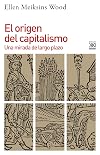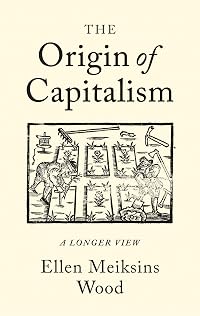
The Origin of Capitalism: A Longer View
by Ellen Meiksins Wood
On This Page
Description
How did the dynamic economic system we know as capitalism develop among the peasants and lords of feudal Europe? In The Origin of Capitalism, a now-classic work of history, Ellen Meiksins Wood offers a clear and accessible introduction to the theories and debates concerning the birth of capitalism, imperialism, and the modern nation state. Capitalism is not a natural and inevitable consequence of human nature, nor simply an extension of age-old practices of trade and commerce. Rather, it is show more a late and localized product of very specific historical conditions, which required great transformations in social relations and in the relationship between humans and nature. show lessTags
Recommendations














Member Reviews
This is a fascinating book. It makes a very strong case that England created capitalism not through the industrial revolution, as most histories from the left and right of the political spectrum assert, but in an earlier period of agrarian land conflict.
As Ms Meiksins Wood says, we cannot navigate our exit from capitalism if we are not aware as to the method of our entry thereinto.
Some of the author's assertions are at odds with Marxist views as well as, naturally, being unrepresentative of neoliberal views. This makes it easy for large blocks to gainsay her claims: that doesn't mean that they are wrong and I, for one, can see their merit.
As Ms Meiksins Wood says, we cannot navigate our exit from capitalism if we are not aware as to the method of our entry thereinto.
Some of the author's assertions are at odds with Marxist views as well as, naturally, being unrepresentative of neoliberal views. This makes it easy for large blocks to gainsay her claims: that doesn't mean that they are wrong and I, for one, can see their merit.
If I recall correctly, I discovered 'The Origin of Capitalism' by idly browsing the Verso website during a sale. I've hardly read any non-fiction in recent months, as the pandemic and my awful job have made me too tired and anxious to appreciate it. I've become accustomed to fiction, so it felt like a concerted effort to read despite being succinct and clearly explained. I've put off writing this review for five days as my brain feels too fuzzy to write a 3,000 word essay, as the book deserves. Half that will have to suffice.
Although 'The Origin of Capitalism' isn't written in full-blown academic style, it begins very much in academic mode with three chapters of literature review and critique. Although these are interesting enough and show more provide context for what follows, parts II and III are inevitably more compelling as they advance the book's thesis. The most thought-provoking element of part I is discussion of what is and isn't capitalism. I've noticed and bemoaned before the tendency to assume there is no alternative to capitalism by essentially conflating all economic systems with it. It is easy to forget that money, commerce, wealth inequality, and trade existed long before capitalism. Wood takes pains to delineate the specificity of capitalism as a system, distinguished by the imperative of participation in markets, competition based on labour productivity, profit maximisation, and capital accumulation. These characteristics result in relentless pressure for economic growth and expansion of markets until all activities and resources are commoditised. I appreciated the emphasis throughout that to treat commercial economies in the early modern period as 'pre-capitalist' implicitly renders capitalism an inevitability. Woods instead points out that non-capitalist commercial economies had notable distinguishing features:
Wood contends that capitalism was born in rural England out of a confluence of social relations that had not occurred elsewhere. It then spread across Europe and beyond:
I think the book makes a very convincing argument on this front. Capitalism had to come from somewhere and required legal, social, and cultural changes that precipitated economic transformation and technological change. Wood marks the advent of capitalism as the point at which participation in markets became necessary for subsistence. Market opportunities had existed long before, but under capitalism there is no escaping markets in order to attain the essentials of life: food and shelter.
Chapter 7 investigates how the theological and philosophical roots of capitalism tangle with imperialism, in the idea that land must be 'improved' and used as productively as possible. Empires existed long before capitalism; capitalism provided a new rationale and economic structure for them. I found the example of Ireland fascinating:
A strategy that could be observed throughout the British Empire in subsequent centuries. This conveys a key point: capitalism has always been backed by violence one way or another. Most likely English farmers did not want to become market-dependent and economically insecure tenants. They were not given the choice, as the legal system removed traditional land rights, enclosed common land, and punitively enforced ownership. Capitalism is also an invasive pest. It must constantly expand its reach, or else collapse:
While it is depressing to confront England's culpability for introducing capitalism into the world, I also found this a very intellectually satisfying book. It breaks down some of the overwhelming absolutism of 21st century capitalism by describing where it came from. It's a bit like seeing pictures of a totalitarian dictator when they were a small and ugly baby. Wood emphasises that seeing the beginning of capitalism also helps us think about its end, despite it being an extremely persistent system that survives cyclical crises. She makes a strong argument for market imperatives undermining attempts to make capitalism gentler:
Wood essentially argues that capitalism has ruined the pre-existing concept of markets, by forcing participation and adding the requirements of endless growth, competition, and profit maximisation. This reminded me why I find concepts like corporate social responsibility, sustainable development, and ethical consumption hollow. They cannot hope to adequately temper the overwhelming imperatives of maximising profits and shareholder returns, which demand reduced production costs, minimum regulatory compliance, and growth, growth, growth. The more I read about capitalism, the more I realise that a bit of government intervention is never going to control its destructiveness. Even without regulatory capture, capitalist markets have to expand in defiance of environmental and social disaster. It's a feature, indeed the defining feature, rather than a bug that can be fixed.
Certain writers are hopeful that capitalism can be crowded out of markets, such as [a:Erik Olin Wright|77447|Erik Olin Wright|https://images.gr-assets.com/authors/1372517258p2/77447.jpg] in [b:How to Be an Anticapitalist in the Twenty-First Century|43218722|How to Be an Anticapitalist in the Twenty-First Century|Erik Olin Wright|https://i.gr-assets.com/images/S/compressed.photo.goodreads.com/books/1563763650l/43218722._SY75_.jpg|67062306]. At the moment I am pessimistic, probably because of the pandemic's effects on my state of mind, more akin to [a:Wolfgang Streeck|377775|Wolfgang Streeck|https://images.gr-assets.com/authors/1428053861p2/377775.jpg] in [b:How Will Capitalism End? Essays on a Failing System|25733863|How Will Capitalism End? Essays on a Failing System|Wolfgang Streeck|https://i.gr-assets.com/images/S/compressed.photo.goodreads.com/books/1490648382l/25733863._SY75_.jpg|45572177]. Nonetheless, I enjoyed 'The Origin of Capitalism'. I think it would read well with [b:Fossil Capital: The Rise of Steam Power and the Roots of Global Warming|25614450|Fossil Capital The Rise of Steam Power and the Roots of Global Warming|Andreas Malm|https://i.gr-assets.com/images/S/compressed.photo.goodreads.com/books/1449996772l/25614450._SY75_.jpg|44301257], which traces the origin of fossil fuel-powered industrialisation, and [b:The Age of Surveillance Capitalism: The Fight for a Human Future at the New Frontier of Power|26195941|The Age of Surveillance Capitalism The Fight for a Human Future at the New Frontier of Power|Shoshana Zuboff|https://i.gr-assets.com/images/S/compressed.photo.goodreads.com/books/1521733914l/26195941._SY75_.jpg|46170685], which analyses the current expansion of markets into the realm of behavioural data. I was left contemplating the irreversibility, inevitability, and expiration of economic systems. show less
Although 'The Origin of Capitalism' isn't written in full-blown academic style, it begins very much in academic mode with three chapters of literature review and critique. Although these are interesting enough and show more provide context for what follows, parts II and III are inevitably more compelling as they advance the book's thesis. The most thought-provoking element of part I is discussion of what is and isn't capitalism. I've noticed and bemoaned before the tendency to assume there is no alternative to capitalism by essentially conflating all economic systems with it. It is easy to forget that money, commerce, wealth inequality, and trade existed long before capitalism. Wood takes pains to delineate the specificity of capitalism as a system, distinguished by the imperative of participation in markets, competition based on labour productivity, profit maximisation, and capital accumulation. These characteristics result in relentless pressure for economic growth and expansion of markets until all activities and resources are commoditised. I appreciated the emphasis throughout that to treat commercial economies in the early modern period as 'pre-capitalist' implicitly renders capitalism an inevitability. Woods instead points out that non-capitalist commercial economies had notable distinguishing features:
It may be possible to argue (as I would be inclined to do) that the non-capitalist character of such commercial economies was as much their strength as their weakness, and that, for instance, the Italian Renaissance, which flourished in the environment of commercial city-states in Northern Italy like Florence, would not have achieved its great heights under the pressures of capitalist imperatives. But that is another story. The point here is simply that, in the absence of those [market] imperatives, the pattern of economic development was bound to be different.
Wood contends that capitalism was born in rural England out of a confluence of social relations that had not occurred elsewhere. It then spread across Europe and beyond:
The most salutary corrective to the naturalisation of capitalism and to question-begging assumptions about its origin is the recognition that capitalism, with its very specific drives of accumulation and profit-maximisation, was born not in the city but in the countryside, in a very specific place, and very late in human history. It required not a simple extension or expansion of barter and exchange but a complete transformation in the most basic human relations and practices, a rupture in the age-old patterns of human interaction with nature.
I think the book makes a very convincing argument on this front. Capitalism had to come from somewhere and required legal, social, and cultural changes that precipitated economic transformation and technological change. Wood marks the advent of capitalism as the point at which participation in markets became necessary for subsistence. Market opportunities had existed long before, but under capitalism there is no escaping markets in order to attain the essentials of life: food and shelter.
With the advent of industrial capitalism, market dependence had truly penetrated to the depths of the social order. But its precondition was an already well-established and deeply rooted market dependence, reaching back to the early days of English agrarian capitalism, when the production of food became subject to the imperatives of competition. This was a unique social form in which the main economic actors, both appropriators and producers, were market-dependent in historically unprecedented ways.
The market dependence of English farmers was based not simply on the need to exchange in order to obtain good they could not produce but also on the particular relation between 'economic' tenants and landlords devoid of extra-economic powers. Even the productive capacity to be self-sufficient did not make producers in England less market-dependent.
Chapter 7 investigates how the theological and philosophical roots of capitalism tangle with imperialism, in the idea that land must be 'improved' and used as productively as possible. Empires existed long before capitalism; capitalism provided a new rationale and economic structure for them. I found the example of Ireland fascinating:
There had long been attempts to subdue Ireland by direct or indirect military means, and in the sixteenth century, there were various unsuccessful efforts to establish private military settlements as a defence against Irish rebellion. This was, in effect, a feudal model of imperial domination, with a kind of feudal lordship being used to dominate a dependent population by extra-economic means. The Tudor monarchy sought to extend its rule over Ireland force in a more systematic way, dominated by the state, but it also tried something new, which was to have far-reaching implications for the development of British imperialism.
In the late sixteenth century, England's Irish strategy underwent something like an instant transition from feudalism to capitalism. The Tudor state decided to embark upon on a more aggressive process of colonisation. But this time, the effort to exert extra-economic control by a more effective military conquest was supplemented by an attempt to impose a kind of economic hegemony, using military force to implant a new economic system, as well as a new political and legal order.
A strategy that could be observed throughout the British Empire in subsequent centuries. This conveys a key point: capitalism has always been backed by violence one way or another. Most likely English farmers did not want to become market-dependent and economically insecure tenants. They were not given the choice, as the legal system removed traditional land rights, enclosed common land, and punitively enforced ownership. Capitalism is also an invasive pest. It must constantly expand its reach, or else collapse:
Capitalism had emerged in one country. After that, it could never emerge again in the same way. Every extension of its laws of motion changed the conditions of development thereafter, and every local context shaped the processes of change. But having once began in a single nation state, and having been followed by other nationally organised processes of economic development, capitalism has spread not by erasing the national boundaries but by reproducing its national organisation, creating an increasing number of national economies and nation states. The inevitably uneven development of separate, if interrelated, national entities, especially when subject to imperatives of competition, has virtually guaranteed the persistence of national forms.
While it is depressing to confront England's culpability for introducing capitalism into the world, I also found this a very intellectually satisfying book. It breaks down some of the overwhelming absolutism of 21st century capitalism by describing where it came from. It's a bit like seeing pictures of a totalitarian dictator when they were a small and ugly baby. Wood emphasises that seeing the beginning of capitalism also helps us think about its end, despite it being an extremely persistent system that survives cyclical crises. She makes a strong argument for market imperatives undermining attempts to make capitalism gentler:
Once market imperatives set the terms of social reproduction, all economic actors - both appropriators and producers, even if they remain in possession, or indeed outright ownership, of the means of production - are subject to the demands of competition, increasing productivity, capital accumulation, and the intense exploitation of labour.
For that matter, even the absence of a division between appropriators and producers, is no guarantee of immunity. Once the market is established as an economic 'discipline' or 'regulator', once economic actors become become market-dependent for the conditions of their own reproduction, even workers who own the means of production, individually or collectively, will be obliged to respond to the market's imperatives - to compete and accumulate, to let 'uncompetitive' enterprises and their workers go to the wall, and to exploit themselves. The history of agrarian capitalism, and everything that followed from it, should make it clear that whatever market imperatives regulate the economy and govern social reproduction, there will be no escape from exploitation.
Wood essentially argues that capitalism has ruined the pre-existing concept of markets, by forcing participation and adding the requirements of endless growth, competition, and profit maximisation. This reminded me why I find concepts like corporate social responsibility, sustainable development, and ethical consumption hollow. They cannot hope to adequately temper the overwhelming imperatives of maximising profits and shareholder returns, which demand reduced production costs, minimum regulatory compliance, and growth, growth, growth. The more I read about capitalism, the more I realise that a bit of government intervention is never going to control its destructiveness. Even without regulatory capture, capitalist markets have to expand in defiance of environmental and social disaster. It's a feature, indeed the defining feature, rather than a bug that can be fixed.
Certain writers are hopeful that capitalism can be crowded out of markets, such as [a:Erik Olin Wright|77447|Erik Olin Wright|https://images.gr-assets.com/authors/1372517258p2/77447.jpg] in [b:How to Be an Anticapitalist in the Twenty-First Century|43218722|How to Be an Anticapitalist in the Twenty-First Century|Erik Olin Wright|https://i.gr-assets.com/images/S/compressed.photo.goodreads.com/books/1563763650l/43218722._SY75_.jpg|67062306]. At the moment I am pessimistic, probably because of the pandemic's effects on my state of mind, more akin to [a:Wolfgang Streeck|377775|Wolfgang Streeck|https://images.gr-assets.com/authors/1428053861p2/377775.jpg] in [b:How Will Capitalism End? Essays on a Failing System|25733863|How Will Capitalism End? Essays on a Failing System|Wolfgang Streeck|https://i.gr-assets.com/images/S/compressed.photo.goodreads.com/books/1490648382l/25733863._SY75_.jpg|45572177]. Nonetheless, I enjoyed 'The Origin of Capitalism'. I think it would read well with [b:Fossil Capital: The Rise of Steam Power and the Roots of Global Warming|25614450|Fossil Capital The Rise of Steam Power and the Roots of Global Warming|Andreas Malm|https://i.gr-assets.com/images/S/compressed.photo.goodreads.com/books/1449996772l/25614450._SY75_.jpg|44301257], which traces the origin of fossil fuel-powered industrialisation, and [b:The Age of Surveillance Capitalism: The Fight for a Human Future at the New Frontier of Power|26195941|The Age of Surveillance Capitalism The Fight for a Human Future at the New Frontier of Power|Shoshana Zuboff|https://i.gr-assets.com/images/S/compressed.photo.goodreads.com/books/1521733914l/26195941._SY75_.jpg|46170685], which analyses the current expansion of markets into the realm of behavioural data. I was left contemplating the irreversibility, inevitability, and expiration of economic systems. show less
This is a short, dense and rewarding book. Although highly analytical I do wish the book somehow was even more clear in its arguments. To give but one example: "capitalist exploitation is characterised by a division of labour between the 'economic' moment of appropriation and the 'extra-economic' or 'political' moment of coercion." In this case, since this is a book about capitalism, the use of "division of labour" in the abstract sense is misleading. Here, Wood is not talking about labour at all, but about the means of capitalist control, or about the institutional structure of capitalism. Why not just write "...a division between..."? This lack of sharpness and clarity piles on, so that stretches of genius are intersperesed with show more unexpectedly bewildering paragraphs that require re-reading. One has very few points of disagreement with the author of this fantastic text - but one does wish that she might have had a more activist editor. show less
Wood’s rigorous distinction between ‘commerce’ and ‘capital,’ (and consequently between perennial and abstract ‘market opportunities’ and historically situated and concrete ‘market imperatives’), alone makes this an essential read.
It is made exceptional by both Wood’s extension of this analysis to an account of the rise of English agrarian capitalism and her disentanglement of the historical relations between capital, industrialism, imperialism, the nation-state, and modernity.
My only criticism is that Wood’s treatment of the interconnections between modernity, the enlightenment, and capitalism are somewhat rushed and, resultantly, not entirely convincing. However, in the scheme of this otherwise excellent work, show more this is a minor shortcoming. show less
It is made exceptional by both Wood’s extension of this analysis to an account of the rise of English agrarian capitalism and her disentanglement of the historical relations between capital, industrialism, imperialism, the nation-state, and modernity.
My only criticism is that Wood’s treatment of the interconnections between modernity, the enlightenment, and capitalism are somewhat rushed and, resultantly, not entirely convincing. However, in the scheme of this otherwise excellent work, show more this is a minor shortcoming. show less
Rather more in-crowd than I'd expected; this should be subtitled 'What previous analyses have got wrong', rather than 'a longer view.' But the central insight is crucial: our society is not something that happens naturally when you get rid of barriers to us doing what comes naturally. It's something that was created by forcing people to do capitalist things.
This is not a book for casual audiences. You are expected to understand what capitalism is, what feudalism is and also have a knowledge of medieval English, French and Dutch history. Ellen Meiskens Wood expects you to know this because she does help you out. This is a very complicated book and will not try to make it simple to understand.
Nonetheless, if you can get past the confusing language, Wood does make a good argument throughout the book. To spoil the gist of the book, she basically argues that the traditional model of what the origin of capitalism is, is wrong. She argues that the 'commercialization model' assumes too much and just assumes that capitalism was always present. She points out that this is wrong and that the origin show more of capitalism is very specific in that it only originated in the English countryside through 'agrarian capitalism'. This book mainly discusses why England is so unique and why they were the only ones to develop capitalism.
She also goes on to discuss her theory in other topic areas such as imperialism or the Enlightenment.
There's also the issue of bias. She is a Marxist so naturally she isn't the biggest fan of capitalism. She actually ends the book saying that socialism is a real alternative to capitalism. show less
Nonetheless, if you can get past the confusing language, Wood does make a good argument throughout the book. To spoil the gist of the book, she basically argues that the traditional model of what the origin of capitalism is, is wrong. She argues that the 'commercialization model' assumes too much and just assumes that capitalism was always present. She points out that this is wrong and that the origin show more of capitalism is very specific in that it only originated in the English countryside through 'agrarian capitalism'. This book mainly discusses why England is so unique and why they were the only ones to develop capitalism.
She also goes on to discuss her theory in other topic areas such as imperialism or the Enlightenment.
There's also the issue of bias. She is a Marxist so naturally she isn't the biggest fan of capitalism. She actually ends the book saying that socialism is a real alternative to capitalism. show less
Members
- Recently Added By
Author Information

19+ Works 2,081 Members
Ellen Meiksins Wood is a leading political theorist and highly influential historian. For many years Professor of Political Science a York University, Toronto, she is the author of many books, including The Pristine Culture of Capitalism, The Origin of Capitalism, Peasant-Citizen and Slave. Citizens to Lords, Empire of 'Capital, and Liberty and show more Properly. show less
Some Editions
Classifications
Statistics
- Members
- 759
- Popularity
- 37,186
- Reviews
- 7
- Rating
- (3.97)
- Languages
- 5 — Czech, English, French, German, Spanish
- Media
- Paper, Audiobook, Ebook
- ISBNs
- 17
- ASINs
- 5