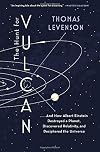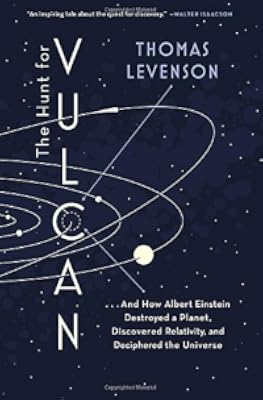
The Hunt for Vulcan: . . . And How Albert Einstein Destroyed a Planet, Discovered Relativity, and Deciphered the Universe
by Thomas Levenson
On This Page
Description
"The captivating, all-but-forgotten story of Isaac Newton, Albert Einstein, and the search for a planet that never existed."--Amazon.com.Tags
Recommendations



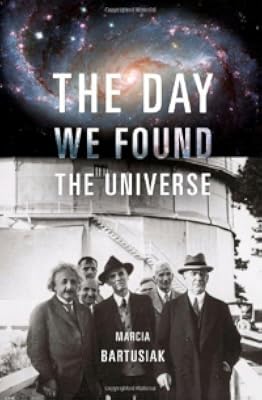
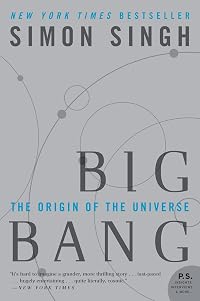

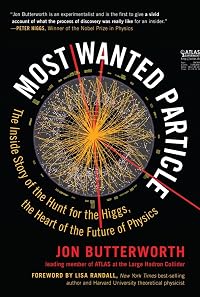
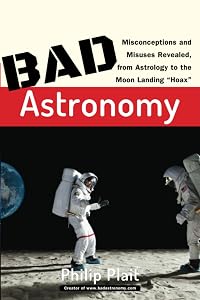
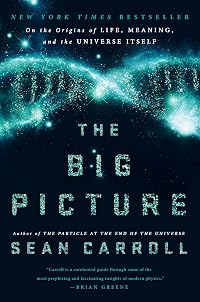

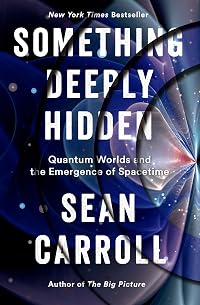

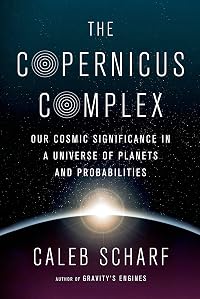



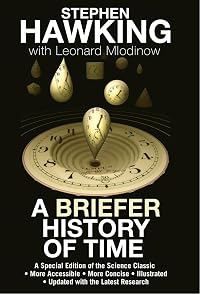

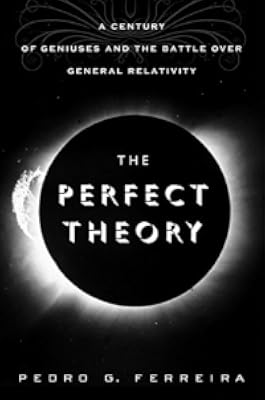

Member Recommendations

American Eclipse: A Nation's Epic Race to Catch the Shadow of the Moon and Win the Glory of the World by David Baron
themulhern These books intersect, "The Hunt for Vulcan" covers the eclipse expedition, and "American Eclipse" includes the siting of Vulcan during the eclipse by James Craig Watson.
Member Reviews
"Remember, you are mortal."
Roman generals, when they came home to celebrate a Triumph (a parade to commemorate a major victory) were supposed to always have a slave accompanying them, whispering that message, lest the pomp of the ceremony go to their heads. It didn't always work, but it couldn't hurt.
It couldn't hurt Thomas Levenson to read that historical anecdote, either.
Don't get me wrong; this is a good book. It teaches a lot about the development of theoretical astronomy. It's usually clear, and it does a pretty good job of supplying scientific background without going overboard with it. The science does tend to come in rather large lumps, and as someone with training in physics, I sometimes wondered why Levenson picked those show more particular spots to get hard-science-ish. But I didn't think they interfered too much. And the saga of Vulcan is a good reminder that the progress of science is not always smooth, but that it usually manages to straighten itself out eventually.
But here's the problem: Albert Einstein was not God. He wasn't even a nice person. Levenson gets the science right. But he doesn't get Einstein right. For instance, when he explains the photoelectric effect and how Einstein solved it (p. 128ff.), he gives the very clear impression that Einstein invented quantum mechanics. This is, flatly, false. Max Planck had invented quantum mechanics five years before as a sort of a theoretical construct to solve a particular problem with electromagnetic radiation. Planck didn't really believe in it, but he published. Einstein, in 1905, saw that a quantum explanation would also explain the photoelectric effect -- and so converted Planck's funny idea from a special case into a general-purpose tool. Einstein made quantum mechanics big -- but he didn't invent it. Indeed, as he got older, he actually refused to accept the way the field was developing.
Or consider page 179: "general relativity has survived every challenge since." Yes it has -- sort of. On a large scale, it has always worked. But at a quantum scale -- no. One of the holy grails of physics is relativistic quantum mechanics. We don't have it; general relativity doesn't work at the quantum level. In some way, which we don't understand, general relativity must be an approximation to the theory of everything in just the same way that Newtonian gravity was an approximation to Einstein's relativistic gravity.
Or take his relationship with his first wife Mileva Marić. On p. 159 Levenson claims that Einstein "cried" when he split up with Marić. He conveniently leaves out the facts that Einstein got her pregnant out of wedlock, delayed the marriage, treated her as property, ordered her to leave him alone, kicked her out, and then tried not to pay spousal support. Some scholars think he beat her. Levinson is perfectly happy to point out that Urbain Jean Joseph Leverrier (the usual spelling, although Levinson writes it Le Verrier), the other physicist to play a big role in this book, was a jerk. So why won't he tell us that Einstein was? As best I can tell, only because Einstein was Einsten. Levenson could, of course, have left out all the personal details -- a history of science doesn't have to be about people. But if he's going to talk about the people, he owes it to his readers to describe the people as they actually were.
I knocked off a full star for that defect. If you want a history of Vulcan, this is a good book -- much clearer than anything else I've read on the subject. But despite the subtitle about Albert Einstein, this is not a book about Einstein. It's about a false idol which Levenson confuses with Einstein.
Einstein, after all, was mortal. show less
Roman generals, when they came home to celebrate a Triumph (a parade to commemorate a major victory) were supposed to always have a slave accompanying them, whispering that message, lest the pomp of the ceremony go to their heads. It didn't always work, but it couldn't hurt.
It couldn't hurt Thomas Levenson to read that historical anecdote, either.
Don't get me wrong; this is a good book. It teaches a lot about the development of theoretical astronomy. It's usually clear, and it does a pretty good job of supplying scientific background without going overboard with it. The science does tend to come in rather large lumps, and as someone with training in physics, I sometimes wondered why Levenson picked those show more particular spots to get hard-science-ish. But I didn't think they interfered too much. And the saga of Vulcan is a good reminder that the progress of science is not always smooth, but that it usually manages to straighten itself out eventually.
But here's the problem: Albert Einstein was not God. He wasn't even a nice person. Levenson gets the science right. But he doesn't get Einstein right. For instance, when he explains the photoelectric effect and how Einstein solved it (p. 128ff.), he gives the very clear impression that Einstein invented quantum mechanics. This is, flatly, false. Max Planck had invented quantum mechanics five years before as a sort of a theoretical construct to solve a particular problem with electromagnetic radiation. Planck didn't really believe in it, but he published. Einstein, in 1905, saw that a quantum explanation would also explain the photoelectric effect -- and so converted Planck's funny idea from a special case into a general-purpose tool. Einstein made quantum mechanics big -- but he didn't invent it. Indeed, as he got older, he actually refused to accept the way the field was developing.
Or consider page 179: "general relativity has survived every challenge since." Yes it has -- sort of. On a large scale, it has always worked. But at a quantum scale -- no. One of the holy grails of physics is relativistic quantum mechanics. We don't have it; general relativity doesn't work at the quantum level. In some way, which we don't understand, general relativity must be an approximation to the theory of everything in just the same way that Newtonian gravity was an approximation to Einstein's relativistic gravity.
Or take his relationship with his first wife Mileva Marić. On p. 159 Levenson claims that Einstein "cried" when he split up with Marić. He conveniently leaves out the facts that Einstein got her pregnant out of wedlock, delayed the marriage, treated her as property, ordered her to leave him alone, kicked her out, and then tried not to pay spousal support. Some scholars think he beat her. Levinson is perfectly happy to point out that Urbain Jean Joseph Leverrier (the usual spelling, although Levinson writes it Le Verrier), the other physicist to play a big role in this book, was a jerk. So why won't he tell us that Einstein was? As best I can tell, only because Einstein was Einsten. Levenson could, of course, have left out all the personal details -- a history of science doesn't have to be about people. But if he's going to talk about the people, he owes it to his readers to describe the people as they actually were.
I knocked off a full star for that defect. If you want a history of Vulcan, this is a good book -- much clearer than anything else I've read on the subject. But despite the subtitle about Albert Einstein, this is not a book about Einstein. It's about a false idol which Levenson confuses with Einstein.
Einstein, after all, was mortal. show less
In his introduction to Vulcan …And How Albert Einstein Destroyed a Planet, Discovered Relativity, and Deciphered the Universe, Thomas Levenson writes, “This book tells Vulcan’s story: its ancestry, its birth, its odd, twilit journey in and out of the grasp of eager would-be discoverers, its time in purgatory, and finally, on the 18th of November, 1915, its decisive end at the hands of Albert Einstein” (p. xii). He cautions those who would use historical hindsight to simply write-off the efforts to find Vulcan, writing, “We may – we do – know more than the folks back then. But we are not thus somehow immune to the habits of mind, the leaps of imagination, or the capacity for error that they possessed. Vulcan’s biography show more is one of the human capacity to both discovery and self-deceive. It offers a glimpse of how hard it is to make sense of the natural world, and how difficult it is for any of us to unlearn the things we think are so, but aren’t” (p. xiv-xv).
The book opens with Newton’s calculus and gravitation, two ideas that played critical roles in the discovery of ice giants Uranus and Neptune by William Herschel and Urbain Le Verrier, Johann Gottfried Galle, and John Couch Adams. Having proved the ability of calculus and Newtonian physics to map and describe the solar system, Le Verrier went on to refine the calculations for other known bodies. His measurements of Mercury revealed a precession of the perihelion in its orbit. Newtonian mechanics suggested that this must result from the gravity of an object between Mercury and the Sun. Le Verrier and other astronomers thus turned their attention toward finding this object, or set of objects if it were an inner asteroid belt (p. 64). Le Verrier’s reputation was enough that it, combined with possible partial sightings, took hold in the public’s imagination. Levenson writes, “Mercury’s perihelion precession was and is real. Newtonian gravitation provides an obvious solution to such a problem” (p. 78). The public dubbed the would-be planet Vulcan due to its proximity to the sun’s fires. Possible sightings continued to trickle in during the mid-nineteenth century, culminating in a search and possible discovery during the American eclipse of 1878. Over time, the theory remained in use but the popular and scientific press slowly petered off in their coverage of possible sightings or rebuttals to those sightings. As Levenson notes, the idea of Vulcan held on because it fit the known facts of Newtonian physics. Historically, Vulcan is no more unusual a hypothesis than the cosmic microwave background radiation, the Higgs boson, or even Neptune itself, all of which scientists eventually found and refined in their understanding of relevant disciplines. Why, then, would Vulcan not reveal itself to determined searchers?
In the twentieth century, Einstein began to explore his theory of relativity, developing an understanding of how gravitation affects space-time. He predicted that the sun’s gravity well should deflect the light from stars appearing near its edge, an experiment made possible during a total eclipse. The eclipse of August 1914 offered just the chance to test Einstein’s hypothesis. Levenson notes, “The symmetry is obvious: Vulcan, of course, had been sought and seen and unseen again in such conditions” (p. 158). Just as a team got underway to Siberia, war broke out. Einstein continued to refine his calculations for relativity and gravitation during the war. He determined that “a ray of light passing through the sun’s gravitational field would deflect by 1.7 arcseconds, double the number his 1913 theory predicted” (p. 170). Continuing to work the numbers, Einstein discovered that “no chunk of matter was required to explain Mercury’s track, no undiscovered planet, no asteroid belt, no dust, no bulging solar belly, nothing at all – except this new, radical conception of gravity. The sun with its great mass creates its dent in space-time. Mercury, so firmly embraced by our star’s gravitational field, lies deep within that solar gravity well” (p. 172).
Levenson concludes, “It was said of Newton that he was a fortunate man, because there was only one universe to discover, and he had done it. It had been said of Le Verrier that he discovered a planet at the tip of his pen. On the 18th of November, 1915, Einstein’s pen destroyed Vulcan – and reimagined the cosmos” (p. 172). Gµv=8πGTµv neatly summarizes Einstein’s theory and ended Vulcan’s place in the solar system. The Eclipse of May 1919 afforded the opportunity to gather photographic evidence of lensing, with careful checks of the data finding it matched Einstein’s prediction. Vulcan was dead, but Levenson returns to his introductory note to point out how the idea of Vulcan over the seventeenth, eighteenth, nineteenth, and early twentieth centuries represents so much of human nature while its ultimate fate represents the best of the scientific method. Levenson’s book manages to capture science in action, placing it in cultural context and weaving a narrative that casual readers will find enthralling. show less
The book opens with Newton’s calculus and gravitation, two ideas that played critical roles in the discovery of ice giants Uranus and Neptune by William Herschel and Urbain Le Verrier, Johann Gottfried Galle, and John Couch Adams. Having proved the ability of calculus and Newtonian physics to map and describe the solar system, Le Verrier went on to refine the calculations for other known bodies. His measurements of Mercury revealed a precession of the perihelion in its orbit. Newtonian mechanics suggested that this must result from the gravity of an object between Mercury and the Sun. Le Verrier and other astronomers thus turned their attention toward finding this object, or set of objects if it were an inner asteroid belt (p. 64). Le Verrier’s reputation was enough that it, combined with possible partial sightings, took hold in the public’s imagination. Levenson writes, “Mercury’s perihelion precession was and is real. Newtonian gravitation provides an obvious solution to such a problem” (p. 78). The public dubbed the would-be planet Vulcan due to its proximity to the sun’s fires. Possible sightings continued to trickle in during the mid-nineteenth century, culminating in a search and possible discovery during the American eclipse of 1878. Over time, the theory remained in use but the popular and scientific press slowly petered off in their coverage of possible sightings or rebuttals to those sightings. As Levenson notes, the idea of Vulcan held on because it fit the known facts of Newtonian physics. Historically, Vulcan is no more unusual a hypothesis than the cosmic microwave background radiation, the Higgs boson, or even Neptune itself, all of which scientists eventually found and refined in their understanding of relevant disciplines. Why, then, would Vulcan not reveal itself to determined searchers?
In the twentieth century, Einstein began to explore his theory of relativity, developing an understanding of how gravitation affects space-time. He predicted that the sun’s gravity well should deflect the light from stars appearing near its edge, an experiment made possible during a total eclipse. The eclipse of August 1914 offered just the chance to test Einstein’s hypothesis. Levenson notes, “The symmetry is obvious: Vulcan, of course, had been sought and seen and unseen again in such conditions” (p. 158). Just as a team got underway to Siberia, war broke out. Einstein continued to refine his calculations for relativity and gravitation during the war. He determined that “a ray of light passing through the sun’s gravitational field would deflect by 1.7 arcseconds, double the number his 1913 theory predicted” (p. 170). Continuing to work the numbers, Einstein discovered that “no chunk of matter was required to explain Mercury’s track, no undiscovered planet, no asteroid belt, no dust, no bulging solar belly, nothing at all – except this new, radical conception of gravity. The sun with its great mass creates its dent in space-time. Mercury, so firmly embraced by our star’s gravitational field, lies deep within that solar gravity well” (p. 172).
Levenson concludes, “It was said of Newton that he was a fortunate man, because there was only one universe to discover, and he had done it. It had been said of Le Verrier that he discovered a planet at the tip of his pen. On the 18th of November, 1915, Einstein’s pen destroyed Vulcan – and reimagined the cosmos” (p. 172). Gµv=8πGTµv neatly summarizes Einstein’s theory and ended Vulcan’s place in the solar system. The Eclipse of May 1919 afforded the opportunity to gather photographic evidence of lensing, with careful checks of the data finding it matched Einstein’s prediction. Vulcan was dead, but Levenson returns to his introductory note to point out how the idea of Vulcan over the seventeenth, eighteenth, nineteenth, and early twentieth centuries represents so much of human nature while its ultimate fate represents the best of the scientific method. Levenson’s book manages to capture science in action, placing it in cultural context and weaving a narrative that casual readers will find enthralling. show less
In 182 pages, Thomas Levenson gives us an account of important advances in science from Newton’s theory of gravity, which was published in 1686, its application to astronomy, to the publication of Einstein’s theory of relativity in 1915. He also writes of the discoveries of Uranus by Sir William Herschel and Neptune by Urbain Le Verrier. Moreover, Levenson doesn’t just list dry facts but portrays scientists as real people, giving us details of their lives and characters that make physics interesting reading for laymen. For example, we learn how Herschel, a country doctor, was also an avid astronomer with a telescope in his garden. He began identifying Uranus by stealing views in between patients. Le Verrier, a leading astronomer show more in 1854, became director of the Paris Observatory. Although a brilliant scientist, his management skills were lacking. During Le Verrier’s first thirteen years as director, 17 astronomers and 46 assistants left the Observatory. Colleagues described Le Verrier as a haughty, disdainful, inflexible autocrat. A few times he actually laid hands on people.
The title, “Hunt for Vulcan . . . and How Albert Einstein Destroyed a Planet, Discovered Relativity, and Deciphered the Universe” isn’t quite accurate. This story does tell of seeking and ostensibly finding a new planet, Vulcan, orbiting between Mercury and the sun. Einstein did not “destroy” Vulcan. Using his theory of relativity, Einstein simply refuted Vulcan’s existence or the need for the discovery of any planet or comet orbiting between Mercury and the sun.
I find it surprising that on November 10, 1919, the New York Times printed on page one an account of Einstein’s theory of relativity, quoting Einstein’s statement that “there were not more than 12 persons in the whole world who would understand it.” It’s hard to imagine a newspaper headlining a complicated theory of physics today.
Science and astronomy are outside my usual reading genres, but Levenson’s history was definitely worth the time. show less
The title, “Hunt for Vulcan . . . and How Albert Einstein Destroyed a Planet, Discovered Relativity, and Deciphered the Universe” isn’t quite accurate. This story does tell of seeking and ostensibly finding a new planet, Vulcan, orbiting between Mercury and the sun. Einstein did not “destroy” Vulcan. Using his theory of relativity, Einstein simply refuted Vulcan’s existence or the need for the discovery of any planet or comet orbiting between Mercury and the sun.
I find it surprising that on November 10, 1919, the New York Times printed on page one an account of Einstein’s theory of relativity, quoting Einstein’s statement that “there were not more than 12 persons in the whole world who would understand it.” It’s hard to imagine a newspaper headlining a complicated theory of physics today.
Science and astronomy are outside my usual reading genres, but Levenson’s history was definitely worth the time. show less
The determined hunt for a planet that doesn't exist
This short but fascinating book works as both an illustration of how scientific ideas advance and an engaging focused history that stretches from Newton, whose work crowned the scientific revolution and helped inspire Europe’s Age of Enlightenment, to Einstein, who spent the WWI years absorbed in his nascent theories of relativity which changed the way we look at the world and made possible most further developments in science and technology. Framing the book’s story is the hunt for a missing planet, known as Vulcan (not Mr. Spock’s planet, unfortunately).
In 1846 Urbain Le Verrier, a French scientist, used the mathematics of Newton's theories of gravity to predict the existence show more and location of Neptune, which was still undiscovered, based on slight anomalies in the orbit of Uranus. With almost perfect accuracy, Le Verrier was able to tell skywatchers where to point their telescopes and several found the planet immediately, a highly exciting moment in physics and astronomy that was downright inspiring to read about.
So when Le Verrier used Newton’s formulas to postulate the existence of a planet between the Sun and Mercury based on anomalies in Mercury’s orbit, everyone assumed he was correct--both Newton and Le Verrier had proven themselves almost god-like in their insights after all. Scientists spent 50 years looking for the planet they called Vulcan--some actually thought they had found it and no one was willing to jettison Newton’s universal law of gravitation--until 1915 when Einstein used the theories of relativity and the bending of spacetime by gravity to prove that Vulcan doesn’t, and couldn't, exist.
With biographical sketches, some history of the era, and accessible explanations of the involved science, The Hunt for Vulcan is informative and highly entertaining. show less
This short but fascinating book works as both an illustration of how scientific ideas advance and an engaging focused history that stretches from Newton, whose work crowned the scientific revolution and helped inspire Europe’s Age of Enlightenment, to Einstein, who spent the WWI years absorbed in his nascent theories of relativity which changed the way we look at the world and made possible most further developments in science and technology. Framing the book’s story is the hunt for a missing planet, known as Vulcan (not Mr. Spock’s planet, unfortunately).
In 1846 Urbain Le Verrier, a French scientist, used the mathematics of Newton's theories of gravity to predict the existence show more and location of Neptune, which was still undiscovered, based on slight anomalies in the orbit of Uranus. With almost perfect accuracy, Le Verrier was able to tell skywatchers where to point their telescopes and several found the planet immediately, a highly exciting moment in physics and astronomy that was downright inspiring to read about.
So when Le Verrier used Newton’s formulas to postulate the existence of a planet between the Sun and Mercury based on anomalies in Mercury’s orbit, everyone assumed he was correct--both Newton and Le Verrier had proven themselves almost god-like in their insights after all. Scientists spent 50 years looking for the planet they called Vulcan--some actually thought they had found it and no one was willing to jettison Newton’s universal law of gravitation--until 1915 when Einstein used the theories of relativity and the bending of spacetime by gravity to prove that Vulcan doesn’t, and couldn't, exist.
With biographical sketches, some history of the era, and accessible explanations of the involved science, The Hunt for Vulcan is informative and highly entertaining. show less
A short but very interesting non-fiction book about the search for an unknown planet postulated to exist closer to the Sun than Mercury. Its existence was proposed in the mid 1800s to explain a very small discrepancy in the orbit of Mercury, specifically how that planet’s orbit precesses over time—that is, how a line drawn between its closest and furthest distance from the sun changes direction in space over centuries.
The discrepancy was first pointed out by the French astronomer Anton Le Verrier. Le Verrier was famous for his earlier prediction that an as-then unknown planet was slightly disturbing the orbit of Uranus. He calculated its position, and then was triumphantly vindicated by the discovery of the planet just where he had show more predicted it to be. It was later named Neptune.
The discrepancy in Mercury’s orbit was tiny indeed. But Newton’s laws of orbital motion were by then so well established, and the mathematics so clear, that the discrepancy needed explanation. Based on his triumphant discovery of Neptune, it is hardly surprising that Le Verrier proposed another as-yet unseen planet, this time closer to the Sun. The hunt was on! Every solar eclipse was an opportunity for observation, trying to see this world so close to the Sun’s bright disc.
Was the missing planet, dubbed Vulcan, ever discovered? Alas for Star Trek fans, Vulcan does not exist. The true explanation for the discrepancies in Mercury’s orbit was uncovered only with the aid of Einstein’s General Theory of Relativity in 1914 and its revelation of curved space-time.
I love this kind of scientific history. Thomas Levenson makes a fascinating story out of it, and does a great job of explaining the scientific issues involved. show less
The discrepancy was first pointed out by the French astronomer Anton Le Verrier. Le Verrier was famous for his earlier prediction that an as-then unknown planet was slightly disturbing the orbit of Uranus. He calculated its position, and then was triumphantly vindicated by the discovery of the planet just where he had show more predicted it to be. It was later named Neptune.
The discrepancy in Mercury’s orbit was tiny indeed. But Newton’s laws of orbital motion were by then so well established, and the mathematics so clear, that the discrepancy needed explanation. Based on his triumphant discovery of Neptune, it is hardly surprising that Le Verrier proposed another as-yet unseen planet, this time closer to the Sun. The hunt was on! Every solar eclipse was an opportunity for observation, trying to see this world so close to the Sun’s bright disc.
Was the missing planet, dubbed Vulcan, ever discovered? Alas for Star Trek fans, Vulcan does not exist. The true explanation for the discrepancies in Mercury’s orbit was uncovered only with the aid of Einstein’s General Theory of Relativity in 1914 and its revelation of curved space-time.
I love this kind of scientific history. Thomas Levenson makes a fascinating story out of it, and does a great job of explaining the scientific issues involved. show less
A lively tale of scientific endeavor connected by the gradually expanding understanding of gravity from Newton to Einstein. A very good time to read this book, as currently various scientists are postulating a new planet, based on regularities in the orbits of various bodies in the Kuiper belt.
The book is divided into three sections. The first covers the period from the earliest work of Newton through the triumphant discovery of Neptune using Newtonian mechanics (refined by Laplace and other persons). The second covers the puzzlement regarding the precession of the perihelion of the planet Mercury, and the invention and regular sightings of the non-existent planet Vulcan. The third covers the new explanation of the observed behavior of show more the planet Mercury based on general relativity.
The first part requires some understanding of Newtonian mechanics, and is therefore pretty easy for me to comprehend. The second, being a tale of the hypothesis of Vulcan and the various astronomers who believed they had found it, is quite entertaining and requires little technical knowledge. The third requires a good understanding of modern physics, and is therefore pretty confusing to me.
Chapter 1: The Immovable Order of the World
Halley's famous conversation with Isaac Newton leads to the Principia. Continues to leave open the question that bothers me...why are the planet's orbits ellipses of some eccentricity instead of perfect circles? Newton relates the observed elliptical orbits of the planets to the hypothesized inverse square law of gravity. The book contends that Halley had hypothesized this inverse square law. Newton also studies the path of a particular comet, determining that it was a parabola, passing through the solar system just once, rather than remaining in an orbit, however extended.
Chapter 2: A Happy Thought
Laplace refines Newton's principles to completely explain, as far as everybody knows, the movement of all the planets in the solar system. He also asserts that he has no need of that hypothesis (God).
Chapter 3: That Star is not on the Map
LeVerrier works on theories of the orbits of the planets, and his prediction of Mercury's transit is 16 seconds off. Uranus's orbit misbehaves; an as yet unobserved planet is postulated. Only a fraction of Uranus' orbit has been observed by this time. LeVerrier and Adams predict the orbit precisely, and when the telescope in the Berlin observatory is pointed in the right direction, the new planet is found almost immediately. Success!
Interlude: "So Very Occult"
Newton feigns no hypotheses, but Leibniz complains because _something_ must be causing this gravity.
Chapter 4: Thirty-Eight Seconds
LeVerrier refines the predictions of the AU, and of the orbits of the inner planets, and theorizes (correctly) about the clumping of asteroids in orbit. Even his most precise calculations leave an error in Mercury's orbit; its perihelion advances faster than predictions allow.
Chapter 5: A Disturbing Mass
Lescarbault spots a strange body, and eventually tells others. LeVerrier interrogates him and is convinced that he has spotted planet Vulcan.
Chapter 6: The Search Will End Satisfactorily
Confidence in the as yet unfound planet is high. Astrophotography is born in the 1860s. The blink comparator, which could not have existed w/out astrophotography, was fundamental to the discovery of Pluto. Le Verrier dies in the late '60s, with the planet still not quite certainly spotted.
Chapter 7: So Long Eluding the Hunters
The 1878 expedition to Wyoming had an assemblage of exceptional people including Thomas Edison (who wanted to test an infrared device), Norman Lockyer (the founder of the journal "Nature" and the discover, by means of spectroscopy, of the the helium in the sun's atmosphere), James Craig Watson (director of the Ann Arbor observatory), Simon Newcomb (mathematical astronomer). Watson believes he has spotted Vulcan, but the negative evidence from so many astronomers outweighs his conviction and the consensus is, finally, that no such planet exists.
Interlude: A Special Way of Finding Things Out
A philosophical discussion about the reaction to the ongoing mystery of Mercury's perihelion, unsolved by any appearance of an explanatory planet Vulcan. The mystery was pretty much ignored for the next 50 years and it was _not_ taken as a contradiction of Newton's gravitational laws. There were two perfectly good reasons for this. The first was that Newton's laws continued to prove very useful in non-Mercury situations. The second was that so much was going on in physics during that time that people didn't have the energy left to worry about Mercury.
There is also a little bit about how the scientific method was not adhered to in its Platonic form, which should have required the utter rejection of Newton's laws because of that damned perihelion. Given how useful Newton's laws were, such an utter rejection would have been serious baby-with-bathwater stuff and pretty stupid.
Chapter 8: The Happiest Thought
Einstein's miracle year. Gallean/Newtonian relativity relies on constant velocity. Einstein decides to accept that the speed of light is constant regardless of the motion of the observer (not regardless of the medium). This leads to interesting disagreements between people in different frames of reference. General relativity has something to do with the equivalence of gravity and acceleration. Einstein sets his sights on explaining the pesky perihelion of Mercury.
Chapter 9: Help Me Or I'll Go Crazy
Minkowski comes up with 4-dimensional space-time and a notion of a shortest distance in it. Einstein gets a full-professorship at Prague. If acceleration and gravity are somehow equivalent, then both must cause light to bend. Geometry is gravity and the direction of light is altered by the curvature in space-time just as the direction of movement of a body.
Chapter 10: Beside Himself with Joy
WWI breaks out and Einstein develops his general theory which agrees very nicely with the orbit of Mercury. He also comes up with his most famous pacifist quotation, about civilization being like an axe in the hands of a psychopath.
Chapter 11: The Longing to Behold Preexisting Harmony
As the war progresses, more and more people are convinced. A German physicist predicts the existence of black holes and expires shortly thereafter from some disease picked up in the trenches. At the end of the war, Arthur Eddington and others observe the deflection of starlight during a solar eclipse. It too agrees with the predictions. The New York Times headline for November 1919 is pretty funny. "LIGHTS ALL ASKEW IN THE HEAVENS: Men of Science More or Less Agog over Results of Eclipse Experiments: Einstein Theory Triumphs: Stars not where the seemed or were calculated to be, but nobody need worry".
THE END show less
The book is divided into three sections. The first covers the period from the earliest work of Newton through the triumphant discovery of Neptune using Newtonian mechanics (refined by Laplace and other persons). The second covers the puzzlement regarding the precession of the perihelion of the planet Mercury, and the invention and regular sightings of the non-existent planet Vulcan. The third covers the new explanation of the observed behavior of show more the planet Mercury based on general relativity.
The first part requires some understanding of Newtonian mechanics, and is therefore pretty easy for me to comprehend. The second, being a tale of the hypothesis of Vulcan and the various astronomers who believed they had found it, is quite entertaining and requires little technical knowledge. The third requires a good understanding of modern physics, and is therefore pretty confusing to me.
Chapter 1: The Immovable Order of the World
Halley's famous conversation with Isaac Newton leads to the Principia. Continues to leave open the question that bothers me...why are the planet's orbits ellipses of some eccentricity instead of perfect circles? Newton relates the observed elliptical orbits of the planets to the hypothesized inverse square law of gravity. The book contends that Halley had hypothesized this inverse square law. Newton also studies the path of a particular comet, determining that it was a parabola, passing through the solar system just once, rather than remaining in an orbit, however extended.
Chapter 2: A Happy Thought
Laplace refines Newton's principles to completely explain, as far as everybody knows, the movement of all the planets in the solar system. He also asserts that he has no need of that hypothesis (God).
Chapter 3: That Star is not on the Map
LeVerrier works on theories of the orbits of the planets, and his prediction of Mercury's transit is 16 seconds off. Uranus's orbit misbehaves; an as yet unobserved planet is postulated. Only a fraction of Uranus' orbit has been observed by this time. LeVerrier and Adams predict the orbit precisely, and when the telescope in the Berlin observatory is pointed in the right direction, the new planet is found almost immediately. Success!
Interlude: "So Very Occult"
Newton feigns no hypotheses, but Leibniz complains because _something_ must be causing this gravity.
Chapter 4: Thirty-Eight Seconds
LeVerrier refines the predictions of the AU, and of the orbits of the inner planets, and theorizes (correctly) about the clumping of asteroids in orbit. Even his most precise calculations leave an error in Mercury's orbit; its perihelion advances faster than predictions allow.
Chapter 5: A Disturbing Mass
Lescarbault spots a strange body, and eventually tells others. LeVerrier interrogates him and is convinced that he has spotted planet Vulcan.
Chapter 6: The Search Will End Satisfactorily
Confidence in the as yet unfound planet is high. Astrophotography is born in the 1860s. The blink comparator, which could not have existed w/out astrophotography, was fundamental to the discovery of Pluto. Le Verrier dies in the late '60s, with the planet still not quite certainly spotted.
Chapter 7: So Long Eluding the Hunters
The 1878 expedition to Wyoming had an assemblage of exceptional people including Thomas Edison (who wanted to test an infrared device), Norman Lockyer (the founder of the journal "Nature" and the discover, by means of spectroscopy, of the the helium in the sun's atmosphere), James Craig Watson (director of the Ann Arbor observatory), Simon Newcomb (mathematical astronomer). Watson believes he has spotted Vulcan, but the negative evidence from so many astronomers outweighs his conviction and the consensus is, finally, that no such planet exists.
Interlude: A Special Way of Finding Things Out
A philosophical discussion about the reaction to the ongoing mystery of Mercury's perihelion, unsolved by any appearance of an explanatory planet Vulcan. The mystery was pretty much ignored for the next 50 years and it was _not_ taken as a contradiction of Newton's gravitational laws. There were two perfectly good reasons for this. The first was that Newton's laws continued to prove very useful in non-Mercury situations. The second was that so much was going on in physics during that time that people didn't have the energy left to worry about Mercury.
There is also a little bit about how the scientific method was not adhered to in its Platonic form, which should have required the utter rejection of Newton's laws because of that damned perihelion. Given how useful Newton's laws were, such an utter rejection would have been serious baby-with-bathwater stuff and pretty stupid.
Chapter 8: The Happiest Thought
Einstein's miracle year. Gallean/Newtonian relativity relies on constant velocity. Einstein decides to accept that the speed of light is constant regardless of the motion of the observer (not regardless of the medium). This leads to interesting disagreements between people in different frames of reference. General relativity has something to do with the equivalence of gravity and acceleration. Einstein sets his sights on explaining the pesky perihelion of Mercury.
Chapter 9: Help Me Or I'll Go Crazy
Minkowski comes up with 4-dimensional space-time and a notion of a shortest distance in it. Einstein gets a full-professorship at Prague. If acceleration and gravity are somehow equivalent, then both must cause light to bend. Geometry is gravity and the direction of light is altered by the curvature in space-time just as the direction of movement of a body.
Chapter 10: Beside Himself with Joy
WWI breaks out and Einstein develops his general theory which agrees very nicely with the orbit of Mercury. He also comes up with his most famous pacifist quotation, about civilization being like an axe in the hands of a psychopath.
Chapter 11: The Longing to Behold Preexisting Harmony
As the war progresses, more and more people are convinced. A German physicist predicts the existence of black holes and expires shortly thereafter from some disease picked up in the trenches. At the end of the war, Arthur Eddington and others observe the deflection of starlight during a solar eclipse. It too agrees with the predictions. The New York Times headline for November 1919 is pretty funny. "LIGHTS ALL ASKEW IN THE HEAVENS: Men of Science More or Less Agog over Results of Eclipse Experiments: Einstein Theory Triumphs: Stars not where the seemed or were calculated to be, but nobody need worry".
THE END show less
https://nwhyte.livejournal.com/3388538.html
A nice little study of two very different parts of astronomical history: first, the mid-nineteenth century quest for the planet Vulcan, and then the story of Einstein's conceptualisation of General Relativity and the practical test during the eclipse of 1919, which confirmed it. I had touched on this issue during my MPhil research on Sir Robert Ball, so it was a nice return to a previous topic. Levenson gets very much into the context of the two different situation, particularly vivid on Le Verrier in Paris in the 1830s and Einstein's early career. I felt he didn't quite bridge the two - I'd have liked a bit more on the noted astronomer James Craig Watson who actually claimed to have seen show more Vulcan during the solar eclipse of 1878, and the book ends up being very firmly two different stories with a common topic of interest but which are otherwise not that closely related. But both stories are interesting. show less
A nice little study of two very different parts of astronomical history: first, the mid-nineteenth century quest for the planet Vulcan, and then the story of Einstein's conceptualisation of General Relativity and the practical test during the eclipse of 1919, which confirmed it. I had touched on this issue during my MPhil research on Sir Robert Ball, so it was a nice return to a previous topic. Levenson gets very much into the context of the two different situation, particularly vivid on Le Verrier in Paris in the 1830s and Einstein's early career. I felt he didn't quite bridge the two - I'd have liked a bit more on the noted astronomer James Craig Watson who actually claimed to have seen show more Vulcan during the solar eclipse of 1878, and the book ends up being very firmly two different stories with a common topic of interest but which are otherwise not that closely related. But both stories are interesting. show less
Members
- Recently Added By
Lists

Science: Astronomy
62 works; 2 members

Books Read in 2016
4,666 works; 199 members
Author Information

16 Works 1,602 Members
Thomas Levenson is an award-winning television producer and the author of one previous book, Ice Time. He lives in Cambridge, Massachusetts.
Awards and Honors
Common Knowledge
- Original publication date
- 2015
- People/Characters
- Albert Einstein; Urbain Jean Joseph Leverrier; Pierre-Simon Laplace; Isaac Newton
- Dedication
- For Katha and Henry, ever-renewing gifts,
and in remembrance of my uncles
Daniel Leveson and David Sebag-Montefiore,
who stood up through the hard years
and the fine ones - First words
- Preface
November 18, 1915, Berlin.
A man is on the move, coming into the center of town from the western suburbs. (Preface)
①
"THE IMMOVABLE ORDER OF THE WORLD"
August 1684, Cambridge.
Edmond Halley had suffered a sad and vexing spring. - Last words
- (Click to show. Warning: May contain spoilers.)Now, strange as it once seemed, beautiful as it is, Einstein's universe is our home.
- Blurbers
- Isaacson, Walter; Lightman, Alan; Tyson, Neil deGrasse; Randall, Lisa; Diaz, Junot; Carroll, Sean (show all 7); Chown, Marcus
Classifications
Statistics
- Members
- 324
- Popularity
- 97,963
- Reviews
- 20
- Rating
- (3.79)
- Languages
- English
- Media
- Paper, Audiobook, Ebook
- ISBNs
- 7
- UPCs
- 1
- ASINs
- 4