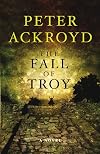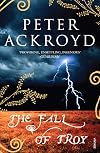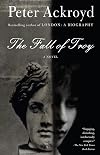
The Fall of Troy
by Peter Ackroyd
On This Page
Description
Fiction. Literature. HTML:In The Fall of Troy, acclaimed novelist and historian Peter Ackroyd creates a fascinating narrative that follows an archaeologist's obsession with finding the ruins of Troy, depicting the blurred line between truth and deception.Obermann, an acclaimed German scholar, fervently believes that his discovery of the ancient ruins of Troy will prove that the heroes of the Iliad, a work he has cherished all his life, actually existed. But Sophia, Obermann's young Greek show more wife, has her suspicions about his motivations — suspicions that only increase when she finds a cache of artifacts that her husband has hidden, and when a more skeptical archaeologist dies from a mysterious fever. With exquisite detail, Ackroyd again demonstrates his ability to evoke time and place, creating a brilliantly told story of heroes and scoundrels, human aspirations and follies, and the temptation to shape the truth to fit a passionately held belief. show lessTags
Recommendations















Member Reviews
A tale of madness, obsession and hubris, this fictionalisation of Schliemann’s discovery of Troy is a real treat. Ackroyd delves into the depths of the obsessive mind, following the excavations of the German archaeologist Herr Obermann as he strives to find the remains of Troy. Cunning and manipulative, Obermann is always ready to ensure that his helpers find what he expects to find, rather than what is there. Alongside the story of the excavation runs the tale of Obermann’s relationship with his young Greek wife, Sophia, who gradually begins to understand that her husband has more secrets than he is willing to admit, and that his whole enterprise is pushing him perilously close to the edge of sanity.
I have a life-long interest in archaeology and an abiding love for Homer and the Greek myths. So when I heard that Peter Ackroyd, a renowned and prolific British author, had published a novel—The Fall of Troy—about the excavation of Troy, I was intrigued.
The more I investigated, the more curious I became. Ackroyd is an author who has published 30 books, as well as countless literary reviews, essays, and poems. His publications are surprisingly broad-based. They include novels, historical biographies, and major works of nonfiction. He is well-known in British literary circles not only for his own works, but also because he has held the position of chief book reviewer for The Times of London for more than twenty years. He has won the show more Whitbread Book Award for Biography, the James Tait Black Memorial Prize, The Guardian Fiction Prize, the Somerset Maugham Award, and one of his novels was shortlisted for the Booker Prize—in all, a stellar literary career.
What intrigued me about The Fall of Troy was why Ackroyd chose to fictionalize the life of Heinrich Schliemann—the infamous 19th-century archaeologist who excavated the ruins of the ancient city of Troy and ruined much of the archaeological evidence in the process. Ackroyd is an accomplished novelist and a prize-winning historical biographer. He wrote a famous biography of Thomas More. Why, in this new book, did he add so much fiction to the story of Schliemann, that he could no longer even call his main character by his real name? Instead we get Heinrich Obermann…and instead of a whole life, we get a fragment of a few months hyped into a highly fictionalized swashbuckling melodrama.
After reading the book it is clear: Ackroyd wanted to satirize Heinrich Schliemann and fiction is, of course, the tool that does this best. The Fall of Troy is a brilliant satire! Schliemann, in the guise of Heinrich Obermann, comes off as a larger-than-life, grandiose, dangerously manipulating, self-promoting buffoon…and I loved it from the very first page!
The character of Obermann is completely over-the-top. But there is just enough authenticity to the man so that readers get the feeling they are truly in the presence of the real Schliemann…and what a horrible, self-deluding racist and egotist he was! Don’t read this book for the plot; read it for the unforgettable characterization of Schliemann. Overlook the plot if you have to—it only deserves two stars—at best, it is trite, predictable, and melodramatic. There were times I felt like I was reading the script for an engaging but awful blockbuster Hollywood movie.
If you read this book, do so primarily for the chance to meet—in literary flesh, so-to-speak—the man and the personality that was Heinrich Schliemann. And then if you want to have even more fun, let this character stand in for any number of other highly placed, self-deluding buffoons that populate our contemporary world, particularly in the political arena. That should get even more smiles out of you.
This is a clever and delightful book, an unexpected excellent satire. Enjoy! show less
The more I investigated, the more curious I became. Ackroyd is an author who has published 30 books, as well as countless literary reviews, essays, and poems. His publications are surprisingly broad-based. They include novels, historical biographies, and major works of nonfiction. He is well-known in British literary circles not only for his own works, but also because he has held the position of chief book reviewer for The Times of London for more than twenty years. He has won the show more Whitbread Book Award for Biography, the James Tait Black Memorial Prize, The Guardian Fiction Prize, the Somerset Maugham Award, and one of his novels was shortlisted for the Booker Prize—in all, a stellar literary career.
What intrigued me about The Fall of Troy was why Ackroyd chose to fictionalize the life of Heinrich Schliemann—the infamous 19th-century archaeologist who excavated the ruins of the ancient city of Troy and ruined much of the archaeological evidence in the process. Ackroyd is an accomplished novelist and a prize-winning historical biographer. He wrote a famous biography of Thomas More. Why, in this new book, did he add so much fiction to the story of Schliemann, that he could no longer even call his main character by his real name? Instead we get Heinrich Obermann…and instead of a whole life, we get a fragment of a few months hyped into a highly fictionalized swashbuckling melodrama.
After reading the book it is clear: Ackroyd wanted to satirize Heinrich Schliemann and fiction is, of course, the tool that does this best. The Fall of Troy is a brilliant satire! Schliemann, in the guise of Heinrich Obermann, comes off as a larger-than-life, grandiose, dangerously manipulating, self-promoting buffoon…and I loved it from the very first page!
The character of Obermann is completely over-the-top. But there is just enough authenticity to the man so that readers get the feeling they are truly in the presence of the real Schliemann…and what a horrible, self-deluding racist and egotist he was! Don’t read this book for the plot; read it for the unforgettable characterization of Schliemann. Overlook the plot if you have to—it only deserves two stars—at best, it is trite, predictable, and melodramatic. There were times I felt like I was reading the script for an engaging but awful blockbuster Hollywood movie.
If you read this book, do so primarily for the chance to meet—in literary flesh, so-to-speak—the man and the personality that was Heinrich Schliemann. And then if you want to have even more fun, let this character stand in for any number of other highly placed, self-deluding buffoons that populate our contemporary world, particularly in the political arena. That should get even more smiles out of you.
This is a clever and delightful book, an unexpected excellent satire. Enjoy! show less
Fall of Troy: no, not another about the Trojan War and its aftermath. This was a suspenseful novel about the archaeological excavations of the 19th century; Heinrich Obermann was a thinly-disguised Heinrich Schliemann. This was a fascinating book; it begins with the marriage of Herr Obermann with a young Greek girl, Sophia, many years younger than Obermann. They travel to Hissarlik, where Obermann feels the actual Troy has been buried. Sophia helps him in his work: she feels "if she embraced her duties with enthusiasm they ceased to be burdensome. That is why she immersed herself in Homer, and why she took pride in he excavations." She meets some of her husband's friends, none of whom are as obsessive and single-minded as Obermann. The show more author shows all through the novel his blindness in his twisting what he sees before him to fit 'truths' he believes about Troy; Troy is always the Troy of Homer. Sophia begins to think her husband is not what he seems; she begins to find deviousness and wants to find out the truth about him. He had a previous wife of whom he had not told her. When Obermann finds a cache of golden ornaments, so that the Turkish government does not find them, he has Sophia spirit them away to a Phrygian Greek couple he knows, to hide them. Sophia hears an odd, anguished scream--not the lady of the house. A visiting American archaeologist mysteriously dies of a fever after exploring a particular cave. After discovery of clay tablets written in an unknown language, a British archaeologist, Thornton, and expert on ancient languages, enters the picture. He makes a shocking discovers about what kind of people had probably lived in Troy. The denouement was fitting. show less
A fictionalized, satirical account of Heinrich Schliemann's excavations at the site of Troy, in what is now Turkey. Schliemann is portrayed here as Heinrich Obermann, an obsessive amateur archaeologist concerned only with discovering the remnants of Homeric Troy, and to fit all the finds into his preconceived notions of what the site should reveal. No dissent will be tolerated!
As with many of his other stories, Ackroyd has taken historical details and weaved them into an engrossing narrative. A good read, as these usually are.
As with many of his other stories, Ackroyd has taken historical details and weaved them into an engrossing narrative. A good read, as these usually are.
I thoroughly enjoyed reading this novel. It felt like flying, may be because I practically read it in the course of two medium-length flights.
As there are many good reviews of this book, I will not extend myself too much.
Ackroyd is a master teller. He polishes the fascination that his amateur archeologist Heinrich Obermann (a.k.a. Henrich Schliemann) feels for anything Homeric to a degree of brilliance that it naturally reflects back from Obermann himself. Those people living around him, or visiting him or spying on him are drawn by his visions and enthusiasm. This fascination proves contagious to the readers too.
The plot is also ingeniously handled. The development of Obermann’s personality simultaneously spins its own threads of show more destiny that will lead, necessarily, to his tragic fate. But I think the final brooch to Ackroyd’s abilities goes to his skill in giving different voices to different characters. Their speech portrays their personality. Not many writers have this chameleonic ability with their pen. Julian Barnes is one of them. Simone de Beauvoir, however, failed.
The novel renewed my interest in the Troy and Schliemann excavations. I already have sitting on top of my piano a framed postcard of the so called “Agamemnon mask”, but as soon as I arrived back home after my flights/reading, I switched on my computer and browsed through the internet checking fiction with fact and looked for further readings.
This is the Agamemnon that, poor thing, has to listen to my piano practice.
Navigating through the web of the American School of Classical Studies in Athens, it is immediately apparent what an extraordinary person Heinrich Schliemann was. Amongst other documents, some of his diaries are preserved. These are written in several languages, depending on where he was writing them. We have his texts in German, French, English, Spanish, Italian, Greek, Arabic, Russian, Dutch, Polish and Turkish. These multifaceted written records can be seen as a proxy to his multifaceted life, abilities and personality.
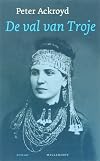
But if one wants to check whether Ackroyd’s eccentric Obermann and his idiosyncratic understanding of Archaeological practices is an appropriate impersonation of Schliemann, the best is to look at the picture of Sophia (could she have had a better name?), wearing the beautiful and becoming treasures found by her husband in his excavations.
Can one have any doubts? show less
Dr. Obermann is certain that he's found the location of the ruined city of Troy. He marries Sophia, a young Greek woman who he feels will have a special connection to the dig site. Sophia accepts her fate, though she does not love the strange, larger-than-life doctor. It soon becomes clear, however, that Dr. Obermann is not what he seems.
A rather slight romp built around the 19th century excavations at the supposed site of ancient Troy. A domineering German archeologist for whom devotion to his theories trumps any other considerations, moral or scholarly is ultimately defeated by the people he betrays and (seemingly) the gods. Clever and pleasant, but not a major Ackroyd novel.
Members
- Recently Added By
Author Information

90+ Works 31,852 Members
Peter Ackroyd was born in London in 1949. He graduated from Cambridge University and was a Fellow at Yale (1971-1973). A critically acclaimed and versatile writer, Ackroyd began his career while at Yale, publishing two volumes of poetry. He continued writing poetry until he began delving into historical fiction with The Great Fire of London show more (1982). A constant theme in Ackroyd's work is the blending of past, present, and future, often paralleling the two in his biographies and novels. Much of Ackroyd's work explores the lives of celebrated authors such as Dickens, Milton, Eliot, Blake, and More. Ackroyd's approach is unusual, injecting imagined material into traditional biographies. In The Last Testament of Oscar Wilde (1983), his work takes on an autobiographical form in his account of Wilde's final years. He was widely praised for his believable imitation of Wilde's style. He was awarded the British Whitbread Award for biography in 1984 of T.S. Eliot, and the Whitbread Award for fiction in 1985 for his novel Hawksmoor. Ackroyd currently lives in London and publishes one or two books a year. He still considers poetry to be his first love, seeing his novels as an extension of earlier poetic work. (Bowker Author Biography) Peter Ackroyd is the award-winning author of four biographies, most recently the national bestseller "The Life of Thomas More", as well as ten novels, including "Chatterton" & "Hawksmoor". He lives in London, where he is at work on his next book, "London: The Biography. (Publisher Provided) Peter Ackroyd is a bestselling writer of both fiction and nonfiction. He lives in London. (Publisher Provided) show less
Common Knowledge
- Original title
- The Fall of Troy
- Original publication date
- 2006
- People/Characters
- Heinrich Obermann; Sophia Chrysanthis; Maria Sophia Obermann; Kadri Bey; Leonid; Theodore Skopelos (show all 9); William Brand; Alexander Thornton; Telemachus
- Important places
- Troy; Hissarlik; Turkey; Greece; Athens, Greece
- First words
- He fell down heavily on his knees, took her hand and brought it up to his mouth.
- Last words
- (Click to show. Warning: May contain spoilers.)From the range of Mount Ida, there came a sudden peal of thunder.
- Original language
- English
Classifications
Statistics
- Members
- 431
- Popularity
- 71,465
- Reviews
- 16
- Rating
- (3.47)
- Languages
- 7 — Dutch, English, French, Greek, Portuguese (Portugal), Spanish, Turkish
- Media
- Paper, Audiobook, Ebook
- ISBNs
- 23
- ASINs
- 6