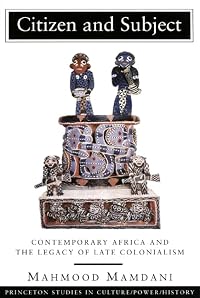
Citizen and Subject: Contemporary Africa and the Legacy of Late Colonialism (Princeton Series in Culture/Power/History)
by Mahmood Mamdani
On This Page
Description
In analyzing the obstacles to democratization in post- independence Africa, Mahmood Mamdani offers a bold, insightful account of colonialism's legacy--a bifurcated power that mediated racial domination through tribally organized local authorities, reproducing racial identity in citizens and ethnic identity in subjects. Many writers have understood colonial rule as either "direct" (French) or "indirect" (British), with a third variant--apartheid--as exceptional. This benign terminology, show more Mamdani shows, masks the fact that these were actually variants of a despotism. While direct rule denied rights to subjects on racial grounds, indirect rule incorporated them into a "customary" mode of rule, with state-appointed Native Authorities defining custom. By tapping authoritarian possibilities in culture, and by giving culture an authoritarian bent, indirect rule (decentralized despotism) set the pace for Africa; the French followed suit by changing from direct to indirect administration, while apartheid emerged relatively later. Apartheid, Mamdani shows, was actually the generic form of the colonial state in Africa. Through case studies of rural (Uganda) and urban (South Africa) resistance movements, we learn how these institutional features fragment resistance and how states tend to play off reform in one sector against repression in the other. The result is a groundbreaking reassessment of colonial rule in Africa and its enduring aftereffects. Reforming a power that institutionally enforces tension between town and country, and between ethnicities, is the key challenge for anyone interested in democratic reform in Africa. show lessTags
Recommendations























Member Reviews
Mahmood Mamdani, professor at Princeton University, specialist of African issues, considered by 'Foreign Policy' and 'Prospect' as being one the 100 most important contemporary intellectuals, attempts here to explain why the process of democratisation failed in most African countries, following their independence.
His thesis? Colonialism wasn't only a racial system whereas Blacks were oppressed by Whites. It was, also, and above all, made possible by very peculiar politics, that led both to ethnic divisions (with tragical consequences at times) and strong a divide between the rural world and the urban one. This last division, to him, is in fact the main cause of the failures. How so?
The African scramble had made necessary the show more implementation of new colonial rules. If the abolition of slavery had transformed the colonies, the limited ruling personnel, compounded by how problematic were communication networks across such vast territories, had made it impossible to rely solely on a White cast to control it all. Decentralisation, then, came as a solution.
Indeed, in those parts where White people had no access or weren't present, they would rely on tribal and local chiefs, created by their own hands (who had nothing traditional about them, then) and who were given considerable powers in order to apply their colonial directives. It was a practical yet deeply cynical approach: corrupting to better conciliate; a dichotomy whereas the State, a mad Janus, took two faces, each defined by the racial identity of who composed it. On the one hand, new customs, completely fabricated by the new chiefs and their White puppeteers, controlling 'subjects' living in rural environments; on the other, in urban areas, the laws of the colonial States being applied only to those who were 'citizens'. And, it's in this institutional evolution that Mahmood Mamdani sees the causes of post-colonial failures when it came to become democratic.
Showing that these divisions (citizens/ subjects, rural world/ urban world) will echo themselves even within nationalist and independentist movements (he delves especially upon the cases of Uganda and South Africa; the first because such movements originated in rural areas, the other because they originated in urban ones) he demonstrates how such movements could only fail managing the disastrous institutional legacy left by colonialism.
The thing was, going from one extreme to the other, democratisation could only be possible through, either a 'detribalisation', involving the replacing of local chiefs (tribal authority) by bureaucrats working solely for the Sate (central authority) and not for their tribes or clans ( something that many refused to do as it would have threaten their own privileges); or, by carrying on with decentralisation as left by previous rulers that is, a maintaining of tribalism and clientelism (and we now know where such tribalism and clientelism have led!).
It's a challenging read, yet that leaves with a new perspective, seductive, that will strike anyone baffled by how deeply the legacy of colonialism had affected Africa, decades after colonialism itself had collapsed. A must-read for anyone interested in African issues. show less
His thesis? Colonialism wasn't only a racial system whereas Blacks were oppressed by Whites. It was, also, and above all, made possible by very peculiar politics, that led both to ethnic divisions (with tragical consequences at times) and strong a divide between the rural world and the urban one. This last division, to him, is in fact the main cause of the failures. How so?
The African scramble had made necessary the show more implementation of new colonial rules. If the abolition of slavery had transformed the colonies, the limited ruling personnel, compounded by how problematic were communication networks across such vast territories, had made it impossible to rely solely on a White cast to control it all. Decentralisation, then, came as a solution.
Indeed, in those parts where White people had no access or weren't present, they would rely on tribal and local chiefs, created by their own hands (who had nothing traditional about them, then) and who were given considerable powers in order to apply their colonial directives. It was a practical yet deeply cynical approach: corrupting to better conciliate; a dichotomy whereas the State, a mad Janus, took two faces, each defined by the racial identity of who composed it. On the one hand, new customs, completely fabricated by the new chiefs and their White puppeteers, controlling 'subjects' living in rural environments; on the other, in urban areas, the laws of the colonial States being applied only to those who were 'citizens'. And, it's in this institutional evolution that Mahmood Mamdani sees the causes of post-colonial failures when it came to become democratic.
Showing that these divisions (citizens/ subjects, rural world/ urban world) will echo themselves even within nationalist and independentist movements (he delves especially upon the cases of Uganda and South Africa; the first because such movements originated in rural areas, the other because they originated in urban ones) he demonstrates how such movements could only fail managing the disastrous institutional legacy left by colonialism.
The thing was, going from one extreme to the other, democratisation could only be possible through, either a 'detribalisation', involving the replacing of local chiefs (tribal authority) by bureaucrats working solely for the Sate (central authority) and not for their tribes or clans ( something that many refused to do as it would have threaten their own privileges); or, by carrying on with decentralisation as left by previous rulers that is, a maintaining of tribalism and clientelism (and we now know where such tribalism and clientelism have led!).
It's a challenging read, yet that leaves with a new perspective, seductive, that will strike anyone baffled by how deeply the legacy of colonialism had affected Africa, decades after colonialism itself had collapsed. A must-read for anyone interested in African issues. show less
Ratings
Members
- Recently Added By
Author Information

19 Works 1,339 Members
Mahmood Mamdani is the Herbert Lehman Professor of Government at Columbia University and executive director of the Makerere Institute of Social Research. His many books include Citizen and Subject (Princeton) and Saviors and Survivors (Crown).
Awards and Honors
Awards
Series
Belongs to Publisher Series
Classifications
- Genres
- Nonfiction, Politics and Government, History, General Nonfiction
- DDC/MDS
- 320.96 — Society, Government, and Culture Political science Types of Government Political situation and conditions Africa
- LCC
- JV246 .M35 — Political Science Colonies and colonization. Emigration and immigration. International migration Colonies and colonization. Emigration and Colonies and colonization
- BISAC
Statistics
- Members
- 181
- Popularity
- 180,290
- Reviews
- 1
- Rating
- (3.83)
- Languages
- English
- Media
- Paper, Ebook
- ISBNs
- 7