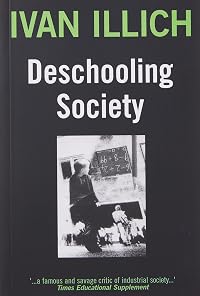
Deschooling Society
by Ivan Illich
On This Page
Description
Schools have failed our individual needs, supporting false and misleading notions of 'progress' and development fostered by the belief that ever-increasing production, consumption and profit are proper yardsticks for measuring the quality of human life. Our universities have become recruiting centers for the personnel of the consumer society, certifying citizens for service, while at the same time disposing of those judged unfit for the competitive rat race. In this bold and provocative show more book, Illich suggest some radical and exciting reforms for the education system. show lessTags
Recommendations












Member Reviews
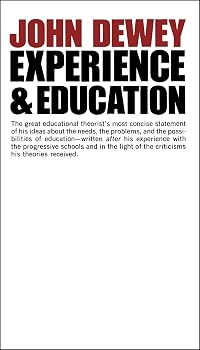
Illich makes a radical critique of education, capitalism, statism, and almost everything that is both extremely focused and also directs slashes at nearly every underpinning assumption of society. Illich's most direct criticism is at the idea that formal education solves problems. Rather than being about skill acquisition or personal development, Illich identifies schools as the ideological wing of the consumption-production engine that is capitalism. The role of schools is to produce ignorance rather than insight, to create credentials and envy of credentials rather than mastery, to suck up surplus labor and intellect in the Promethean furnace of a culture consuming itself. The criticism starts with Dewey's ideas about education, and show more moves through Johnson's Great Society, international development, drawing heavily on Illich's personal experiences in Mexico, the Vietnam War, and the industrial design of the transistor radio. Don't mistake this for Marxism though; Illich calls out the Soviet system as another gear in the world-spanning educational system.
Against traditional classrooms and curriculum, Illich imagines 'learning webs', where computers would connect people who wanted to learn something to people who already knew it, forming tutoring pairings and affinity groups that meet in cafes and converted shopfronts. Mass production of tapes and audiobooks, along with appropriate technology in the developing world, will liberate minds. Most of Illich's criticisms are directed at the liberal consensus, and he's not afraid of citing Milton Friedman's voucherization of school systems as a positive example, but mostly it's the idea of any sort of formal, obligatory, schooling that is the enemy. There's a direct line between military discipline and educational discipline, and for Illich both are wasteful, anti-human, and evil. The institutional attempt to achieve a goal will always fulfill it's opposite.
As a historical artifact, this work was published in 1971, when for a brief glorious moment it seemed like the Counterculture would triumph, and that all the corrupt and evil institutions of a rotten society would crumble to be replaced by a new dawn met people where they were. Now, more than 40 years on, we know that this moment would last only a little longer. But Illich, even in his strident utopianism, wasn't wrong. Speaking as someone in the 23rd grade, too much education is useless credentialism that serves to indebt the ambitious working classes. Those with power and money have their own networks of private tutors to pursue actually effective education for their children, while basic skills like knowing how to do something, or how to think in a straight line for 500 words, are increasingly the privilege of the elite. show less
Against traditional classrooms and curriculum, Illich imagines 'learning webs', where computers would connect people who wanted to learn something to people who already knew it, forming tutoring pairings and affinity groups that meet in cafes and converted shopfronts. Mass production of tapes and audiobooks, along with appropriate technology in the developing world, will liberate minds. Most of Illich's criticisms are directed at the liberal consensus, and he's not afraid of citing Milton Friedman's voucherization of school systems as a positive example, but mostly it's the idea of any sort of formal, obligatory, schooling that is the enemy. There's a direct line between military discipline and educational discipline, and for Illich both are wasteful, anti-human, and evil. The institutional attempt to achieve a goal will always fulfill it's opposite.
As a historical artifact, this work was published in 1971, when for a brief glorious moment it seemed like the Counterculture would triumph, and that all the corrupt and evil institutions of a rotten society would crumble to be replaced by a new dawn met people where they were. Now, more than 40 years on, we know that this moment would last only a little longer. But Illich, even in his strident utopianism, wasn't wrong. Speaking as someone in the 23rd grade, too much education is useless credentialism that serves to indebt the ambitious working classes. Those with power and money have their own networks of private tutors to pursue actually effective education for their children, while basic skills like knowing how to do something, or how to think in a straight line for 500 words, are increasingly the privilege of the elite. show less
My mum recommended this short but extremely thought-provoking book to me. She read it decades ago and found it life-changing. I wouldn’t necessarily say the same, but found it disproportionately interesting for its length. It is a critique of the formal, mandatory education system originally published in 1970. My thoughts on it can be roughly grouped under three headings: responses to the theoretical points advanced, reflections on my personal experiences with the education system, and thoughts on how the book has aged. On the first front, I initially found Illich’s hostility to organised education disconcerting. I’d never previously read anything so critical not just of specific aspects of the education system, but of formalised show more education in principle. If it ever was fashionable in heterodox economics, this sort of critique certainly isn’t now. Indeed, development economics places huge emphasis on education as a route out of poverty. Once I’d got past my surprise, however, I found myself sympathetic to many of Illich’s points. In particular, that school both trains children to be consumers and reproduces inequalities by qualification gatekeeping. In terms of his wider critique of capitalism, I liked this deconstruction of the ideology of progress:
I was particularly struck by this having been written prior to the triumph of neoliberalism/’End of History’ period in the 1980s. On the other hand, I found some of Illich’s bitter criticisms of teachers and teaching less convincing. Potentially because I’ve always found school work manageable? I was one of those quiet kids who didn’t speak up much but did well in exams. Although in principle I think it’s ridiculous the level to which future life chances are mediated by exam marks at a young age, I also find it difficult to propose a better system as I test well. In fact, I systematically do better in exams than class work. That aside, what Illich’s discussions of school don’t really engage with are the potential purposes of education. I presume because he sees learning as an entirely open-ended, self-directed process, whereas ‘education’ is inherently constraining and wrong. Basically, I think his critique of schools goes to extremes I found too libertarian, whilst also making some very good points and proving an interesting new angle from which to challenge capitalism.
One chapter in particular made me reflect on postgraduate education and the PhD process. Doing a PhD really is self-directed learning, although mine may well have been more so than most. I was given total freedom to shape my project and choose the methods and data I used, with very little input from my supervisor or indeed anyone else. Illich’s section on ‘the ritualization of progress’ made me consider how I’d had to earn this freedom by getting through the preceding 18 years of mandatory educational instruction and exam-taking. Then, as soon as I’d earned this right to learn by myself, I was expected to turn around and teach others, controlling their learning and setting them up to pass exams. It suddenly seemed very cyclical, reproducing the importance of instruction. As Illich puts it: ‘In school we are taught that valuable learning is the result of attendance; that the value of learning increases with the amount of input; and, finally, that this value can be measured and documented by grades and certificates… This transfer of responsibility from self to institution guarantees social regression, especially once it has been accepted as an obligation. So rebels against Alma Mater often “make it” into her faculty instead of growing into the courage to infect others with their personal teaching and to assume responsibility for the results’.
This reminded me that both myself and a high school teacher friend feel like we need to justify any original teaching approaches we use (I always tried to slip in some critique of free market economics, for example) by also ensuring our students get good exam results. The most rewarding students to teach haven’t fully internalised the concept of education as merely a means of gaining qualifications, but also appreciate learning for its own sake. The space in educational institutions for non-exam focused learning seems to be small and shrinking, however. Indeed, I realise that there’s probably a link between my enjoyment of learning for fun & teaching beyond the syllabus and my ability to get good exam marks. If all my energy and time had been required to get decent exam marks, I wouldn’t have been able to learn beyond that and probably wouldn’t have wanted to do so. This seems profoundly unfair and illogical: being rewarded for exam ability by not having to use exam skills anymore! Instead, you’ve earned the right to try and convey exam skills to a new generation. I doubt I’m particularly helpful at that, in any case, as I don’t know exactly why exams are relatively manageable for me in comparison to others. Quite apart from the fact that exam skills have little to no relevance in the world of work, let alone the rest of life. I agree with Illich that practical tests (of typing, for example) are more useful to vet candidates suitability for a job than exam results. Indeed, such tests seem pretty common – but only if the candidates have also passed the exam results hurdle.
Whilst I’m on the general theme of higher education, I must mention Illich’s excellent analysis of motorway systems as ‘false public utilities’. If I’d come across this before I might have worked it into my thesis, as it’s so well put:
Update the language in that paragraph slightly and you have a summary of Urry’s ‘System of Automobility’ theory. It remains a fundamental paradox of current transport policy that so-called private modes of transport require the massive public subsidy of a road system, whereas so-called public transport has been deregulated with the intention of getting its users to bear the full costs. I didn’t expect to find such lucid analysis of transport in a short book about deschooling society, I must say.
Moving on to how the book’s thesis has aged, I think it is fascinating to consider how Illich’s analysis fares in the internet age. Central to the entire book is the simple maxim that, ‘Most learning is not the result of instruction’. At several points, Illich attempts to describe systems that would enable independent, self-directed, peer-to-peer learning and comes up with essentially a pre-digital internet:
Although by no means everyone has internet access, these days an extremely powerful version of just such a network exists and is used by 40% of the world’s population. The fact that I found that statistic on Wikipedia clearly demonstrates the potential of the internet for quick and easy self-directed learning! So, given that Illich’s vision of information availability and opinion sharing has been achieved beyond his wildest imaginings, how do his ideas of the consequences hold up? This strikes me as a fascinating question worthy of much more in-depth answers than I can provide. Obviously, schools have not withered away as he hoped. Indeed, the totemic power of exam results has only increased with the marketization of education, both school and higher. On the other hand, parallel to and hidden by mainstream education are powerful counter-trends. Amongst my friendship group are a number of people who earn very good wages as coders – and, as far as I know, every one of them is self-taught. Indeed, I taught myself some limited coding in order to use R for statistics during my PhD, with instruction from Professor Google but no formal training whatsoever. However, my friends and I are all university graduates. Is it the case that we are more able to use the internet for self-directed learning thanks to our university training? Or is it the case (as one coder friend contends) that the contents of our degrees were pointless and the process only useful as a means of meeting people?
Then again, this is just the specific case of a skill that is increasingly relevant to the job market; Illich would not approve of such emphasis I suspect. The internet has undoubtedly made it much easier to learn practical and hobby-type skills like playing instruments, knitting, and cookery techniques. At the moment, these forms of learning parallel rather than replacing the school system, which appears very firmly entrenched. This may change in the future, although the internet is not the totally free and independent network that Illich foresaw. Large portions of it are controlled by private monopolies (good old Professor Google) and the whole contends with copyright issues (which prevent free sharing of the information in published books, for instance). Given the creeping privatisation of public institutions like schools, I find it easier to imagine a future in which online Google School courses were just as mandatory and specific as the current curriculum, rather than kids being set free to learning through doing. Equally, Illich’s ideas about learning to operate and repair technology appear antithetical to the current trends of manufactured obsolescence and strong defences of technological patents. Illich wanted all information to be set free; the internet cannot achieve that without substantial legal reform. Then again, laws protecting copyright are fighting a losing battle against the ease of spreading information. Moreover, open source software and Wikipedia demonstrate that learning and creation can thrive outside private monopolies.
To conclude, I should mention a reason why I was initially so disconcerted by Illich’s anti-school attitude: because his libertarian rhetoric of educational choice has been firmly co-opted by the right wing (which I bet he resented). Talk of free schools, of vouchers towards education, and of choosing between education providers smacks to me of privatisation. Specifically, it reminds me of Michael Gove’s reforms of the UK education system. Illich clearly did not intend his vision of educational freedom to be constrained within markets, but in the 21st century that is what choice has become tied to. If there are different providers of some service, they must be competing with each other within a market. Yet this will undoubtedly produce more of the same narrow, ideological teaching that Illich abhors, generally at lower quality. Depressingly, it is hard to see how education could be made freer and more self-directed whilst also defending it from further market incursion. Perhaps the most promising route is that outlined by Paul Mason in [b:Postcapitalism: A Guide to Our Future|24878857|Postcapitalism A Guide to Our Future|Paul Mason|https://images.gr-assets.com/books/1437580637s/24878857.jpg|44526761]: neoliberalism will destroy itself because it cannot cope with information becoming an increasing proportion of GDP. That thesis links quite neatly to ‘Deschooling Society’ – the institution of school produces consumers and workers, so capitalism cannot readily survive without it. Conversely, capitalism also relies on learning that takes place outside school. If Mason’s analysis is correct, school will become increasingly irrelevant as mechanisation destroys jobs and those that remain require coding skills, which can be gained through independent study and involvement with an online community of peers. So technology could yet undermine the school system and encourage a much freer model of learning, albeit in a manner that in 1970 Illich could not hope to foresee. Undoubtedly his book remains relevant and interesting nearly fifty years after he wrote it. It contains a density of provocative ideas that not many writers can match. show less
Not to go where one can go would be subversive. It would unmask as folly the assumption that every satisfied demand entails the discovery of an even greater unsatisfied one. Such insight would stop progress. Not to produce what is possible would expose the law of ‘rising expectations’ as a euphemism for a growing frustration gap, which is the motor of a society built on the coproduction of services and increased demand.
I was particularly struck by this having been written prior to the triumph of neoliberalism/’End of History’ period in the 1980s. On the other hand, I found some of Illich’s bitter criticisms of teachers and teaching less convincing. Potentially because I’ve always found school work manageable? I was one of those quiet kids who didn’t speak up much but did well in exams. Although in principle I think it’s ridiculous the level to which future life chances are mediated by exam marks at a young age, I also find it difficult to propose a better system as I test well. In fact, I systematically do better in exams than class work. That aside, what Illich’s discussions of school don’t really engage with are the potential purposes of education. I presume because he sees learning as an entirely open-ended, self-directed process, whereas ‘education’ is inherently constraining and wrong. Basically, I think his critique of schools goes to extremes I found too libertarian, whilst also making some very good points and proving an interesting new angle from which to challenge capitalism.
One chapter in particular made me reflect on postgraduate education and the PhD process. Doing a PhD really is self-directed learning, although mine may well have been more so than most. I was given total freedom to shape my project and choose the methods and data I used, with very little input from my supervisor or indeed anyone else. Illich’s section on ‘the ritualization of progress’ made me consider how I’d had to earn this freedom by getting through the preceding 18 years of mandatory educational instruction and exam-taking. Then, as soon as I’d earned this right to learn by myself, I was expected to turn around and teach others, controlling their learning and setting them up to pass exams. It suddenly seemed very cyclical, reproducing the importance of instruction. As Illich puts it: ‘In school we are taught that valuable learning is the result of attendance; that the value of learning increases with the amount of input; and, finally, that this value can be measured and documented by grades and certificates… This transfer of responsibility from self to institution guarantees social regression, especially once it has been accepted as an obligation. So rebels against Alma Mater often “make it” into her faculty instead of growing into the courage to infect others with their personal teaching and to assume responsibility for the results’.
This reminded me that both myself and a high school teacher friend feel like we need to justify any original teaching approaches we use (I always tried to slip in some critique of free market economics, for example) by also ensuring our students get good exam results. The most rewarding students to teach haven’t fully internalised the concept of education as merely a means of gaining qualifications, but also appreciate learning for its own sake. The space in educational institutions for non-exam focused learning seems to be small and shrinking, however. Indeed, I realise that there’s probably a link between my enjoyment of learning for fun & teaching beyond the syllabus and my ability to get good exam marks. If all my energy and time had been required to get decent exam marks, I wouldn’t have been able to learn beyond that and probably wouldn’t have wanted to do so. This seems profoundly unfair and illogical: being rewarded for exam ability by not having to use exam skills anymore! Instead, you’ve earned the right to try and convey exam skills to a new generation. I doubt I’m particularly helpful at that, in any case, as I don’t know exactly why exams are relatively manageable for me in comparison to others. Quite apart from the fact that exam skills have little to no relevance in the world of work, let alone the rest of life. I agree with Illich that practical tests (of typing, for example) are more useful to vet candidates suitability for a job than exam results. Indeed, such tests seem pretty common – but only if the candidates have also passed the exam results hurdle.
Whilst I’m on the general theme of higher education, I must mention Illich’s excellent analysis of motorway systems as ‘false public utilities’. If I’d come across this before I might have worked it into my thesis, as it’s so well put:
The highway system does not similarly become available to someone who merely learns to drive. The telephone and postal networks exist to serve those who wish to use them [not now they’ve been privatised!], while the highway system mainly serves as an accessory to the private automobile. The former are [were once] true public utilities, whereas the latter is a public service for the owners of cars, trucks, and buses. Public utilities exist for the sake of communication between men; highways, like other institutions of the right, exist for the sake of a product. Auto manufacturers, we have already observed, produce simultaneously both cars and the demand for cars. They also produce the demand for multilane highways, bridges, and oilfields. The private car is the focus of a cluster of right-wing institutions. The high cost of each element is dictated by elaboration of the basic product, and to sell the basic product is to “hook” society on the entire package.
Update the language in that paragraph slightly and you have a summary of Urry’s ‘System of Automobility’ theory. It remains a fundamental paradox of current transport policy that so-called private modes of transport require the massive public subsidy of a road system, whereas so-called public transport has been deregulated with the intention of getting its users to bear the full costs. I didn’t expect to find such lucid analysis of transport in a short book about deschooling society, I must say.
Moving on to how the book’s thesis has aged, I think it is fascinating to consider how Illich’s analysis fares in the internet age. Central to the entire book is the simple maxim that, ‘Most learning is not the result of instruction’. At several points, Illich attempts to describe systems that would enable independent, self-directed, peer-to-peer learning and comes up with essentially a pre-digital internet:
’The most radical alternative to school would be a network or service which gave each man the same opportunity to share his current concern with others motivated by the same concern.’
‘What are needed are new networks, readily available to the public and designed to spread equal opportunity for learning and teaching… The money now tied up in TV installations throughout Latin America could have provided every fifth adult with a tape recorder. In addition, the money could have sufficed to provide an almost unlimited library of prerecorded tapes, with outlets even in remote villages, as well as an ample supply of empty tapes.
This network of tape recorders, of course, would be radically different from the present network of TV. It would provide opportunity for free expression: literate and illiterate alike could record, preserve, disseminate, and repeat their opinions.’
Although by no means everyone has internet access, these days an extremely powerful version of just such a network exists and is used by 40% of the world’s population. The fact that I found that statistic on Wikipedia clearly demonstrates the potential of the internet for quick and easy self-directed learning! So, given that Illich’s vision of information availability and opinion sharing has been achieved beyond his wildest imaginings, how do his ideas of the consequences hold up? This strikes me as a fascinating question worthy of much more in-depth answers than I can provide. Obviously, schools have not withered away as he hoped. Indeed, the totemic power of exam results has only increased with the marketization of education, both school and higher. On the other hand, parallel to and hidden by mainstream education are powerful counter-trends. Amongst my friendship group are a number of people who earn very good wages as coders – and, as far as I know, every one of them is self-taught. Indeed, I taught myself some limited coding in order to use R for statistics during my PhD, with instruction from Professor Google but no formal training whatsoever. However, my friends and I are all university graduates. Is it the case that we are more able to use the internet for self-directed learning thanks to our university training? Or is it the case (as one coder friend contends) that the contents of our degrees were pointless and the process only useful as a means of meeting people?
Then again, this is just the specific case of a skill that is increasingly relevant to the job market; Illich would not approve of such emphasis I suspect. The internet has undoubtedly made it much easier to learn practical and hobby-type skills like playing instruments, knitting, and cookery techniques. At the moment, these forms of learning parallel rather than replacing the school system, which appears very firmly entrenched. This may change in the future, although the internet is not the totally free and independent network that Illich foresaw. Large portions of it are controlled by private monopolies (good old Professor Google) and the whole contends with copyright issues (which prevent free sharing of the information in published books, for instance). Given the creeping privatisation of public institutions like schools, I find it easier to imagine a future in which online Google School courses were just as mandatory and specific as the current curriculum, rather than kids being set free to learning through doing. Equally, Illich’s ideas about learning to operate and repair technology appear antithetical to the current trends of manufactured obsolescence and strong defences of technological patents. Illich wanted all information to be set free; the internet cannot achieve that without substantial legal reform. Then again, laws protecting copyright are fighting a losing battle against the ease of spreading information. Moreover, open source software and Wikipedia demonstrate that learning and creation can thrive outside private monopolies.
To conclude, I should mention a reason why I was initially so disconcerted by Illich’s anti-school attitude: because his libertarian rhetoric of educational choice has been firmly co-opted by the right wing (which I bet he resented). Talk of free schools, of vouchers towards education, and of choosing between education providers smacks to me of privatisation. Specifically, it reminds me of Michael Gove’s reforms of the UK education system. Illich clearly did not intend his vision of educational freedom to be constrained within markets, but in the 21st century that is what choice has become tied to. If there are different providers of some service, they must be competing with each other within a market. Yet this will undoubtedly produce more of the same narrow, ideological teaching that Illich abhors, generally at lower quality. Depressingly, it is hard to see how education could be made freer and more self-directed whilst also defending it from further market incursion. Perhaps the most promising route is that outlined by Paul Mason in [b:Postcapitalism: A Guide to Our Future|24878857|Postcapitalism A Guide to Our Future|Paul Mason|https://images.gr-assets.com/books/1437580637s/24878857.jpg|44526761]: neoliberalism will destroy itself because it cannot cope with information becoming an increasing proportion of GDP. That thesis links quite neatly to ‘Deschooling Society’ – the institution of school produces consumers and workers, so capitalism cannot readily survive without it. Conversely, capitalism also relies on learning that takes place outside school. If Mason’s analysis is correct, school will become increasingly irrelevant as mechanisation destroys jobs and those that remain require coding skills, which can be gained through independent study and involvement with an online community of peers. So technology could yet undermine the school system and encourage a much freer model of learning, albeit in a manner that in 1970 Illich could not hope to foresee. Undoubtedly his book remains relevant and interesting nearly fifty years after he wrote it. It contains a density of provocative ideas that not many writers can match. show less
I found this book thru mention in Christopher Lasch’s “Culture of Narcissism” and I think it comes at things from a wonderfully contrarian perspective, just like that book does. This book exists in the Marxist tradition (although I don’t know if Illich considered himself one) of deconstructing a cultural monolith that is so omnipresent and ingrained that most people don’t even realize it’s there - in this case it’s compulsory schooling, though by the end of the book Ilich shows us the vast scope of his ideas. The central ideas of this book seem to me three fold:
- compulsory education is a transgression on freedom and dignity
- compulsory education destroys the essential desire to learn and educate oneself under their own show more volition
- compulsory education is boot camp for a society in which our main duty is to consume
From these criticisms of the educational system as it exists in effectively every corner of the Earth, he extends out into an extremely compelling and (to my ears) highly novel argument against the institutionalization of every aspect of modern life.
Ilich was clearly a highly accomplished and down to earth man who didn’t put much stock in impotent theory - this book is full of practical recommendations as to how to institute the decentralized, curriculum-free version of education he supports. This is some of the drier material in the book, but it’s also valuable to conceiving how such a radical overhaul of one of society’s most basic concepts - the school - might be carried out. And yet, such a vast topic requires much more fleshing out than it gets here, which is ok because this is a book about ideas, not an instruction manual. But as an “educator” myself who would be enthusiastic about putting Ilich’s ideas into practice, I still struggle to envision how education would look under his proposed system.
This book is prescient in so many ways. Illich absolutely predicted the internet in terms of its functionality, but he doesn’t say much about how such a system would be administered and maintained. Perhaps he thought the deschooling of society would occur before technology reached the point we are at now. But even in a world where you can learn almost anything by yourself simply by opening a web browser, the systematic coercion of our educational system, it’s monopoly on the criterium of success remains stalwart. Illich obviously wanted his readers to feel hopeful about the possibility of his educational webs idea (in fact the concept of “hope” is a central concept to the closing part of the book) and so focused on a rather utopian conception of what it would look like; I can’t imagine he would be so naive about that fact that under our current system such a “web” would immediately be monetized by the most craven of capitalist accumulators. This brings me to what I think is the biggest hole in his argument, a kind of educational chicken or the egg; is our fucked society a result of our educational system or is our fucked educational system a result of our society. Illich bucks the typical answer by saying it’s the former rather than the latter, but I’m not sure I feel convinced of that fact after reading this book. That’s not a major slight as there is only so much you can cover in a rather slim volume. show less
- compulsory education is a transgression on freedom and dignity
- compulsory education destroys the essential desire to learn and educate oneself under their own show more volition
- compulsory education is boot camp for a society in which our main duty is to consume
From these criticisms of the educational system as it exists in effectively every corner of the Earth, he extends out into an extremely compelling and (to my ears) highly novel argument against the institutionalization of every aspect of modern life.
Ilich was clearly a highly accomplished and down to earth man who didn’t put much stock in impotent theory - this book is full of practical recommendations as to how to institute the decentralized, curriculum-free version of education he supports. This is some of the drier material in the book, but it’s also valuable to conceiving how such a radical overhaul of one of society’s most basic concepts - the school - might be carried out. And yet, such a vast topic requires much more fleshing out than it gets here, which is ok because this is a book about ideas, not an instruction manual. But as an “educator” myself who would be enthusiastic about putting Ilich’s ideas into practice, I still struggle to envision how education would look under his proposed system.
This book is prescient in so many ways. Illich absolutely predicted the internet in terms of its functionality, but he doesn’t say much about how such a system would be administered and maintained. Perhaps he thought the deschooling of society would occur before technology reached the point we are at now. But even in a world where you can learn almost anything by yourself simply by opening a web browser, the systematic coercion of our educational system, it’s monopoly on the criterium of success remains stalwart. Illich obviously wanted his readers to feel hopeful about the possibility of his educational webs idea (in fact the concept of “hope” is a central concept to the closing part of the book) and so focused on a rather utopian conception of what it would look like; I can’t imagine he would be so naive about that fact that under our current system such a “web” would immediately be monetized by the most craven of capitalist accumulators. This brings me to what I think is the biggest hole in his argument, a kind of educational chicken or the egg; is our fucked society a result of our educational system or is our fucked educational system a result of our society. Illich bucks the typical answer by saying it’s the former rather than the latter, but I’m not sure I feel convinced of that fact after reading this book. That’s not a major slight as there is only so much you can cover in a rather slim volume. show less
This book takes the myth of schooling as a place where anything important happens and rips it to shreds, and replaces it with deep trust in humanity to learn and to grow on their own terms and not having the terms of 'learning' or 'improvement' dictated to an individual by others. This book confirmed what on some level I think we all know: kids hate school for a reason, and that reason is that school is dumb, no true learning happens, and the actualization of one's authentic self, and the growth needed to be one's best self, happens outside of school. Most of us didn't like being in school anyway, but somehow we forget, and push the values of standardized education onto the next generation. I wish Ivan Illich could run the world. I'd be show more scared at first, the man is truly radical, but it would be better than the shitshow we have going on right now. show less
Ivan Illich doesn’t mince words. So far as formal schooling goes, he argues for a society where school is not just out for summer, it’s out completely. In Deschooling Society he writes, “The modern state has assumed the duty of enforcing the judgment of its educators…much as [did] the Spanish kings who enforced the judgments of their theologians through the conquistadors and the Inquisition.” The Inquisition? Now that’s a concussive statement.
Illich’s goal is to unshackle education from institutions. He doesn’t want government or other formal bodies deciding how to educate the populace. He protests that “only by channeling dollars away from the institutions which now treat…education…can the further impoverishment show more resulting from their disabling side effects be stopped.” How stop these disabling acts? Nothing less than a Bill of Rights of Education will do, with the first provision being “The state shall make no law with respect to the establishment of education.” He’d also, we figure out, likely endorse banning educational methods based on the concept of “Childhood.” A related consequence is his idea of permitting “a boy of twelve to become a man fully responsible for his participation in the life of the community…[and] allowed to come of age.” Recalling that he’d been a parish priest, that statement can cause one to blanch.
All this is assertive enough to get my attention. Does he deserve yours? It doesn’t help that the book’s first paragraph is bad enough to discourage any faith he won’t waste our time. And oh, that relentless rhetoric, with hardly a living being in sight. The author offers a torrent of pronouncements notable for the absence of opinions from young people. Illich is the man on the street corner expostulating with oratory that can seem like static because he won’t intrude on his argument testimony from the souls he seeks to save. It would help him, and us, a lot if they could testify.
Interwoven in the argument is Illich’s strong conviction that school exists to serve the power elite. This is no secondary matter and motivates much of his distaste. In his hands, though, that subject becomes boring and distracts from the more interesting theme of revolutionizing education.
In his final chapter, Illich verges on apocalyptic. It appears we now find ourselves in a kind of End Times in which “survival of the human race” will depend on rediscovery of “hope.” Hope, he clarifies, “means trusting faith in the goodness of nature” and it “centers desire on a person from whom we await a gift.” This hope Illich summons calls immediately to mind childhood’s trusting faith when looking to loving parents for help. It is an irony: Illich invokes such hope despite earlier insisting that “Growing up through childhood means being condemned to a process of inhuman conflict between self-awareness and the role imposed by a society.” But by whom is that role introduced? By one’s parents, for most. So it seems we are to achieve survival when the conditions associated with inhuman conflict tend to be at large.
Still, despite how one might be driven away from Deschooling Society, the book has merits. His attitudes toward licensure, certification, and credentialing deserve notice. He understands the mania of how societies “create needs faster than they can create satisfaction.” And while his notion of “learning webs” isn’t introduced all that effectively, it is a prescient idea that the internet age makes realistic. Unless a reader is resistant to hearing others’ thoughts, the book will be a stimulus, even if only to wrestle with how to form objections. Naturally it would please Illich best if your wrestling is undertaken for some purpose other than completing a school or institutional assignment.
A fascinating article illustrating a real-world educational alternative called “unschooling” was published in Outside magazine a few years ago. It is “We Don’t Need No Education,” by Ben Hewitt, and is online. There are living young people in it and their experiences speak to the possibility that education can be done without curriculum-bound schools or “home” schools. Check it out, along with Hewitt’s other writings on the subject, especially if Illich’s way of arguing cause you to lose interest not in his subject but in his book. show less
Illich’s goal is to unshackle education from institutions. He doesn’t want government or other formal bodies deciding how to educate the populace. He protests that “only by channeling dollars away from the institutions which now treat…education…can the further impoverishment show more resulting from their disabling side effects be stopped.” How stop these disabling acts? Nothing less than a Bill of Rights of Education will do, with the first provision being “The state shall make no law with respect to the establishment of education.” He’d also, we figure out, likely endorse banning educational methods based on the concept of “Childhood.” A related consequence is his idea of permitting “a boy of twelve to become a man fully responsible for his participation in the life of the community…[and] allowed to come of age.” Recalling that he’d been a parish priest, that statement can cause one to blanch.
All this is assertive enough to get my attention. Does he deserve yours? It doesn’t help that the book’s first paragraph is bad enough to discourage any faith he won’t waste our time. And oh, that relentless rhetoric, with hardly a living being in sight. The author offers a torrent of pronouncements notable for the absence of opinions from young people. Illich is the man on the street corner expostulating with oratory that can seem like static because he won’t intrude on his argument testimony from the souls he seeks to save. It would help him, and us, a lot if they could testify.
Interwoven in the argument is Illich’s strong conviction that school exists to serve the power elite. This is no secondary matter and motivates much of his distaste. In his hands, though, that subject becomes boring and distracts from the more interesting theme of revolutionizing education.
In his final chapter, Illich verges on apocalyptic. It appears we now find ourselves in a kind of End Times in which “survival of the human race” will depend on rediscovery of “hope.” Hope, he clarifies, “means trusting faith in the goodness of nature” and it “centers desire on a person from whom we await a gift.” This hope Illich summons calls immediately to mind childhood’s trusting faith when looking to loving parents for help. It is an irony: Illich invokes such hope despite earlier insisting that “Growing up through childhood means being condemned to a process of inhuman conflict between self-awareness and the role imposed by a society.” But by whom is that role introduced? By one’s parents, for most. So it seems we are to achieve survival when the conditions associated with inhuman conflict tend to be at large.
Still, despite how one might be driven away from Deschooling Society, the book has merits. His attitudes toward licensure, certification, and credentialing deserve notice. He understands the mania of how societies “create needs faster than they can create satisfaction.” And while his notion of “learning webs” isn’t introduced all that effectively, it is a prescient idea that the internet age makes realistic. Unless a reader is resistant to hearing others’ thoughts, the book will be a stimulus, even if only to wrestle with how to form objections. Naturally it would please Illich best if your wrestling is undertaken for some purpose other than completing a school or institutional assignment.
A fascinating article illustrating a real-world educational alternative called “unschooling” was published in Outside magazine a few years ago. It is “We Don’t Need No Education,” by Ben Hewitt, and is online. There are living young people in it and their experiences speak to the possibility that education can be done without curriculum-bound schools or “home” schools. Check it out, along with Hewitt’s other writings on the subject, especially if Illich’s way of arguing cause you to lose interest not in his subject but in his book. show less
Deschooling Society is a collection of essays based around the author's idea that society might be better off without the formal schooling system that is prevalent in most industrialised countries. He supports this radical proposition by stating that the majority of learning is done outside of the formal educational system, and that school itself is therefore not necessary for education.
A second strand to the argument is that industrialised nations have to rely too much on "pre-packaged" services, in which a service is consumed. As the whole of society revolves around consumer institutions, be these in healthcare, education, and retail, we treat these services as something we complacently consume and not as something we actively show more participate in. This is in contrast to historic or non-industrialised nations where learning is achieved when it is useful to the individual, for example during an apprenticeship for a certain means of livelihood, or learning from family elders. The instituton of school, the author claims, is maladjusted to the needs of the individual and seeks to teach everyone the same thing whether it is useful to them or not – thereby wasting vast resources of time and money. The very existence of schools and universities create a demand for their products, whether or not they are actually needed for practical reasons of imparting useful learning: because it looks bad if you are the one, in a competitive society, who hasn't completed school or obtained a degree. There is probably more than a little truth in this view.
There is a lot of rhetoric and bold statement in this book, and not as much convincing argument in favour of the project of deschooling as the book could have benefited from. It is certainly a very interesting idea that modern society could be better served by alternative modes of education, however there is little here to make a convincing case that warrants the enthusiasm that the author has for this project.
As with many people who criticise current systems, sensible alternative propositions are somewhat lacking, however one of the essays does go into some detail about new proposed methods of learning. Being written in the 70s when audio cassettes and sending things by post were the state of the art, some of the proposed alternative methods of learning have now been more or less realised in a more advanced form on the internet including forums for the discussion of special interests, "how to" videos on You-tube, and online learning courses.
There is enough in this volume to prompt the reader to seriously consider the feasibility of a society in which the school system was disestablished, and this itself deserves some credit. show less
A second strand to the argument is that industrialised nations have to rely too much on "pre-packaged" services, in which a service is consumed. As the whole of society revolves around consumer institutions, be these in healthcare, education, and retail, we treat these services as something we complacently consume and not as something we actively show more participate in. This is in contrast to historic or non-industrialised nations where learning is achieved when it is useful to the individual, for example during an apprenticeship for a certain means of livelihood, or learning from family elders. The instituton of school, the author claims, is maladjusted to the needs of the individual and seeks to teach everyone the same thing whether it is useful to them or not – thereby wasting vast resources of time and money. The very existence of schools and universities create a demand for their products, whether or not they are actually needed for practical reasons of imparting useful learning: because it looks bad if you are the one, in a competitive society, who hasn't completed school or obtained a degree. There is probably more than a little truth in this view.
There is a lot of rhetoric and bold statement in this book, and not as much convincing argument in favour of the project of deschooling as the book could have benefited from. It is certainly a very interesting idea that modern society could be better served by alternative modes of education, however there is little here to make a convincing case that warrants the enthusiasm that the author has for this project.
As with many people who criticise current systems, sensible alternative propositions are somewhat lacking, however one of the essays does go into some detail about new proposed methods of learning. Being written in the 70s when audio cassettes and sending things by post were the state of the art, some of the proposed alternative methods of learning have now been more or less realised in a more advanced form on the internet including forums for the discussion of special interests, "how to" videos on You-tube, and online learning courses.
There is enough in this volume to prompt the reader to seriously consider the feasibility of a society in which the school system was disestablished, and this itself deserves some credit. show less
Didn't think I'd find myself in such agreement with Illich. Basically, what he's saying is that when you attempt to organize education from a top-down bureaucracy, lead by authoritarian teachers, organized into standardized cirricula, sanctified by abstract diplomas and certification and strictly confined by age.... the results are less than spectacular. Illich's counter-proposal, in short, is open-learning based on peer-to-peer networking (remarkably predicting of a world where people are linked via computers years and years before personal pcs and the internet come about) and the disestablishment of degrees and certification as qualifications. While I didn't find everything he said to be utopian, and even the author admits to flaws in show more his proposals, he does, however, point out that the status quo is hardly benevolent and working, and that alternatives shouldn't therefore be dismissed because of flaws, but on the weight of their benefits to pitfalls. show less
Members
- Recently Added By
Lists

Books Read in 2010
631 works; 11 members
Author Information

78 Works 4,688 Members
Born in Vienna in 1926, Ivan Illich grew up in Europe. He studied theology, philosophy, history, and natural science. During the 1950s he worked as a parish priest among Puerto Ricans in the Hell's Kitchen section of New York City and then served as rector of the Catholic University of Puerto Rico. During the 1960s he founded centers for show more cross-cultural communication, first in Puerto Rico and then in Cuernavaca, Mexico. Since the late 1970s, he has divided his time among Mexico, the United States, and Germany. He is also a professor of Science, Technology, and Society at Penn State University. Illich's radical anarchist views first became widely known through a set of four books published during the early 1970s---Deschooling Society (1971), Tools for Conviviality (1973), Energy and Equity (1974), and Medical Nemesis (1976). Tools is the most general statement of Illich's principles; the other three expand on examples sketched in Today in order to critique what he calls "radical monopolies" in the technologies of education, energy consumption, and medical treatment. This critique applies equally to both the so-called developed and the developing nations but in different ways. Two subsequent collections of occasional pieces---Toward a History of Needs (1978) and Shadow Work (1981)---stress the distorting influence on society and culture of the economics of scarcity, or the presumption that economies function to remedy scarcities rather than to share goods. Toward a History of Needs also initiates a project in the history or archaeology of ideas that takes its first full-bodied shape in Gender (1982), an attempt to recover social experiences of female-male complementarity that have been obscured by the modern economic regime. H2O and the Waters of Forgetfulness (1985) extends this project into a history of "stuff." ABC:The Alphabetization of the Popular Mind (1988) carries Illich's project forward into the area of literacy, as does his most recent book, In the Vineyard of the Text (1993). In the Mirror of the Past (1992) is a collection of occasional essays and talks from the 1980s, linking his concerns with economics, education, history, and the new ideological meaning of life. Illich himself is a polymath who speaks at least six languages fluently and who writes regularly in three of these (English, Spanish, and German); his books have been translated into more than 15 other languages. (Bowker Author Biography) show less
Awards and Honors
Series
Belongs to Publisher Series
Work Relationships
Has as a reference guide/companion
Common Knowledge
- Canonical title
- Deschooling Society
- Original title
- Deschooling Society
- Original publication date
- 1970
- First words
- Many sudents, especially those who are poor, intuitively know what the schools do for them.
- Last words
- (Click to show. Warning: May contain spoilers.)I suggest that these hopeful brothers and sisters be called Epimethean men.
- Original language*
- Engels
*Some information comes from Common Knowledge in other languages. Click "Edit" for more information.
Classifications
Statistics
- Members
- 1,293
- Popularity
- 18,871
- Reviews
- 19
- Rating
- (3.90)
- Languages
- 12 — Dutch, English, Finnish, French, German, Italian, Norwegian (Bokmål), Polish, Portuguese, Spanish, Swedish, Turkish
- Media
- Paper, Ebook
- ISBNs
- 41
- ASINs
- 22