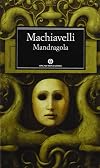
The Mandrake Root
by Niccolò Machiavelli
On This Page
Description
Set in sixteenth-century Florence, the play blends songs and robust action in detailing the hilarious lengths to which the smitten Callimaco goes in winning the favors of Lucrezia, the beautiful young wife of the rich and aged lawyer, Nicia. Enlisting the aid of the artful trickster Ligurio, Callimaco is passed off as a doctor who has devised a magic potion which, he promises Nicia, will make the heretofore childless Lucrezia conceive. But the catch is that the first man who sleeps with her show more after she takes the potion will die. show lessTags
Recommendations



















Member Reviews
This book really brought out the worst in people.
The reactions to it today in my Political Theory class were repugnant. Rape apologism, victim-blaming, sexism, misogyny...
I hated this play, but I suppose it brought out some passionate responses in me - a silver lining.
Certainly connects to Machiavelli's views on how people should behave, and raises some interesting questions - what does it truly mean to be happy? Is ignorance bliss, in the case of a buffoon like Nicia? How has Lucrezia changed? (One student called her a 'harlot'. Perhaps we should burn her at the stake for exercising her agency in the only way possible.)
This review is a little incoherent because of how furious the class discussions made me. The "I know, it's show more horrendously sexist, ha-ha" reaction is not acceptable. show less
The reactions to it today in my Political Theory class were repugnant. Rape apologism, victim-blaming, sexism, misogyny...
I hated this play, but I suppose it brought out some passionate responses in me - a silver lining.
Certainly connects to Machiavelli's views on how people should behave, and raises some interesting questions - what does it truly mean to be happy? Is ignorance bliss, in the case of a buffoon like Nicia? How has Lucrezia changed? (One student called her a 'harlot'. Perhaps we should burn her at the stake for exercising her agency in the only way possible.)
This review is a little incoherent because of how furious the class discussions made me. The "I know, it's show more horrendously sexist, ha-ha" reaction is not acceptable. show less
This was filthy and basically about two men, a wannabe lover and an unhappy husband, planning the rape of unhappy husband's wife. Spare yourself.
This is bawdy. The story is not complicated, a man really wants to win a woman and therefore tries to trick her and her husband with a trick, so that he can succeed. The whole Macchiavelli thing reminds us of Boccaccio, of course. Here the priests are no longer holy, cuckolding is a joke, deception is de rigueur. Of course, by today's standards, it is terribly male chauvinistic. Spare yourself if you are a moralist bigot.
Apr 12, 2025Portuguese (Brazil)
Nekem mindig fura színdarabot olvasni, hiszen azt elvileg nem azért írták, hogy elolvassam, hanem azért, hogy színpadon eljátsszák. Ennek megfelelően ez nem egy regény, hiányoznak teljesen a leíró részek, jóformán csak párbeszédet tartalmaz a mű. Van azért némi belső monológ is amikor a jelenetben egyetlen szereplő van aki indokolatlanul magában beszél.
A történet nem túl bonyolult, egy férfi nagyon meg akar szerezni egy nőt és ezért egy csellel próbálja rávenni a nőt és férjét, hogy ez sikerülhessen neki. Engem Boccacciora emlékeztetett az egész, itt sem szentéletűek már a papok, a felszarvazás egy vicc, mások becsapása erény. A cselekmény nem túl bonyolult, a könyvet nagyon gyorsan show more el lehet olvasni. Mai szemmel persze rettentően hímsoviniszta. show less
A történet nem túl bonyolult, egy férfi nagyon meg akar szerezni egy nőt és ezért egy csellel próbálja rávenni a nőt és férjét, hogy ez sikerülhessen neki. Engem Boccacciora emlékeztetett az egész, itt sem szentéletűek már a papok, a felszarvazás egy vicc, mások becsapása erény. A cselekmény nem túl bonyolult, a könyvet nagyon gyorsan show more el lehet olvasni. Mai szemmel persze rettentően hímsoviniszta. show less
Feb 4, 2025Hungarian
Ratings
Members
- Recently Added By
Lists

Italian Literature
556 works; 41 members

Harold Bloom - The Western Canon: B. The Aristocratic Age
231 works; 13 members

My Play Collection
769 works; 3 members

Next Plays to Watch
50 works; 1 member
Author Information

451+ Works 42,982 Members
Niccolo Machiavelli was born on May 3, 1469 in Florence, Italy. He was a political philosopher, statesman, and court advisor. Starting out as a clerk, he quickly rose in the ranks because he understood balance of power issues involved in many of his diplomatic missions. His political pursuits quickly ended after he was imprisoned by the Medici show more family. He is best known for The Prince, his guide to power attainment and cutthroat leadership. He also wrote poetry and plays, including a comedy named Mandragola. He died on June 21, 1527 at the age of 58. (Bowker Author Biography) show less
Some Editions
Series
Belongs to Publisher Series
Work Relationships
Common Knowledge
- Canonical title
- The Mandrake Root
- Original title
- Mandragola
- Original publication date
- 1518
- People/Characters
- Lucrezia
- Related movies
- Mandragola (1962 | IMDb); La mandragola (1965 | IMDb); La mandragore (1972 | IMDb); Au théâtre ce soir:La mandragore (1976 | IMDb); Matraguna (2002 | IMDb)
- Original language*
- Italiaans
*Some information comes from Common Knowledge in other languages. Click "Edit" for more information.
Classifications
- Genre
- Fiction and Literature
- DDC/MDS
- 852.3 — Literature & rhetoric Italian, Romanian & related literatures Italian drama Age of Leo the Tenth 1492–1542
- LCC
- PQ4627 .M2 .M2313 — Language and Literature French, Italian, Spanish and Portuguese literatures Italian literature Individual authors, 1400-1700
- BISAC
Statistics
- Members
- 730
- Popularity
- 38,665
- Reviews
- 4
- Rating
- (3.58)
- Languages
- 10 — Dutch, English, French, German, Hungarian, Italian, Norwegian (Bokmål), Polish, Portuguese (Portugal), Spanish
- Media
- Paper, Ebook
- ISBNs
- 49
- ASINs
- 15