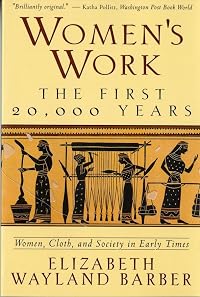
Women's Work: The First 20,000 Years Women, Cloth, and Society in Early Times
by Elizabeth Wayland Barber
On This Page
Description
New discoveries about the textile arts reveal women's unexpectedly influential role in ancient societies. Twenty thousand years ago, women were making and wearing the first clothing created from spun fibers. In fact, right up to the Industrial Revolution the fiber arts were an enormous economic force, belonging primarily to women. Despite the great toil required in making cloth and clothing, most books on ancient history and economics have no information on them. Much of this gap results show more from the extreme perishability of what women produced, but it seems clear that until now descriptions of prehistoric and early historic cultures have omitted virtually half the picture. Elizabeth Wayland Barber has drawn from data gathered by the most sophisticated new archaeological methods-methods she herself helped to fashion. In a "brilliantly original book" (Katha Pollitt, Washington Post Book World), she argues that women were a powerful economic force in the ancient world, with their own industry: fabric. show lessTags
Recommendations



















Member Recommendations

EerierIdyllMeme A book about achaeology giving evidence that common assumptions about gender roles are not borne out by the evidence, and a near future narrative framed as a story told from the far future based on archaeology exploring gender roles and possible far future assumptions about them.
Member Reviews
In contemporary western society, fiber arts are practiced mostly by women. And, it turns out, that’s the way it’s been for thousands of years. But crafts like spinning and weaving were more than just hobbies. Textiles were integral to the economy as far back as paleolithic times. In this book, Elizabeth Wayland Barber describes why women came to be responsible for making cloth. Then she describes the various types of cloth, production methods, and end uses from the invention of string and sewing over 20,000 years ago, up to Classical Greece around 500 BCE.
Because textiles naturally degrade over time, researchers cannot rely solely on archaeological evidence. Barber found several other avenues of inquiry which she used to develop a show more picture of these early societies. For example, she obtained a great deal of insight from studying early language. If language included a word for cloth or a garment, then that item must have existed even if no physical remains have been found. The geographic scope is limited to what is now Europe and the Middle East, not because these were the only societies producing cloth, but for practical reasons: a broader scope would have made for a larger and possibly less accessible book.
I appreciated the way this book not only outlined the evolution of fiber arts, but validated the role of women and their contributions to society. show less
Because textiles naturally degrade over time, researchers cannot rely solely on archaeological evidence. Barber found several other avenues of inquiry which she used to develop a show more picture of these early societies. For example, she obtained a great deal of insight from studying early language. If language included a word for cloth or a garment, then that item must have existed even if no physical remains have been found. The geographic scope is limited to what is now Europe and the Middle East, not because these were the only societies producing cloth, but for practical reasons: a broader scope would have made for a larger and possibly less accessible book.
I appreciated the way this book not only outlined the evolution of fiber arts, but validated the role of women and their contributions to society. show less
This is basically the Guns, Germs, and Steel of textiles, fabrics, and the women who weave with them. My entry point in this book was Gregory Clark's excellent Big History book A Farewell to Alms, where he discussed how in large part the first phase of the Industrial Revolution was almost entirely driven by productivity improvements in the textile industry. Weaving being then as now a primarily female-dominated industry, I was interested to learn more about the sociological effects of that revolution, and though this book wasn't what I was expecting at all, covering "only" from the Paleolithic to the Iron Age, there's still lots that should be right up the alley of anyone looking for something in the intersection of archaeology, show more textiles, and the feminization of labor.
There are probably many different economic rationales for why some professions have been considered "women's work" for tens of thousands of years, but the most basic one is pretty straightforward: if some relatively simple task is compatible with having to take care of children, it will probably be women who are doing it. Barber quotes a researcher who lists the following characteristic of such jobs: "they do not require rapt concentration and are relatively dull and repetitive; they are easily interruptible [I see a rueful smile on every care giver's face!] and easily resumed once interrupted; they do not place the child in potential danger; and they do not require the participant to range very far from home." There's a lot to ponder in that description. It's interesting that even in the 21st century it seems like knitting is still almost exclusively a female hobby, even when the woman in question doesn't have kids. Barber doesn't go into why that is, but she does discuss the question of why, given that women dominated the ranks of knitters, most labor-saving technology like the spinning jenny was invented by men. Barber's explanation is that women were so busy trying to keep up with demand that didn't have the time to sit around and play with technology. That sounds plausible, although it seems like even in ancient times enough clothing was being made for luxury use that at least one woman would have the time to think "There's got to be a better way."
Regardless of how weaving came to be considered women's work, it's obvious that most of the women who did the work took pride in it and developed traditions around it. Barber discusses how the basic style of string skirt that survives today in Eastern European peasant garb has been almost unchanged for nearly 20,000 years, which is pretty mindblowing. Fascinatingly, it appears that certain more advanced weaving concepts like the heddle were so conceptually difficult that they were only actually invented once - thus allowing archaeologists to roughly date when various tribes split off from each other by whether they possessed the advanced concepts or not. In between defining important terms like carding, twill, or worsted, Barber follows weavers from the earliest records of the Paleolithic through the Neolithic and the agricultural revolution, to Bronze Age societies like the Minoans, Middle Kingdom Egyptians, and Myceneans, and finally to the Iron Age and classical Greek civilization. There's lots of good discussion behind things like the storytelling-through-fabric tradition that includes the famous Bayeux Tapestry, or why different types of looms were adopted in some places but not others, or how class structure did or did not affect weaving (a surprising number of powerful queens wove just like commoners, albeit with higher-quality fabrics), leavened with citations from all over the place, such as the Odyssey, Greek mythology, and peasant folklore like the stories in Grimm's.
I was disappointed that she ended two thousand years before the vast changes of the Industrial Revolution (even aside from the economic impact of the women in the textile industry then, surely the cultural impact of tricoteuses such as Madame Defarge in Dickens' A Tale of Two Cities would have been worth a mention), and even today, women in the garment trade are a vital part of the development of countries like Bangladesh. Probably the additional scope would have resulted in a book several times the size, but even with its limits, this is a very well-researched and interesting look at the history of weaving and its role in the world from a primarily female perspective. Barber is funny too; here's her relating a story from Xenophon about Socrates' friend Aristarchos buying a bunch of wool to keep his female houseguests busy:
"As a result, resources were found, and wool was bought. The women ate their noon meal while they worked, and quit working only at suppertime; and they were cheerful instead of gloomy. Presently Aristarchos returned to tell Socrates how splendidly everything was working out. But, he adds, the ladies are displeased at one thing - namely, that he himself is idle. The story ends with Socrates suggesting that Aristarchos tell them that he is like the apparently idle sheepdog, who gets better treatment than the sheep because his protection is what allows them all to prosper.
We do not hear how that fable went over with the women, but we know how it would be received today." show less
There are probably many different economic rationales for why some professions have been considered "women's work" for tens of thousands of years, but the most basic one is pretty straightforward: if some relatively simple task is compatible with having to take care of children, it will probably be women who are doing it. Barber quotes a researcher who lists the following characteristic of such jobs: "they do not require rapt concentration and are relatively dull and repetitive; they are easily interruptible [I see a rueful smile on every care giver's face!] and easily resumed once interrupted; they do not place the child in potential danger; and they do not require the participant to range very far from home." There's a lot to ponder in that description. It's interesting that even in the 21st century it seems like knitting is still almost exclusively a female hobby, even when the woman in question doesn't have kids. Barber doesn't go into why that is, but she does discuss the question of why, given that women dominated the ranks of knitters, most labor-saving technology like the spinning jenny was invented by men. Barber's explanation is that women were so busy trying to keep up with demand that didn't have the time to sit around and play with technology. That sounds plausible, although it seems like even in ancient times enough clothing was being made for luxury use that at least one woman would have the time to think "There's got to be a better way."
Regardless of how weaving came to be considered women's work, it's obvious that most of the women who did the work took pride in it and developed traditions around it. Barber discusses how the basic style of string skirt that survives today in Eastern European peasant garb has been almost unchanged for nearly 20,000 years, which is pretty mindblowing. Fascinatingly, it appears that certain more advanced weaving concepts like the heddle were so conceptually difficult that they were only actually invented once - thus allowing archaeologists to roughly date when various tribes split off from each other by whether they possessed the advanced concepts or not. In between defining important terms like carding, twill, or worsted, Barber follows weavers from the earliest records of the Paleolithic through the Neolithic and the agricultural revolution, to Bronze Age societies like the Minoans, Middle Kingdom Egyptians, and Myceneans, and finally to the Iron Age and classical Greek civilization. There's lots of good discussion behind things like the storytelling-through-fabric tradition that includes the famous Bayeux Tapestry, or why different types of looms were adopted in some places but not others, or how class structure did or did not affect weaving (a surprising number of powerful queens wove just like commoners, albeit with higher-quality fabrics), leavened with citations from all over the place, such as the Odyssey, Greek mythology, and peasant folklore like the stories in Grimm's.
I was disappointed that she ended two thousand years before the vast changes of the Industrial Revolution (even aside from the economic impact of the women in the textile industry then, surely the cultural impact of tricoteuses such as Madame Defarge in Dickens' A Tale of Two Cities would have been worth a mention), and even today, women in the garment trade are a vital part of the development of countries like Bangladesh. Probably the additional scope would have resulted in a book several times the size, but even with its limits, this is a very well-researched and interesting look at the history of weaving and its role in the world from a primarily female perspective. Barber is funny too; here's her relating a story from Xenophon about Socrates' friend Aristarchos buying a bunch of wool to keep his female houseguests busy:
"As a result, resources were found, and wool was bought. The women ate their noon meal while they worked, and quit working only at suppertime; and they were cheerful instead of gloomy. Presently Aristarchos returned to tell Socrates how splendidly everything was working out. But, he adds, the ladies are displeased at one thing - namely, that he himself is idle. The story ends with Socrates suggesting that Aristarchos tell them that he is like the apparently idle sheepdog, who gets better treatment than the sheep because his protection is what allows them all to prosper.
We do not hear how that fable went over with the women, but we know how it would be received today." show less
Extremely readable and still scholarly overview of women's textile work from the Stone Age through to the very early Iron Age in Eurasia. Fascinating information about all sorts of wonderful things. The nature of women's work, what textiles tell us about women's social roles in different ages and societies, the development and spread of various techniques and materials and what that spread can tell us about the movement and status of different peoples in the ancient world. The uses of cloth and clothing to send social signals, in religious observances, in diplomacy and trade.
The most wonderful thing about this book is that all of this information is firmly rooted in the evidence of real textiles, loom weights, texts, sculptures, show more account records, wall paintings, recreations of historical textiles and techniques and so on. So much of the traditional work of women doesn't precisely leave a record graven in stone. As a consequence the subject of women's work gives rise to huge temptations to speculate in advance of the evidence or even in the absence of evidence altogether.
Given some of the patronising tosh that has been said about women's work in the past I do understand how tempting it can be to make a large cake from a small bit of flour. One longs to create a different fantasy if only to combat the old ones. But understanding how tempting it can be makes me appreciate Barber even more, how she teases real information and knowledge out of such small details as the orientation of fallen loom weights, and how if she can't find evidence she doesn't make stuff up.
Its worth reading the book for her discussion of methodology alone; how to seek and organize evidence for the more ephemeral occupations like clothmaking, cooking, music, dance. I am deeply impressed by the mountain of hard thoughtful work on which this book is perched. At the same time, as I said its still very readable - another considerable achievement - when someone is so close to so many tiny details its impressive to be able to pull back and tell a coherent and interesting story about them.
My enjoyment of this book is partly due to my deep interest in the subject matter, but I highly recommend it to anyone. show less
The most wonderful thing about this book is that all of this information is firmly rooted in the evidence of real textiles, loom weights, texts, sculptures, show more account records, wall paintings, recreations of historical textiles and techniques and so on. So much of the traditional work of women doesn't precisely leave a record graven in stone. As a consequence the subject of women's work gives rise to huge temptations to speculate in advance of the evidence or even in the absence of evidence altogether.
Given some of the patronising tosh that has been said about women's work in the past I do understand how tempting it can be to make a large cake from a small bit of flour. One longs to create a different fantasy if only to combat the old ones. But understanding how tempting it can be makes me appreciate Barber even more, how she teases real information and knowledge out of such small details as the orientation of fallen loom weights, and how if she can't find evidence she doesn't make stuff up.
Its worth reading the book for her discussion of methodology alone; how to seek and organize evidence for the more ephemeral occupations like clothmaking, cooking, music, dance. I am deeply impressed by the mountain of hard thoughtful work on which this book is perched. At the same time, as I said its still very readable - another considerable achievement - when someone is so close to so many tiny details its impressive to be able to pull back and tell a coherent and interesting story about them.
My enjoyment of this book is partly due to my deep interest in the subject matter, but I highly recommend it to anyone. show less
This book is lauded in crafty-fiber circles, apparently for being the only one of its kind to focus on women's history rather than for giving any great insight about archaeology or, you know, the titular women's work.
I mean, okay, it's still interesting and informative and fairly well-written. But it's more "non-fiction" than "scholarly", and I took off a star for that; there isn't enough meat on these bones, not enough exploration or discussion. Some parts are deeply repetitive and some parts build off each other, so it doesn't pay to read straight through and it doesn't pay to pick and choose chapters (that's another star gone).
The author learned to weave as a child, and it shows. She probably knows how to spin, too -- there's some show more familiarity with spindles -- but I am a spinner myself and her explanations gave up more questions than answers. She says this low-whorl type of spindle is suited for wool, and this high-whorl one for flax -- well, why? (I've spun both fibers on a drop-spindle; I prefer low-whorl, but there is no real difference that can't be adapted for by using different techniques, like starting the spin between your hands rather than twisting with your fingers). She says the Egyptians "spliced" the flax before spinning -- how? Why add the extra step? (Europeans spun both flax and wool using a distaff.) I imagine it gives a stronger, finer thread -- but without trying, there's no way to know.
Barber spends the final chapter reminding us that we don't know the limits of our knowledge; there are questions we never think to ask. I know a little bit about spinning and it opened a hundred holes in her writing. What else am I too ignorant to question? show less
I mean, okay, it's still interesting and informative and fairly well-written. But it's more "non-fiction" than "scholarly", and I took off a star for that; there isn't enough meat on these bones, not enough exploration or discussion. Some parts are deeply repetitive and some parts build off each other, so it doesn't pay to read straight through and it doesn't pay to pick and choose chapters (that's another star gone).
The author learned to weave as a child, and it shows. She probably knows how to spin, too -- there's some show more familiarity with spindles -- but I am a spinner myself and her explanations gave up more questions than answers. She says this low-whorl type of spindle is suited for wool, and this high-whorl one for flax -- well, why? (I've spun both fibers on a drop-spindle; I prefer low-whorl, but there is no real difference that can't be adapted for by using different techniques, like starting the spin between your hands rather than twisting with your fingers). She says the Egyptians "spliced" the flax before spinning -- how? Why add the extra step? (Europeans spun both flax and wool using a distaff.) I imagine it gives a stronger, finer thread -- but without trying, there's no way to know.
Barber spends the final chapter reminding us that we don't know the limits of our knowledge; there are questions we never think to ask. I know a little bit about spinning and it opened a hundred holes in her writing. What else am I too ignorant to question? show less
A scholarly study of women and textiles from pre-historic times. Lots of data, lots of citations, but the overall message was enlightening. I am glad that someone took the time to pull this information together and draw conclusions that are valid to the increasing volume of women's history.
Not only does this book tell us how spinning and weaving became "women's work", it tells us how long ago and how hard women have been working to clothe their families for thousands of years. It is a fascinating history of women even if you aren't a spinner or weaver and it will make you appreciate textiles that you've always taken for granted. Just think, Columbus sailed three grand ships to find America but there were hundreds, if not thousands, of women's hands making the threads and weaving the cloth that channeled the wind into the sails that powered those ships. I read this book long before I thought about being a weaver/spinner but today when I sit down to do either of those things I feel the connection of thousands of years of show more other women doing the exact same things I'm doing today. It's an awesome connection that will make you feel both proud AND humble. show less
What an interesting read!
Barber introduces her book with a very relevant story that also proves why she is the perfect choice to tell it. She weaves as a hobby, a profession that women have undertaken for many, many thousands of years. It’s a relatively simple craft, but there tricks of the trade that can only be deduced by somebody who has actually woven. But as Barber shows, women have been weaving for thousands of years, and academia has traditionally been male (for reference, the publish date of this book is 1994). Her postscript also calls out a tradition in academia to not attempt the craft to understand the difficulties ancient peoples would have experienced, and therefore likely draw incorrect conclusions.
There’s a few other show more things that have relegated the history of women to the wayside. Cloth rots, so unless it’s sunk in a bog or buried in an extremely arid tomb, it likely won’t survive to modern days. Sites that were dug up in the 1800s weren’t always kept separate by strata, so the timelines of technology can get very messy. Women are doing a lot of the monotonous duties at home, which are less worthy of great stories because they’re so unremarkable (e.g. a modern book would not explain every detail of how to drive a car, with how to put the car in reverse, how to use a turn signal, how to moderately apply the gas pedal, etc. It would just say that somebody drove somewhere).
Barber’s fascination with weaving is both a strength and a weakness for arguing her thesis. Her interest is obviously more towards the mechanics of weaving, such as the making of yarn, technological advancements to ease the craft and how they spread across the world. She’s much less focused on the intricacies of the life of the women. This isn’t immediately apparent - Barber definitely tries to share what cultural tidbits she’s been able to glean (one imagines that those remote European villages are losing more and more of their traditions as internet/globalization becomes more ubiquitous) - but her interest is pretty obviously more towards the actual making of fiber and fabric, than with what women were doing. There are a few offhand comments that they're also making food, but not in any kind of detail.
So while I appreciated the stories we got, I think I would have liked some more on all of the professions available to women. Obviously cloth-making was tremendously important (consider the fact that even noblewomen wove or embroidered. There was no escaping the necessity of clothing, even if a noblewoman’s products would likely be used as noble gifts or something like a storytelling tapestry that a serf woman wouldn’t have the luxury of time to detail), but if women are also in charge of daily food preparation, I would have liked to hear more about that. Barber postulates that women end up in the home because they need duties that are easy to put down to go deal with childcare. I can accept that hypothesis, but there absolutely has to be more to that life than just spinning or weaving.
In summary: good talk on the mechanics of weaving, I would have preferred more on actual treatment of women. show less
Barber introduces her book with a very relevant story that also proves why she is the perfect choice to tell it. She weaves as a hobby, a profession that women have undertaken for many, many thousands of years. It’s a relatively simple craft, but there tricks of the trade that can only be deduced by somebody who has actually woven. But as Barber shows, women have been weaving for thousands of years, and academia has traditionally been male (for reference, the publish date of this book is 1994). Her postscript also calls out a tradition in academia to not attempt the craft to understand the difficulties ancient peoples would have experienced, and therefore likely draw incorrect conclusions.
There’s a few other show more things that have relegated the history of women to the wayside. Cloth rots, so unless it’s sunk in a bog or buried in an extremely arid tomb, it likely won’t survive to modern days. Sites that were dug up in the 1800s weren’t always kept separate by strata, so the timelines of technology can get very messy. Women are doing a lot of the monotonous duties at home, which are less worthy of great stories because they’re so unremarkable (e.g. a modern book would not explain every detail of how to drive a car, with how to put the car in reverse, how to use a turn signal, how to moderately apply the gas pedal, etc. It would just say that somebody drove somewhere).
Barber’s fascination with weaving is both a strength and a weakness for arguing her thesis. Her interest is obviously more towards the mechanics of weaving, such as the making of yarn, technological advancements to ease the craft and how they spread across the world. She’s much less focused on the intricacies of the life of the women. This isn’t immediately apparent - Barber definitely tries to share what cultural tidbits she’s been able to glean (one imagines that those remote European villages are losing more and more of their traditions as internet/globalization becomes more ubiquitous) - but her interest is pretty obviously more towards the actual making of fiber and fabric, than with what women were doing. There are a few offhand comments that they're also making food, but not in any kind of detail.
So while I appreciated the stories we got, I think I would have liked some more on all of the professions available to women. Obviously cloth-making was tremendously important (consider the fact that even noblewomen wove or embroidered. There was no escaping the necessity of clothing, even if a noblewoman’s products would likely be used as noble gifts or something like a storytelling tapestry that a serf woman wouldn’t have the luxury of time to detail), but if women are also in charge of daily food preparation, I would have liked to hear more about that. Barber postulates that women end up in the home because they need duties that are easy to put down to go deal with childcare. I can accept that hypothesis, but there absolutely has to be more to that life than just spinning or weaving.
In summary: good talk on the mechanics of weaving, I would have preferred more on actual treatment of women. show less
Members
- Recently Added By
Lists

Yarncrafts and Textiles in History
4 works; 1 member

Handweavers Resources
30 works; 2 members

Books Read in 2018
4,360 works; 110 members

LQW Research Reading List
75 works; 1 member

Books in the Bibliography of The Dawn of Everything by Graeber & Wengrow
478 works; 2 members
Talk Discussions
Past Discussions
Women's Work: The First 20,000 Years : Women, Cloth, and Society in Early Times in One Book One Thread (February 2020)
Author Information

15+ Works 2,578 Members
Elizabeth Wayland Barber is the author of six books, including Women's Work The First 20,000 Years and The Mummies of rmchi. A professor emerita at Occidental College and a research associate at the Cotsen Institute of Archaeology, UCLA, she also teaches and choreographs for Occidental's Folk and Historical Dance Troupe, which she founded in 1971.
Awards and Honors
Awards
Notable Lists
Common Knowledge
- Original publication date
- 1994
- Dedication
- To Paul, whose idea it was
- First words
- Introduction:
"Four, three, two, one--good. One more bunch to go; then we've got to get dinner on."
Chapter 1:
For millennia women have sat together spinning,weaving, and sewing. - Last words
- (Click to show. Warning: May contain spoilers.)Far from being dull and in need of fanciful paint to make it more interesting, this truth is sometimes (as far as the saying goes) stranger than fiction, a fascinating tale in itself.
Classifications
- Genres
- Anthropology, History, Nonfiction, Sexuality and Gender Studies, General Nonfiction
- DDC/MDS
- 305 — Society, government, & culture Social sciences, sociology & anthropology Social group - Age, Gender, Ethnicity
- LCC
- GN799 .T43 .B37 — Geography, Anthropology and Recreation Anthropology Anthropology Prehistoric archaeology
- BISAC
Statistics
- Members
- 1,385
- Popularity
- 17,165
- Reviews
- 30
- Rating
- (4.40)
- Languages
- English
- Media
- Paper, Audiobook, Ebook
- ISBNs
- 6
- ASINs
- 8