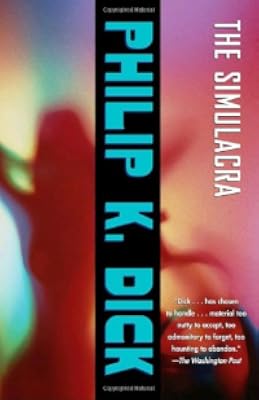
The Simulacra
by Philip K. Dick
On This Page
Description
Set in the middle of the twenty-first century, "Simulacra" is the story of an America where the whole government is a fraud and the President is an android. Against this backdrop Dr. Superb, the sole remaining psychotherapist, is struggling to practice in a world full of the maladjusted. Ian Duncan is desperately in love with the first lady, Nicole Thibideaux, who he has never met. Richard Kongrossian refuses to see anyone because he is convinced his body odor is lethal. And the fascistic show more Bertold Goltz is trying to overthrow the government. With wonderful aplomb, Philip K. Dick brings this story to a crashing conclusion and in classic fashion shows there is always another layer of conspiracy beneath the one we see. show lessTags
Recommendations















Member Reviews
“… the story of an America where the whole government is a fraud and the President is an android.” Replace ‘android’ with ‘asshole’ and you would be describing America right now!
“All these years, Dr. Superb thought. We’ve worshipped a dummy. A being inert and devoid of life.”
A simulacrum is a fake version of something real. Like the current president of the United States. Really, this couldn't be a timelier read! Who is the real power behind the thing we see on our screens? And why are we following it, some of us blindly? A very timely read indeed!
Part of the story takes place in Jenner, CA, which is close to where I live!
Big pharma getting psychologists banned from practicing... sounds like something they'd show more do...
Time machines
Jug playing
A papoola!
First Lady in charge - for 73 years! AND, Hermann Goering has been brought from the past to help her!
“I wonder if our society, our style of life, will survive this.” - something I myself think every day under president 47… show less
“All these years, Dr. Superb thought. We’ve worshipped a dummy. A being inert and devoid of life.”
A simulacrum is a fake version of something real. Like the current president of the United States. Really, this couldn't be a timelier read! Who is the real power behind the thing we see on our screens? And why are we following it, some of us blindly? A very timely read indeed!
Part of the story takes place in Jenner, CA, which is close to where I live!
Big pharma getting psychologists banned from practicing... sounds like something they'd show more do...
Time machines
Jug playing
A papoola!
First Lady in charge - for 73 years! AND, Hermann Goering has been brought from the past to help her!
“I wonder if our society, our style of life, will survive this.” - something I myself think every day under president 47… show less
I'm really digging Philip K Dick lately. The Simulacra has a lot of different layers and seems to be a commentary about the illusory underpinnings of the culture in which we live. Seems to suggest that the structure on which we base our lives and which we find vitally important may be a construct. Not just an organic construct, a gradual building up of the system as we know it by generations of individual actions and an unwritten social contract, but an intentional construct devised by individuals for the purpose of controlling the masses and maintaining their own power. This book explores what happens when those in power learn they really aren't and the reality on which we all depend crumbles. When I put it that way, it sounds a little show more bleak. But I actually found it somewhat hopeful. show less
I barely know how to rate this one. All the right elements are here and it is full of interesting ideas. But it’s Philip K. Dick writing it, so the end result is a disjointed mess of a story which adds no weight to the concepts it explores. Nor are there any deep, engaging or unique characters to follow.
Putting aside his well documented personal problems, you can feel he wants to explore what he perceives as realities beyond the veil, but like in every other PKD I’ve read (this being my seventh), he simply lacked the ability to do so. And here is a perfect example of him trying to connect random, disconnected situations without really making any sort of point along the way. I really wanted to like this one just because of certain show more things he was grasping at - the false government, the OCD sufferer, the fascist takeover - but none are explored intelligently and circumstances seem to move around without direction.
It does at least eerily echo today’s political circus, but there’s little else here of value. Genuinely one of the most overrated writers that has ever existed. show less
Putting aside his well documented personal problems, you can feel he wants to explore what he perceives as realities beyond the veil, but like in every other PKD I’ve read (this being my seventh), he simply lacked the ability to do so. And here is a perfect example of him trying to connect random, disconnected situations without really making any sort of point along the way. I really wanted to like this one just because of certain show more things he was grasping at - the false government, the OCD sufferer, the fascist takeover - but none are explored intelligently and circumstances seem to move around without direction.
It does at least eerily echo today’s political circus, but there’s little else here of value. Genuinely one of the most overrated writers that has ever existed. show less
I am not, I will happily admit, a fan of Dick’s books, and the only reason I read this one is because it’s in the SF Masterworks series (and the series has way too many books by Dick in it, as well). I find his novels slapdash, the good ideas wasted on haphazard plots and inconsistent settings. In this one, the US and Germany have formed the USEA, the president is a simulacrum (although only those in the know, er, know it), and the country is effectively ruled by the First Lady. There are also colonists on Mars, and roadside spaceship dealers who sell craft capable of reaching the Red Planet to those wishing to emigrate. The dealers are apparently mobile and unregulated. The novel opens with all psychotherapists, except one, being show more banned from practising. And that one is needed to treat a psychokinetic pianist who is a favourite of the First Lady. Meanwhile, the current president, or the der Alte (“the” and “der” are tautologous), is about the be retired and a new one built–but this time by a small firm and not a large German cartel. There’s also the Sons of Job, which seems to be a weirdly inoffensive neo-nazi popular movement, whose leader has access to a time-travel device. As indeed do the upper echelons of the USEA. A handful of ordinary people sort of bounce around the US–well, California and Washington, DC–stumbling into various plots and conspiracies, and so bringing everything crashing down to a somewhat abrupt end. And that’s it. A pretty fast read, and mildly amusing, but certainly not a Masterwork and not even one of Dick’s better books. show less
Philip K Dick - The Simulacra
Philip K Dick at his most weird and wonderful, but weird and wonderful even in science fiction stories doesn't always provide a coherent novel. I read about a third of this novel and put it aside for a few days and when I picked it up again I realised I had not much of a clue to the storyline and so I started again. It made a little more sense the second time round but when I got to the unread part of the book I soon became lost again. I ploughed on through realising it would be fairly pointless to get to grips with the plot. There are so many science fiction themes crammed into this short novel: time travel, alternate time lines, colonies on mars, robots as simulacrum, use of new technologies, telekinesis, show more mutants, throwbacks, post nuclear devastation that the many characters struggle to make much of an impact and seem as confused by events as I became.
Trying to summarise the plot would be a pointless exercise even if I was capable of doing it. Its all a bit of a mess, but it is a Philip K Dick mess shot through with interesting ideas and lots of silliness. 3 stars. (It is another Philip K Dick novel from the SF Masterwork series). show less
Philip K Dick at his most weird and wonderful, but weird and wonderful even in science fiction stories doesn't always provide a coherent novel. I read about a third of this novel and put it aside for a few days and when I picked it up again I realised I had not much of a clue to the storyline and so I started again. It made a little more sense the second time round but when I got to the unread part of the book I soon became lost again. I ploughed on through realising it would be fairly pointless to get to grips with the plot. There are so many science fiction themes crammed into this short novel: time travel, alternate time lines, colonies on mars, robots as simulacrum, use of new technologies, telekinesis, show more mutants, throwbacks, post nuclear devastation that the many characters struggle to make much of an impact and seem as confused by events as I became.
Trying to summarise the plot would be a pointless exercise even if I was capable of doing it. Its all a bit of a mess, but it is a Philip K Dick mess shot through with interesting ideas and lots of silliness. 3 stars. (It is another Philip K Dick novel from the SF Masterwork series). show less
Classic science fiction published in 1964 in which the government has a simulacrum as a figurehead. It tells a story of maintaining control through sustaining the status quo and limiting access to information. It is quite forward-thinking for its time of publication, anticipating the equivalent of video chat, increased roles for women, environmental degradation, self-driving cars, artificial intelligence, and machines that are mixtures of the biological and the mechanical.
This book in particular explores the idea that the status quo will be maintained until it falls into complete disorganization. The author applies scientific principles to social systems and plays with them in interesting ways. It also anticipates a social show more stratification based on access to information. The “Bes” are basically at the lowest access level. They only get carefully edited information based on officially approved broadcasts. The “Ges” are the highest level. They know precisely what is going on and they engage in power plays with each other to gain ultimate control over the government. Speaking of government, this future world has the United States of Europe and America (USEA), where Germany and other European countries have joined the US as a single conglomerate.
It includes an ability for people to escape the earth and live on Mars next to a family of simulacra neighbors, the capability of teleporting people from the past, laws outlawing the practices of mental health therapists, and a colony of modern Neanderthals living in the Pacific Northwest. It feels a bit fragmented at first, but once the puzzle pieces come together, it is quite compelling. I always find Philip K. Dick’s works creative and thought-provoking. show less
This book in particular explores the idea that the status quo will be maintained until it falls into complete disorganization. The author applies scientific principles to social systems and plays with them in interesting ways. It also anticipates a social show more stratification based on access to information. The “Bes” are basically at the lowest access level. They only get carefully edited information based on officially approved broadcasts. The “Ges” are the highest level. They know precisely what is going on and they engage in power plays with each other to gain ultimate control over the government. Speaking of government, this future world has the United States of Europe and America (USEA), where Germany and other European countries have joined the US as a single conglomerate.
It includes an ability for people to escape the earth and live on Mars next to a family of simulacra neighbors, the capability of teleporting people from the past, laws outlawing the practices of mental health therapists, and a colony of modern Neanderthals living in the Pacific Northwest. It feels a bit fragmented at first, but once the puzzle pieces come together, it is quite compelling. I always find Philip K. Dick’s works creative and thought-provoking. show less
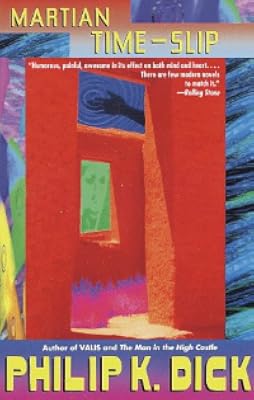
One of Dick's busier books, with a large cast of characters and many throw-away ideas. Like other stories from this productive period, Germans and German companies are a major force in America, and not for good. There's a colony on Mars, probably much like the ones in Three Stigmata and Martian Time-Slip, but we never go there. There are aliens on Earth, but very subjugated. One is treated as nothing more than a biological recording device, and the other is used to influence shoppers in a used space ship lot. There are devices to look ahead in probabilistic time, similar to Minority Report but electronic, not human. Somewhat unusually, there are no blurred boundaries of reality, but deception by the government is at the heart of show more everything that happens. There are too many threads to list. The focus of attention shifts every few pages and what seems the main plot also keeps changing. Fortunately, for all this busy-ness, it's not hard to follow and reaches a clear conclusion.
Recommended but second tier Dick for me, above the potboilers but below the best. The ideas and plotting are fine, but none of the characters came to life for me. I was interested to see what happened overall, but I didn't care what happened to any particular character. show less
Recommended but second tier Dick for me, above the potboilers but below the best. The ideas and plotting are fine, but none of the characters came to life for me. I was interested to see what happened overall, but I didn't care what happened to any particular character. show less
Members
- Recently Added By
Lists

Best Science Fiction Novels
816 works; 426 members

S.F. Masterworks (Complete)
229 works; 15 members

SF Masterworks
193 works; 8 members

Books Read in 2023
5,638 works; 147 members
Author Information

691+ Works 147,370 Members
Phillip Kindred Dick was an American science fiction writer best known for his psychological portrayals of characters trapped in illusory environments. Born in Chicago, Illinois, on December 16, 1928, Dick worked in radio and studied briefly at the University of California at Berkeley before embarking on his writing career. His first novel, Solar show more Lottery, was published in 1955. In 1963, Dick won the Hugo Award for his novel, The Man in the High Castle. He also wrote a series of futuristic tales about artificial creatures on the loose; notable of these was Do Androids Dream of Electric Sheep?, which was later adapted into film as Blade Runner. Dick also published several collections of short stories. He died of a stroke in Santa Ana, California, in 1982. (Bowker Author Biography) show less
Some Editions
Series
Belongs to Publisher Series
Knaur Science Fiction (708)
Work Relationships
Is contained in
Common Knowledge
- Canonical title
- The Simulacra
- Original title
- The Simulacra
- Original publication date
- 1964; 1963-08-28 (manuscript) (manuscript)
- People/Characters
- Nicole Thibodeaux; Charles "Chic" Strikerock; Ian Duncan; Nat Flieger; Richard Kongrosian; Al Miller (show all 31); Vince Strikerock; Maury Frauenzimmer; Wilder Pembroke; Jim Planck; Molly Dondoldo; Dr. Egon Superb; Julie Applequist; Janet Raimer; Merrill Judd; Bertold Goltz; Patrick Doyle; Garth McCrae; Reichsmarschall Hermann Goering; Amanda Conners; Loony Luke; Donald Tishman; Anton Karp; Emil Stark; Harold Slezak; Leo Dondoldo; Gordon Rugge; Edgar Stone; Greta Trupe; Beth Kongrosian; Corley
- Important places
- White House, Washington, D.C., USA; San Francisco, California, USA; Reno, Nevada, USA; Tijuana, Mexico
- First words
- The interoffice memo at Electronic Musical Enterprise frightened Nat Flieger and he did not know why.
- Original language
- English
Classifications
Statistics
- Members
- 1,655
- Popularity
- 13,621
- Reviews
- 18
- Rating
- (3.59)
- Languages
- 13 — Czech, English, Finnish, French, German, Greek, Hungarian, Italian, Japanese, Polish, Portuguese, Spanish, Turkish
- Media
- Paper, Audiobook, Ebook
- ISBNs
- 48
- UPCs
- 1
- ASINs
- 28