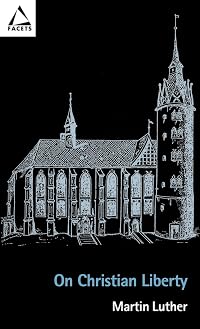
Christian Liberty
by Martin Luther
On This Page
Description
This timeless little classic communicates essential teachings of Martin Luther. The subject of Freedom is both timely and poignantly relevant today. For the Christian, this freedom is liberty from sin and death, and the opportunity to serve one's neighbor. Written in a simple style, On Christian Liberty conveys significant spiritual insight into the grace of God and liberating faith in Christ Jesus. It is counter-cultural, down-to-earth, and accessible to young adult readers in an show more inexpensive pocket-sized book. show lessTags
Recommendations


Member Reviews
The "liberty" in question being the liberty to ignore the suffering in the world because faith not works will get us into heaven. Or maybe the liberty to hate and eschew the glories of creation--your food, drink, music, dance, sex--because the soul suffers not their absence and is reborn each day anew (so fuck the body). In either case, this is pernicious as a loyalty oath.
In 1520, three years after posting his famous theses, Luther was still a monk in the Catholic Church. It was then that he wrote this short manifesto regarding the nature of the freedom of a Christian. In it he elucidates some of the principles that would become the foundation of the Protestant Reformation. He opens with a discussion of "man's twofold nature" of the inner spiritual nature or the soul and the outer bodily nature of the flesh. These two natures are in conflict for it is the inner nature or soul that is fed by the preaching of Christ that makes it righteous. He also discusses the seeming contradiction that the Christian is both free and subject to no one while at the same time in bondage and servant to all.
This short but show more rich text also brings out the importance of each individual being his own priest; thus laying the foundation for the doctrine of the "priesthood of all believers". I was impressed with Luther's style of argument, for he argued from the text of the Bible rather than from his unsupported views. In doing so he was able to rationally support statements that seemed contradictory on the surface. Admittedly the arguments depended on your acceptance of the divinity of the Bible as God's word. However, for Luther and his audience this was not an issue.
Luther had been concerned with edicts by the hierarchy of the Catholic Church that had no biblical support. It is likely that with this in mind that on September 6, 1520 he sent this manifesto with a letter to Pope Leo X. However the Catholic hierarchy was not be responsive to Luther's arguments. In the following year he was called to appear before the Diet of Worms and was declared a heretic. show less
This short but show more rich text also brings out the importance of each individual being his own priest; thus laying the foundation for the doctrine of the "priesthood of all believers". I was impressed with Luther's style of argument, for he argued from the text of the Bible rather than from his unsupported views. In doing so he was able to rationally support statements that seemed contradictory on the surface. Admittedly the arguments depended on your acceptance of the divinity of the Bible as God's word. However, for Luther and his audience this was not an issue.
Luther had been concerned with edicts by the hierarchy of the Catholic Church that had no biblical support. It is likely that with this in mind that on September 6, 1520 he sent this manifesto with a letter to Pope Leo X. However the Catholic hierarchy was not be responsive to Luther's arguments. In the following year he was called to appear before the Diet of Worms and was declared a heretic. show less
Different translation
His command of language, especially in criticism and protest, is sparkling.
I was interested in reading this considering the role of contemplation in Christian freedom. Luther talks about the outer and inner human. He never prescribes HOW one nurtures the inner human through faith, likely because prayer, worship, even contemplation, become works and, writing to Pope Leo, he does not want to give an excuse for contradiction. However, I find it hard to imagine coming to faith as Luther describes any other way bit contemplation on the teaching received through good preaching and the Scriptures.
His command of language, especially in criticism and protest, is sparkling.
I was interested in reading this considering the role of contemplation in Christian freedom. Luther talks about the outer and inner human. He never prescribes HOW one nurtures the inner human through faith, likely because prayer, worship, even contemplation, become works and, writing to Pope Leo, he does not want to give an excuse for contradiction. However, I find it hard to imagine coming to faith as Luther describes any other way bit contemplation on the teaching received through good preaching and the Scriptures.
That was pretty bad. The introduction was seething and then it went straight into fallacies, weak arguments, and pedantic legalism. I can't believe it is as weak as it is.
One of the most influential booklets of Early Reformation. Luther distinguishes between the Gospel and the Law. Between the legalism of the Babylonian church and true freedom in Christ.
One of the most influential booklets of Early Reformation. Luther distinguishes between the Gospel and the Law. Between the legalism of the Babylonian church and true freedom in Christ.
A work that every Christian ought to own and be familiar with. The "marriage" illustration is one of the most profound insights Luther gave the church.
Members
- Recently Added By
Published Reviews
ThingScore 100
This is an awesome piece. I just printed it off the web, I'm sure it's found in one of many Luther's published works. He absolutely destroys justification by works in the first part of this work and then goes on to teach the proper place of works in the individual Christian's life as well as in the life of the local church. He talks a bit about disputable matters from 1 Cor 8-10 and Romans show more 14-15:2 as well. Great stuff. show less
added by R.I.F.
Lists

Generation Joshua
115 works; 3 members
Author Information

Martin Luther (1483-1546) was the Father of the Reformation. Most famous possibly for his 95 theses, he wrote many works which sparked debate and helped shape thinking - not only in his own time, but ours as well.
Some Editions
Series
Belongs to Publisher Series
Common Knowledge
- Canonical title
- Christian Liberty
- Original publication date
- 1520
Classifications
Statistics
- Members
- 1,194
- Popularity
- 20,983
- Reviews
- 11
- Rating
- (3.91)
- Languages
- 5 — English, Finnish, Italian, Spanish, Portuguese (Portugal)
- Media
- Paper, Audiobook, Ebook
- ISBNs
- 61
- ASINs
- 30