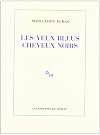
Blue Eyes, Black Hair
by Marguerite Duras
On This Page
Description
En mand og en kvinde tilbringer en række nætter i fælles, uforløst længsel efter den samme mand: en ung udlænding med blå øjne, sort hår.Tags
Recommendations

































Member Reviews
As unassuming as it is surprising, this is a book about the quietly obsessive love of two individuals who've both become enamoured with the same nearly untouchable and idealized man. What sounds as if it would be torrid or silly or frustrating, though, at the very least, becomes utterly beautiful in the writing of Duras. The graceful passages of the novel, or novella, I suppose, are so simple and honest that the relationship of the man and woman at the heart of the novel is delivered in a manner that nearly comes across as innocent. Though, this is also tinged with a constant erotic pressure so that innocent feelings are tuned also toward undoubtedly adult sense and material.
If all of this sounds jumbled, it may be because the book show more itself is something of a beautiful puzzle, built for readers to slip through in a single reading. Duras' language and tone are perfectly set, and the interjections on artistry and acting, as if the entire novel is being read and performed on a private stage, add a level of alien maturity that is nearly indescribable when combined with the simply related relationship at the center of the work.
In the end, this is one of those short works that is both clear in its first communication, and yet demaning of a re-read. It is artful, smart, and perfectly tuned for a quiet read and meditation on relationships, love, and what binds one individual to the next for better or worse.
Absolutely recommended. show less
If all of this sounds jumbled, it may be because the book show more itself is something of a beautiful puzzle, built for readers to slip through in a single reading. Duras' language and tone are perfectly set, and the interjections on artistry and acting, as if the entire novel is being read and performed on a private stage, add a level of alien maturity that is nearly indescribable when combined with the simply related relationship at the center of the work.
In the end, this is one of those short works that is both clear in its first communication, and yet demaning of a re-read. It is artful, smart, and perfectly tuned for a quiet read and meditation on relationships, love, and what binds one individual to the next for better or worse.
Absolutely recommended. show less
Blue Eyes, Black Hair might not be recommended for a first-time reader of Duras. The book is not flowing or visual or erotic in the manner of The Lover. It seems more a continuation of Duras' literary themes rather than a novel that stands by itself. It might be of more interest to devotees of Duras' greater body of work than to the casual reader. In it, a man sees another man, briefly, through a window, and feels an attraction as strong as love. Weeping in a cafe, later the same night, he meets a young woman with black hair and blue eyes who reminds him very much of the man he saw and desired but never met. The two acknowledge to one another that they are both lonely, and the man asks the woman to go with him to his room by the sea. He show more wants to watch her sleep. The novel is basically a story of the transferal of desire and the lack of communion between two individuals. The book explores the idea of objectifying a love, of two people wanting things so different that their desires somehow become similar, and of feelings involved in close emotional relationships between people of different sexual orientations. It addresses the themes of loneliness, the exploration of desire and despair, of distance and fear, and of the pain in never really knowing - emotionally or physically - the desired other. show less
"Ele diz-lhe que se enganou, que não é o dia a chegar, que é o crepúsculo, que eles se aproximam de uma noite nova, que vai ser preciso esperar que passe toda a duração dessa noite para se chegar ao dia, que se enganaram quanto à passagem das horas. Ela pergunta-lhe qual é a cor do mar. Ele já não sabe.
Ele ouve-a chorar. Pergunta-lhe porque chora. Não espera pela resposta. Pergunta-lhe qual devia ser a cor do mar. Ela diz que o mar fica com a cor do céu - que se trata menos de uma cor do que do estado da luz.
Ela diz que eles talvez tenham começado a morrer.
Ele diz que não sabe nada sobre a morte, que é um homem que não sabe quando amou, quando ama, quando morre. Na voz dele ainda há gritos, mas longínquos, chorados.
Ele show more diz-lhe no entanto que também ele, agora, pensa que entre eles se deve tratar daquilo que ela dizia nos primeiros dias da história. Ela esconde o rosto contra o chão, chora." show less
Ele ouve-a chorar. Pergunta-lhe porque chora. Não espera pela resposta. Pergunta-lhe qual devia ser a cor do mar. Ela diz que o mar fica com a cor do céu - que se trata menos de uma cor do que do estado da luz.
Ela diz que eles talvez tenham começado a morrer.
Ele diz que não sabe nada sobre a morte, que é um homem que não sabe quando amou, quando ama, quando morre. Na voz dele ainda há gritos, mas longínquos, chorados.
Ele show more diz-lhe no entanto que também ele, agora, pensa que entre eles se deve tratar daquilo que ela dizia nos primeiros dias da história. Ela esconde o rosto contra o chão, chora." show less
Duras has this tough face. Her novels, when they're good, take on the functionality of her face. This one goes so fast and is hard on you. It is looking, in a way, right there. It is looking around at nothing, without anything to see for sheesh for years.
My head swam. I think I know what was happening, and I believe I got the message. Seductive and unsettling. Sexuality and sorrow. Secretly appealing.
Thanks to Laura. If I had known.
Thanks to Laura. If I had known.
This wasn't as good as The Lover... and I think the other one I read was North China Lover? Not sure, since it seems like all her books cover the very same territory, this one included. Which I am getting kinda bored of.
Members
- Recently Added By
Lists

le donne raccontano
116 works; 1 member
Author Information

226+ Works 18,867 Members
Marguerite Duras was born in Gia-Dinh, Indochina on April 4, 1914. After attending school in Saigon, she moved to Paris, France to study law and political science. After graduation, she worked as a secretary in the French Ministry of the Colonies until 1941. During World War II, she joined the Resistance and published her first books. After the show more liberation, she became a member of the French Communist Party, and though she later resigned, she always described herself as a Marxist. Her first book, Les Impudents, was published in 1943. During her lifetime, she wrote more than 70 novels, plays, screenplays and adaptations. Her novels include The Sea Wall, The Lover, The Lover from Northern China, The War, and That's All. In 1959, she wrote her first film scenario, Hiroshima, Mon Amour, and has since been involved in a number of other films, including India Song, Baxter, Vera Baxter, Le Camion (The Truck), and The Lover. She died on March 4, 1996 at the age of 81. (Bowker Author Biography) show less
Some Editions
Series
Belongs to Publisher Series
Common Knowledge
- Canonical title
- Blue Eyes, Black Hair
- Original title
- Les yeux bleus cheveux noirs
- Original publication date
- 1986
- Dedication*
- Für Yann Andréa
- First words*
- EIN Sommerabend, sagt der Schauspieler, wäre Zentrum der Geschichte.
- Original language
- French
*Some information comes from Common Knowledge in other languages. Click "Edit" for more information.
Classifications
Statistics
- Members
- 561
- Popularity
- 52,821
- Reviews
- 11
- Rating
- (3.49)
- Languages
- 11 — Danish, Dutch, English, Finnish, French, German, Italian, Portuguese, Romanian, Spanish, Swedish
- Media
- Paper, Ebook
- ISBNs
- 34
- ASINs
- 4