On This Page
Description
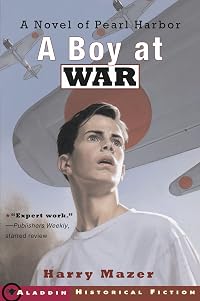
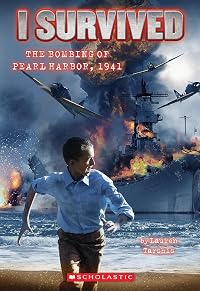
While fishing with his friends off Honolulu on December 7, 1941, teenaged Adam is caught in the midst of the Japanese attack and through the chaos of the subsequent days tries to find his father, a naval officer who was serving on the U.S.S. Arizona when the bombs fell.Tags
Recommendations















Member Reviews
Adam Pelko is a 14 year old boy who moves to Hawaii with his family during the early part of World War II. His father is an officer in the United States Navy, and according to Adam, he "runs a tight ship." Adam, his sister and his mother all know how to "behave" and ther right way to act as an officer's family.
As Adam explores Hawaii, he becomes friends with a boy named Davy, whose family is Japanese. Adam's father is not very happy with Adam When he learns about his new friend, because the Americans my soon be going to war against the Japanese. Adam, Davy and another friend decide to go fishing early one Saturday morning. As they begin fishing, they hear the sound of airplanes, and as they watch the planes from their small boat, they show more think that there must be a movie being taped because the sound of bombs is so real. They don't know it then, but eventually learn that it is not a movie, the Japanese are bombing Pearl Harbor. The description of the planes flying, and the bombs falling makes you feel as if you were there right in the middle of it.
As the boys try to get back to their families, Adam is mistaken for a soldier, and is used to help rescue Navy men who were on the ships that were bombed. Adam becomes angry at Davy for what his "family" is doing to the Americans, and their friendship is at risk. Adam must decide whether he will behave the way the world thinks he should, or listen to his true feelings. show less
As Adam explores Hawaii, he becomes friends with a boy named Davy, whose family is Japanese. Adam's father is not very happy with Adam When he learns about his new friend, because the Americans my soon be going to war against the Japanese. Adam, Davy and another friend decide to go fishing early one Saturday morning. As they begin fishing, they hear the sound of airplanes, and as they watch the planes from their small boat, they show more think that there must be a movie being taped because the sound of bombs is so real. They don't know it then, but eventually learn that it is not a movie, the Japanese are bombing Pearl Harbor. The description of the planes flying, and the bombs falling makes you feel as if you were there right in the middle of it.
As the boys try to get back to their families, Adam is mistaken for a soldier, and is used to help rescue Navy men who were on the ships that were bombed. Adam becomes angry at Davy for what his "family" is doing to the Americans, and their friendship is at risk. Adam must decide whether he will behave the way the world thinks he should, or listen to his true feelings. show less
I borrowed this book from one of our ELD teachers, who uses this first book as well as the other two in the series, with her high school aged English learners.
As a hi-lo book, A Boy At War functions well. The story is engaging. A boy and his friends are fishing in Pearl Harbor in Hawaii on the morning of December 7, 1941, and each of them is caught up in the tragedy in a different way. Adam Pelko has to confront the death of his father, a commander on the USS Arizona, while trying to find his way home to his mother and sister. He is swept up in the turmoil, as he is mistaken for a young soldier and is put to work by a small troop. There is plenty of action, and the story is dramatic as Adam sees one of his friends killed and is show more separated from the other.
The language is appropriate for students reading at approximately 5th grade level (lexile level 530) and has many features of good hi-lo books. It is relatively short--112 pages-- and the type is large enough that struggling readers would feel confident instead of intimidated. Because the events at Pearl Harbor are a part of the eleventh grade American history curriculum, even students as old as 16 would feel validated, as opposed to babied, if assigned this book.
The characters are strongly delineated and easily distinguished from one another with very little description, and the story is told chronologically, without any shifts in perspective. Sentences are relatively short and the vocabulary is simple. More difficult words are well-defined in context, particularly military terminology and Hawaiian words.
According to the teacher from whom I borrowed the book, her students love this book and the next two in the series, each of which they read in her class. I also read the reviews on Amazon.com and this book seems very popular among young readers.
Although this book is certainly appropriate for younger readers, ages 10-14, older students who are also struggling readers will find plenty to interest them here. show less
As a hi-lo book, A Boy At War functions well. The story is engaging. A boy and his friends are fishing in Pearl Harbor in Hawaii on the morning of December 7, 1941, and each of them is caught up in the tragedy in a different way. Adam Pelko has to confront the death of his father, a commander on the USS Arizona, while trying to find his way home to his mother and sister. He is swept up in the turmoil, as he is mistaken for a young soldier and is put to work by a small troop. There is plenty of action, and the story is dramatic as Adam sees one of his friends killed and is show more separated from the other.
The language is appropriate for students reading at approximately 5th grade level (lexile level 530) and has many features of good hi-lo books. It is relatively short--112 pages-- and the type is large enough that struggling readers would feel confident instead of intimidated. Because the events at Pearl Harbor are a part of the eleventh grade American history curriculum, even students as old as 16 would feel validated, as opposed to babied, if assigned this book.
The characters are strongly delineated and easily distinguished from one another with very little description, and the story is told chronologically, without any shifts in perspective. Sentences are relatively short and the vocabulary is simple. More difficult words are well-defined in context, particularly military terminology and Hawaiian words.
According to the teacher from whom I borrowed the book, her students love this book and the next two in the series, each of which they read in her class. I also read the reviews on Amazon.com and this book seems very popular among young readers.
Although this book is certainly appropriate for younger readers, ages 10-14, older students who are also struggling readers will find plenty to interest them here. show less
V. short and exciting. A bit didactic, but after all that's why I grabbed it from the thrift store - I wanted to learn a bit about the Pearl Harbor aspect of WWII. Probably excellent for a male reluctant reader - I recommend teachers of 5th-10th grade have it in their classrooms.
Seemed well researched - I just question a reference to WWI - in the weeks before the attack on Pearl Harbor had we already renamed The Great War?
Seemed well researched - I just question a reference to WWI - in the weeks before the attack on Pearl Harbor had we already renamed The Great War?
This short book introduces you to Adam Pelko, the 14-year-old son of a Navy Lieutenant assigned to the U.S.S. Arizona in Honolulu, Hawaii. Mazer does a nice job of explaining the problems of being a military brat and the chaos of the Pearl Harbor attack and its aftermath, including the plight of the Japanese Americans living on the islands, from Adam's view. It's followed by a historical note from Mazer which covers the military effect of the attack on the U.S. and the war and on the Japanese living in Hawaii and in the States. I think that children who read this book will understand what a conflicted time it was in our history.
Harry Mazer's A Boy at War, published in 2001, recounts the experiences of fourteen-year-old Adam Pelko. Adam is a young man from a military family who lives in Hawaii in the days leading up to and during the Japanese attack on Pearl Harbor.It is just a matter of chance that Adam and two friends are fishing in a rowboat on the harbor. On that fateful morning when the attack occurs. At first, the boys assume that they have been caught in a drill. But quickly realized, that the planes and bombs are real. In the confusion following the initial onslaught, Adam helplessly witnesses the sinking of the Arizona, the ship on which his father is stationed.
My opinion on the book is that it makes you feel like you were their. And how it educates show more you on the real story that started world war 2. I feel as if people read this book they won't be interested in it. I feel this way because some people get emotional when it comes to stuff like this. Especially if its their country or race. Besides that i thought the book was very well with the characters and the settings that were explained. show less
My opinion on the book is that it makes you feel like you were their. And how it educates show more you on the real story that started world war 2. I feel as if people read this book they won't be interested in it. I feel this way because some people get emotional when it comes to stuff like this. Especially if its their country or race. Besides that i thought the book was very well with the characters and the settings that were explained. show less
Even though this book is about the beginning of a war (World War II), the main character is a boy, and the story involves injuries, blood, and getting shot (which is why it is more of a boy book than a girl book), I enjoyed it. Harry Mazer did a good job writing the book and did a good job creating his characters. I think Adam is a character they'd be able to relate to, especially if they have a parent who is in the army. The book has tense moments, when Adam is trying to find and help is friends after the Japanese attack Pearl Harbor, and it draws you in further.
Though the book is thin and easy to read, I think it is more appropriate for older kids because of the war related storyline. A 4th grader would enjoy it and if he was mature show more it wouldn't be bad, but I think it'd have to be something a parent decided if he was ready for. show less
Though the book is thin and easy to read, I think it is more appropriate for older kids because of the war related storyline. A 4th grader would enjoy it and if he was mature show more it wouldn't be bad, but I think it'd have to be something a parent decided if he was ready for. show less
I tried going into this from the age group that this was meant for (so maybe older Elementary school kids) and I really enjoyed it.
The dad was a bit of a jerk but I still felt bad when learning his fate.
The dad was a bit of a jerk but I still felt bad when learning his fate.
Members
- Recently Added By
Lists

Book Talks 9/13/17
46 works; 1 member
Author Information

42+ Works 5,057 Members
Harry Mazer was born on May 31, 1925 in New York City. During World War II, he served in the U.S. Army Air Force and received a Purple Heart and an Air Medal with four bronze oak leaf clusters. He received a B.A. from Union College in 1948 and a M.A. in education from Syracuse University in 1960. Before becoming a full-time writer, he was as a show more welder in a factory, a railroad brakeman and switchtender for New York Central, and an English teacher. He has written more than 20 books for young readers including Please, Somebody Tell Me Who I Am; My Brother Abe; The Last Mission; The Boy at War trilogy; The Wild Kid; The Dog in the Freezer; The Island Keeper; and Snow Bound. He along with his wife, Norma Fox Mazer, received an ALAN award in 2003 for outstanding contribution to adolescent literature. He died on April 7, 2016 at the age of 90. (Bowker Author Biography) show less
Some Editions
Awards and Honors
Awards
Distinctions
Notable Lists
Series

Common Knowledge
- Important places
- Pearl Harbor, O'ahu, Hawai'i, USA
- Important events
- World War II (1939 | 1945); World War II, Pacific Theater (1941-12-07 | 1945-09-02); Attack on Pearl Harbor (1941-12-07)
Classifications
- Genre
- Fiction and Literature
- DDC/MDS
- 808.7 — Literature & rhetoric Literature, rhetoric & criticism Rhetoric and collections of literary texts from more than two literatures Rhetoric of humor and satire
- LCC
- PZ7 .M47397 .B — Language and Literature Fiction and juvenile belles lettres Fiction and juvenile belles lettres Juvenile belles lettres
- BISAC
Statistics
- Members
- 1,694
- Popularity
- 13,194
- Reviews
- 16
- Rating
- (3.72)
- Languages
- English, French
- Media
- Paper, Ebook
- ISBNs
- 12
- ASINs
- 2