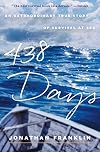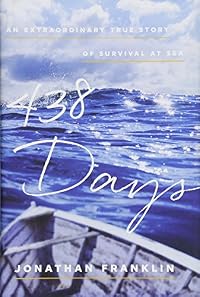
438 Days: An Extraordinary True Story of Survival at Sea
by Jonathan Franklin
On This Page
Description
The miraculous account of the man who survived alone and adrift at sea longer than anyone in recorded history. For fourteen months, Alvarenga survived constant shark attacks. He learned to catch fish with his bare hands. He built a fish net from a pair of empty plastic bottles. Taking apart the outboard motor, he fashioned a huge fishhook. Using fish vertebrae as needles, he stitched together his own clothes. Based on dozens of hours of interviews with Alvarenga and interviews with his show more colleagues, search and rescue officials, the medical team that saved his life and the remote islanders who nursed him back to health, this is an epic tale of survival. Print run 75,000. show lessTags
Recommendations






















Member Reviews
“A mutual survival instinct overcame fatigue. With the morning sun, they could see the waves approaching, rising high above them and then splitting open. Each man would brace and lean against a side of the open-hulled boat. Depending from which direction a big wave appeared, the men would jump to the opposite rail in an attempt to counteract the roll. But the waves were mad, slapping each other in midair, joining forces to create swells that raised the men to a brief peak where they could get a third-story view, then with the sensation of a falling elevator, instantly drop them.”
True story of two men who left Mexico in November 2012 during a fierce storm and how one of them survived for over a year adrift in the Pacific Ocean. The show more ingenuity this man showed was amazing. He found a way to capture raw fish, turtles, and birds, accumulate fresh rainwater, and endure life in a twenty-three-foot boat with no motor while shielding himself from the sun by curling up in an ice box!
I am very impressed with the author’s ability to take José Salvador Alvarenga’s thoughts and craft them into a compelling account without repetition (the days adrift must have been incredibly similar). He weaves in expert commentary and includes maps of ocean currents to track the boat’s path to the Marshall Islands. It provides insight into how a person can improve the chances of making it through an ordeal with an unknown ending date without succumbing to despair. It is well written and will appeal to anyone who enjoys true stories of survival.
“Despite his temporary bonding with God, Alvarenga’s true faith remained attached to one of his core beliefs: optimism. “I never thought in the negative, I remained positive,” he said. “I told myself I was going to survive, to be brave, have faith, not fall down. I knew that I was adrift, but I was thinking about surviving. I was always thinking ahead, planning. I was brainstorming inside the icebox. How did I do it? I imagined solutions.” show less
True story of two men who left Mexico in November 2012 during a fierce storm and how one of them survived for over a year adrift in the Pacific Ocean. The show more ingenuity this man showed was amazing. He found a way to capture raw fish, turtles, and birds, accumulate fresh rainwater, and endure life in a twenty-three-foot boat with no motor while shielding himself from the sun by curling up in an ice box!
I am very impressed with the author’s ability to take José Salvador Alvarenga’s thoughts and craft them into a compelling account without repetition (the days adrift must have been incredibly similar). He weaves in expert commentary and includes maps of ocean currents to track the boat’s path to the Marshall Islands. It provides insight into how a person can improve the chances of making it through an ordeal with an unknown ending date without succumbing to despair. It is well written and will appeal to anyone who enjoys true stories of survival.
“Despite his temporary bonding with God, Alvarenga’s true faith remained attached to one of his core beliefs: optimism. “I never thought in the negative, I remained positive,” he said. “I told myself I was going to survive, to be brave, have faith, not fall down. I knew that I was adrift, but I was thinking about surviving. I was always thinking ahead, planning. I was brainstorming inside the icebox. How did I do it? I imagined solutions.” show less
“A mutual survival instinct overcame fatigue. With the morning sun, they could see the waves approaching, rising high above them and then splitting open. Each man would brace and lean against a side of the open-hulled boat. Depending from which direction a big wave appeared, the men would jump to the opposite rail in an attempt to counteract the roll. But the waves were mad, slapping each other in midair, joining forces to create swells that raised the men to a brief peak where they could get a third-story view, then with the sensation of a falling elevator, instantly drop them.”
True story of two men who left Mexico in November 2012 during a fierce storm and how one of them survived for over a year adrift in the Pacific Ocean. The show more ingenuity this man showed was amazing. He found a way to capture raw fish, turtles, and birds, accumulate fresh rainwater, and endure life in a twenty-three-foot boat with no motor while shielding himself from the sun by curling up in an ice box!
I am very impressed with the author’s ability to take José Salvador Alvarenga’s thoughts and craft them into a compelling account without repetition (the days adrift must have been incredibly similar). He weaves in expert commentary and includes maps of ocean currents to track the boat’s path to the Marshall Islands. It provides insight into how a person can improve the chances of making it through an ordeal with an unknown ending date without succumbing to despair. It is well written and will appeal to anyone who enjoys true stories of survival.
“Despite his temporary bonding with God, Alvarenga’s true faith remained attached to one of his core beliefs: optimism. “I never thought in the negative, I remained positive,” he said. “I told myself I was going to survive, to be brave, have faith, not fall down. I knew that I was adrift, but I was thinking about surviving. I was always thinking ahead, planning. I was brainstorming inside the icebox. How did I do it? I imagined solutions.” show less
True story of two men who left Mexico in November 2012 during a fierce storm and how one of them survived for over a year adrift in the Pacific Ocean. The show more ingenuity this man showed was amazing. He found a way to capture raw fish, turtles, and birds, accumulate fresh rainwater, and endure life in a twenty-three-foot boat with no motor while shielding himself from the sun by curling up in an ice box!
I am very impressed with the author’s ability to take José Salvador Alvarenga’s thoughts and craft them into a compelling account without repetition (the days adrift must have been incredibly similar). He weaves in expert commentary and includes maps of ocean currents to track the boat’s path to the Marshall Islands. It provides insight into how a person can improve the chances of making it through an ordeal with an unknown ending date without succumbing to despair. It is well written and will appeal to anyone who enjoys true stories of survival.
“Despite his temporary bonding with God, Alvarenga’s true faith remained attached to one of his core beliefs: optimism. “I never thought in the negative, I remained positive,” he said. “I told myself I was going to survive, to be brave, have faith, not fall down. I knew that I was adrift, but I was thinking about surviving. I was always thinking ahead, planning. I was brainstorming inside the icebox. How did I do it? I imagined solutions.” show less
Jóse Salvador Alvarenga, originally from El Salvador, was a survivor alright: in his mid-thirties, tough, a life of hard physical work alternating with four-day drinking binges, he was once set upon by half a dozen men in a bar, stabbed eleven times and left for dead in the street—but recovered. Fearing they’d be back to finish the job, he slipped away along the coast and resurfaced in the fishing village (population 200) of Costa Azul in Mexico’s far south-west. Here he became one of the Sharkers. “While lesser men fished the lagoon for snapper and flounder and the shrimpers went out twelve miles to work the farms, the deep-sea guys, this crowd, would motor straight out to sea, long past the point where they could see shore. show more Only when they reached fifty miles, sometimes a hundred miles, would they prepare their lines… Sharkers earned more. And died younger.”
His boat was a simple twenty-five-foot fibreglass hull, powered by an outboard and with a crew of two. It had neither cabin nor, tellingly, running lights or anything to reflect sunlight, making it practically invisible at sea. On November 17, 2012, Alvarenga and a younger crewman set off out into the Gulf of Tehuantepec on what was supposed to be a routine two-day fish. But a hundred miles offshore they were slowly engulfed by a feared Norteño, storms which form in the Caribbean and then cross the isthmus to rip into the Pacific. This one lasted for a full five days and left them with a smashed engine, helplessly being carried further out into the eastern rim of the world’s largest ocean. They drifted for days, then weeks, finally months.
To avoid spoilers, I won’t describe most of what Alvarenga went through thereafter, except to say that along the way his crewman died and he was left to face the ocean alone. Traversing, from east to west, the low latitudes known as the Doldrums, his boat was moving “…at an average speed of one mile an hour. Had a baby been crawling alongside, Alvarenga would have been left behind.” His ordeal was to last more than a year—he crossed most of the Pacific—which is, so far as anyone knows, by some margin the longest anybody has been adrift at sea like this.
Inevitably, the experience changed his life. The downside was that he became global news, and the author of 438 Days, Jonathan Franklin, has clearly decided to leave any of the more lurid speculation about Alvarenga’s survival to the gutter-press tabloid newspapers and half-wits who infest social media. This book is thoroughly researched (he spent a year interviewing Alvarenga, gently coaxing the story out of him) and sticks to the facts.
And the upside? “I now appreciate small pleasures… Think about it, I didn’t see another person for over a year! Or a tree. Or a fruit. Or a tortilla… Not one tortilla.” show less
His boat was a simple twenty-five-foot fibreglass hull, powered by an outboard and with a crew of two. It had neither cabin nor, tellingly, running lights or anything to reflect sunlight, making it practically invisible at sea. On November 17, 2012, Alvarenga and a younger crewman set off out into the Gulf of Tehuantepec on what was supposed to be a routine two-day fish. But a hundred miles offshore they were slowly engulfed by a feared Norteño, storms which form in the Caribbean and then cross the isthmus to rip into the Pacific. This one lasted for a full five days and left them with a smashed engine, helplessly being carried further out into the eastern rim of the world’s largest ocean. They drifted for days, then weeks, finally months.
To avoid spoilers, I won’t describe most of what Alvarenga went through thereafter, except to say that along the way his crewman died and he was left to face the ocean alone. Traversing, from east to west, the low latitudes known as the Doldrums, his boat was moving “…at an average speed of one mile an hour. Had a baby been crawling alongside, Alvarenga would have been left behind.” His ordeal was to last more than a year—he crossed most of the Pacific—which is, so far as anyone knows, by some margin the longest anybody has been adrift at sea like this.
Inevitably, the experience changed his life. The downside was that he became global news, and the author of 438 Days, Jonathan Franklin, has clearly decided to leave any of the more lurid speculation about Alvarenga’s survival to the gutter-press tabloid newspapers and half-wits who infest social media. This book is thoroughly researched (he spent a year interviewing Alvarenga, gently coaxing the story out of him) and sticks to the facts.
And the upside? “I now appreciate small pleasures… Think about it, I didn’t see another person for over a year! Or a tree. Or a fruit. Or a tortilla… Not one tortilla.” show less
I received an advance copy of this title from the publisher in exchange for an honest review.
I not only appreciate the incredible story told, a story that has much to tell anyone who has ever felt themselves facing seemingly insurmountable odds (which is pretty much everyone), but also the tremendous research which creates the basis for the tale, and the heartfelt sympathy and respect that Mr. Franklin gave to Salvador Alvarenga, our protagonist. This story is a feast for the mind as well as the heart.
I would place Mr. Franklin’s book on the same shelf as such classics as Alive and Into Thin Air. I found it particularly interesting to have read this book right after finishing The Martian. While I loved The Martian, it paled in show more comparison (mainly because it was fiction) to the real story. It is an apt analogy on some levels, yet Alvarenga’s suffering was much more profound than that of the fictional astronaut and his isolation was no less extreme.
Franklin’s deep research provides tremendous insight into the incredible journey: into the true immensity and isolation of the Pacific Ocean, the daily requirements and suffering of being a castaway for more than a year, as well as the physical and even more illuminating, at least to me, the psychological toll that it took on Alvarenga, a man who probably was the one in a million who could have survived this ordeal.
Another unexpected and appreciated surprise for me was that Franklin did not end the story with the rescue, as most authors do. He stayed with Alvarenga as he attempted to readjust to society, both physically and mentally. This is the “rest of the story” that we are usually not given. I also appreciated Mr. Franklin’s deep sympathy and respect for Mr. Alvarenga, which gave the story an emotional impact that is often missing in nonfiction. I can’t imagine a novel exploring the emotional and physical suffering of its hero any deeper than this fine book.
5 stars. Highest recommendation. show less
I not only appreciate the incredible story told, a story that has much to tell anyone who has ever felt themselves facing seemingly insurmountable odds (which is pretty much everyone), but also the tremendous research which creates the basis for the tale, and the heartfelt sympathy and respect that Mr. Franklin gave to Salvador Alvarenga, our protagonist. This story is a feast for the mind as well as the heart.
I would place Mr. Franklin’s book on the same shelf as such classics as Alive and Into Thin Air. I found it particularly interesting to have read this book right after finishing The Martian. While I loved The Martian, it paled in show more comparison (mainly because it was fiction) to the real story. It is an apt analogy on some levels, yet Alvarenga’s suffering was much more profound than that of the fictional astronaut and his isolation was no less extreme.
Franklin’s deep research provides tremendous insight into the incredible journey: into the true immensity and isolation of the Pacific Ocean, the daily requirements and suffering of being a castaway for more than a year, as well as the physical and even more illuminating, at least to me, the psychological toll that it took on Alvarenga, a man who probably was the one in a million who could have survived this ordeal.
Another unexpected and appreciated surprise for me was that Franklin did not end the story with the rescue, as most authors do. He stayed with Alvarenga as he attempted to readjust to society, both physically and mentally. This is the “rest of the story” that we are usually not given. I also appreciated Mr. Franklin’s deep sympathy and respect for Mr. Alvarenga, which gave the story an emotional impact that is often missing in nonfiction. I can’t imagine a novel exploring the emotional and physical suffering of its hero any deeper than this fine book.
5 stars. Highest recommendation. show less
Unbelievable courage, creativity and skill!
This story of marine survival opens with a lengthy introduction to Salvador Alvarenga before the storm drove his disabled boat deep in the open Pacific. Franklin’s careful and detailed research is obvious from the start. His revelations at times, however, seemed tedious and overdone as he droned on and on about the fishing village and the fishing culture. His purpose, of course, was to provide Alvarenga’s personal background, show his ability to overcome adversity, highlight his love and seeming fearlessness of the sea and his strange dietary proclivities. Eating raw fish didn’t start with the need to stave off starvation. His friends describe a time when Alvarenga thought a take-out meal show more order was too long in arriving. He reached into the bait pail, pulled out a hand-sized half-frozen sardine, rolled it up in a tortilla and munched away on the raw fish.
The fateful day began with his usual fishing partner unable to go out on the boat. An inexperienced young man, Ezequiel Cordoba was signed up for the quick trip out to the deep waters. Warned of an impending storm, Alvarenda quipped, “I am going with this new guy, but I will be back in time for the party.”
He loaded his boat with ample supplies in the event a return trip was delayed. In a scene reminiscent of Sebastian Junger’s, “The Perfect Storm” all the best laid plans of man are nothing against the power of Mother Nature.
You feel the sea roil and the winds howl. You feel Cordoba’s seasickness and fear. As the storm builds with rapid intensity, they cut loose the 2-mile long fishing line and head toward shore, nearly making it to safety. Incredible bad luck and perhaps the lack of advance equipment safety checks leave the two men stranded with a disabled motor, knife, machete and a small open-topped fish box drifting out to sea at the mercy of the ocean currents.
There is no question by the end of the book Alvarenda has proved he was the right man with the right credentials to survive this long voyage. His life struggles in the past help him hone his survival strengths. It is unimaginable how anyone can stay psychologically and physically capable of enduring over 14 months alone at sea in a 25 foot boat.
Choosing to narrate this story in the third person was somewhat distracting but overall the story is so amazing it didn’t matter in the end. You feel so sad for the young sailor who felt lost when they left the shore and feared for his life long before the ship faced true danger. Despite Alvarenga’s best efforts to inspire and keep the young man alive, Cordoba was unable to overcome the odds.
My pre-conceived perceptions of open ocean marine life were toppled. It was shocking to learn that despite its size, the Pacific has become a garbage dump.
It was hard to rate this book. The story, overwhelming in its reality, seemed to drag in places. I finally decided on 3.5 stars. A worthy read.
Share this: show less
This story of marine survival opens with a lengthy introduction to Salvador Alvarenga before the storm drove his disabled boat deep in the open Pacific. Franklin’s careful and detailed research is obvious from the start. His revelations at times, however, seemed tedious and overdone as he droned on and on about the fishing village and the fishing culture. His purpose, of course, was to provide Alvarenga’s personal background, show his ability to overcome adversity, highlight his love and seeming fearlessness of the sea and his strange dietary proclivities. Eating raw fish didn’t start with the need to stave off starvation. His friends describe a time when Alvarenga thought a take-out meal show more order was too long in arriving. He reached into the bait pail, pulled out a hand-sized half-frozen sardine, rolled it up in a tortilla and munched away on the raw fish.
The fateful day began with his usual fishing partner unable to go out on the boat. An inexperienced young man, Ezequiel Cordoba was signed up for the quick trip out to the deep waters. Warned of an impending storm, Alvarenda quipped, “I am going with this new guy, but I will be back in time for the party.”
He loaded his boat with ample supplies in the event a return trip was delayed. In a scene reminiscent of Sebastian Junger’s, “The Perfect Storm” all the best laid plans of man are nothing against the power of Mother Nature.
You feel the sea roil and the winds howl. You feel Cordoba’s seasickness and fear. As the storm builds with rapid intensity, they cut loose the 2-mile long fishing line and head toward shore, nearly making it to safety. Incredible bad luck and perhaps the lack of advance equipment safety checks leave the two men stranded with a disabled motor, knife, machete and a small open-topped fish box drifting out to sea at the mercy of the ocean currents.
There is no question by the end of the book Alvarenda has proved he was the right man with the right credentials to survive this long voyage. His life struggles in the past help him hone his survival strengths. It is unimaginable how anyone can stay psychologically and physically capable of enduring over 14 months alone at sea in a 25 foot boat.
Choosing to narrate this story in the third person was somewhat distracting but overall the story is so amazing it didn’t matter in the end. You feel so sad for the young sailor who felt lost when they left the shore and feared for his life long before the ship faced true danger. Despite Alvarenga’s best efforts to inspire and keep the young man alive, Cordoba was unable to overcome the odds.
My pre-conceived perceptions of open ocean marine life were toppled. It was shocking to learn that despite its size, the Pacific has become a garbage dump.
It was hard to rate this book. The story, overwhelming in its reality, seemed to drag in places. I finally decided on 3.5 stars. A worthy read.
Share this: show less
"What could be worse than being alone at sea?...What further suffering could there be than this?"
By sally tarbox on 17 June 2017
Format: Kindle Edition
An astonishing true-life adventure of a fisherman lost at sea for fourteen months.
Salvador Alvarenga, an El Salvador native, worked for a small fishing concern in Mexico. When his normal partner was called away, he engaged a rookie local lad as his mate as they set off in a 'banana boat' - "no cabin or roof, just a long, narrow canoe-shaped boat." Overfishing required them to travel further out - and when a storm blew up and their engine died, they were swept out into the Pacific.
The dire conditions are brought to life: storms when the deck was knee-deep in water - and stretches of dry show more weather when they were on minimum water rations. Grabbing passing rubbish gave them empty containers for storage; in the unrelenting heat they sheltered in the icebox. And they subsisted on fish - snatched fromn the sea, and eaten raw or dried; and turtles ands seabirds.
The difference in the men's emotional strength becomes apparent, as young Ezequiel Cordoba starts to give up, unable to stomach the food and thinking of death, Alvarenga continues to fight to survive as the ship drifts in the Doldrums at a mile an hour...
Washing up eventually in the Marshall Islands, 9000 miles away, this is an unputdownable narrative. show less
By sally tarbox on 17 June 2017
Format: Kindle Edition
An astonishing true-life adventure of a fisherman lost at sea for fourteen months.
Salvador Alvarenga, an El Salvador native, worked for a small fishing concern in Mexico. When his normal partner was called away, he engaged a rookie local lad as his mate as they set off in a 'banana boat' - "no cabin or roof, just a long, narrow canoe-shaped boat." Overfishing required them to travel further out - and when a storm blew up and their engine died, they were swept out into the Pacific.
The dire conditions are brought to life: storms when the deck was knee-deep in water - and stretches of dry show more weather when they were on minimum water rations. Grabbing passing rubbish gave them empty containers for storage; in the unrelenting heat they sheltered in the icebox. And they subsisted on fish - snatched fromn the sea, and eaten raw or dried; and turtles ands seabirds.
The difference in the men's emotional strength becomes apparent, as young Ezequiel Cordoba starts to give up, unable to stomach the food and thinking of death, Alvarenga continues to fight to survive as the ship drifts in the Doldrums at a mile an hour...
Washing up eventually in the Marshall Islands, 9000 miles away, this is an unputdownable narrative. show less
Excellent non-fiction story of Salvador Alvarenga's 438 day drift across the Pacific ocean in a boat with no motor, no fishing gear except a knife and no shelter save for a large icebox in 2013-2014. An incredible tale of tenacity and foresight that saw him live on seabirds who landed on the boat, fish that came up underneath, barnacles that grew on the bottom of the boat and turtles that swam by. When he eventually washes up on a remote Pacific atoll people are at first sceptical, but one look at his rancid boat, covered with mould and bird and fish bones , and the terrible state of his legs from a year without much vitamin C is proof. When the Marshall Islands contacts his home town in Mexico they discover that he was indeed lost to a show more terrible storm and they have even held a funeral for him. Amazing to read what Alvarenga did and then have Survival experts, neurologists, dietitians and psychologists explain how this helped him. For example, he focuses on the 14 year old daughter he is estranged from and promises himself to survive so that he can reignite contact with her. Unfortunately Salvador is not alone when his boat drifts into the ocean and the reader knows that his companion dies but is grpped with finding out how he passes away. Note that the first chapter is a little boring but necessary to set up how poor Alvarenga is and how ill-equipped he was for his journey. Story really gets going in second chapter when storm starts brewing. show less
Members
- Recently Added By
Author Information

13 Works 756 Members
Jonathan Franklin regularly reports for the Guardian. He also works with the team at Retro Report, producing documentaries broadcast by The New York Times. Franklin's previous book 33 Men, the exclusive account of Chilean miners trapped underground, became a national bestseller and was translated into nineteen languages. Learn more at show more JonathanFranklin.com and @FranklinBlog. show less
Some Editions
Common Knowledge
- Original publication date
- 2015
- People/Characters
- José Salvador Alvarenga; Ezequiel Córdoba
- Important places
- Pacific Ocean; Costa Azul, Chiapas, Mexico; Marshall Islands
- Dedication
- To my father, Tom Franklin, who from an early age taught me the value of a well-placed comma, a properly tended Japanese garden and a devilish sense of humour, and who has always exemplified the power of positive thinking.
- First words
- His name was Salvador and he arrived with bloody feet, said he was looking for work - anything to start - but to those who saw the newcomer arrive, he looked like a man on the run.
- Last words
- (Click to show. Warning: May contain spoilers.)"There are challenges and punishments in life, but you have to fight!"
Classifications
- Genres
- Hunting and Fishing, Sports and Leisure, Nonfiction, Travel, General Nonfiction, Biography & Memoir
- DDC/MDS
- 910.9164 — History & geography Geography & travel modified standard subdivisions of Geography and travel History, geographic treatment, biography - Discovery. exploration Geography of and travel in areas, regions, places in general Air And Water Pacific Ocean
- LCC
- G525 .F66 — Geography, Anthropology and Recreation Geography (General) Adventures, shipwrecks, buried treasure, etc.
- BISAC
Statistics
- Members
- 358
- Popularity
- 87,568
- Reviews
- 19
- Rating
- (4.01)
- Languages
- English, German, Spanish
- Media
- Paper, Audiobook, Ebook
- ISBNs
- 19
- ASINs
- 7