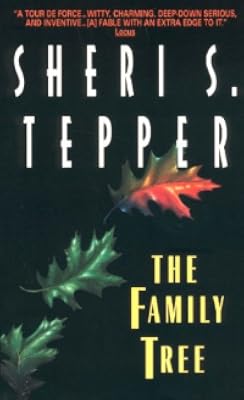
The Family Tree
by Sheri S. Tepper
On This Page
Description
THE ONCE FERTILE EARTH OF DORA HENRY'S CHILDHOOD HAS BEEN UNDERVALUED AND OVERDEVELOPED. NOW NATURE, APPARENTLY, HAS DECIDED TO FIGHT BACK.Police officer Dora Henry is investigating the bizarre murders of three geneticists. Meanwhile, strange things are happening everywhere she turns. Weeds are becoming trees; trees are becoming forests. Overnight, a city is being transformed into a wild and verdant place.And, strangest of all, Dora can somehow communicate with the rampaging flora.A show more potential civilization-ending catastrophe is in the making. The bearer Dora gets to a murderer--and to the truth--the more seemingly disparate events begin to entwine. And the answers she seeks today to the salvation of humankind may lie in afar distant future. . .one which is suddenly much closer than anyone imagines.An exhilarating and enchanting novel that deftly combines fantastic invention with insight and a social conscience, from one of the most lyrical and important voices in contemporary speculative fiction.THE ONCE FERTILE EARTH OF DORA HENRYS CHILDHOOD HAS BEEN UNDERVALUED AND OVERDEVELOPED. NOW NATURE, APPARENTLY, HAS DECIDED TO FIGHT BACK.Police officer Dora Henry is investigating the bizarre murders of three geneticists. Meanwhile, strange things are happening everywhere she turns. Weeds are becoming trees; trees are becoming forests. Overnight, a city is being transformed into a wild and verdant place.And, strangest of all, Dora can somehow communicate with the rampaging flora.A potential civilization-ending catastrophe is in the making. The bearer Dora gets to a murderer--and to the truth--the more seemingly disparate events begin to entwine. And the answers she seeks today to the salvation of humankind may lie in afar distant future. . .one which is suddenly much closer than anyone imagines.An exhilarating and enchanting novel that deftly combines fantastic invention with insight and a social conscience, from one of the most lyrical and important voices in contemporary speculative fiction. show lessTags
Recommendations







Member Recommendations
Member Reviews
An absolute delight to read. Tepper is one of my favourite authors, and I'm willing to forgive her a lot of her soapboxes (heavily laboured in this book as they are) because of the beautifully crafted nature of her stories. I never have difficulty reading her books - they slide through the mind like jelly down the throat. (okay, so I might be exaggerating here. there is at least one of her books that I'm unlikely to read again, but being a sad completist, I've probably still got it in my collection. this year at least).
Split between a future time and the present, the story follows Dora Henry (in the present) a cop with husband troubles and the plant that mysteriously appears in her garden, and a group of assorted travellers (in the show more future) all of whom are following one fortune or another, as seen by one of the 'Seers of Sworp'. It is no surprise that the present and future peoples meet, but there are a number of surprises from that point on, which on rereading as only very slightly telegraphed.
My big complaint about this book is not the enviro-evangalism, which is at least reasonably well integrated into the plot in this book (unlike, umm, whatever the one is that I'm never going to read again, but am too lazy to go and look up the title), but the ending, which seems to come at the wrong point of the story. Not that I'm sure that it could go anywhere, and the threads that are hanging loose are just everyday ones (do they have kids? what happens to the settlers? what happens to the bad guys?), but I don't have that satisfaction of having finished reading a story. Instead, I'm wishing that there was more to read. show less
Split between a future time and the present, the story follows Dora Henry (in the present) a cop with husband troubles and the plant that mysteriously appears in her garden, and a group of assorted travellers (in the show more future) all of whom are following one fortune or another, as seen by one of the 'Seers of Sworp'. It is no surprise that the present and future peoples meet, but there are a number of surprises from that point on, which on rereading as only very slightly telegraphed.
My big complaint about this book is not the enviro-evangalism, which is at least reasonably well integrated into the plot in this book (unlike, umm, whatever the one is that I'm never going to read again, but am too lazy to go and look up the title), but the ending, which seems to come at the wrong point of the story. Not that I'm sure that it could go anywhere, and the threads that are hanging loose are just everyday ones (do they have kids? what happens to the settlers? what happens to the bad guys?), but I don't have that satisfaction of having finished reading a story. Instead, I'm wishing that there was more to read. show less
Oh, Tepper, how I love you. Why have I not read all of your books?
This is, at first, a confusing bunch of unrelated stories and then suddenly, magically, inevitably it is one blisteringly good story- a story that makes one question one's essential assumptions about what it means to be human, what it means to be ethical, what it means to be good. There's a richness here that wells up slowly and almost imperceptibly, a richness that comes from top-notch writing and plotting. This is a book to be read over and over. I can already tell that once is not nearly enough- and I can't wait to go back and see what I missed.
This is, at first, a confusing bunch of unrelated stories and then suddenly, magically, inevitably it is one blisteringly good story- a story that makes one question one's essential assumptions about what it means to be human, what it means to be ethical, what it means to be good. There's a richness here that wells up slowly and almost imperceptibly, a richness that comes from top-notch writing and plotting. This is a book to be read over and over. I can already tell that once is not nearly enough- and I can't wait to go back and see what I missed.
The Family Tree deals with all of the serious themes that Tepper is known for - ecology, overpopulation, etc... but does so in a very clever, funny way. The format is one of two seemingly unrelated, interleaved stories (one a contemporary drama, one an Arabian-Nights-flavored fairy tale) which merge about halfway through the book - some might find it a bit gimmicky, but I like it...
It's one of those books that it's hard to say much about without major spoilers, so I'll leave it at that!
It's one of those books that it's hard to say much about without major spoilers, so I'll leave it at that!
The first half of this book takes place in two timelines: present-day America, told from the point of view of Dora, a police sergeant who is finally leaving a loveless marriage, and in a fantasy world, told from the point of view of Opalears, who is accompanying her prince on a quest to fulfill a prophecy, picking up fellow travelers along the way. The two stories seem unrelated except that in both times, the trees are acting strangely, growing up in great numbers and rebelling against people. Although both stories are very readable, the high contrast between them is very disorienting--until they come together with a very neat but completely unexpected revelation. Toward the end, Tepper's hand becomes a little heavy; the authorial point show more of view--her frustration with the destruction of the earth's resources, her strong feminism--intrudes just a bit too much. Overall, though, this is a well-crafted adventure story that's pretty hard to put down. show less
I enjoyed the humor in this Tepper and her renderings of the various 'people' and characters. Many of them captured my heart, more and more so as I learned more about them. Very cleverly done. The plot was also sinuous - almost unmanageably so, but never quite over the limit. Hard to write about this one without spoiling anything, but let us just say, that there are omens and portents of an imminent disaster in a time three thousand years in the future that need to be investigated, and which involves a trip 3000 years back into the past..... At the same time, more critically..... I am sure the story would annoy some readers into almost tearing their hair out, it has a slightly preachy air to it. I didn't mind it. ****
A parable, tho I thought parables were usually much shorter. You could call it a fairy tale, or two fairy tales that eventually join up. In the one tale, there is an ordinary woman whose world is taken over by trees. In the other, Scheherazade setting with a quest, mystery to solve and journeys. As the chapters alternated between the 2 settings, I wondered what could these two tales have in common.
This book had a kind of "surface" feel to it: lighthearted despite talking about serious matters, targetted to your head instead of your heart. I was reminded a little of Piers Anthony's series with his play-on-words approach. Happily Tepper didn't go as far overboard.
This was not the kind of writing I expected from Tepper, but in the end I show more thought it was a very appropriate read during this year of the pandemic. show less
This book had a kind of "surface" feel to it: lighthearted despite talking about serious matters, targetted to your head instead of your heart. I was reminded a little of Piers Anthony's series with his play-on-words approach. Happily Tepper didn't go as far overboard.
This was not the kind of writing I expected from Tepper, but in the end I show more thought it was a very appropriate read during this year of the pandemic. show less
The Family Tree by Sheri Tepper is a book that is difficult to categorize. It is part post-plague apocalyptical tale, part romance, part fantasy/sci-fi, part eco-treatise, and partly confusing! At the same time, it was fascinating, well written, believable, immersive, and completely unique.
Firstly, the confusing part: the story is written part current times, part future; in addition, the story is told by a number of different narrators (from both the past and the future) in alternating chapters. I found this so frustrating that I actually skipped many of the alternating chapters until I could work out what was going on, then went back to them. I don't recommend this, as there are some very interesting twists to the story. Stick with show more it...all the threads come together and make sense.
Now the rest: This is a greatly enjoyable story which will likely be with me for quite some time. Believable...?! The day after I finished it I read a newspaper article describing one of the main events in the story. It is clear that a plague could easily decimate the population, and other threads in the story are just as plausible. The fantasy elements of the story are strong, but again, not too far fetched. The characters are idiosyncratic, flawed, lovely. Conversation is interesting, and the plot is fast paced.
All in all, reading this book was a very unique experience and I'm glad I did. show less
Firstly, the confusing part: the story is written part current times, part future; in addition, the story is told by a number of different narrators (from both the past and the future) in alternating chapters. I found this so frustrating that I actually skipped many of the alternating chapters until I could work out what was going on, then went back to them. I don't recommend this, as there are some very interesting twists to the story. Stick with show more it...all the threads come together and make sense.
Now the rest: This is a greatly enjoyable story which will likely be with me for quite some time. Believable...?! The day after I finished it I read a newspaper article describing one of the main events in the story. It is clear that a plague could easily decimate the population, and other threads in the story are just as plausible. The fantasy elements of the story are strong, but again, not too far fetched. The characters are idiosyncratic, flawed, lovely. Conversation is interesting, and the plot is fast paced.
All in all, reading this book was a very unique experience and I'm glad I did. show less
Members
- Recently Added By
Published Reviews
"[Tepper] takes the mental risks that are the lifebloodof science fiction and all imaginative narrative.
added by cmwilson101
In Tepper's latest consciousness-raising venture (the splendid Gibbon's Decline and Fall, 1996, etc.), cop Dora Henry investigates three supposedly unrelated and apparently motiveless murders whose victims were all leading geneticists. Dora's husband, Jared, takes no sexual or other interest in her--viewing her as merely a live-in housekeeper. One day a strange weed springs up outside their show more house. Jared, who loathes disorder, tries to uproot it, but the weed resists and stings him nearly to death. In a matter of days, the weed multiplies into a forest blanketing the suburbs--and Dora finds she can talk with the trees! Encouraged, she leaves Jared and teams up with biologist Abilene McCord. Meanwhile, 3,000 years in the future, a peaceful, low-tech, multi-tribal civilization writhes in turmoil when a dreadful prophecy warns that all intelligent life faces extinction. So a diverse group of travelers--among them magician-polymath Prince Izakar, arrogant Prince Sahir, and harem slave and part-time narrator Nassif--seek the remote Hospice of St. Weel, where, according to the prophecy, some way of averting the catastrophe might be found. The intricate yet exquisitely controlled plot, impossible to summarize but involving time travel, plague, genetic experiments on animals, sorcery, a secret society, and the astonishing identity of the travelers themselves, reveals how, why, and what happens after Nassif and the princes materialize in Dora's newly forested backyard. Beautifully realized, full of delightful surprises and sparkling wit, this out-and-out charmer is unquestionably Tepper's best work so far. show less
added by cmwilson101
This technically polished novel ingeniously combines elements from traditional quests, fables, and novels. A seemingly rhetorical question is posed in chapter 1: Why did sociable, smart Dora Henry marry cold, controlling Jared Gerber? But that question is the key to the book and to the parallel stories told by Sheri Tepper. The sets of characters unravel their separate puzzles until all become show more different aspects of the same web of events, shaking the reader's, and Dora's, perceptions to the core. Tepper's linguistic sleight-of-hand with metaphor and image is breathtaking; her storytelling is deft and funny; her characters are memorable and sympathetic. Topical, mythical, archetypal, and provocative, this is a book no fantasy or science fiction reader should miss. show less
added by cmwilson101
Lists

Best Science Fiction Novels
816 works; 430 members

Best Feminist Science Fiction
188 works; 35 members

Favorite Science Fiction by Women Authors
737 works; 202 members

Dystopian and Apocalyptic Literature
350 works; 74 members
Arthur C. Clarke Award Winners and Shortlisted Books
219 works; 14 members

Nonhuman Protagonists
235 works; 34 members

SFFCat 2015
35 works; 1 member

Best Books About Animals
143 works; 48 members

Books Read in 2015
3,299 works; 129 members

Adult Stories Involving Animals
76 works; 6 members

Books With Trees and Plants in the Title
27 works; 2 members
Author Information

80+ Works 25,726 Members
Sheri S. Tepper was born Shirley Stewart Douglas on July 16, 1929 near Littleton, Colorado. She held numerous jobs before becoming a full-time author including working at Rocky Mountain Planned Parenthood from 1962 to 1986, eventually becoming the executive director. In the early 1960s, she wrote poems and children's stories under the name Sheri show more S. Eberhart. In the 1980s, she became a feminist and science fiction/fantasy writer. Her books include The Revenants, After Long Silence, The Gate to Women's Country, Grass, Shadow's End, Gibbon's Decline and Fall, The Family Tree, Six Moon Dance, Singer from the Sea, The Fresco, The Visitor, The Companions, and The Margarets. She received the Locus Award for Beauty and a World Fantasy life achievement award in 2015. She also wrote horror under the name E. E. Horlak and mysteries under the names A. J. Orde and B. J. Oliphant. She died on October 22, 2016 at the age of 87. (Bowker Author Biography) show less
Awards and Honors
Awards
Series
Belongs to Publisher Series
Common Knowledge
- Original publication date
- 1997
- People/Characters
- Dora Henry; Opalears 'Nassif'; Prince Izakar; Abilene 'Abby' McCord; Jared 'Woput'; Mrs. Gerber (show all 10); Lucy Low; Emperor Faros VII; Prince Sahir; Countess Elianne
- First words
- Midmorning, a Tuesday in July, went out the front door of Jared's place to get the paper that the paper boy had, as usual, dropped just over the picket fence.
- Quotations
- Seeing the things I do every day, I think sometimes it's better if we just let the nonsurvivors go. They don't enjoy life. They suffer through it, being angry all the time, hating people, grieving over things, and everyone wh... (show all)o loves them suffers right along. They're like a fish out of water, flapping the whole time, from this disaster to that disaster, and we flap with them, feeling the air burning our gills, getting drier and drier with the pain. Better if we let them go.
The Ghotian council of bishops said it was not a former time in the bubble your father longed for, but some other bubble altogether.
Why is it that in every cycle, people start out able to do magic, and then as time progresses, they are unable to do it anymore?
In the universe of all things that could happen, there are some events with vanishingly small probability of happening. Still, occasionally, things do happen which have a very small probability, and these things are called mi... (show all)racles. Some of them are quite nice, like instantaneous cures for incurable diseases or escapes from certain death. Some are quite nasty, like rains of frogs.
True, Izakar had said a number of things I had not at all understood, almost as though he lived in some other world. Or visited some other world, from time to time.
Everywhere we went, people seemed to spend a lot of time drinking tea. I suppose it gave people something to do when they weren't sure what else to do or needed time to think.
She herself, I later learned, was not a "man." She was a womb-man. I thought this distinction interesting.
It was in this time, now, that the mother of us all was stripped naked and left to die in shame of her children, she who had been robed in glory like this, adorned like this. - Last words
- (Click to show. Warning: May contain spoilers.)"One can only say, of the umminhi, they are a very mannerly people."
THE PEOPLES OF EARTH
HIS EXCELLENCY, EMPEROR FAROS VII
Classifications
Statistics
- Members
- 1,132
- Popularity
- 22,313
- Reviews
- 24
- Rating
- (3.88)
- Languages
- English, Spanish
- Media
- Paper, Ebook
- ISBNs
- 8
- ASINs
- 5