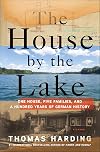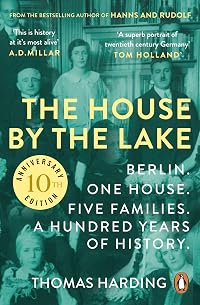
The House by the Lake: One House, Five Families, and a Hundred Years of German History
by Thomas Harding
On This Page
Description
A Finalist for the Costa Biography Award Longlisted for the Orwell Prize Named a Best Book of the Year by The Times (London) - New Statesman (London) - Daily Express (London) - Commonweal magazine In the summer of 1993, Thomas Harding traveled to Germany with his grandmother to visit a small house by a lake on the outskirts of Berlin. It had been her "soul place," she said-a holiday home for her and her family, but also a refuge-until the 1930s, when the Nazis' rise to power forced them to show more leave. The trip was his grandmother's chance to remember her childhood sanctuary as it was. But the house had changed, and when Harding returned once again nearly twenty years later, it was about to be demolished. It now belonged to the government, and as Harding began to inquire about whether the house could be saved, he unearthed secrets that had lain hidden for decades. Slowly he began to piece together the lives of the five families who had lived there: a wealthy landowner, a prosperous Jewish family, a renowned composer, a widow and her children, a Stasi informant. All had made the house their home, and all but one had been forced out. The house had weathered storms, fires and abandonment, witnessed violence, betrayals and murders, and had withstood the trauma of a world war and the dividing of a nation. Breathtaking in scope and intimate in its detail, The House by the Lake is a groundbreaking and revelatory new history of Germany, told over a tumultuous century through the story of a small wooden house. show lessTags
Recommendations
































Member Recommendations

Member Reviews
In 1927 Thomas Harding’s great-grandfather built a weekend cottage for his family on the shore of a lake in Groß Glienicke, on the western edge of Berlin. The Alexanders were able to enjoy the house for a few years before Hitler’s anti-Jewish policies made them emigrate to Britain. Another family, the Meisels, then acquired the place cheaply as “abandoned Jewish property”, but lost it again when it became part of the Soviet Zone and later the DDR. Two further families lived in the house during the DDR period, when it changed from dacha to permanent residence — but with the peculiarity that the Berlin Wall now ran through the back garden, cutting the house off from the lake.
Harding went to Berlin in 2013 to look for the show more now-abandoned house his relatives had talked about, and to research its history by talking to residents of Groß Glienicke, an exercise which culminated in a project to turn the house into a protected monument and eventually a museum of local history.
Harding uses a mixture of oral history and documents to chronicle the history of the house and the village from the 1890s, before the local landowner sold off portions of his estate for housing, right through to the campaign to restore the house. This is all quite engaging, particularly because Harding treats all the people who have lived in the house with equal respect and focuses on their experience of living there rather than allowing himself to be tempted into recriminations about strangers living in the house his family built for themselves. We get a lively — albeit somewhat arbitrary — slice of German social history through time, with quite a lot of interesting details.
The book is a little less successful when Harding is trying to fill us in on the bigger picture of German history to give a context to the events: inevitably, he has to condense and simplify, and he often ends up with a story that is lacking in nuance and precision. A lot of relevant information is banished to the (ridiculously long) endnotes, and Penguin make things worse by not allowing him to put references to the notes in the text: you have to guess which passages might have notes attached to them and which don’t.
Not bad on the whole, but I think there are much more interesting books about German history written by actual Germans (OK, Australians too…). show less
Harding went to Berlin in 2013 to look for the show more now-abandoned house his relatives had talked about, and to research its history by talking to residents of Groß Glienicke, an exercise which culminated in a project to turn the house into a protected monument and eventually a museum of local history.
Harding uses a mixture of oral history and documents to chronicle the history of the house and the village from the 1890s, before the local landowner sold off portions of his estate for housing, right through to the campaign to restore the house. This is all quite engaging, particularly because Harding treats all the people who have lived in the house with equal respect and focuses on their experience of living there rather than allowing himself to be tempted into recriminations about strangers living in the house his family built for themselves. We get a lively — albeit somewhat arbitrary — slice of German social history through time, with quite a lot of interesting details.
The book is a little less successful when Harding is trying to fill us in on the bigger picture of German history to give a context to the events: inevitably, he has to condense and simplify, and he often ends up with a story that is lacking in nuance and precision. A lot of relevant information is banished to the (ridiculously long) endnotes, and Penguin make things worse by not allowing him to put references to the notes in the text: you have to guess which passages might have notes attached to them and which don’t.
Not bad on the whole, but I think there are much more interesting books about German history written by actual Germans (OK, Australians too…). show less
Author Thomas Harding is the grandson of a German Jewish woman whose family left Germany in the 1930s and established homes and lives in England. His grandmother, Elsie, never forgot the vacation house that her father built by Groß Glienicke lake on Berlin's western outskirts. The family spent several happy summers there before the ever-increasing restrictions and pressures on Germany's Jews caused them to leave Germany. Several years before her death, Elsie took her grandchildren to Germany to see the house that her father had built. Two decades later, Harding returned to find the house in disrepair and in danger of being torn down for a redevelopment project. Harding set out to see if there might be a way to save the house. In the show more process, he researched the history of the land, the house, and all of the families that had lived in the house. The history encompasses the entire 20th century, including landmark events such as the Nazi era, the post-World War II denazification process, the Russian administration of East Germany, the construction of the Berlin Wall between the house and the lake, the East German Stasi and its monitoring and control of East Germans, and the eventual fall of the Berlin Wall and the reunification of Germany. While there is an undercurrent of sadness and loss throughout the book, ultimately it's a story of reconciliation and hope. Highly recommended for readers with an interest in the history of Germany's Jews leading up to the Holocaust, the history of Berlin, the border regions in the Cold War era, and the reunification of Germany.
This review is based on an electronic advance reader's copy provided by the publisher through NetGalley. show less
This review is based on an electronic advance reader's copy provided by the publisher through NetGalley. show less
For me, this is the most enjoyable type of history. Thomas Harding's starting point is the story of his German jewish family prospering in 1920s Berlin. They buy the eponymous house by the lake outside Berlin as a weekend and holiday retreat. But then, instead of giving us a history of his family's struggles through the Nazi era, he focuses on the house itself and details the lives of the numerous families who occupied it both before and after his own. This structure provides a fascinating history of 20th century Germany.
Of course, Hitler's rise to power and the subsequent persecution of the Jews is covered but it's the lesser known stories of ordinary Germans living through the 2nd world war and the immediate aftermath followed by the show more long years of communist rule and the building of the Berlin Wall (the barrier built between the east and west cuts the lake house off from the lake!) that is even more interesting.
The story is brought up to date by describing how the house and it's occupants have fared since reunification. But despite all the sad and tragic events during the house's history, Harding ends on an uplifting note with his family and the local people fighting to save and renovate the house. show less
Of course, Hitler's rise to power and the subsequent persecution of the Jews is covered but it's the lesser known stories of ordinary Germans living through the 2nd world war and the immediate aftermath followed by the show more long years of communist rule and the building of the Berlin Wall (the barrier built between the east and west cuts the lake house off from the lake!) that is even more interesting.
The story is brought up to date by describing how the house and it's occupants have fared since reunification. But despite all the sad and tragic events during the house's history, Harding ends on an uplifting note with his family and the local people fighting to save and renovate the house. show less
Berlin. One House. Five Families. A hundred years of History.
The above description on the cover of The House by the Lake caught my attention straight away because I love stories about old houses and their inhabitants down through the years and the fact that The house by the Lake by Thomas Harding was located on the outskirts of Berlin and Harding's ancestors were forced to leave when the Nazis swept to power really enhanced my interest. A home which played a major part of so many family's lives, a home where a concrete footpath cut through the garden marking where the Berlin Wall had stood for nearly three decades.
Thomas Harding was eager to save his ancestral home from demolition and began the mammoth task of researching the show more house's history and that of the five families who were connected with the house. A noble farmer, a prosperous Jewish family, a renowned Nazi composer, a widow and her children and a Stasi informant.
This book is a wonderful read well researched and well written, and and what could easily have been just a family memoir turns out to be a book that will be of great historical interest to many. The author has a talent for research and turning his research into a terrific historical read and account of life behind the Iron curtain. I have read a few books about the Iron Curtain and German reunification but this is one that really really offers so much more and brings to life twentieth century Germany for the reader.
I picked up a hard copy of this book in my local bookstore and had never come across the writer before. I have enjoyed every minute I spent with this book so much so that I announced to my husband on finishing the book " I have to visit Berlin" and his usual response was " another book another trip"
A great read for those interested in social history and twentieth century Germany and a book that is moving and evocative but never too sentimental. The book contains numerous photographs, Family trees, Maps of Germany & Berlin and an extremely detailed notes section which I really appreciated. show less
The above description on the cover of The House by the Lake caught my attention straight away because I love stories about old houses and their inhabitants down through the years and the fact that The house by the Lake by Thomas Harding was located on the outskirts of Berlin and Harding's ancestors were forced to leave when the Nazis swept to power really enhanced my interest. A home which played a major part of so many family's lives, a home where a concrete footpath cut through the garden marking where the Berlin Wall had stood for nearly three decades.
Thomas Harding was eager to save his ancestral home from demolition and began the mammoth task of researching the show more house's history and that of the five families who were connected with the house. A noble farmer, a prosperous Jewish family, a renowned Nazi composer, a widow and her children and a Stasi informant.
This book is a wonderful read well researched and well written, and and what could easily have been just a family memoir turns out to be a book that will be of great historical interest to many. The author has a talent for research and turning his research into a terrific historical read and account of life behind the Iron curtain. I have read a few books about the Iron Curtain and German reunification but this is one that really really offers so much more and brings to life twentieth century Germany for the reader.
I picked up a hard copy of this book in my local bookstore and had never come across the writer before. I have enjoyed every minute I spent with this book so much so that I announced to my husband on finishing the book " I have to visit Berlin" and his usual response was " another book another trip"
A great read for those interested in social history and twentieth century Germany and a book that is moving and evocative but never too sentimental. The book contains numerous photographs, Family trees, Maps of Germany & Berlin and an extremely detailed notes section which I really appreciated. show less
The House by the Lake by Thomas Harding tells the story of a summer house by a picturesque lake, and the family stories of its various residents during the mostly turbulent time post The Great War, near Berlin.
Intertwined with these stories is some that of the author's quest to save the house from demolition, and also to discover more about his own family history.
The book is a thoroughly engrossing read, well researched, and a timely reminder of the need for generous relating between diverse cultures.
Intertwined with these stories is some that of the author's quest to save the house from demolition, and also to discover more about his own family history.
The book is a thoroughly engrossing read, well researched, and a timely reminder of the need for generous relating between diverse cultures.
A really interesting book that provides a side-light on the history of Germany since the start of the 20th Century by focussing on a single wooden house, originally built as a weekend holiday home for Berliners. The book follows the history of the various families who occupied it as the waves of history washed over them from the Kaiser's War to Nazi Germany to the Soviet Occupation and the DDR. Interestingly the fall of the Berlin Wall brought its own share of problems as competing claims emerged for the house by those disposed by the Nazis or the Soviets. The book ends on a hopeful note with the house becoming a focus for reconciliation. An interesting 'micro-history' that highlights the impact on ordinary people of the march of show more history. David Denny show less
This is a fascinating story of a small summer house on a lake near Berlin and the families who lived in it over almost 100 years. That time covers the rise of Nazism, WW2, the Communist regime post-war , the Berlin Wall (built in the land between the house and the lake) and the reunification of Germany. The detail is staggering and the amount of research required is mind-boggling. I read it in three days - I couldn't put it down.
Members
- Recently Added By
Published Reviews
ThingScore 75
It is Harding’s great achievement that he has painted a large canvas of history, but done so with glinting individual stories.
added by inge87
Lists

Top Five Books of 2016
795 works; 228 members

Recommend the 20 best books you've read in the last five years
2,168 works; 602 members

Books Read in 2016
4,666 works; 199 members

Books Read in 2021
5,361 works; 113 members

Western & Northern Europe
60 works; 1 member
Author Information

15 Works 1,149 Members
Thomas Harding is a former documentary filmmaker and journalist who has written for the Financial Times and The Guardian, among other publications. He founded a television station in Oxford, England, and for many years was an award-winning publisher of a newspaper in West Virginia. He lives in Hampshire, England.
Awards and Honors
Series
Belongs to Publisher Series
dtv (34935)
Work Relationships
Common Knowledge
- Canonical title
- The House by the Lake: One House, Five Families, and a Hundred Years of German History
- Original title
- The House By The Lake: Berlin. One House. Five Families. A Hundred years of History
- Original publication date
- 2015
- Important places
- Groß Glienicke, Germany (Berlin and Brandenburg)
- Original language
- English
- Disambiguation notice
- This is the original memoir, for adults.
Please do not combine with the version for younger readers (ISBN 978-1-5362-1274-7).
Classifications
- Genres
- History, Nonfiction, Biography & Memoir, General Nonfiction
- DDC/MDS
- 943.1546 — History & geography History of Europe Central Europe: Germany, Austria, Switzerland, Czech, Poland, Hungary Northeastern Germany Brandenburg and Berlin
- LCC
- DD901 .P8 .H37 — History of Europe, Asia, Africa and Oceania Germany History of Germany Local history and description Other cities, towns, etc., A-Z
- BISAC
Statistics
- Members
- 382
- Popularity
- 81,865
- Reviews
- 21
- Rating
- (4.03)
- Languages
- 6 — Dutch, English, German, Italian, Portuguese, Spanish
- Media
- Paper, Audiobook, Ebook
- ISBNs
- 23
- ASINs
- 8