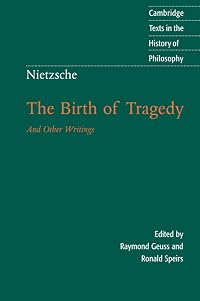
The Birth of Tragedy and Other Writings
by Friedrich Nietzsche 
On This Page
Description
The Birth of Tragedy is one of the seminal philosophical works of the modern period. Nietzsche's discussion of the nature of culture, of the conditions under which it can flourish and of those under which it will decline, his analysis of the sources of discontent with the modern world, his criticism of rationalism and of traditional morality, his aesthetic theories and his conception of the 'Dionysiac' have had a profound influence on the philosophy, literature, music, and politics of the show more twentieth century. This edition presents a new translation by Ronald Speirs and an introduction by Raymond Geuss that sets the work in its historical and philosophical context. The volume also includes two essays on related topics that Nietzsche wrote during the same period, and that throw further light on the themes treated in the main text. show lessTags
Recommendations







Member Reviews
This book is logically impossible to rate. As Nietzsche's first major writing, The Birth of Tragedy strays from Nietzsche's main ideology he develops later in life. This edition of the book has Nietzsche's second preface to The Birth of Tragedy, "An Attempt at Self-Criticism" in which he criticizes his own writing in The Birth of Tragedy yet defends it as a readable work. This in itself is extraordinarily hard to dissect, since Nietzsche is an unreliable narrator, and has a very self-absorbed persona. There is no question that he things The Birth of Tragedy is poor: at this time in his life he still sees himself as a peer or student of Richard Wagner and Arthur Schopenhauer—this will change.
The other essays included, "The Dionysiac show more Worldview" and "Truth and Lying in a Non-Moral Sense" are very different from each other, yet are both related to the ideas of The Birth of Tragedy; "The Dionysiac Worldview" can even be seen as a precursor to "The Birth of Tragedy." However, "Truth and Lying in a Non-Moral Sense," itself a short essay, seems characteristically different from the others, as Nietzsche demonstrates greater autonomy in his literate character. This is perhaps more the case, as he is moving away from the Classics, a study which he has forced upon himself to his own detriment. show less
The other essays included, "The Dionysiac show more Worldview" and "Truth and Lying in a Non-Moral Sense" are very different from each other, yet are both related to the ideas of The Birth of Tragedy; "The Dionysiac Worldview" can even be seen as a precursor to "The Birth of Tragedy." However, "Truth and Lying in a Non-Moral Sense," itself a short essay, seems characteristically different from the others, as Nietzsche demonstrates greater autonomy in his literate character. This is perhaps more the case, as he is moving away from the Classics, a study which he has forced upon himself to his own detriment. show less
Ratings
Members
- Recently Added By
Author Information

1,395+ Works 78,439 Members
The son of a Lutheran pastor, Friedrich Wilhelm Nietzsche was born in 1844 in Roecken, Prussia, and studied classical philology at the Universities of Bonn and Leipzig. While at Leipzig he read the works of Schopenhauer, which greatly impressed him. He also became a disciple of the composer Richard Wagner. At the very early age of 25, Nietzsche show more was appointed professor at the University of Basel in Switzerland. In 1870, during the Franco-Prussian War, Nietzsche served in the medical corps of the Prussian army. While treating soldiers he contracted diphtheria and dysentery; he was never physically healthy afterward. Nietzsche's first book, The Birth of Tragedy Out of the Spirit of Music (1872), was a radical reinterpretation of Greek art and culture from a Schopenhaurian and Wagnerian standpoint. By 1874 Nietzsche had to retire from his university post for reasons of health. He was diagnosed at this time with a serious nervous disorder. He lived the next 15 years on his small university pension, dividing his time between Italy and Switzerland and writing constantly. He is best known for the works he produced after 1880, especially The Gay Science (1882), Thus Spake Zarathustra (1883-85), Beyond Good and Evil (1886), On the Genealogy of Morals (1887), The Antichrist (1888), and Twilight of the Idols (1888). In January 1889, Nietzsche suffered a sudden mental collapse; he lived the last 10 years of his life in a condition of insanity. After his death, his sister published many of his papers under the title The Will to Power. Nietzsche was a radical questioner who often wrote polemically with deliberate obscurity, intending to perplex, shock, and offend his readers. He attacked the entire metaphysical tradition in Western philosophy, especially Christianity and Christian morality, which he thought had reached its final and most decadent form in modern scientific humanism, with its ideals of liberalism and democracy. It has become increasingly clear that his writings are among the deepest and most prescient sources we have for acquiring a philosophical understanding of the roots of 20th-century culture. (Bowker Author Biography) show less
Friedrich Nietzsche has a Legacy Library. Legacy libraries are the personal libraries of famous readers, entered by LibraryThing members from the Legacy Libraries group.
Series
Belongs to Publisher Series
Work Relationships
Contains
Common Knowledge
- Canonical title
- The Birth of Tragedy and Other Writings
- Original publication date
- 1999
Classifications
Statistics
- Members
- 422
- Popularity
- 73,383
- Reviews
- 1
- Rating
- (3.77)
- Languages
- English, German, Serbian
- Media
- Paper, Ebook
- ISBNs
- 5