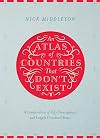
An Atlas of Countries That Don't Exist: A Compendium of Fifty Unrecognized and Largely Unnoticed States
by Nick Middleton
On This Page
Description
What is a country? Acclaimed travel writer and Oxford geography don Nick Middleton brings to life the origins and histories of 50 states that, lacking international recognition and United Nations membership, exist on the margins of legitimacy in the global order. From long-contested lands like Crimea and Tibet to lesser-known territories such as Africa's last colony and a European republic that enjoyed independence for a single day, Middleton presents fascinating stories of shifting borders, show more visionary leaders, and "forgotten" peoples. Beautifully illustrated with 50 regional maps, each country is literally die-cut out of the page, offering a distinctive tactile experience while exploring these remarkable places. show lessTags
Recommendations











Member Reviews
The Introduction to this fascinating book is beautifully, succinctly, yet inclusively written to describe some of the attributes of ‘countries’ and to describe some things that are not in countries. Borders as a construct make an appearance, too.
The book is divided into geographical and ‘other’ zones. They are Europe, Africa, North America, South America, Asia, Oceania, and Elsewhere. The countries include colonized areas reasserting sovereignty, concrete-and-coral-block atols, tribal organizations, and political and logical entities making a statement.
Each country is allotted 4 pages – The first has name, brief description, and flag. The second has the die-cut out surrounding the 4th page’s map of the country, Date show more Declared, Capital, Population,, Area, Continent, and Language(s). Some have Founder and Date Dissolved. The third page is vivid prose highlighting either general historical info or a specific incident that describes the beginning or ending of the country’s existence. The fourth page is the map of the country within the context of sister countries, and the location on a globe.
The information is fascinating. It is just enough to give a feel to the country or its founder, not too much to drag out. It made me want to learn more about some of these countries.
My only criticism is that the color choice for the first and second pages, a red, and the font on the third page, italic, make it a bit of an effort to read.
Edit | More show less
The book is divided into geographical and ‘other’ zones. They are Europe, Africa, North America, South America, Asia, Oceania, and Elsewhere. The countries include colonized areas reasserting sovereignty, concrete-and-coral-block atols, tribal organizations, and political and logical entities making a statement.
Each country is allotted 4 pages – The first has name, brief description, and flag. The second has the die-cut out surrounding the 4th page’s map of the country, Date show more Declared, Capital, Population,, Area, Continent, and Language(s). Some have Founder and Date Dissolved. The third page is vivid prose highlighting either general historical info or a specific incident that describes the beginning or ending of the country’s existence. The fourth page is the map of the country within the context of sister countries, and the location on a globe.
The information is fascinating. It is just enough to give a feel to the country or its founder, not too much to drag out. It made me want to learn more about some of these countries.
My only criticism is that the color choice for the first and second pages, a red, and the font on the third page, italic, make it a bit of an effort to read.
Edit | More show less
 This review was written for LibraryThing Early Reviewers.
This is a beautiful book. A lot of attention to detail and care has been put into the design of this amazing book, from the color scheme of subtle gray-blue and cherry red, to the way each location is set in a map, with the previous page having a cut-out so that the reader first encounters the country, and then its place on the globe. This isn't the kind of book designed to help children with their geography homework, or to be an information-filled guidebook, instead, each entry is features a flag and some basic information, with a few paragraphs telling the story of each state, with the intention of arousing curiosity and interest, rather than providing a lot of details. These stories are often poignant or weird, but always show more interesting.
I loved Judith Schalansky's Atlas of Remote Islands, and this book falls into the same wheelhouse, being more about the idea of these places than anything else. The places featured range from the well-known and expected (Greenland, Catalonia) to the off-beat and obscure (Transnistria and Somaliland) to the downright odd (Elgaland-Vargaland, Atlantium), but all are fascinating. show less
I loved Judith Schalansky's Atlas of Remote Islands, and this book falls into the same wheelhouse, being more about the idea of these places than anything else. The places featured range from the well-known and expected (Greenland, Catalonia) to the off-beat and obscure (Transnistria and Somaliland) to the downright odd (Elgaland-Vargaland, Atlantium), but all are fascinating. show less
This review was written for LibraryThing Early Reviewers.This one sounds more interesting than it actually is. Each region gets a full page map and approximately half of a page of text, so readers learn less than they would have if they had just consulted Wikipedia.
As it styles itself an atlas one would think it would have good maps, but that is not the case: they do not show recognized national borders within the regions discussed, making it difficult to know what country is claiming them (the text rarely makes this clear, either); the scales are hidden so deep in the gutter that I didn't even notice they were there until halfway through the book; and all of the maps were rendered in an unattractive combination of blue-grey and red.
In short, it's definitely not worth the $30 cover price.
As it styles itself an atlas one would think it would have good maps, but that is not the case: they do not show recognized national borders within the regions discussed, making it difficult to know what country is claiming them (the text rarely makes this clear, either); the scales are hidden so deep in the gutter that I didn't even notice they were there until halfway through the book; and all of the maps were rendered in an unattractive combination of blue-grey and red.
In short, it's definitely not worth the $30 cover price.
This review was written for LibraryThing Early Reviewers.A partly serious, partly cheeky geographers look at the world. Some of these hidden countries are deadly serious - Northern Cyprus, Catalonia, Crimea, Tibet, Bangsamro - and some are a lark: Sealand and seemingly countless fantasy islands. I was left wanting more about the serious countries and much less about the fantasies, but I suppose that isn't keeping in the spirit of the book. A good book to set aside for punctuated reading in bursts.
This review was written for LibraryThing Early Reviewers.In terms of looks, this gets 4 stars, being rather handsomely designed (though the type, being italic, is harder to read). In terms of content, however, I found myself wanting more, sometimes quite literally. The selection of "countries" seems rather arbitrary, as the author admits, and has both formerly independent entities, often forcibly annexed to bigger neighbors, and quixotic libertarian projects. While this itself doesn't bother me (I appreciate books that have humor as well as seriousness) it's more of an issue that each receives half a page of text no matter the circumstances. As a result some countries get short shrift while others receive way more attention than their historical importance, current influence or number of show more inhabitants seem to warrant. I suspect if I want fuller stories on any of these, I'll have to turn to Wikipedia or Google -- especially since no bibliography is included. show less
This review was written for LibraryThing Early Reviewers.The physical book itself is beautiful and must have cost quite a lot to produce. Each "country" is presented with a two-page introduction on red paper with a cut-out revealing the shape of the country that is printed on the next page. It's very stylish and I'm at a loss to figure out how the publisher created these cut-outs short of doing them by hand.
They made an odd choice when they decided to use an italic font for the half-page article that accompanies each "country". It's a little hard to read and takes away from the pleasure of reading I normally get.
The selection of "countries" seems a little odd too. Some are all but legitimate sovereignties with seemingly strong legal claims to their own government. Others however are pretty show more farcical and the way the book is laid out makes no distinction between the two.
My biggest complaint however is that no matter how legit, ancient, and interesting the claim, each "country" gets the same short half-page write-up. It seems to me that some of these entries deserved at least a couple of pages to more fully explain the history and debate of the claim.
So to sum up, beautiful physical book but poorly executed "one-size-fits-all" format with a bad font choice to boot.
NOTE: If you'd really like to read a story about a failed "country", read Kurt Vonnegut's editorial Biafra: A People Betrayed. It'll break your heart, and the story of Biafra didn't even get a mention in this book! show less
They made an odd choice when they decided to use an italic font for the half-page article that accompanies each "country". It's a little hard to read and takes away from the pleasure of reading I normally get.
The selection of "countries" seems a little odd too. Some are all but legitimate sovereignties with seemingly strong legal claims to their own government. Others however are pretty show more farcical and the way the book is laid out makes no distinction between the two.
My biggest complaint however is that no matter how legit, ancient, and interesting the claim, each "country" gets the same short half-page write-up. It seems to me that some of these entries deserved at least a couple of pages to more fully explain the history and debate of the claim.
So to sum up, beautiful physical book but poorly executed "one-size-fits-all" format with a bad font choice to boot.
NOTE: If you'd really like to read a story about a failed "country", read Kurt Vonnegut's editorial Biafra: A People Betrayed. It'll break your heart, and the story of Biafra didn't even get a mention in this book! show less
This review was written for LibraryThing Early Reviewers.A triumph of design over content, this volume's 232 pages are chiefly consumed by peek-a-boo maps, double-page continent headings and fact sheets with huge borders. That leaves little space with useful content, just a page for each of 50 “countries.” I did learn a little about places I was unfamiliar with, but it really wasn't worth it.
Members
- Recently Added By
Lists

Evan's Reading List 2022
18 works; 1 member
Author Information

All Editions
Common Knowledge
- Original publication date
- 2015
Classifications
Statistics
- Members
- 258
- Popularity
- 125,943
- Reviews
- 17
- Rating
- (3.59)
- Languages
- 5 — English, French, German, Italian, Spanish
- Media
- Paper, Ebook
- ISBNs
- 9
- ASINs
- 2