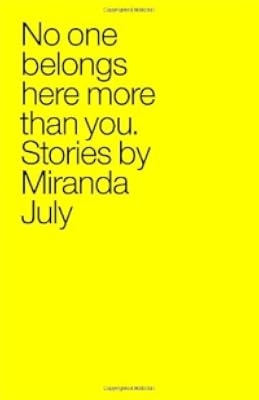
No One Belongs Here More Than You: Stories
by Miranda July
On This Page
Description
In a series of stories that are shocking, sexy, charming, and ultimately unforgettable, Miranda July explores the hearts and minds of characters who are desperate for human connection and yet don't know what to do when it actually happens. In the brilliant opening story, "The Shared Patio," a woman longs to share her neighbor's life, but learns that her fantasy of him has no resemblance to reality. In "The Swim Team," a young woman teaches three elderly citizens in a town with no water how show more to swim. A man who works at a leather factory gets set-up by his co-worker for a date that never arrives in "The Sister." In "Something That Needs Nothing," a young woman's job at a peep show changes her identity in the eyes of her friend, allowing for their relationship to take a different course. In these stories Miranda July shows a remarkable skill for inhabiting the hearts and minds of a varied cast of characters, imbuing them with a tenderness and humanity that is the mark of a great writer. show lessTags
Recommendations







Member Recommendations
pingdjip Charmant vreemd: in het verlengde van wat nog net normaal is en met een blikkerend inzicht in sociale interactie. Vreemd, maar toch naturel en vanzelfsprekend.
Member Reviews
I appreciate July's writing for the strength of her voice, which I find lacking is so many other contemporaries. I like picking up a story and knowing who wrote it without having to look at the cover. The stories are not all great, but overall it was a refreshing change from lots of contemporary fiction that either tries too hard to be new or just falls into the same old patterns. The image of the carcass of a dead whale slowly sinking to the bottom of the unknown lonely sea still sticks with me, and I find it a good metaphor for her entire work: a world in which our grander hopes are eventually overcome and swallowed by cold reality, and even as the whale sits there on the seabed, rotting, we can't help but imagine its life on the show more whitecaps. I look forward to reading a novel and seeing how she sustains herself over the long distance... show less
3.5/5 I did myself a disservice by reading July's (really great) novel "The First Bad Man" before reading this collection of short stories. Had I read in order, I would have been delighted to see the themes of "No One Belongs Here..." revisited and perfected in the long fiction format. I would have first been exposed to her metasexualism via snippets, and I would see it unfold over several hundred pages into a very clear picture of a new and nuanced kind of sexuality. I would have noted the consistency of her narrative voice, that you can read a half-paragraph and know it is Miranda July writing. I would have noted that her signature comedic-bathetic style, and her penchant for describing the 'magical' cures and rituals of ordinary show more obsessive-compulsive behavior--considered 'twee' by early readers of July--were decidedly proven to be the very opposite with the appearance of TFBM. Unfortunately, I can't know how much I would have liked this book when it first appeared. I don't know if I would have thought it was twee, or if I would have thought she is a blatantly raw talent worth keeping an eye on.
Nevertheless, TFBM resists twee-ness, and in so doing asks that the reader look back to NOBH with new non-twee-seeking eyes.
But what is twee-ness? A brand of sentimentalism? July's characters are almost all of them sentimentalists: they see themselves as lacking something crucial and they seek to fill their respective voids. They (on the whole) are particularly susceptible to faddish life-cures proposing to provide body/soul/world integration, self-fulfillment, a different improved! kind of life, a different improved! kind of worldview. Perhaps July's characters are twee, but I maintain that her handling of them is not. As a writer she is not mawkish, not mocking. She presents their sentimentalism to her readers and asks us to consider it.
What I like about July generally speaking (besides what I have called her "metasexualism" in my review of TFBM), is that she is one of the few living writers successfully recovering (resuscitating) the long derided concept of "bathos," which (IMO) stands to be positively revalued in our modern lexicon. For too long "bathos" has been associated with a valueless or silly sentimentalism. Instead, July presents us with truly bathetic art--bathos as it should be understood--as an exceptional, evocative and stirring commonness.
July's characters share a hopefulness that they will find redemption, be special (to themselves, to anyone), and this is also part of their commonness. We wish well for them (or I do), to transcend it; maybe even for their quack-medicines to work for them, or for them to exercise their hidden potential: connectedness wherever they can, in whatever weird way they choose. The allowance of this weirdness, I am conjecturing here, is bathos. To call it "twee" is to make it sound as though sentimentalism is easy or profoundly stupid, or both. July's characters are neither, but they may be (on the whole) naive. She reminds us that there is a logic to the ordinary, however it is lived, and in the absence of perceived connection and relation, people go mad in all kinds of small, undramatic, and often funny kinds of ways. They want to be self-soothing, or maybe just to be soothed.
So all that said: read in order. This one is a let down (although it shouldn't be) after reading TFBM. NOBH one has it all, just differently. More diffusely, but just as interestingly. show less
Nevertheless, TFBM resists twee-ness, and in so doing asks that the reader look back to NOBH with new non-twee-seeking eyes.
But what is twee-ness? A brand of sentimentalism? July's characters are almost all of them sentimentalists: they see themselves as lacking something crucial and they seek to fill their respective voids. They (on the whole) are particularly susceptible to faddish life-cures proposing to provide body/soul/world integration, self-fulfillment, a different improved! kind of life, a different improved! kind of worldview. Perhaps July's characters are twee, but I maintain that her handling of them is not. As a writer she is not mawkish, not mocking. She presents their sentimentalism to her readers and asks us to consider it.
What I like about July generally speaking (besides what I have called her "metasexualism" in my review of TFBM), is that she is one of the few living writers successfully recovering (resuscitating) the long derided concept of "bathos," which (IMO) stands to be positively revalued in our modern lexicon. For too long "bathos" has been associated with a valueless or silly sentimentalism. Instead, July presents us with truly bathetic art--bathos as it should be understood--as an exceptional, evocative and stirring commonness.
July's characters share a hopefulness that they will find redemption, be special (to themselves, to anyone), and this is also part of their commonness. We wish well for them (or I do), to transcend it; maybe even for their quack-medicines to work for them, or for them to exercise their hidden potential: connectedness wherever they can, in whatever weird way they choose. The allowance of this weirdness, I am conjecturing here, is bathos. To call it "twee" is to make it sound as though sentimentalism is easy or profoundly stupid, or both. July's characters are neither, but they may be (on the whole) naive. She reminds us that there is a logic to the ordinary, however it is lived, and in the absence of perceived connection and relation, people go mad in all kinds of small, undramatic, and often funny kinds of ways. They want to be self-soothing, or maybe just to be soothed.
So all that said: read in order. This one is a let down (although it shouldn't be) after reading TFBM. NOBH one has it all, just differently. More diffusely, but just as interestingly. show less
Sometimes, more often than not lately, I try to write my reviews in the voice of the author of the book I just finished. In part, this is because I just finished the book and the author's voice had overwriten mine for a while and I hadn't yet reverted back to the voice I'd begun with. I'm pretty sure there is such a thing as a voice of my own but at the same time, I know that we are all co-constructions of our culture as well. Part of that self-creation in fact just took place because I had perused a few of the other reviews of this book before I began writing my own. It's almost as if I was afraid I might say something too original if I didn't first consult the general tide of opinion.
What I noticed was that some readers positively show more hated the book and, though their reasons made no sense to me, I sort of knew what they'd meant. I had felt some of that dislike early on to the point that I almost stopped reading. What made me continue reading wasn't pleasure, but a wish to solve a puzzle. There's something she does in her writing that I needed to figure out, like it was a brain teaser I had run across in a magazine and felt a compulsion to solve. The something I needed to name was a uniformity that gave many of the stories a sameness. I would forget, at times, exactly which story I was in, expecting characters from one of the other stories to show up.
At one point, I thought I was close to the solution. I had been reading while waiting my turn to be photographed for an ID card and the person at the desk, a middle aged Asian woman, called me over and said "You don't have anyone to notify in case of emergency." She meant that I had left that part of the application blank, but the way she phrased it made it sound tragic. "It's optional," she added, because I must have looked worried. I smiled and explained that, after filling out so much application, I had become tired of entering the familiar facts of my documentary life, and noticing that no more was required of me, I took advantage of the opportunity to stop writing. As I said this, I thought that there was something so Miranda July about this interchange.
It was the multiplicity of levels--the presumed importance of the data I was supplying along side my casual refusal to grant it that importance, all being played out over the issue of an emergency contact, with the implied intimacy or lack thereof.
And that's exactly what I had found annoying about the book. Everything and nothing was important at the same time. There is a pervasive irony tuned so precisely that at times you can't be sure it's really still there and that maybe you are adding it yourself and blaming it on Miranda.
And yet that precision is somehow beautiful, and my characterization of it isn't the whole story. It isn't formulaic, as I feared, but something artful instead. It is something I can't copy and parody but have to appreciate instead.
By the end I wanted to give it 5 stars, as if the number of stars I gave a book were of some kind of cosmic significance, but, remembering my early annoyance, I stopped at 4. show less
What I noticed was that some readers positively show more hated the book and, though their reasons made no sense to me, I sort of knew what they'd meant. I had felt some of that dislike early on to the point that I almost stopped reading. What made me continue reading wasn't pleasure, but a wish to solve a puzzle. There's something she does in her writing that I needed to figure out, like it was a brain teaser I had run across in a magazine and felt a compulsion to solve. The something I needed to name was a uniformity that gave many of the stories a sameness. I would forget, at times, exactly which story I was in, expecting characters from one of the other stories to show up.
At one point, I thought I was close to the solution. I had been reading while waiting my turn to be photographed for an ID card and the person at the desk, a middle aged Asian woman, called me over and said "You don't have anyone to notify in case of emergency." She meant that I had left that part of the application blank, but the way she phrased it made it sound tragic. "It's optional," she added, because I must have looked worried. I smiled and explained that, after filling out so much application, I had become tired of entering the familiar facts of my documentary life, and noticing that no more was required of me, I took advantage of the opportunity to stop writing. As I said this, I thought that there was something so Miranda July about this interchange.
It was the multiplicity of levels--the presumed importance of the data I was supplying along side my casual refusal to grant it that importance, all being played out over the issue of an emergency contact, with the implied intimacy or lack thereof.
And that's exactly what I had found annoying about the book. Everything and nothing was important at the same time. There is a pervasive irony tuned so precisely that at times you can't be sure it's really still there and that maybe you are adding it yourself and blaming it on Miranda.
And yet that precision is somehow beautiful, and my characterization of it isn't the whole story. It isn't formulaic, as I feared, but something artful instead. It is something I can't copy and parody but have to appreciate instead.
By the end I wanted to give it 5 stars, as if the number of stars I gave a book were of some kind of cosmic significance, but, remembering my early annoyance, I stopped at 4. show less
Miranda July's stories are usually narrated by awkward and sometimes sexually or emotionally dysfunctional female narrators. Sometimes their circumstances are bizarre and fantastic, sometimes they are extraordinarily ordinary. Whichever the case, they are frequently at the root of an epiphany, an AhHa!, some magic that July has eked, milked, wrought from their experience. These stories can be painful, and they can be laugh out loud funny; July is a highly original author who should be read over and over again. [ full review ]
An absolutely gut-wrenching tear-down of the nuances that make us frail and human. No other collection of stories has made me feel so uncomfortable, so violated and so weak-hearted all through the eyes of naïve innocence. No One Belongs Here More Than You is simply masterful — I doubt, however, that I could recommend it to anyone in clear conscience.
Halfway through this book, I was a little bit overwhelmed by the onslaught of nontraditional love stories. I was having trouble processing it as I read, which I always do with short stories, but especially this collection. Then, I got to "Making Love in 2003." I remember reading this story about five years ago, and I had recently been trying to recall where I had read it and who it was by. All I remembered was that it was a sacrilegious story about Madeleine L'Engle, which I remember being offended by, although at that point in my life, I was almost always offended by short stories. It was so exciting to accidentally stumble upon this story and get the chance to read it again through changed eyes. Although sometimes the ambiguity of show more these stories seems to be reaching, July's style is so captivating that it's easy to forget. I was constantly reaching for this book throughout the week, which is another rarity for me with short story collections, as I usually find myself weighed down by one or another or just by the prospect of ingesting more stories. This was a real delight, and I would love to have the privilege of reading what July has the time to do with a full-length novel. show less
This is an amazing collection of short stories that silently weave in and out of genre and any type of categorization. It starts quirky and funny and sidles into heart rending despair. Definitely some stories stick out more than others, but I feel that everyone will find something in this book that they will remember for a long time.
Members
- Recently Added By
Lists

Favorite Short Fiction
228 works; 99 members

Books Read in 2016
4,666 works; 199 members

Books With Numbers in the Title
308 works; 13 members

Literary Travelogue of the United States Challenge
133 works; 6 members

Simon & Schuster
136 works; 4 members
Author Information

22+ Works 6,993 Members
Miranda July is a filmmaker and writer. She wrote, directed, and starred in The Future. Her film, Me and You and Everyone We Know, received a special jury prize at the Sundance Film Festival and the Caméra d'Or at Cannes. Her stories have appeared in The New Yorker, The Paris Review, and Harper's. No One Belongs Here More Than You won the Frank show more O'Connor International Short Story Award. Her debut novel, The First Bad Man, was published in 2015 and made The New Zealand Best Seller List. (Bowker Author Biography) show less
Awards and Honors
Series
Belongs to Publisher Series
Common Knowledge
- Canonical title
- No One Belongs Here More Than You: Stories
- Original title
- No One Belongs Here More Than You
- Original publication date
- 2007; 2008 (édition française) (édition française)
- Dedication
- For Julia Bryan-Wilson
- First words
- It still counts, even though it happened when he was unconscious.
- Quotations
- That day I carried the dream around like a full glass of water, moving gracefully so I would not lose any of it
- Last words
- (Click to show. Warning: May contain spoilers.)And they were triumphant.
- Blurbers
- Eggers, Dave; Hempel, Amy; Saunders, George; Byrne, David
Classifications
Statistics
- Members
- 3,333
- Popularity
- 5,085
- Reviews
- 103
- Rating
- (3.69)
- Languages
- 15 — Catalan, Danish, Dutch, English, Estonian, Finnish, French, German, Italian, Japanese, Norwegian (Bokmål), Polish, Spanish, Swedish, Portuguese (Portugal)
- Media
- Paper, Audiobook, Ebook
- ISBNs
- 46
- UPCs
- 1
- ASINs
- 13