A River Sutra
by Gita Mehta
On This Page
Description
Set on the banks of India's holiest river amid the constant traffic of pilgrims, archaeologists, policemen, priests, and traders, A River Sutra weaves the richness of India into the dangerous lives of its characters. A bureaucrat retires to the sacred river in search of tranquility only to encounter a girl fleeing her kidnappers, a naked ascetic and the child he has saved from prostitution, a teacher who confesses to murder, a millionaire monk, and a musician silenced by desire. Instead of show more finding serenity, the bureaucrat is forced to confront the powers of mythology, religion, music, and philosophy, and to acknowledge that the holy river has a sanctity more threatening than he can imagine. In this exquisitely written novel, Gita Mehta uses the traditional forms of Indian story-telling to explore the savagery of human love and to illuminate the paradoxes of India. show lessTags
Recommendations











Member Reviews
Having read this book, and assembled my thoughts prepatory to putting them ´down on paper´ (as it were) it also passes through my mind whether I might be accused of doing something here akin to shooting Bambi. It certainly feels like it. I´d best explain.
There is an exquisite premise to this novel, an Indian civil servant renounces ambition and takes up the spiritual life, acting as custodian of a small travellers guest house. The location is both culturally and visually rich and well served by Mehta´s beautiful scene setting. The structure is also as perfect as you could ever see in a novel, a sort of Chaucerian set of tales, of travellers passing through, confiding in the narrator who is not only the custodian of the lodge, but show more also a custodian or stories and (potentially) the spiritual heritage of the locale.
So where did the wheels fall off? Well, there is almost no sense of the custodian´s ´sense of being´ or having changed through his abandonment of his former life. He has moved into a spiritual location (and a visually splendid one), but there is no ´internal relocation´ apparent to the reader. The custodian and the locale seems like an excuse to put the episodes before the reader rather than being part of the story. And the episodes read almost like extracts from lodge´s booking diary, ¨Yes, so and so coming on the 12th, under a curse and showing suicidal tendencies, probably won´t be requiring breakfast on the 13th¨. Gita Mehta is authentically Indian, but something not quite authentic nags at the corner of my mind. The dialog is frankly discordant. The voices of the characters (the pitch, the language, the nuances) seem to wander (from page to page) between India, London and New York. And the references to religious or historical matters reads at times more like a high school assignment - scrupulously correct, but somehow lifeless, with no connection to the inner life of the characters.
So, visually beautiful, and potentially wonderful, but let down by a complete absence of character development and woeful dialog. I wasn´t sorry I read it. But noting what amazing potential it had, I was sorry that someone with more talent for character and dialog hadn´t written it. show less
There is an exquisite premise to this novel, an Indian civil servant renounces ambition and takes up the spiritual life, acting as custodian of a small travellers guest house. The location is both culturally and visually rich and well served by Mehta´s beautiful scene setting. The structure is also as perfect as you could ever see in a novel, a sort of Chaucerian set of tales, of travellers passing through, confiding in the narrator who is not only the custodian of the lodge, but show more also a custodian or stories and (potentially) the spiritual heritage of the locale.
So where did the wheels fall off? Well, there is almost no sense of the custodian´s ´sense of being´ or having changed through his abandonment of his former life. He has moved into a spiritual location (and a visually splendid one), but there is no ´internal relocation´ apparent to the reader. The custodian and the locale seems like an excuse to put the episodes before the reader rather than being part of the story. And the episodes read almost like extracts from lodge´s booking diary, ¨Yes, so and so coming on the 12th, under a curse and showing suicidal tendencies, probably won´t be requiring breakfast on the 13th¨. Gita Mehta is authentically Indian, but something not quite authentic nags at the corner of my mind. The dialog is frankly discordant. The voices of the characters (the pitch, the language, the nuances) seem to wander (from page to page) between India, London and New York. And the references to religious or historical matters reads at times more like a high school assignment - scrupulously correct, but somehow lifeless, with no connection to the inner life of the characters.
So, visually beautiful, and potentially wonderful, but let down by a complete absence of character development and woeful dialog. I wasn´t sorry I read it. But noting what amazing potential it had, I was sorry that someone with more talent for character and dialog hadn´t written it. show less
This is a wonderful little book simply telling the story of a retired civil servant who now manages a guest house on the banks of the Narmada - India's holiest river. The search for an escape from the world has brought the narrator to this place but there are still lessons to be learnt. Over the course of the book we are briefly introduced to other characters and their stories; like the river they move on. This is a picture of the various religions of India; the sacred songs; life and music. Mehta has brought to life the multifaceted culture and history of India in an exquisite gem of a book.
A Government official in India is in charge of a Government Rest House--a sort of inn. He is told stories about various individuals: a Jain monk previously from a wealthy family; a music teacher; a courtesan searching for her lost daughter; an insane playboy; a River Minstrel and an anchorite who worships Shiva. All this takes place near the river Narmada, a place of spiritual pilgrimage to Hindus. Gorgeous, lush writing that taught me something of Indian culture.
An office-worker turned inn-keeper is the central character. He runs a guesthouse on the banks of the Narmada River, India's holiest river. The stories are told by his guests. Lush, beautiful writing.
A beautiful set of interlocking stories about the Narmada, India’s holiest river. The main character is a bureaucrat who has retired to run a guesthouse on the banks of the Narmada, and the stories are told by those who cross his path.
Book Title: The River Sutra
Author: Gita Mehta
Genre: Fiction/Drama
Book Title:
The book title ' The River Sutra ' is very different and novel.
Book Cover:
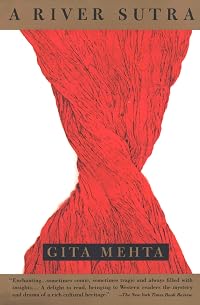
The book cover is a beautiful abstract art of a river, tribal life but nothing much can be explained about the story.
Plot:
The story is about a retired civil servant, a widower and a person who battles with extreme loneliness trying to understand the purpose of life. Being childless is also one of the reason to his idea of withdrawing from life. In order to beat the suffocating loneliness he decides to divert his attention to work again. He then applies to the manager post, for the guesthouse on the bank of river Narmada.
His new life starts with a different frequency. The protagonist here show more meets a varied list of different characters whose weird and strange experiences with memorable backgrounds makes the encounters interesting and surprising. A girl who falls in love with the kidnapper who abducted her, a womaniser who learns a life time lesson, a rich business man's son from UK decides to wave his spiritual path, the death of an aspiring musician who is visually challenged and many such different stories.
More than a straight novel, the books is a garland of various stories that are told under same roof. Every story had a message and the protagonist has some take away from these stories. The after journey of the protagonist with all these experiences is how the book ends. The author has beautifully illustrated the characters, their behaviour and the inner struggle everyone goes through.
Narration:
Gripping and very interesting style of narration can be observed. Kudos to the author.
Characters:
Every character is fantastically scripted and made responsible to draw the attention of the reader.
Language & Grammar:
Easy language and flawless vocabulary is used.
My Verdict:
An excellent one time read.
Book Title: 3/5
Book Cover: 3/5
Plot: 3/5
Narration: 3/5
Characters: 3/5
Language & Grammar: 3/5
Final Rating : 3/5 show less
Author: Gita Mehta
Genre: Fiction/Drama
Book Title:
The book title ' The River Sutra ' is very different and novel.
Book Cover:
The book cover is a beautiful abstract art of a river, tribal life but nothing much can be explained about the story.
Plot:
The story is about a retired civil servant, a widower and a person who battles with extreme loneliness trying to understand the purpose of life. Being childless is also one of the reason to his idea of withdrawing from life. In order to beat the suffocating loneliness he decides to divert his attention to work again. He then applies to the manager post, for the guesthouse on the bank of river Narmada.
His new life starts with a different frequency. The protagonist here show more meets a varied list of different characters whose weird and strange experiences with memorable backgrounds makes the encounters interesting and surprising. A girl who falls in love with the kidnapper who abducted her, a womaniser who learns a life time lesson, a rich business man's son from UK decides to wave his spiritual path, the death of an aspiring musician who is visually challenged and many such different stories.
More than a straight novel, the books is a garland of various stories that are told under same roof. Every story had a message and the protagonist has some take away from these stories. The after journey of the protagonist with all these experiences is how the book ends. The author has beautifully illustrated the characters, their behaviour and the inner struggle everyone goes through.
Narration:
Gripping and very interesting style of narration can be observed. Kudos to the author.
Characters:
Every character is fantastically scripted and made responsible to draw the attention of the reader.
Language & Grammar:
Easy language and flawless vocabulary is used.
My Verdict:
An excellent one time read.
Book Title: 3/5
Book Cover: 3/5
Plot: 3/5
Narration: 3/5
Characters: 3/5
Language & Grammar: 3/5
Final Rating : 3/5 show less
A series of tales set in India all centered on the Namada River. Not really short stories, but many of the chapter could stand on their own. Maybe its more like folktales? Didn't like it as much as I had hoped I would.
Members
- Recently Added By
Lists

500 Great Books by Women
507 works; 60 members
TML 200 Best Books 1950-1999
202 works; 10 members

A Novel Cure
742 works; 23 members

The Modern Library (The Two Hundred Best Novels....
202 works; 1 member
Author Information

13+ Works 1,593 Members
Awards and Honors
Work Relationships
Has as a student's study guide
Common Knowledge
- Original title
- A River Sutra
- Original publication date
- 1993
- Important places
- India; Narmada River (India)
- Epigraph
- Listen, O brother,
Man is the greatest truth.
Nothing beyond.
Love Songs of Chandidas - Dedication
- For Aditya
- First words
- The Government still pays my wages but I no longer think of myself as a bureaucrat.
- Quotations
- My father was expressing himself with such urgency I dared not interrupt him. “Do you know how that serene old monk hopes to die? Starving himself to death. He observes respect for life when all the time he is working towar... (show all)d the goal of denying his own life.”
He stared at me, waiting for my response, but I could not speak. His anguish had melted the numbness that froze my heart. I was overcome by compassion for him, for myself, for my concerned and curious wife, for the human helplessness that linked us all.
It was my first experience of ahimsa.
In his attempt to frighten me, my father had made me realize that to prevent suffering a man must be capable of suffering, that a man who cannot suffer is not alive.
My father could not understand why I needed to be with the monk more than ever and I could not explain, for the lesson of ahimsa must be learned by the heart, not the mind.
But I knew I could never return to the anesthesia of wealth that had for so long numbed me to the suffering that could make me human.
“There was no art until Shiva danced the Creation,” he said, explaining how melody was born. “Music lay asleep inside a motionless rhythm—deep as water, black as darkness, weightless as air. Then Shiva shook his drum.... (show all) Everything started to tremble with the longing to exist. The universe erupted into being as Shiva danced. The six mighty ragas, the pillars of all music, were born from the expressions on Shiva’s face, and through their vibrations the universe was brought into existence.
“The melodies of these six ragas sustain the harmonies of living things. When they fuse together they become the beat of Shiva’s drum that brings the universe to destruction. But they are all male. And music can never be still, it can never be without desire. Life must create more life or become death. So each of the six ragas was given six wives, six raginis to teach them love. Their children are the putras, and in this way music lives and multiplies.” - Last words
- (Click to show. Warning: May contain spoilers.)At the bend of the river the clay lamps were still flickering as the current carried them to the ocean.
- Original language
- English
Classifications
Statistics
- Members
- 633
- Popularity
- 45,986
- Reviews
- 9
- Rating
- (3.79)
- Languages
- 8 — Danish, Dutch, English, Finnish, French, German, Spanish, Swedish
- Media
- Paper, Audiobook, Ebook
- ISBNs
- 19
- ASINs
- 6