Raccoon's Last Race
by Joseph Bruchac, James Bruchac
On This Page
Description
Tells the story of how Raccoon, the fastest animal on earth, loses his speed because he is boastful and breaks his promises.Tags
Recommendations





Member Reviews
In this Abenaki story, Raccoon plays an arrogant trickster who races all the other animals and always wins thanks to his long legs and long body. When the other animals refuse to race Raccoon anymore, he challenges a large rock to a race down a mountain. The rock squashes Raccoon. Raccoon asks some ants to help stretch his body out again by promising them that he will be their friend. However, when Raccoon is almost stretched out, he brushes the ants off and taunts them. When he walks off, he realizes the ants weren't done! Raccoon is left with the squashy, short body that raccoons have today.
Trickster stories from any culture tend to be a favorite among children and adults, who love to see either the clever trickster outwitting an show more opponent or the arrogant trickster getting his comeuppance. This traditional folktale from the Abenaki (a Northwestern Native American tribe and First Nation) is a prime example of the latter type of trickster story. Raccoon is portrayed as mean and taunting to build up the story, and readers will delight when the rude Raccoon meets the consequences of his actions.
The prose is told in a traditional style, with some added sound effects that make it clear Raccoon's Last Race is meant to be told aloud, in the oral storytelling tradition. As the Raccoon races the other animals, the fox goes zip-zip! When Raccoon falls down the mountain and is squashed by the rock, readers are treated to the Ka-boom! Ka-boom! SPLAT! Ka-boom! as the rock travels down the mountain. When the rabbit ignores Raccoon's pleas at the end to help him, he goes ka-bunk, ka-bunk!
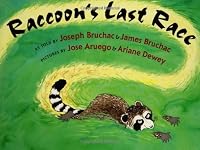
The illustrations are decent, though not exceptional in any way. The backgrounds are an impressionist blur of watercolor suggesting a field, or a sky, or a mountain on each page. The main characters and foreground objects are rendered in a sharp, crude style that is jarring when put against the softer backgrounds, and somehow robs the story of its dignity. When placed against the traditional storytelling style, the modern illustrations are jarring and discordant.
Additionally, some of the illustrations are unpleasant to look at: Raccoon's original body looks stretched and grotesque, and his expression is mean and scary. The rock is portrayed with sharp edges, and, inexplicably, sharp teeth in its mouth.
Though the story is fun and well-told, the illustrations detract from the story itself, leaving this a middling read. show less
Trickster stories from any culture tend to be a favorite among children and adults, who love to see either the clever trickster outwitting an show more opponent or the arrogant trickster getting his comeuppance. This traditional folktale from the Abenaki (a Northwestern Native American tribe and First Nation) is a prime example of the latter type of trickster story. Raccoon is portrayed as mean and taunting to build up the story, and readers will delight when the rude Raccoon meets the consequences of his actions.
The prose is told in a traditional style, with some added sound effects that make it clear Raccoon's Last Race is meant to be told aloud, in the oral storytelling tradition. As the Raccoon races the other animals, the fox goes zip-zip! When Raccoon falls down the mountain and is squashed by the rock, readers are treated to the Ka-boom! Ka-boom! SPLAT! Ka-boom! as the rock travels down the mountain. When the rabbit ignores Raccoon's pleas at the end to help him, he goes ka-bunk, ka-bunk!
The illustrations are decent, though not exceptional in any way. The backgrounds are an impressionist blur of watercolor suggesting a field, or a sky, or a mountain on each page. The main characters and foreground objects are rendered in a sharp, crude style that is jarring when put against the softer backgrounds, and somehow robs the story of its dignity. When placed against the traditional storytelling style, the modern illustrations are jarring and discordant.
Additionally, some of the illustrations are unpleasant to look at: Raccoon's original body looks stretched and grotesque, and his expression is mean and scary. The rock is portrayed with sharp edges, and, inexplicably, sharp teeth in its mouth.
Though the story is fun and well-told, the illustrations detract from the story itself, leaving this a middling read. show less
In this traditional Abenaki tale, Azban the raccoon learns too late that it is unwise to brag, or to break one's word. The fastest of all the animals, with a propensity to taunt his slower adversaries, Azban becomes so unpopular that the other animals will have nothing to do with him. When he is unwise enough to challenge a mountain-top rock to a race, the consequences are unexpected, and permanent...
Retold by the prolific Joseph Bruchac, together with his son, Raccoon's Last Race is a charming picture book that will appeal to folktale lovers everywhere. The illustrations by Jose Aruego and Ariane Dewey, whether pastel or gouache, add a sense of vitality to the story.
Retold by the prolific Joseph Bruchac, together with his son, Raccoon's Last Race is a charming picture book that will appeal to folktale lovers everywhere. The illustrations by Jose Aruego and Ariane Dewey, whether pastel or gouache, add a sense of vitality to the story.
This was an unfamiliar story with twists and turns I couldn't predict. I knew the lithe and speedy raccoon would change its form, but as a reader I was unsure how this would happen. What a nice change of pace!
This is a Native American trickster tail told with animals and a great big grandfather boulder. The pace of the story moves quickly, the animal qualities are wisely attributed. There is an explanation for the raccoon we recognize today and many messages about appreciating the little but strong, refraining from taunting, or even patiently waiting. With so many kernels of wisdom, any reader could find something to take from this story. Although older applications for the text such as creative writing could be considered, I thought show more younger children would enjoy the text and illustrations.
Trickster tales are often popular with audiences of a variety of ages and this one does not disappoint. The raccoon taunts friends, alienates itself, and eventually goes so far as to push an elderly boulder into a race it does not wish to compete in. As with other stories, there are consequences for the braggart of a raccoon. The animals placed in abstract backgrounds are often rudimentary and have simple lines and easily recognizable colors. This could help with an out-loud reading. As the reader read aloud the text, listeners eyes would be able to examine everything on the page before the reader turned the page.
I would be curious to read another version and examine the effect more detailed illustrations might have on the story or the characters. It's exciting to have a Native American tale from the Abenaki Indian culture. show less
This is a Native American trickster tail told with animals and a great big grandfather boulder. The pace of the story moves quickly, the animal qualities are wisely attributed. There is an explanation for the raccoon we recognize today and many messages about appreciating the little but strong, refraining from taunting, or even patiently waiting. With so many kernels of wisdom, any reader could find something to take from this story. Although older applications for the text such as creative writing could be considered, I thought show more younger children would enjoy the text and illustrations.
Trickster tales are often popular with audiences of a variety of ages and this one does not disappoint. The raccoon taunts friends, alienates itself, and eventually goes so far as to push an elderly boulder into a race it does not wish to compete in. As with other stories, there are consequences for the braggart of a raccoon. The animals placed in abstract backgrounds are often rudimentary and have simple lines and easily recognizable colors. This could help with an out-loud reading. As the reader read aloud the text, listeners eyes would be able to examine everything on the page before the reader turned the page.
I would be curious to read another version and examine the effect more detailed illustrations might have on the story or the characters. It's exciting to have a Native American tale from the Abenaki Indian culture. show less
I really liked the story; it was about a mischievous Raccoon who was blessed with speed and agility. However, instead of using his talents and abilities for doing good, he used them to trick and mistreat others, which eventually led to his misfortune and the loss of his extraordinary abilities. The story’s moral is that what goes around comes around. Although the theme and moral of the story is a common lesson taught across many cultures, what made Raccon’s Last Race different is its Native American Abenaki twist. In my opinion, the story’s emphasis on the Raccoon’s physical and behavioral characteristics was one of the story’s elements that highlighted the Abenaki cultural and mythology about animal behavior and evolution. I show more particularly like how the story carried a mythological explanation that attributed the modern Raccoon’s awkward physical characteristics to its mischievous behavior. From the story telling perspective I believe the story teller stayed true to his culture. However, I think the illustration in the book slightly deviated from the story’s cultural background in order to conform to Western cultures more. Although the illustrations were bright, supportive to the story and greatly added and extended to the story, they did not reflect the culture they represented.
In brief, I found the story to be very interesting, well written an illustrated. The moral story it carries and its cultural twisted distinguished it from other stories that carries the same moral message and added to its appeal to young readers. show less
In brief, I found the story to be very interesting, well written an illustrated. The moral story it carries and its cultural twisted distinguished it from other stories that carries the same moral message and added to its appeal to young readers. show less
Legend has it that raccoons have not always been the cute chubby creatures that we know today. In this Native American tale, we see a story as to why raccoons got their short stature. Long ago there was a raccoon named Azban. He was the fastest animal in all the land, he had long legs and a extremely long body. He raced every animal he could find and always won. Azban was not the least bit humble and loved to brag about how fast he was. The other animals stopped associating with him because he was just so mean. When Azban found himself in a bind, no one would help him. Azban was stuck with no way out. No animals but an ant were willing to him. With teamwork and dedication the colony of ants were able to pick Azban up and save him with show more the promise that they would be friends forever. The only downside to being saved was that raccoons were never the same again. Azban lost his long legs and speed but gained a true friendship. This book had so many lessons to be learned. Friendship is a powerful and selfless. Even though Azban thought he was better than everyone, his new found friendship proved even the smallest and powerless creature can be something bigger than himself. No matter how fast, smart, pretty, and better at something you are, always be nice and humble, you never know when the abilities that make you stand out from the rest will be taken away. This story reminded me of the "Tortoise and a the Hare." The fastest do not always come out as winners. I enjoyed this story, the style of this story was energetic and humorous with a great theme that kids will love. show less
Bruchac, J. & Bruchac, J. (2004). Raccoon’s last race. New York, NY: Dial Books for Young Readers.
This Native American folktale is about a trickster: the raccoon. Long ago, Abzan the Raccoon was one of the fastest animals. However, he was extremely arrogant and competitive. He believed that no one could outrun him. One day, Abzan decides to challenge Big Rock (Grandfather). Abzan pushes Big Rock down a hill. As the rock tumbles down a steep hill, it begins to pick up speed. At first, Abzan flew past the rock. But as he turns around to taunt Big Rock, he trips. Big Rock then smashes him. Eventually, ants put a flattened Abzan back to into shape, but he never looks the same again.
According to the authors, in Abenaki, the word show more “azebansoo” means “to act like a raccoon” or “to play a trick.” The motif in this story is that being a trickster causes misfortune. As a trickster tries to deceive everyone, he ultimately becomes a victim of his own actions. The point of the story is to be careful in what you do.
Although this story warns about the downfall of arrogance, the illustrations are lively and fun. Readers will notice the difference in the length of Abzan’s legs in the beginning of the story and at the end of the story. show less
This Native American folktale is about a trickster: the raccoon. Long ago, Abzan the Raccoon was one of the fastest animals. However, he was extremely arrogant and competitive. He believed that no one could outrun him. One day, Abzan decides to challenge Big Rock (Grandfather). Abzan pushes Big Rock down a hill. As the rock tumbles down a steep hill, it begins to pick up speed. At first, Abzan flew past the rock. But as he turns around to taunt Big Rock, he trips. Big Rock then smashes him. Eventually, ants put a flattened Abzan back to into shape, but he never looks the same again.
According to the authors, in Abenaki, the word show more “azebansoo” means “to act like a raccoon” or “to play a trick.” The motif in this story is that being a trickster causes misfortune. As a trickster tries to deceive everyone, he ultimately becomes a victim of his own actions. The point of the story is to be careful in what you do.
Although this story warns about the downfall of arrogance, the illustrations are lively and fun. Readers will notice the difference in the length of Abzan’s legs in the beginning of the story and at the end of the story. show less
Not only does this book retell a classic Native American folktale, but it is also a great read aloud! The reader can perform the voice of Azban the Raccoon as he taunts the other animals and ask children leading questions about the plot direction or illustrations. A good starting point may be asking children why Raccoon in the book looks different than racoons today. The author's note at the beginning gives this tale authenticity in retelling this story. Apart from use in storytimes, this book can generate discussion about animal origin stories and other similar folktales.
Members
- Recently Added By
Author Information

196+ Works 28,745 Members
Joseph Bruchac, author of more than seventy books for children and adults, is also an acclaimed storyteller and poet. He has received many prestigious literary awards, including the American Book Award, the PEN Syndicated Fiction Award, and the Lifetime Achievement Award from the Native Writers' Circle of The Americas
7+ Works 1,255 Members
All Editions
Common Knowledge
- Original title
- Raccoon's Last Race: A Traditional Abenaki Story
- Original publication date
- 2004
- People/Characters
- Abzan the Raccoon; Big Rock (Grandfather); Ants
- Dedication
- To Wolfsong and his children.
- First words
- Long ago, Raccoon did not look the way he does today.
- Quotations
- Perhaps I can play a trick on that one. Perhaps I can challenge him to a race.
But having broken his promise, he knew that the ants would never agree to finish the job. - Last words
- (Click to show. Warning: May contain spoilers.)And he is certainly not a fast runner.
Classifications
Statistics
- Members
- 86
- Popularity
- 369,899
- Reviews
- 16
- Rating
- (3.71)
- Languages
- English, French
- Media
- Paper
- ISBNs
- 2