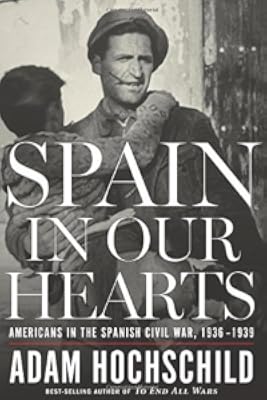
Spain in Our Hearts: Americans in the Spanish Civil War, 1936–1939
by Adam Hochschild
On This Page
Description
From the acclaimed, best-selling author Adam Hochschild, a sweeping history of the Spanish Civil War, told through a dozen characters, including Ernest Hemingway and George Orwell: a tale of idealism, heartbreaking suffering, and a noble cause that failedFor three crucial years in the 1930s, the Spanish Civil War dominated headlines in America and around the world, as volunteers flooded to Spain to help its democratic government fight off a fascist uprising led by Francisco Franco and aided show more by Hitler and Mussolini. Today we're accustomed to remembering the war through Hemingway's For Whom the Bell Tolls and Robert Capa's photographs. But Adam Hochschild has discovered some less familiar yet far more compelling characters who reveal the full tragedy and importance of the war: a fiery nineteen-year-old Kentucky woman who went to wartime Spain on her honeymoon, a Swarthmore College senior who was the first American casualty in the battle for Madrid, a pair of fiercely partisan, rivalrous New York Times reporters who covered the war from opposites sides, and a swashbuckling Texas oilman with Nazi sympathies who sold Franco almost all his oil — at reduced prices, and on credit.
It was in many ways the opening battle of World War II, and we still have much to learn from it. Spain in Our Hearts is Adam Hochschild at his very best.
. show less
Tags
Recommendations









Member Reviews
At the end of the book in the chapter title "Kaddish," a niece of one of the fallen volunteers of the International Brigade visits the area where her uncle was last seen:
"...somehow I managed to say kaddish for this son, brother, uncle. All this brought up enormous emotion. It hardly seemed just my own, or my family's. It felt part of a universal sorrow for the human struggle that played out in Spain during those dark days that were just the beginning of the trauma and tragedy that overcame all of Europe and throughout the world..."
This book is the story of the American men and women who volunteered in the Spanish Civil War. Hochschild did a tremendous amount of research for this book, bringing alive these people through their letters show more and diaries. He also draws on the reporters and writers who were there; and we learn about the inspiration for [For Whom the Bell Tolls]. The use of letters and diaries really bring the people to life.
He also does a great job of putting the struggle in context. He addresses questions of whether WWII would have occurred if the Allies had helped the Republic and whether the Republic would have become a satellite of the Soviet Union. We all know how it ends, yet as I finished this book, I had tears in my eyes, saddened that the idealism of the men and women who volunteered was not supported or honored during their lives. It's also sad to see that many things don't change; governments are still run by expediency rather than by morality. Franklin Roosevelt, whom I admire, knew it was right to support the Republic, but didn't want to lose voters. Media didn't tell the whole story, and corporations - Texaco here -- made a lot of money off the suffering of others. So, this story is relevant.
This is the best kind of narrative nonfiction. And there are plenty of helpful maps and pictures. Wonderful, wonderful book. show less
"...somehow I managed to say kaddish for this son, brother, uncle. All this brought up enormous emotion. It hardly seemed just my own, or my family's. It felt part of a universal sorrow for the human struggle that played out in Spain during those dark days that were just the beginning of the trauma and tragedy that overcame all of Europe and throughout the world..."
This book is the story of the American men and women who volunteered in the Spanish Civil War. Hochschild did a tremendous amount of research for this book, bringing alive these people through their letters show more and diaries. He also draws on the reporters and writers who were there; and we learn about the inspiration for [For Whom the Bell Tolls]. The use of letters and diaries really bring the people to life.
He also does a great job of putting the struggle in context. He addresses questions of whether WWII would have occurred if the Allies had helped the Republic and whether the Republic would have become a satellite of the Soviet Union. We all know how it ends, yet as I finished this book, I had tears in my eyes, saddened that the idealism of the men and women who volunteered was not supported or honored during their lives. It's also sad to see that many things don't change; governments are still run by expediency rather than by morality. Franklin Roosevelt, whom I admire, knew it was right to support the Republic, but didn't want to lose voters. Media didn't tell the whole story, and corporations - Texaco here -- made a lot of money off the suffering of others. So, this story is relevant.
This is the best kind of narrative nonfiction. And there are plenty of helpful maps and pictures. Wonderful, wonderful book. show less
Best known today as that war Hemingway wrote about in [For Whom the Bell Tolls], the Spanish Civil War was conscientiously ignored by much of the world. For many who do know of it, it's seen as a minor prelude to World War II. It was more than that, as Adam Hochschild explains in [Spain in Our Hearts]. For Germany and Italy, and to a lesser extent the USSR, it was a testing and training exercise for war to come. For Britain, France, and the US, it was a blown opportunity. For the Spanish, it was a catastrophe, of course; by 1939, the war was over and 36 years of vicious totalitarian rule was beginning.
As 1936 began, Spain was effectively a feudal society. Wealthy industrialists, landowners with holdings sometimes exceeding 75,000 show more acres, and the Catholic Church were the country's powers. But elections in February unexpectedly turned the government over to the Popular Front, a coalition of liberal, socialist, and communist parties. Less than 6 months later, martial law was declared in Melilla, a city of Spanish Morocco, by the Spanish Foreign Legion. According to Hochschild, the "key plotter" was General Francisco Franco. "Ambitious and puritanical, an architect of the elite Spanish Foreign Legion, he was driven by a fierce belief that he was destined to save Spain from a deadly conspiracy of Bolsheviks, Freemasons, and Jews (no matter that King Ferdinand and Queen Isabella had expelled the latter from their realm in 1492, during the Inquisition, and that few had ever returned)."
The leftist government fought to defend the election results, to defend its reforms, to hold on to power. While it had a military, its military leaders —well, former leaders— were leading the revolt. Thus the Republican defense was conducted by Spanish loyalists (anarchists, socialists, and communists of various stripes) and by a hodge-podge of volunteers from the US, Britain, France, the USSR, and other countries, all of whom had leftist sympathies. Hochschild reports that some Americans were true believers who'd moved to the Soviet, became disillusioned, and left to share in the defense of Spain. Most found disorganization, persistent bickering over ideologies, and unqualified officers. Guns and ammo were in very short supply, and this because, as the author writes, "the embattled Republican government faced an extraordinary paradox. The only major nation willing to sell it arms and ammunition was not another democracy. It was Joseph Stalin's Soviet Union." He continues:
Citing an overriding focus on the Great Depression, FDR kept the US government from getting involved. As the war continued, and as he was besieged by anti-Franco partisans, FDR hid behind the threat that the Catholic vote would turn him out of office. Hochschild notes that "[w]hen running for reelection in 1936, FDR was believed to have quietly promised the American Catholic leadership that he would not take sides in Spain." Blaming the Catholics was convenient, he adds, "because the liberals pressing the president to sell arms to the Republic were willing to believe anything ill of the Catholic Church, as were Roosevelt's fellow upper-class WASPs. 'Dammit... if I lift the embargo,' FDR said to one person who came to lobby him for the Republic, 'the Catholics will crucify me!' "
The shocking aspect, to me, was that quite a number of America's big international businesses sided with Franco. Texaco in particular supplied all of Franco petroleum needs ON CREDIT. "By US law," Hochschild writes, "the export of 'arms, ammunition, and implements of war' to other countries at war was prohibited. Early in 1937, a congressional resolution made clear that any weapons destined for 'the unfortunate civil strife in Spain' were included in the ban." Texaco skirted the ban by double-manifesting oil shipments on its tankers. They'd leave port in the US with a shipment ostensibly going to some non-warring destination, then unseal the manifest for the true destination once the tanker was in international waters.
In addition, Texaco, through its European sales apparatus, collected information on shipping by rivals and forwarded details to the Nationalists (Franco's forces). Ford and GM, with manufacturing plants in Europe, supplied vehicles to Franco, but not to the legitimate government. Firestone supplied tires. Repercussions for these businesses were nil.
As the war spread across Spain, the ultimate defeat of the legitimate government was foretold by the Fascist forces behind Franco: Germany and Italy. Hochschild:
Hitler especially reaped great rewards for his assistance.
In the end, the Nationalists crushed the Republicans. Texaco, GM, Ford, and other American companies got paid. The German Luftwaffe used its experience in crushing Poland, in overwhelming the Netherlands, Belgium, France, and in besieging Britain. Hundreds of thousands of Spaniards were killed in the aftermath, and the nation was plunged back into feudalism until Franco's death in the 1970s.
Spain in Our Hearts is an excellent history, thorough and footnoted. We learn about the Internationals in the trenches, the horrible conditions under which medical treatment was provided, the efforts of news correspondents to get the story run in their newspapers. Hemingway turns up, of course, and not always in complimentary terms. George Orwell's experiences and his reports of them are covered. A vexing, frustrating story. I give it both thumbs up! show less
As 1936 began, Spain was effectively a feudal society. Wealthy industrialists, landowners with holdings sometimes exceeding 75,000 show more acres, and the Catholic Church were the country's powers. But elections in February unexpectedly turned the government over to the Popular Front, a coalition of liberal, socialist, and communist parties. Less than 6 months later, martial law was declared in Melilla, a city of Spanish Morocco, by the Spanish Foreign Legion. According to Hochschild, the "key plotter" was General Francisco Franco. "Ambitious and puritanical, an architect of the elite Spanish Foreign Legion, he was driven by a fierce belief that he was destined to save Spain from a deadly conspiracy of Bolsheviks, Freemasons, and Jews (no matter that King Ferdinand and Queen Isabella had expelled the latter from their realm in 1492, during the Inquisition, and that few had ever returned)."
The leftist government fought to defend the election results, to defend its reforms, to hold on to power. While it had a military, its military leaders —well, former leaders— were leading the revolt. Thus the Republican defense was conducted by Spanish loyalists (anarchists, socialists, and communists of various stripes) and by a hodge-podge of volunteers from the US, Britain, France, the USSR, and other countries, all of whom had leftist sympathies. Hochschild reports that some Americans were true believers who'd moved to the Soviet, became disillusioned, and left to share in the defense of Spain. Most found disorganization, persistent bickering over ideologies, and unqualified officers. Guns and ammo were in very short supply, and this because, as the author writes, "the embattled Republican government faced an extraordinary paradox. The only major nation willing to sell it arms and ammunition was not another democracy. It was Joseph Stalin's Soviet Union." He continues:
...Stalin waited in vain for Britain or France to provide weapons to the Republic...Several months after the coup, he finally dispatched the first shiploads of Soviet arms to Spain...
By autumn the Soviet Union was not just quietly selling the Republic arms, but also sending military advisors, pilots, and tank crews. Eager to make use of the tremendous sympathy for the Republic among leftists throughout the world, the Communist International, or Comintern, through which Stalin controlled Communist parties in other countries, passed the word to begin recruiting special brigades of volunteers to help fight Franco.
Citing an overriding focus on the Great Depression, FDR kept the US government from getting involved. As the war continued, and as he was besieged by anti-Franco partisans, FDR hid behind the threat that the Catholic vote would turn him out of office. Hochschild notes that "[w]hen running for reelection in 1936, FDR was believed to have quietly promised the American Catholic leadership that he would not take sides in Spain." Blaming the Catholics was convenient, he adds, "because the liberals pressing the president to sell arms to the Republic were willing to believe anything ill of the Catholic Church, as were Roosevelt's fellow upper-class WASPs. 'Dammit... if I lift the embargo,' FDR said to one person who came to lobby him for the Republic, 'the Catholics will crucify me!' "
The shocking aspect, to me, was that quite a number of America's big international businesses sided with Franco. Texaco in particular supplied all of Franco petroleum needs ON CREDIT. "By US law," Hochschild writes, "the export of 'arms, ammunition, and implements of war' to other countries at war was prohibited. Early in 1937, a congressional resolution made clear that any weapons destined for 'the unfortunate civil strife in Spain' were included in the ban." Texaco skirted the ban by double-manifesting oil shipments on its tankers. They'd leave port in the US with a shipment ostensibly going to some non-warring destination, then unseal the manifest for the true destination once the tanker was in international waters.
In addition, Texaco, through its European sales apparatus, collected information on shipping by rivals and forwarded details to the Nationalists (Franco's forces). Ford and GM, with manufacturing plants in Europe, supplied vehicles to Franco, but not to the legitimate government. Firestone supplied tires. Repercussions for these businesses were nil.
As the war spread across Spain, the ultimate defeat of the legitimate government was foretold by the Fascist forces behind Franco: Germany and Italy. Hochschild:
Over the course of the war Germany alone would send Franco antiaircraft batteries that helped cripple the Republican air force, the newest field artillery, some 200 tanks, and more than 600 military aircraft. Most equipment was of the latest models, since the Wehrmacht was eager to try them out in battle. Altogether, some 19,000 German troops, aviators, instructors, and advisors would see action in Spain or take part in training thousands of Nationalist officers and NCOs….
emsp;Mussolini's airplanes were less advanced, but he would send the Nationalists 762 of them by the war's end, as well as 1,801 artillery pieces, at least 149 tanks, 223,784 rifles, 3,436 machine guns, and large quantities of bombs and ammunition. Nearly 80,000 Italian troops would eventually fight for Franco.
Hitler especially reaped great rewards for his assistance.
For him Nationalist Spain was also a crucial source of raw materials. He demanded payment for his aid in copper, in iron ore, which Germany was acutely short of, and in pyrites, which yield sulfur and other minerals. These were supplies he wanted for building up his armed forces…
The greatest aid Spain provided the Nazis, however... [was] the wealth of experience that German aviators and other military men gained in nearly three years of the civil war. Twenty-seven different models of Nazi aircraft were tested in Spanish skies. As air force chief Hermann Goring later put it when on trial at Nuremberg, the Spanish war was an opportunity "to test my young Luftwaffe. ... In order that the personnel, too, might gather a certain amount of experience, I saw to it that... new people were constantly being sent and others recalled.
In the end, the Nationalists crushed the Republicans. Texaco, GM, Ford, and other American companies got paid. The German Luftwaffe used its experience in crushing Poland, in overwhelming the Netherlands, Belgium, France, and in besieging Britain. Hundreds of thousands of Spaniards were killed in the aftermath, and the nation was plunged back into feudalism until Franco's death in the 1970s.
Spain in Our Hearts is an excellent history, thorough and footnoted. We learn about the Internationals in the trenches, the horrible conditions under which medical treatment was provided, the efforts of news correspondents to get the story run in their newspapers. Hemingway turns up, of course, and not always in complimentary terms. George Orwell's experiences and his reports of them are covered. A vexing, frustrating story. I give it both thumbs up! show less
After King Leopold's Ghost, I'm willing to give anything by Hochschild a spin. Spain in Our Hearts is not quite worth it. The Spanish Civil War, and in particular the involvement of the International Brigades, is a subject where the moral issues seem to overwhelm historical objectivity. This was the first fight against fascism! And yet the Republicans were abandoned by the Western Democracies. The USSR was the Republic's most reliable supporter, and Stalinist commissars held key positions, enacting their own purges against Republican fighters deemed insufficiently loyal to the party line. The war was gloriously fought, gloriously doomed, and gloriously recorded by Frank Capa and Ernest Hemingway.
Hochschild knew several veterans of the show more Lincoln Brigades as a young reporter in San Francisco, and a kind of sappy nostalgia suffuses the whole book. When General Franco and a handful of officers attempted a coup in 1936, they captured roughly a third of the Republic. But Franco got key strategic support, high-tech airplanes and tanks from Nazi Germany, thousands of soldiers from Fascist Italy, and oil on credit from Texaco.
The Republic got the sweepings of international leftists, men with ideals but little training or discipline. The Republic's gold reserves were sent to Russia, where they were spent by Stalin on Soviet arms for the Republic, starting with the dregs of Tsarist arms warehouses. Other equipment was blockaded by France or sunk at sea by Nationalist submarines. The International Brigades fought like shock troops, suffering three times the casualty rate of Republican Spanish units, but they were forced back repeatedly, as Franco's arms isolated and blockaded various regions, before finally crushing the Republic. Deemed 'premature anti-fascists' by the House Unamerican Activities Committee, veterans faced lifelong suspicion.
Hoschchild blends together recently published diaries from soldiers, but most readers would be better served by either the primary sources, Hemingway's novel For Whom the Bell Tolls, or from a military history angle, possible Beevor's The Battle for Spain show less
Hochschild knew several veterans of the show more Lincoln Brigades as a young reporter in San Francisco, and a kind of sappy nostalgia suffuses the whole book. When General Franco and a handful of officers attempted a coup in 1936, they captured roughly a third of the Republic. But Franco got key strategic support, high-tech airplanes and tanks from Nazi Germany, thousands of soldiers from Fascist Italy, and oil on credit from Texaco.
The Republic got the sweepings of international leftists, men with ideals but little training or discipline. The Republic's gold reserves were sent to Russia, where they were spent by Stalin on Soviet arms for the Republic, starting with the dregs of Tsarist arms warehouses. Other equipment was blockaded by France or sunk at sea by Nationalist submarines. The International Brigades fought like shock troops, suffering three times the casualty rate of Republican Spanish units, but they were forced back repeatedly, as Franco's arms isolated and blockaded various regions, before finally crushing the Republic. Deemed 'premature anti-fascists' by the House Unamerican Activities Committee, veterans faced lifelong suspicion.
Hoschchild blends together recently published diaries from soldiers, but most readers would be better served by either the primary sources, Hemingway's novel For Whom the Bell Tolls, or from a military history angle, possible Beevor's The Battle for Spain show less
This is the kind of history I like reading: told from the perspectives of (extra)ordinary people—in this case, Americans, whether volunteer soldiers, nurses, or reporters—as seen in their letters, dispatches, and journals. But in this case it felt lacking; I wanted both a grand, historical sweep and the ordinary Spaniard’s POV, whether Republican or Nationalist. Nonetheless, it’s a vivid recounting of the Spanish Civil War But one can’t call this an outsider’s perspective, because the people Hochschild features in his book were in the trenches themselves; the courageous volunteers of the International Brigades were ready to fight against fascism at all costs.
In general, an overview of the course of the Spanish Civil War, with an emphasis on the American volunteers who fought for the leftist Spanish Republic. The author is clearly writing from a point of view that is sympathetic to the left (he talks about "social justice" in his introduction), though to his credit he does not shirk from noting what Stalin was doing in Spain through his intermediaries. A running theme is the perfidy of Texaco (which sold oil on credit to Franco, and engaged in dubious intelligence practices) and the Catholic Church. Luckily, the progressive point of view isn't oppressive, and you can enjoy the book on its merits. Recommended.
This is an outstanding history of the Spanish Civil War. Hochschild weaves the stories of volunteers, reporters and others in a way the personalizes the conflict and brings it home. I was unaware of the role that Texaco oil and its CEO played in Franco's victory. This book was an eye-opener on many fronts!
I first got interested in George Orwell when I read his "Homage to Catalonia", a book I have returned to many times. I always wondered about the other international volunteers who went to Spain to fight for the Republic. Adam Hochschild's meticulous research has satisfied a good deal of that curiosity. Hochschild sets the stage with a brief summary of events that lead to the revolt soon led by Franco, and adds context with depictions of the interest and aid offered to each side by the Soviet Union, Italy and Germany. He also uses first person narratives to take readers into the trenches and battles, as well as into the hospitals, of the Republican side. After finishing the book, I understood much better the history of the Spanish Civil show more War and the place it held, maybe still holds, in the hearts of my parents' generation. show less
Members
- Recently Added By
Published Reviews
ThingScore 100
"Hochschild narrates such tales with prose that is consistently vivid yet emotionally restrained. His main contribution is to retell a familiar story with a focus on Americans and an unromantic assessment of why the “good guys” lost, so that he adroitly evokes the commitments of Americans on both sides while eschewing any retrospective cheerleading for the Republic."
added by theaelizabet
"Hochschild is an exceptional writer; his narrative is well-paced, delivered in clear prose, and focused on important and colorful details of the historical moment. Volunteers from around the world....saw the Republican cause as a last-ditch effort to stop fascism before it spread across Europe, and Hochschild tells their story beautifully."
added by theaelizabet
Lists

Global Reads: Books Set in Western Europe
186 works; 10 members

Western & Northern Europe
60 works; 1 member

THE WAR ROOM
813 works; 24 members
Author Information

16+ Works 9,744 Members
Adam Hochschild was born in New York City in 1942. As a college student, he spent a summer working on an anti-government newspaper in South Africa and worked briefly as a civil rights worker in Mississippi in 1964. He began his journalism career as a reporter at the San Francisco Chronicle. Then he worked for ten years as a magazine editor and show more writer, at Ramparts and Mother Jones, which he co-founded. He has also written for The New Yorker, Harper's Magazine, The New York Review of Books, The New York Times Magazine, and The Nation. His first book, Half the Way Home: A Memoir of Father and Son, was published in 1986. His other books include The Mirror at Midnight: A South African Journey; The Unquiet Ghost: Russians Remember Stalin; Finding the Trapdoor: Essays, Portraits, Travels; King Leopold's Ghost: A Story of Greed, Terror, and Heroism in Colonial Africa; Bury the Chains: Prophets and Rebels in the Fight to Free an Empire's Slaves; and To End All Wars: A Story of Loyalty and Rebellion, 1914-1918. He teaches writing at the Graduate School of Journalism at the University of California, Berkeley. (Bowker Author Biography) show less
Awards and Honors
Awards
Distinctions
Notable Lists
Common Knowledge
- Canonical title
- Spain in Our Hearts: Americans in the Spanish Civil War, 1936–1939
- Alternate titles
- Spain in Our Hearts
- Original publication date
- 2016
- People/Characters
- Ernest Hemingway; George Orwell; Francisco Franco; Benito Mussolini; John Gates; George Watts (show all 8); Herbert L. Matthews; Robert Merriman
- Important places
- Madrid, Spain
- Important events
- Spanish Civil War
- Original language
- English US
Classifications
- Genres
- History, Nonfiction, General Nonfiction
- DDC/MDS
- 946.081 — History & geography History of Europe Spain & Portugal Spain Second Republic; Dictatorship; Juan Carlos I; Felipe VI 1931- Second Republic; Spanish Civil War
- LCC
- DP269.47 .A46 .H63 — History of Europe, Asia, Africa and Oceania Spain – Portugal History of Spain
- BISAC
Statistics
- Members
- 569
- Popularity
- 51,870
- Reviews
- 19
- Rating
- (4.10)
- Languages
- Chinese, English, Spanish
- Media
- Paper, Audiobook, Ebook
- ISBNs
- 14
- ASINs
- 4