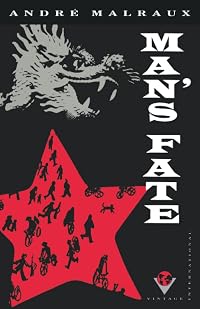
Man's Fate
by André Malraux
On This Page
Description
As explosive and immediate today as when it was originally published in 1933, Man's Fate (La Condition Humaine), an account of a crucial episode in the early days of the Chinese Revolution, foreshadows the contemporary world and brings to life the profound meaning of the revolutionary impulse for the individuals involved. As a study of conspiracy and conspirators, of men caught in the desperate clash of ideologies, betrayal, expediency, and free will, Andre Malraux's novel remains unequaled.Tags
Recommendations














Member Recommendations

Member Reviews
What a tale of jihad and lust during a civil war. If that appears reductive, there is a touch more shadow and verse at play in this gripping and frenetic novel of Shanghai in 1927.
Equally dogmatic and dour, Man's Fate is episodic in terms of narrative and ensemble. There is gore and grief and considerable historical certainty at what the Future holds----even as the vanquished are tortured and often burned alive. Elements are included of miscegenation and misogyny. These simply enhance the noir. There's plenty of silence, muttering and plaintive smoking. There's a suicide bomber and a confidence man straight out of Melville.
Equally dogmatic and dour, Man's Fate is episodic in terms of narrative and ensemble. There is gore and grief and considerable historical certainty at what the Future holds----even as the vanquished are tortured and often burned alive. Elements are included of miscegenation and misogyny. These simply enhance the noir. There's plenty of silence, muttering and plaintive smoking. There's a suicide bomber and a confidence man straight out of Melville.
Early in Man’s Fate, before the armed uprising in Shanghai that proved a key conflict in China’s early 20th century history, André Malraux describes an interesting way his Chinese revolutionaries transmit secret messages.
Two vinyl recordings labeled as language-teaching records are played, each starting at the same instant. The first record hisses so one can’t hear the words on the second record. At select moments the hissing briefly stops, a quiet interval just long enough so that a single word from the second record is heard. Then the hissing resumes until it stops again to allow a second word to be heard. The hissing/quiet/hissing/quiet continues until, by the time both records reach their ends, all words of the message have show more been revealed. Plus, the two records are always shipped separately to ensure security of the message.
Vinyl Encryption! Nice. Effective for 1920s rebels and not a bad name for a band. It’s even possible to see it as a symbol for how essential coordination and communication are to success, which becomes terribly evident as the revolt goes on.
In this novel Malraux gives the impression he would rather be thought to have a highly original intelligence, or a great capacity for the profound, than anything else praiseworthy. The risk of appearing ordinary in the extraordinary scenes he has composed seems to me slight but, just in case, his characters often express thoughts more apt to arrest and distract the reader than immerse him in the story. In this he does those characters, notably the Gisors, no favors. This heightened desire for originality reminds me of the similarly surnamed Norman Mailer who often seemed to be striving to find ideas that would make people want to talk to him at parties. Malraux emerged into fame from 1920s Paris, a competitive scene for the creatively gifted where one could not, I imagine, not value any effort that might make a memorable impression.
In contrast, Malraux does well with how he makes us aware of conditions provoking the general strike that occurred just before the uprising, simply reporting the slogans expressing demands on banners hung about Shanghai: “A twelve-hour working day,” “No more employment of children under eight,” “Right to sit down for women-workers.” No explanation needed. No wonder the protests and revolt.
I’ve read complaints about Haakon Chevalier’s translation of La Condition Humaine, voiced mostly by readers who acknowledge not knowing French. When one doesn’t know the original language, how is it decided that the translator, not the author, is at fault? One way would be to compare Chevalier’s version to Alistair MacDonald’s, titled A Storm in Shanghai, a title not boding well for McDonald’s effort. Let’s give Haakon some credit. Man’s Fate is a way better title than MacDonald‘s invention. As for the immediately obvious The Human Condition, that strikes me as a literalism that could hardly be duller or more vague. If we have to choose between pretentious titles then at least let us choose the most portentous.
But, well, that’s just, like, my opinion, man.
My other opinion is that this is a dramatic story Malraux has told, with the playing out of the revolution having the qualities of suspense, excitement, and surprise that I like such a story to have. And despite what can seem excessive devotion to profundity and portent in Malraux’s telling, he often enough hits on just the right tone and mood to make his story have an impact it could not otherwise have. He is even, at times, original and possibly profound.
For a more conventional but also good novel set during the Chinese revolution of the 1920s, try The Sand Pebbles by Richard McKenna. show less
Two vinyl recordings labeled as language-teaching records are played, each starting at the same instant. The first record hisses so one can’t hear the words on the second record. At select moments the hissing briefly stops, a quiet interval just long enough so that a single word from the second record is heard. Then the hissing resumes until it stops again to allow a second word to be heard. The hissing/quiet/hissing/quiet continues until, by the time both records reach their ends, all words of the message have show more been revealed. Plus, the two records are always shipped separately to ensure security of the message.
Vinyl Encryption! Nice. Effective for 1920s rebels and not a bad name for a band. It’s even possible to see it as a symbol for how essential coordination and communication are to success, which becomes terribly evident as the revolt goes on.
In this novel Malraux gives the impression he would rather be thought to have a highly original intelligence, or a great capacity for the profound, than anything else praiseworthy. The risk of appearing ordinary in the extraordinary scenes he has composed seems to me slight but, just in case, his characters often express thoughts more apt to arrest and distract the reader than immerse him in the story. In this he does those characters, notably the Gisors, no favors. This heightened desire for originality reminds me of the similarly surnamed Norman Mailer who often seemed to be striving to find ideas that would make people want to talk to him at parties. Malraux emerged into fame from 1920s Paris, a competitive scene for the creatively gifted where one could not, I imagine, not value any effort that might make a memorable impression.
In contrast, Malraux does well with how he makes us aware of conditions provoking the general strike that occurred just before the uprising, simply reporting the slogans expressing demands on banners hung about Shanghai: “A twelve-hour working day,” “No more employment of children under eight,” “Right to sit down for women-workers.” No explanation needed. No wonder the protests and revolt.
I’ve read complaints about Haakon Chevalier’s translation of La Condition Humaine, voiced mostly by readers who acknowledge not knowing French. When one doesn’t know the original language, how is it decided that the translator, not the author, is at fault? One way would be to compare Chevalier’s version to Alistair MacDonald’s, titled A Storm in Shanghai, a title not boding well for McDonald’s effort. Let’s give Haakon some credit. Man’s Fate is a way better title than MacDonald‘s invention. As for the immediately obvious The Human Condition, that strikes me as a literalism that could hardly be duller or more vague. If we have to choose between pretentious titles then at least let us choose the most portentous.
But, well, that’s just, like, my opinion, man.
My other opinion is that this is a dramatic story Malraux has told, with the playing out of the revolution having the qualities of suspense, excitement, and surprise that I like such a story to have. And despite what can seem excessive devotion to profundity and portent in Malraux’s telling, he often enough hits on just the right tone and mood to make his story have an impact it could not otherwise have. He is even, at times, original and possibly profound.
For a more conventional but also good novel set during the Chinese revolution of the 1920s, try The Sand Pebbles by Richard McKenna. show less
Outre l'irréductible échéance liée à la mort, outre les multiples et indicibles souffrances, n'est-il pas donné à tous de choisir son destin ? Certes la vie est tragique mais elle doit avoir un sens. Un sens, peut-être des sens, mais seuls quelques-uns aux vertus salvatrices s'offrent aux hommes pour les affranchir de leur condition. La Révolution, au nom d'une foi en la fraternité, est une arme tournée contre la misère, celle qui enchaîne l'homme parce qu'elle le prive de sa dignité. Vaincre l'humiliation en leur nom propre ou pour les autres par le biais de la Révolution, voici le combat que se sont choisis les héros de La Condition humaine. Pour échapper à l'angoisse de 'n'être qu'un homme', l'amour est un autre de show more ces moyens, mais seul l'amour véritable et fusionnel qu'éprouvent Kyo et May l'un pour l'autre est susceptible de briser la profonde solitude des êtres. Misérable humanité, humanité héroïque et grandiose, c'est 'la condition humaine'... Elle résonnera à jamais comme un écho au fond de soi, tant il est vrai que ce roman est 'd'une intelligence admirable et, malgré cela, profondément enfoncé dans la vie, engagé, et pantelant d'une angoisse parfois insoutenable', comme l'avait écrit Gide. --Lenaïc Gravis et Jocelyn Blériot show less
“Tonight, his life was going to change: the power of thought is not great against the metamorphosis to which death can oblige a man. He was henceforth thrown back upon himself. The world no longer had any meaning, no longer existed: the irretrievable immobility, there, beside that body which had bound him to the universe, was like a suicide of God.”
I’ve not read any fictionalized version of the Chinese Revolution. Admittedly, it’s mostly been of the Soviet variety. So, I can appreciate getting a backdrop to events that I only know cursorily through history—the motivations and psychology that went into each moving part, each country or faction’s stake in the event, each principle character lending a hand in constructing (or show more deconstructing, depending on the instance) a picture to a very complicated puzzle.
Unfortunately, the characters really have no personality deeper than those motivations or allegiances to their faction. Whether Chinese, Japanese, French, or Russian, I really don’t get a sense of any individual personality outside of its group. They seem more facsimile than real beings of pathos. And the settings leave you wondering just where in the hell you are. If that were the point—to leave you disoriented and crouched in the jungle gloom—I’d get it; but, honestly, it’s hard to pay attention to flat characters moving from offices to bombed-out buildings to forests to streets, especially with all that action.
Don’t get me wrong—there are some shining moments here. Some truly painful moments. One scene with a character splitting his cyanide tablet in half for a pair of suffering revolutionaries who then drop those pieces . . . yeah, more of that kind of shit. A character stumbles across a child’s severed arm, and that visual is strong, but then it’s immediately whisked away with more bombing. Which, to be fair, wouldn’t probably get properly assessed until later, anyway. But we never get that character’s reckoning of the horror in any real sense. More complexity of characters and their interactions instead of merely steamrolling the action would’ve had more impact.
Honestly, with all that death and self-sacrifice, I was kind of bored with the politics, the boardroom meetings, the too-quick revelations of man’s condition. Which is especially disappointing since the French title is 𝘓𝘢 𝘊𝘰𝘯𝘥𝘪𝘵𝘪𝘰𝘯 𝘏𝘶𝘮𝘢𝘪𝘯𝘦. I wanted more than just shrapnel to stick into the meat. Maybe I was looking for too much. But I often found myself drifting . . .
“The room remained the same: the mosquito-net, the blank walls, the clear rectangle of light; murder changes nothing . . .” show less
I’ve not read any fictionalized version of the Chinese Revolution. Admittedly, it’s mostly been of the Soviet variety. So, I can appreciate getting a backdrop to events that I only know cursorily through history—the motivations and psychology that went into each moving part, each country or faction’s stake in the event, each principle character lending a hand in constructing (or show more deconstructing, depending on the instance) a picture to a very complicated puzzle.
Unfortunately, the characters really have no personality deeper than those motivations or allegiances to their faction. Whether Chinese, Japanese, French, or Russian, I really don’t get a sense of any individual personality outside of its group. They seem more facsimile than real beings of pathos. And the settings leave you wondering just where in the hell you are. If that were the point—to leave you disoriented and crouched in the jungle gloom—I’d get it; but, honestly, it’s hard to pay attention to flat characters moving from offices to bombed-out buildings to forests to streets, especially with all that action.
Don’t get me wrong—there are some shining moments here. Some truly painful moments. One scene with a character splitting his cyanide tablet in half for a pair of suffering revolutionaries who then drop those pieces . . . yeah, more of that kind of shit. A character stumbles across a child’s severed arm, and that visual is strong, but then it’s immediately whisked away with more bombing. Which, to be fair, wouldn’t probably get properly assessed until later, anyway. But we never get that character’s reckoning of the horror in any real sense. More complexity of characters and their interactions instead of merely steamrolling the action would’ve had more impact.
Honestly, with all that death and self-sacrifice, I was kind of bored with the politics, the boardroom meetings, the too-quick revelations of man’s condition. Which is especially disappointing since the French title is 𝘓𝘢 𝘊𝘰𝘯𝘥𝘪𝘵𝘪𝘰𝘯 𝘏𝘶𝘮𝘢𝘪𝘯𝘦. I wanted more than just shrapnel to stick into the meat. Maybe I was looking for too much. But I often found myself drifting . . .
“The room remained the same: the mosquito-net, the blank walls, the clear rectangle of light; murder changes nothing . . .” show less
This was an interesting read; one of my random picks for 2017 and also chosen because it was a winner of the Goncourt (1933), it tells the story of the 1927 Chinese revolution and the violent suppression of the communist party in China.
Authors of this period, such as Malraux, André Gide and Romain Roland were attracted to leftist politics, specifically the version put forth by the Soviet Union. Both their own ideological convictions and material concerns played a role in this, as the USSR sponsored conferences of writers and helped found literary organizations during the Popular Front era, which for it marked a definite de-emphasis of the revolutionary role of the working class, and an accommodation with intellectuals as well as the show more ruling class itself in the name of anti-fascism. https://thatfaintlight.wordpress.com/.... The author of this book is French and this is French literature but it is set in China. It does feature a Ferrel, a French man who would be a typical capitalist stereotype, definitely lacking in redeeming traits and other foriegn countries are represented. This story is of 4 men; Kyo Gisors, an idealist, Chen Ta Erh, a communist terrorist, Baron Clappique – a French merchant and smuggler, and Kaptov, a Russian advisor to the communist party.
I found the story interesting in comparison to the history I had been taught about Chiang Kai-shek and conservative factions in the Kuomintang (Nationalist Party). This was a whole different perspective and a look at the world of the terrorist from the point of view of the terrorist. I found the book easy to read. My translation was by Haakon M. Chevalier.
Quotes;
"the sons of torture victims make good terrorist", pg 189 Suan
pages 238-239; talks about his fate as man.... All that man is willing to die for " A man is the sum of his actions, of what he has done, of what he can do" "to be more than a man, in a world of men. To escape man's fate." "Not powerful: all powerful. The visionary disease, of which the will to power is only intellectual justification is the will to god-head. Every man dreams of being god."
pg 243, "it was necessary that terrorism become a mystic cult."
Rating: 4 show less
Authors of this period, such as Malraux, André Gide and Romain Roland were attracted to leftist politics, specifically the version put forth by the Soviet Union. Both their own ideological convictions and material concerns played a role in this, as the USSR sponsored conferences of writers and helped found literary organizations during the Popular Front era, which for it marked a definite de-emphasis of the revolutionary role of the working class, and an accommodation with intellectuals as well as the show more ruling class itself in the name of anti-fascism. https://thatfaintlight.wordpress.com/.... The author of this book is French and this is French literature but it is set in China. It does feature a Ferrel, a French man who would be a typical capitalist stereotype, definitely lacking in redeeming traits and other foriegn countries are represented. This story is of 4 men; Kyo Gisors, an idealist, Chen Ta Erh, a communist terrorist, Baron Clappique – a French merchant and smuggler, and Kaptov, a Russian advisor to the communist party.
I found the story interesting in comparison to the history I had been taught about Chiang Kai-shek and conservative factions in the Kuomintang (Nationalist Party). This was a whole different perspective and a look at the world of the terrorist from the point of view of the terrorist. I found the book easy to read. My translation was by Haakon M. Chevalier.
Quotes;
"the sons of torture victims make good terrorist", pg 189 Suan
pages 238-239; talks about his fate as man.... All that man is willing to die for " A man is the sum of his actions, of what he has done, of what he can do" "to be more than a man, in a world of men. To escape man's fate." "Not powerful: all powerful. The visionary disease, of which the will to power is only intellectual justification is the will to god-head. Every man dreams of being god."
pg 243, "it was necessary that terrorism become a mystic cult."
Rating: 4 show less
The novel is the story of the 1927 Shanghai massacre as experienced by several fictional characters representing various points of view including Chinese and Russian Communists, terrorists, Western businessmen and dilettantes, and members of the factions of the Kuomintang. In addition to the multiway political strife, there is personal animosity, philosophical existential angst and betrayal. Malraux was an interesting character himself, perhaps somewhat of a self-invented con man (http://www.nytimes.com/2005/04/10/books/review/malraux-one-mans-fate.html), but I don't think any less of the novel for that - after all, he did write it.
Ultimately, I found the story moving (Nabokov apparently ridiculed it as melodramatic), but the text was show more sometimes awkward and difficult to read. It won the Prix Goncourt in 1933 and I suspect that the problem is with the translation. There is another English translation by Alastair MacDonald; it is out of print, but I recommend looking for it.
----------
Randomly chosen examples of these not infrequent difficulties are:
"If you don't have confidence in the International, mustn't belong to the Party." [Is there a word missing here?]
" 'Yes, Gisors, Kyoshi.(1)'
1. Kyo is an abbreviation." [Is abbreviation the correct English word to mean nickname?]
---------
And...a favorite quote that might be useful in the future:
"When you're through prostituting yourselves to the State, you take your cowardice for wisdom, and believe that to be a Venus de Milo all you need is to be armless..." show less
Ultimately, I found the story moving (Nabokov apparently ridiculed it as melodramatic), but the text was show more sometimes awkward and difficult to read. It won the Prix Goncourt in 1933 and I suspect that the problem is with the translation. There is another English translation by Alastair MacDonald; it is out of print, but I recommend looking for it.
----------
Randomly chosen examples of these not infrequent difficulties are:
"If you don't have confidence in the International, mustn't belong to the Party." [Is there a word missing here?]
" 'Yes, Gisors, Kyoshi.(1)'
1. Kyo is an abbreviation." [Is abbreviation the correct English word to mean nickname?]
---------
And...a favorite quote that might be useful in the future:
"When you're through prostituting yourselves to the State, you take your cowardice for wisdom, and believe that to be a Venus de Milo all you need is to be armless..." show less
Re-read September, 2010.
I can see why I was so enthusiastic about this book 30 years ago. The archetypes Malraux creates have stuck with me: Kyo, the idealist; his father, Old Gisors, the world-weary professor; May, the self-sacrificing wife of Kyo; Katov, the true believer; Hemmelrich, the longsuffering family man; Ferral, the political businessman; Clappique, the clown; and especially Ch'en, the driven man of action.
Ch'en is a tortured soul who has overcome his Christian upbringing with a commitment to action. He feels religion has inhibited him and in the end, action frees him. This is the part of the book I recalled most vividly, because I saw myself in him.
In fact, I was so focused on the characters that I passed over the show more philosophical parts of the book.
Perhaps Malraux wouldn't mind, though. He's sending his philosophical message through his characters. As he says of Old Gisors: "[His] penetration had its source in the fact that he recognized elements of his own personality in those he spoke to, and that one could have made the most subtle portrait of him by piecing together his examples of perspicacity." show less
I can see why I was so enthusiastic about this book 30 years ago. The archetypes Malraux creates have stuck with me: Kyo, the idealist; his father, Old Gisors, the world-weary professor; May, the self-sacrificing wife of Kyo; Katov, the true believer; Hemmelrich, the longsuffering family man; Ferral, the political businessman; Clappique, the clown; and especially Ch'en, the driven man of action.
Ch'en is a tortured soul who has overcome his Christian upbringing with a commitment to action. He feels religion has inhibited him and in the end, action frees him. This is the part of the book I recalled most vividly, because I saw myself in him.
In fact, I was so focused on the characters that I passed over the show more philosophical parts of the book.
Perhaps Malraux wouldn't mind, though. He's sending his philosophical message through his characters. As he says of Old Gisors: "[His] penetration had its source in the fact that he recognized elements of his own personality in those he spoke to, and that one could have made the most subtle portrait of him by piecing together his examples of perspicacity." show less
Members
- Recently Added By
Lists

The Guardian's 1000 Novels Everyone Must Read
1,005 works; 547 members

Le Monde - Les 100 livres du siècle
121 works; 25 members

1001 Books You Must Read Before You Die
1,448 works; 1,133 members

Best of French Literature
138 works; 27 members

Philosophical Fiction
97 works; 27 members

The Top Ten: Writers Pick Their Favorite Books
240 works; 31 members

Canon de la narrativa universal del siglo XX
254 works; 6 members
20th Century Literature
1,161 works; 54 members

In or About the 1930s
198 works; 27 members
Harold Bloom - The Western Canon: D. The Chaotic Age
833 works; 24 members

Lamont's Hundred Best Novels (1947)
100 works; 4 members

Fiction Set During a Revolution
55 works; 24 members
Existentialism
90 works; 11 members

1930s
262 works; 5 members

Books Read in 2020
4,379 works; 124 members

Tammen Keltainen kirjasto
81 works; 1 member
Les 50 meilleurs livres de langue française de 1900 à aujourd’hui
69 works; 2 members

Recommended Reading : 600 Classics Reviewed, Editors of Salem Press, 2015
634 works; 6 members
Canon de la narrativa universal del s. XX (cicutadry)
499 works; 3 members

For Further Reading: A List of 160 Novels from 15 Literatures
160 works; 4 members

THE WAR ROOM
813 works; 24 members

Greatest Books, allegedly
484 works; 9 members

Trinity College Booklist (1951): Class Nine, Foreign Literatures
161 works; 3 members
.
396 works; 1 member
Author Information

188+ Works 6,578 Members
Andre (Georges) Malraux, 1901- 1976 French novelist Andre Malraux was born in Paris to a wealthy family. His father was Fernand-Georges Malraux, a stockbroker, and his mother was Berthe (Lamy) Malraux. He attended the Lycee Condorcet and studied oriental languages at the Ecole des Langues Orientales. His parents separated when he was a child, and show more his mother brought him up. His father committed suicide in 1930. Malraux was also considered an adventurer, art historian, and statesman. He was the Minister for Cultural Affairs for eleven years from 1958-1969. He worked as an art editor at Gallimard publishers in Paris. He attended archaeological expeditions in Iran and Afghanistan. At the age of twenty-one, Malraux went to Cambodia with his wife, writer Clara Goldsmidt, where he was imprisoned for taking bas-reliefs from a Khmer temple. In 1925, he went to Saigon and joined the anti-colonial Young Annam League. In World War II, Malraux served in a French tank Unit. He was wounded and captured, but he managed to escape and join the Resistance where he met General Charles de Gaulle. He escaped a second capture in 1944 and received the Medaille de la Resistance, the Croix de Guerre and the British Distinguished Service Order for his service. Malraux's short novel "Le Temps De Mapris" (1935), tells the story of a Communist who's held prisoner in a Nazi concentration camp. In the Spanish Civil War, Malraux fought for the Republicans (1936-1939). He was wounded twice in the effort to stop Franco's advance on Madrid. His novel "L'Espoir" (1937) tells of Republican Spain in combat. This was also adapted for the screen in 1938 and the film was titled Sierrade Teruel. After "L'Espoir", Malraux divorced and had a liaison with Josette Clotis. She died in a railroad accident in 1945. At this time, Malraux broke from communism and began writing non-fiction. In 1948, Malrauxe married Marie-Madeline Lioux, a concert pianist and widow of his half-brother. In 1961, he lost his two sons in an accident. In 1958, when de Gaulle came to power, he was appointed first Minister of Information and then, a year later, Minister of State for Cultural Affairs. In 1967, Malraux's autobiography "Anti-Memoires" was published. In it, Malraux mixed fact with fiction and excerpts from his novels. Later volumes of his personal recollections involved Pablo Picasso, Leopold Sedar Senghor and de Gaulle. In "Felled Oaks" (1971), Malraux tells of his conversations with de Gaulle, his political idol. After leaving politics, Malraux retired to a suburb of Paris and continued to write until his death on November 23, 1976. (Bowker Author Biography) show less
Some Editions
Awards and Honors
Notable Lists
Series
Belongs to Publisher Series
Work Relationships
Is contained in
Has as a commentary on the text
Has as a student's study guide
Common Knowledge
- Canonical title
- Man's Fate
- Original title
- La condition humaine
- Alternate titles
- Man's Estate
- Original publication date
- 1933; 1934 (English: Chevalier) (English: Chevalier)
- People/Characters
- Chen Ta Erh; Baron Clappique; Kyo Gisors; Baron De Clappique; Old Gisors; May Gisors (show all 11); Katov; Ferral; Valerie; Konig; Suan
- Important places
- Shanghai, China
- Epigraph*
- Voor Eddy du Perron
- Dedication
- a' Eddy du Perron
- First words
- Should he try to raise the mosquito-netting?
- Last words
- (Click to show. Warning: May contain spoilers.)"I hardly ever weep any more now," she said with a bitter pride.
- Blurbers
- J.B. Priestley
- Original language
- French
- Disambiguation notice*
- Original title: La Condition Humaine
*Some information comes from Common Knowledge in other languages. Click "Edit" for more information.
Classifications
Statistics
- Members
- 2,865
- Popularity
- 6,297
- Reviews
- 39
- Rating
- (3.71)
- Languages
- 21 — Catalan, Czech, Danish, Dutch, English, Finnish, French, German, Greek, Hebrew, Hungarian, Italian, Lithuanian, Malayalam, Norwegian (Bokmål), Norwegian, Portuguese, Romanian, Spanish, Swedish, Turkish
- Media
- Paper, Audiobook, Ebook
- ISBNs
- 81
- ASINs
- 90