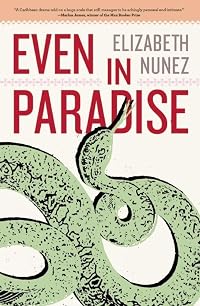
Even in Paradise
by Elizabeth Nunez
On This Page
Description
Retiring in Barbados, widower Peter Ducksworth concludes he must divide his land between his three daughters. Feeling snubbed by his youngest daughter, he declares that she receive hers only after his death and so sets in motion a discord in the family.Tags
Recommendations

















Member Reviews
This is a retelling of Shakespeare’s King Lear set in the Caribbean. Peter Duckworth is a Trinidadian and proud of it, but after his wife dies he decides to move to Barbados where he builds a magnificent house, high on a hill, surrounded by considerable property and with stunning views of the sea. His youngest daughter, Corrine, continues to live with him, while his older daughters are at university and about to be married.
What a wonderful character study! Nunez had me on the edge of my seat a few times, even though I knew the basic story line already. I liked how she wove in current issues of race and class and history of colonialism (and slavery) in the Caribbean.
Her narrator is Emile, the son of a prominent black doctor who once show more saved Peter Duckworth’s life. He first meets Duckworth and Corrine at the racetrack stables in Trinidad, when Corrine is just a child, 9 or 10 years old. He later reconnects with the family when they’ve moved to Barbados and he is a university student. His best friend, Albert Glazal, has fallen in love with Glynnis and he’s invited Emile to come along when he’s to meet Mr Duckworth for the first time.
The tragic event is shrouded in further mystery, and I’m glad that Nunez leaves so much to the imagination. What IS clear is the motivation of Glynnis. Poor Albert. But I’m reminded of the parable of the little girl who picks up a half-dead rattlesnake …. He knew what he was getting into. show less
What a wonderful character study! Nunez had me on the edge of my seat a few times, even though I knew the basic story line already. I liked how she wove in current issues of race and class and history of colonialism (and slavery) in the Caribbean.
Her narrator is Emile, the son of a prominent black doctor who once show more saved Peter Duckworth’s life. He first meets Duckworth and Corrine at the racetrack stables in Trinidad, when Corrine is just a child, 9 or 10 years old. He later reconnects with the family when they’ve moved to Barbados and he is a university student. His best friend, Albert Glazal, has fallen in love with Glynnis and he’s invited Emile to come along when he’s to meet Mr Duckworth for the first time.
The tragic event is shrouded in further mystery, and I’m glad that Nunez leaves so much to the imagination. What IS clear is the motivation of Glynnis. Poor Albert. But I’m reminded of the parable of the little girl who picks up a half-dead rattlesnake …. He knew what he was getting into. show less
Hugely disappointing. "King Lear" is one of the most majestic and challenging works ever penned, plumbing the depths of human cruelty and depravity, precariously balancing against those forces our capacity for love, loyalty, and forgiveness, doing so in language that pushes the very limits of what words can express. What's the point of writing a contemporary novel based on such a tragic monument if you're not going to at least take a stab at some of that? Elizabeth Nunez's "Even in Paradise" settles for just cribbing its plot and its character list (going so far as to have the narrator comment on the parallels several times, even grad-studentsplaining them to other characters), in language that barely ever rises above the pedestrian. show more Even where the novel does something interesting and original — transposing the story to modern-day Trinidad, Barbados, and Jamaica, with their varied and troubling legacies of colonial exploitation and the persistence of white privilege — it doesn't so much explore those themes as tentatively allude to them, then back away to focus more on the soap-opera of the plot's domestic conflicts. That plot unfolds so ploddingly that it never gains momentum (in contrast with its source, which plunges us into the disastrous division of Lear's estate, his rejection of Cordelia, and the machinations of Goneril, Regan, and Edmund within the first scene, the novel doesn't get around to that plot point till about 2/3 of the way through), and caps it off with a meek little plot twist that you can spot a mile away. I sure hope I'll be more impressed by Edward St. Aubyn's and Preti Taneja's takes on the material. show less
 This review was written for LibraryThing Early Reviewers.
Set in Trinidad, Barbados and Jamaica, this novel is not only a retelling of [King Lear], but also a view of the complexities of the Caribbean societies that result from slavery and colonialism. Èmile Baxter, the narrator, is a black Trinidadian. His best friend, Albert Glazal is Trinidadian of Lebanese descent. When Albert becomes engaged to Glynis Duckworth, we are introduced to another group of Trinidadians, those of British descent. As in [Lear] there are three sisters, but theirs wasn't the most compelling story.
As the story progresses, we see how slavery and colonialism still affect society in the islands. The Syrian-Lebanese community usually marries within itself, and whites and blacks don't date. Glynis voices the unspoken show more rule when she says that Èmile is an unsuitable boyfriend for her sister Corinne because he is black. Whites are privileged, while blacks live in poor, underserved neighborhoods like the Tivoli Gardens.
Èmile, who aspires to be a poet, becomes involved in the literary scene, and we see the importance of art to a culture: "Stories, poems connect with people emotionally, make them feel. It's the heart, not the head that causes people to take to the streets, that sets off revolutions when you feel other people's pain -- and stories and poetry make you feel other people's pain -- you can't just sit back and do nothing. You have to demand change."
And perhaps this also speaks to the enduring power of the story of [King Lear]. Art allows people to express themselves: no matter the race, class or ethnicity.
Nunez has written a wonderful, thoughtful novel, that makes us look at how the past influences our lives today. This is my first novel by her, but it won't be the last. show less
As the story progresses, we see how slavery and colonialism still affect society in the islands. The Syrian-Lebanese community usually marries within itself, and whites and blacks don't date. Glynis voices the unspoken show more rule when she says that Èmile is an unsuitable boyfriend for her sister Corinne because he is black. Whites are privileged, while blacks live in poor, underserved neighborhoods like the Tivoli Gardens.
Èmile, who aspires to be a poet, becomes involved in the literary scene, and we see the importance of art to a culture: "Stories, poems connect with people emotionally, make them feel. It's the heart, not the head that causes people to take to the streets, that sets off revolutions when you feel other people's pain -- and stories and poetry make you feel other people's pain -- you can't just sit back and do nothing. You have to demand change."
And perhaps this also speaks to the enduring power of the story of [King Lear]. Art allows people to express themselves: no matter the race, class or ethnicity.
Nunez has written a wonderful, thoughtful novel, that makes us look at how the past influences our lives today. This is my first novel by her, but it won't be the last. show less
This review was written for LibraryThing Early Reviewers.4+. King Lear, three daughters, greed and manipulation, and a mentally disintegrating father. Nunez takes this to the Caribbean, Trinidad and Barbados and uses a family named Duckworth, a widower with three daughters to tell her story. Moving from Barbados from Trinidad, Mr. Duckworth has a beautiful house on some gorgeous land, land his two, elder daughters desperately want. They are also jealous of the youngest, Corinne who is apple of her Father's eye. Into this mix is Emilie, the black son of Duckworth's physician and his friend Alfred, who is of Lebanese descent and becomes engaged to the eldest Duckworth daughter.
Amazing writing, absolutely gorgeous, very addicting story told very well. The manipulations and greed of the two show more eldest sisters plays out against a backdrop of racial discrimination and a politically charged time in Trinidad. The Tivoli Garden massacre is part of a young activist's poem and Tivoli Gardens itself will be used to construct the attempted downfall of the youngest sister. But greed is I believe is the unifying theme, greed of country rulers and the greed within a family. Well played out juxtaposition.
First book by this author for me, but it will not be my last.
ARC from publisher. show less
Amazing writing, absolutely gorgeous, very addicting story told very well. The manipulations and greed of the two show more eldest sisters plays out against a backdrop of racial discrimination and a politically charged time in Trinidad. The Tivoli Garden massacre is part of a young activist's poem and Tivoli Gardens itself will be used to construct the attempted downfall of the youngest sister. But greed is I believe is the unifying theme, greed of country rulers and the greed within a family. Well played out juxtaposition.
First book by this author for me, but it will not be my last.
ARC from publisher. show less
This was the first book I read by this highly regarded author and I look forward to reading more of her work. I loved the comfortable and engaging writing style that pulled one into this story of greed, racism, classicism, Islamophobia, family disfunction and, yes, love and its of it. This is the King Lear drama played out in the paradise that is the Caribbean islands, with their beauty, history of oppression and slavery, multiculturalism and social issues. The island people, their culture and their history are as strongly and clearly presented as are the main characters, their backdrops and their strength and weaknesses. Really enjoyed this book.
This review was written for LibraryThing Early Reviewers.This book does a great job with naturally and meaningfully introducing issues of race, land use, colonial legacy, and national identity in its lushly developed Caribbean setting. In contrast, most of the characters were very flat, with little understandable motivation beyond their actions. The plot felt plodding, and in the end the climax left me wanting and also left some hefty loose ends in what otherwise seemed to be a standalone novel. The dialogue felt sometimes overly formal. I do wish Nunez had spent more time on the conflicts arising from race, identity, and colonial legacy and less on the evil sisters/inheritance Lear plot, because her writing was at its most compelling and engaging when addressing those, and she had powerful show more things to say. An enjoyable read in a well-developed setting that taught me a lot about the Caribbean, Even in Paradise falls a little flat in its characters and the actions driving the plot. show less
This review was written for LibraryThing Early Reviewers.This was an engrossing tale that I found hard to put down. Peter Ducksworth, a Trinidadian of English descent, has three daughters Glynis the eldest, Rebecca the middle daughter and Corinne, the youngest and Mr. Ducksworth's favorite.
After moving to Barbados, from Trinidad in order to live his life in paradise along the white sandy beaches, Peter Ducksworth decides to hand over two pieces of his land to the older daughters. Rebecca has just eloped with a new husband of English ancestry and Glynis is about to marry Albert, a Trinidadian of Lebanese descent. Corinne will have to wait for her inheritance, which is to be the biggest plot of land where her father has his house, in which he intends to spend the rest of his days. But, show more resentful of the fact that Corinne is the favored daughter, the others may have designs on her future inheritance and Mr. Ducksworth himself doesn't make things easy for his daughters with his constant need for attention and affection.
The story is narrated by Emile, a Trinidadian of African descent, who has know the family since he was a child. He is in fact the son of Mr. Ducksworth's personal physician, and Albert, Glynis' finance is Emile best friend. He is therefore privy to all the family dynamics and is able to tell the story of greed, sibling rivalry and manipulation like an insider. As he gets closer to Corinne, he becomes more than an outsider and is able to make the reader feel as if he is having an intimate chat with a close friend.
I loved the way this book covered so many themes, from colonialism, racism, current politics, greed, rivalry and jealousy and was still able to convey the characters in a way that the reader feels an intimate connection with them. The multiple stories within the book were fascinating and well told.
Thanks to the Library Thing giveaway and Akashic Books for allowing me to read this book in exchange for an honest review.
More reviews at: www.susannesbooklist.blogspot.com show less
After moving to Barbados, from Trinidad in order to live his life in paradise along the white sandy beaches, Peter Ducksworth decides to hand over two pieces of his land to the older daughters. Rebecca has just eloped with a new husband of English ancestry and Glynis is about to marry Albert, a Trinidadian of Lebanese descent. Corinne will have to wait for her inheritance, which is to be the biggest plot of land where her father has his house, in which he intends to spend the rest of his days. But, show more resentful of the fact that Corinne is the favored daughter, the others may have designs on her future inheritance and Mr. Ducksworth himself doesn't make things easy for his daughters with his constant need for attention and affection.
The story is narrated by Emile, a Trinidadian of African descent, who has know the family since he was a child. He is in fact the son of Mr. Ducksworth's personal physician, and Albert, Glynis' finance is Emile best friend. He is therefore privy to all the family dynamics and is able to tell the story of greed, sibling rivalry and manipulation like an insider. As he gets closer to Corinne, he becomes more than an outsider and is able to make the reader feel as if he is having an intimate chat with a close friend.
I loved the way this book covered so many themes, from colonialism, racism, current politics, greed, rivalry and jealousy and was still able to convey the characters in a way that the reader feels an intimate connection with them. The multiple stories within the book were fascinating and well told.
Thanks to the Library Thing giveaway and Akashic Books for allowing me to read this book in exchange for an honest review.
More reviews at: www.susannesbooklist.blogspot.com show less
This review was written for LibraryThing Early Reviewers.Members
- Recently Added By
Lists

Kirkus Starred Fiction Reviews of Books Published in 2016
63 works; 3 members

Books Read in 2016
4,666 works; 199 members

Stories Inspired by Other Fiction
127 works; 24 members
Author Information

13+ Works 611 Members
Elizabeth Nunez is a CUNY Distinguished Professor of English at Medgar Evers College.
Work Relationships
Was inspired by
Common Knowledge
- People/Characters
- Corinne Ducksworth; Peter Ducksworth
- Epigraph
- Think'st thou that duty shall have dread to speak
When power to flattery bows?
- King Lear - Dedication
- For my granddaughters, Jordan and Savannah Nunez Harrell
- First words
- I met Corinne Ducksworth when she was a young girl, just turned twelve.
- Quotations
- History is replete with stories of mercenary daughters hastening the demise of fathers whose earthly goods they are impatient to possess.
Classifications
Statistics
- Members
- 53
- Popularity
- 574,463
- Reviews
- 12
- Rating
- (3.93)
- Languages
- English
- Media
- Paper, Audiobook, Ebook
- ISBNs
- 8
- ASINs
- 1