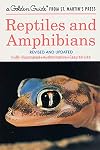
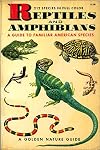
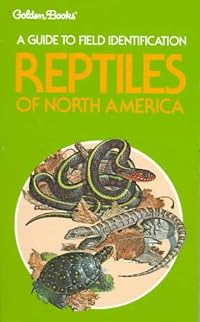
Reptiles and Amphibians (Golden Guides)
by Herbert Spencer Zim, Hobart M. Smith (Author)
Golden Guides (Nature)
On This Page
Description
Sections on turtles, lizards, snakes, alligators and crocodiles, frogs and toads, and salamanders give information on description, habits and range for each species common in the United States.Tags
Recommendations





























Member Reviews
As kids, we had several Golden Guides, which offered a handy means of identification of animals we'd encounter in our yard, the woods, and the nearby park. This guide probably didn't get much use (since other than the occasional garter snake and frog, our paths weren't crossed very often by amphibians and reptiles. Nevertheless, it was fun to page through the guide to see the different types of lizards, snakes, and turtles. Who'd have imagined that someday I'd grow up and make such animals the subject of intensive study, and to build a research career out of them!
When I was a kid, this was our "go-to" reference for identification of amphibians and reptiles. As a "Golden Nature Guide" paperback, it is small enough to slip into a pocket or backpack.
It contains detailed color illustrations, along with descriptions of the individual animals' morphology and natural history, and a small distribution map. Geographic coverage is of US species (thus, the "American" of the title refers to that portion of North America governed by the US). Separate chapters are devoted to turtles, lizards, snakes, alligators and crocodiles, frogs & toads, and salamanders. Species and species groupings are identified by common name (thus scientific names are not given). Introductory sections deal briefly with evolutionary show more history, fact and fable, "values" of reptiles and of amphibians (hmmm...), conservation, snake bite, and activities (including collecting and care in captivity).
This particular guide has the distinction of being authored by Herbert Zim along with the eminent herpetologist Hobart Smith. Its authorship gives assurance that it was up to date, as of 1956, in terms of taxonomy, geographical distributions, and natural history.
Having been published over 50 years ago, this small nature guide will mainly be of historical interest and to collectors of natural history ephemera. Now, of course, it has long since been superceded by works more complete, accurate, and current. show less
It contains detailed color illustrations, along with descriptions of the individual animals' morphology and natural history, and a small distribution map. Geographic coverage is of US species (thus, the "American" of the title refers to that portion of North America governed by the US). Separate chapters are devoted to turtles, lizards, snakes, alligators and crocodiles, frogs & toads, and salamanders. Species and species groupings are identified by common name (thus scientific names are not given). Introductory sections deal briefly with evolutionary show more history, fact and fable, "values" of reptiles and of amphibians (hmmm...), conservation, snake bite, and activities (including collecting and care in captivity).
This particular guide has the distinction of being authored by Herbert Zim along with the eminent herpetologist Hobart Smith. Its authorship gives assurance that it was up to date, as of 1956, in terms of taxonomy, geographical distributions, and natural history.
Having been published over 50 years ago, this small nature guide will mainly be of historical interest and to collectors of natural history ephemera. Now, of course, it has long since been superceded by works more complete, accurate, and current. show less
The copy I have is falling apart. I got it at a library book sale for ten cents. I know its outdated (and its also based off of an evolutionary worldview), but I met my expectations when I bought it, hence the five star rating. I mostly use it for reference pictures when knitting stuffed snakes, so it works perfectly for me.
Golden Press has been producing these little guides for decades. Note the title of this series is a "nature" guide. Most in the nature series are not field guides which are used for identification. These nature guides are designed to introduce young children to specific study areas (ie. birds, flowers, pond life, etc.) in the natural sciences. Most are limited to common examples from large geographical areas. The information presented, in diagrams, descriptions and colorful illustrations, provides a basic introduction into the specific topic. They are wonderful for young children who can read. This rating is based on my judgement of the content, printing quality, and age of the reader.
Serves its purpose, perhaps, but is too basic. Good for kids.
Ratings
Members
- Recently Added By
Author Information

183+ Works 27,204 Members
Herbert S. Zim was born in 1909 in New York City. He was a naturalist, author, editor and also known as the fonder and editor in chief of the Golden Guides series of nature books. Zim wrote or edited more than one hundred scientific books, and in a thirty-year career teaching in the public schools introduced laboratory instruction into elementary show more school science. He is best known as the founder in 1945, of the Golden Guides, pocket-size introductions for children to such subjects as fossils, zoology, microscopy, rocks and minerals, codes and secret writings, trees, wildflowers, dinosaurs, navigation and more. He was the sole or co-author for many of the books, which were valued for their clarity, accuracy and attractive presentation helped by the illustrations of James Gordon Irving. He continued to work on the Golden Guides series until Alzheimer's disease forced him to slow down in the 1990s. He died in 1994 at Plantation Key, Florida. (Bowker Author Biography) show less
Some Editions
Series

Common Knowledge
- Original publication date
- 1953
Classifications
Statistics
- Members
- 858
- Popularity
- 31,647
- Reviews
- 5
- Rating
- (3.61)
- Languages
- English, German, Spanish
- Media
- Paper, Ebook
- ISBNs
- 13
- ASINs
- 15