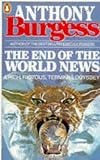
The End of the World News
by Anthony Burgess 
On This Page
Description
Presented without chapter breaks, the plot weaves together three storylines. One follows Leon Trotsky on a journey to New York City shortly before the Russian Revolution of 1917. This story is written as the libretto of an Off-Broadway musical. A second tale covers the life and career of Sigmund Freud and includes portrayals of Havelock Ellis and Krafft-Ebing. The third part is set in the future, shortly before the impact of a rogue, extrasolar planet with the Earth. Because of the latter show more story line, it is considered a work of fantastic fiction. show lessTags
Recommendations






















Member Reviews
Whenever Graham Greene wrote a book he was afraid might detract from his reputation as a serious Catholic novelist, he labelled it “An entertainment”. Burgess borrows that trick here, to let us know that it is OK for us not to take this entirely seriously. He reinforces this by framing the text with a preface and an epilogue both aimed at undermining the authority of the narrator. But then he goes on to write a book dealing with what prima facie look like three very serious subjects…
The central conceit of the book is that pages from three apparently unrelated texts have got mixed up: an apocalyptic science fiction novel, a musical libretto about Trotsky in New York, and a historical novel about Freud. This pushes the book a long show more way towards cleverness-for-its-own-sake, always a risk with Burgess, but there is some very interesting writing along the way, particularly in the Freud story, which was clearly researched carefully and invites us to think about the way the founders of intellectual movements inevitably lose their control over the way the movement develops. Almost as though psychoanalysis found itself hating its father and wanting to sleep with its mother. The Trotsky story doesn’t really add much apart from some engagingly bad jokes and a genre shift that allows Burgess to play around with contrapuntal lyrics. The science fiction story has a drunken-writer protagonist who seems a bit too much like Burgess to be really likeable and a deliberately shaky plot that keeps veering off on parodic tangents. But it claims to be an entertainment and it does entertain, so we shouldn’t complain! show less
The central conceit of the book is that pages from three apparently unrelated texts have got mixed up: an apocalyptic science fiction novel, a musical libretto about Trotsky in New York, and a historical novel about Freud. This pushes the book a long show more way towards cleverness-for-its-own-sake, always a risk with Burgess, but there is some very interesting writing along the way, particularly in the Freud story, which was clearly researched carefully and invites us to think about the way the founders of intellectual movements inevitably lose their control over the way the movement develops. Almost as though psychoanalysis found itself hating its father and wanting to sleep with its mother. The Trotsky story doesn’t really add much apart from some engagingly bad jokes and a genre shift that allows Burgess to play around with contrapuntal lyrics. The science fiction story has a drunken-writer protagonist who seems a bit too much like Burgess to be really likeable and a deliberately shaky plot that keeps veering off on parodic tangents. But it claims to be an entertainment and it does entertain, so we shouldn’t complain! show less
What do Trotsky, Freud, and a rogue planet have in common?
This novel -- and not much else. Burgess attempts to bring these three parallel stories together at the end of this end-of-times novel. He succeeds in a satisfactory way, to be sure, but the synthesis is less than the sum of its parts. There is no resonance, as there would be with three topics whose connection inspired the book: one is left with the impression that Freud and Trotsky were chosen haphazardly, as if Burgess were reading about them anyways and decided to incorporate them into the novel.
And what a novel it is! Putting aside the sympathetic biopic of Freud and the unsympathetic musical of Trotsky, this is a fantastic end-of-the-world story. The politicians and show more scientists are trying to find some way to preserve human culture. But what defines human culture? What deserves to be saved? The question echoes throughout the story, and everybody has their own answer. show less
This novel -- and not much else. Burgess attempts to bring these three parallel stories together at the end of this end-of-times novel. He succeeds in a satisfactory way, to be sure, but the synthesis is less than the sum of its parts. There is no resonance, as there would be with three topics whose connection inspired the book: one is left with the impression that Freud and Trotsky were chosen haphazardly, as if Burgess were reading about them anyways and decided to incorporate them into the novel.
And what a novel it is! Putting aside the sympathetic biopic of Freud and the unsympathetic musical of Trotsky, this is a fantastic end-of-the-world story. The politicians and show more scientists are trying to find some way to preserve human culture. But what defines human culture? What deserves to be saved? The question echoes throughout the story, and everybody has their own answer. show less
This is probably my favorite bk that I've read by Burgess. It interweaves (I know, I know, that's an overused word in this type of context) 3 stories: one of wch is all about Freud. Learning about the genesis of psychoanalysis was esp interesting for me. I never realized what an INVENTION it was - not even necessarily by doctors.
PSICANÁLISE,SOCIALISMO INTERNACIONAL EO FIM -TRES TEMAS,TRES HISTÓRIAS -ENTRELAÇADOS EM VERTIGINOSO CONTRAPONTO NUM ROMANCE CHEIO DE PIROTECNIAS VERBAIS ,INCRIVEIS VOOS DE FANTASIA E DIVERTIDAS ANEDOTAS ,TUDO COROADO POR UM BRILHANTE E INESPERADO FINALE -A OBRA-PRIMA DE UM ROMANCISTA NO ÁPICE DE SUA FORMA LITERÁRIA.
Jun 16, 2021Portuguese (Brazil)
Ratings
Members
- Recently Added By
Lists

The Guardian's 1000 Novels Everyone Must Read
1,005 works; 549 members
Author Information

120+ Works 48,185 Members
Anthony Burgess was born in 1917 in Manchester, England. He studied language at Xaverian College and Manchester University. He had originally applied for a degree in music, but was unable to pass the entrance exams. Burgess considered himself a composer first, one who later turned to literature. Burgess' first novel, A Vision of Battlements show more (1964), was based on his experiences serving in the British Army. He is perhaps best known for his novel A Clockwork Orange, which was later made into a movie by Stanley Kubrick. In addition to publishing several works of fiction, Burgess also published literary criticism and a linguistics primer. Some of his other titles include The Pianoplayers, This Man and Music, Enderby, The Kingdom of the Wicked, and Little Wilson and Big God. Burgess was living in Monaco when he died in 1993. (Bowker Author Biography) show less
Anthony Burgess has a Legacy Library. Legacy libraries are the personal libraries of famous readers, entered by LibraryThing members from the Legacy Libraries group.
Some Editions
Awards and Honors
Common Knowledge
- Canonical title
- The End of the World News
- Original title
- The End of the World News
- Original publication date
- 1982
Classifications
Statistics
- Members
- 562
- Popularity
- 52,391
- Reviews
- 4
- Rating
- (3.59)
- Languages
- 6 — English, French, German, Italian, Spanish, Swedish
- Media
- Paper
- ISBNs
- 13
- ASINs
- 2