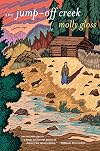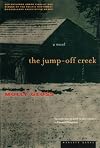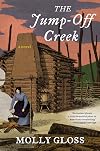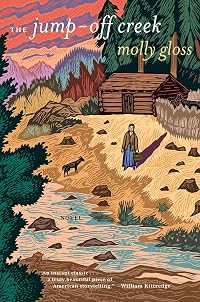
The Jump-Off Creek
by Molly Gloss
On This Page
Description
A widowed homesteader is determined to make a life in the unforgiving mountains of late 19th century Oregon in this "powerful novel of struggle and loss" (Dallas morning News).Acclaimed author Molly Gloss drew on pioneer diaries and old family stories to write this modern Western classic of a solitary woman's frontier life. In the 1890s, Lydia Sanderson leaves her old life behind and journey's to Jump-Off Creek to make her way as a homesteader. Enduring the hardships and deprivations of show more Oregon's high mountain country, Lydia finds both courage and community in her determination to survive.
This "unsparing portrait of pioneer life, recounted simply and without romanticism" displays an "intimate understanding of the harsh physical conditions" of the Western frontier, as well as the methods and practices that made such conditions livable (Publishers Weekly). show less
Tags
Recommendations











Member Reviews
I loved this book, and it's by an Oregon author! This is the story of a woman homesteader, Lydia Sanderson, who is trying to create a home in Easter Oregon in the 1890's. She is a widow, escaping what seems to have been a loveless past, with no desire to remarry. Gloss appears to have done a lot of research, including with her own great-grandmothers, and the story feels very real. Life was hard work, with very little time for any luxury. (I ended up really appreciating my house, with heating and plumbing and a floor. )
Gloss also shows the poverty of her characters inner lives. They all had hard childhoods, and grew up with a limited emotional range -- but still with a human need to connect. The two main characters, Lydia, and a nearby show more rancher, Tim Whiteaker, develop a relationship of sorts, and throughout the book struggle to discover what they mean to each other.
This is a short book, and Gloss uses spare, carefully considered language to great effect. This simplicity reflects the homesteading reality and keeps the reader in Lydia's reality. show less
Gloss also shows the poverty of her characters inner lives. They all had hard childhoods, and grew up with a limited emotional range -- but still with a human need to connect. The two main characters, Lydia, and a nearby show more rancher, Tim Whiteaker, develop a relationship of sorts, and throughout the book struggle to discover what they mean to each other.
This is a short book, and Gloss uses spare, carefully considered language to great effect. This simplicity reflects the homesteading reality and keeps the reader in Lydia's reality. show less
Beautifully written, low-key, with the truthfulness of life itself. [return][return]Molly Gloss excels at stories of life on the edge: one of my very favorite novels is "The Dazzle of Day," her beautifully written, low-key and truthful story of a group of Quakers who flee political and ecological chaos on Earth in a generation starship headed for a distant star. "The Jump-Off Creek" reverses the polarity of Gloss' imaginative time-machine, and recreates world of the 1890s Oregon frontier, and the life of Lydia Sanderson, a young widow who has sold up all the baggage of her unhappy marriage and bought a smallholding in Oregon, with little more ambition than, for the first time in her life being her own boss, and keeping body and soul show more together. [return][return]Encounters with her neighbours -- fellow smallholders, scraping a living from the land during a depression that is adding to the general struggle to survive, their wives, who raise and bury children, and long for brief opportunities for female companionship, and "wolfers," embittered young cowboys who scrape a living from the bounty they receive for killing the wolves that prey on cattle and sheep -- build up to a narrative of her first year in her new home on the Jump-off Creek.[return][return]I can't think of any way to put it better than the late, Blessed Ursula Le Guin, who described it as " ... the West behind the swaggering and hokum." A marvellous story of the quiet courage that went into the settling of America. show less
It's all "between the lines," in the silences - I probably shouldn't be reading Molly Gloss. I'm a guy, after all. But maybe, at 64, some of the nastiness of being a guy has finally worn off. Because I love the way this woman writes. The Hearts of Horses hooked me, Wild Life wowed me, and now, this earlier absolute gem of a novel just blew me away. How does she do this thing where the essence of the story lies in what is not said? Lydia Sanderson, Tim Whiteaker, Blue Odell. None of them say very much of any real significance. All are stoic and uncomplaining of the "narrow circumstances" life has dealt them. In fact they are nearly inarticulate; yet all these feelings - of yearning and loneliness, of sorrow and regret, they are all show more somehow laid bare in the pauses. The descriptions, the gestures, the sidelong glances, the facial expressions - all become muted dialogue. Even the one character who seems unabashedly bad, the angry bigoted boy that is Harley Osgood, has an element of humanity in him that doesn't quite let you hate him. There are no simple black-and-white characters in Gloss's fiction. There are, instead, infinite shades of gray, and an attention to descriptive detail that makes you understand implicitly much of what is left unsaid. The years-long friendship between the two cowboys Whiteaker and Odell is perhaps one of the best portrayals of love between men that fiction has to offer. And I'm not talking about any "Brokeback Mountain" kinda stuff here either. These are just two men who have stuck together through thick and thin, mostly the latter, and a bond has formed that is stronger than most marriages. Enough said. This is simply a superb story. There oughta be a ten-star rating for books of this caliber. And by the way, what a wonderful film for thinking adults this could be. Thanks again, Molly. I'll be watching for the next book, so please, Write on! show less
This novel, about homesteading the Oregon wilderness in the late 19th century's Long Depression, succeeds in creating a convincing and poignant sense of the isolation experienced by its characters. Their vulnerability and the tenuous viability of their way of life invests the narrative with a riveting, real-world tension. The prose is honed and beautiful.
Maybe it's the fact that The Jump-Off Creek takes place in 1895 and times are hard, hard, hard; maybe it's just the way Gloss wanted her characters, but everyone in The Jump-Off Creek is stiff, dour, reserved, uncomfortable. It got harder and harder for me to read. There is no real joy in this book. On the one side you have Harley Osgood and his companions. They are poisoning cows to attract wolves. Wolf pelts are going for a pretty penny and it's nothing personal. They are just trying to make a living because as I said, times are hard. On the other side, Tim and his partner, Blue, are trying to keep their livestock safe from the poisonings, but even pet dogs are not safe from the strychnine. [Note: heartbreak alert.] In the middle is show more Lydia Sanderson, a lone (and lonely) widow who has come back to claim her homestead. The Jump-Off Creek borders her property and while the surrounding land needs a great deal of work, she is determined to make her way. show less
The Jump-Off Creek by Molly Gloss is about homesteading in Oregon in the late 1800s. A woman who has been widowed comes to this remote area, near the Umpqua Mountains to take up her claim. She purchased the deed to an abandoned site so she starts with some land cleared and a ramshackle cabin. Her nearest neighbours are a couple of single men who are raising cattle. This was a very hard life as just in order to survive, she must work all day at tending her goats, improving her cabin, planting and caring for a garden, and clearing the land. She also had to live with the loneliness, insecurity, and the dirt.
The story is told plainly and without romanticizing any part of the life. The author used pioneer diaries, journals and the stories of show more her own relatives to portray an accurate picture of the hardship that was frontier life. Although there is a story about an on-going feud between a squatter and one of her neighbours, the author really concentrates on the actuality of pioneering with descriptions of branding cattle, milking goats and logging. These descriptions draw a portrait that is very effective at both giving us insight into the hardships but also a glimmer of the slow development of community.
The Jump-Off Creek is an engrossing and moving read about pioneering, a subject I love to read about but am most appreciative that I don’t have to live it. show less
The story is told plainly and without romanticizing any part of the life. The author used pioneer diaries, journals and the stories of show more her own relatives to portray an accurate picture of the hardship that was frontier life. Although there is a story about an on-going feud between a squatter and one of her neighbours, the author really concentrates on the actuality of pioneering with descriptions of branding cattle, milking goats and logging. These descriptions draw a portrait that is very effective at both giving us insight into the hardships but also a glimmer of the slow development of community.
The Jump-Off Creek is an engrossing and moving read about pioneering, a subject I love to read about but am most appreciative that I don’t have to live it. show less
The Jump-Off Creek is beautifully written prose about day-to-day life in the 1890’s in Oregon; a compelling description of the fortitude of those who survived and ultimately conquered the frontier. The book is a fascinating story about everyday life.
Members
- Recently Added By
Lists

Pen/Faulkner Winners and Finalists
178 works; 9 members

Read-alike - One Thousand White Women by Jim Fergus
17 works; 1 member

Unmarried women
66 works; 6 members
Author Information

15+ Works 2,067 Members
Molly Gloss was a finalist for the PEN/Faulkner Award. She teaches writing and literature of the American West at Portland State University and lives in Portland, Oregon. (Bowker Author Biography)
Awards and Honors
Common Knowledge
- Original publication date
- 1989
- People/Characters
- Lydia Bennett Sanderson; Tim Whiteaker
- Important places
- Oregon, USA
- Dedication
- For my Great-Grandmothers-- Molly Mizell Donaldson 1875-1944, Miles, Texas Emma Castle Hurlburt Bettey 1862-1924, Walla Walla, Washington Nancy Kerr Lovelace 1853-1938, Irion County, Texas Lena Meyers Remlinger 1860-1930 F... (show all)ort Vancouver, Washington--Westering Women, All
- First words
- 6 April Bought the black hinny Mule today, $18, also the spavint gray as my money is so short and I have hope he will put on wt, his eyes are clear w a smart look in them and his feet not tender.
- Last words
- (Click to show. Warning: May contain spoilers.)When I said I had made Hay, he said he would learn it from me if I would teach him, and I said I would.
- Blurbers
- Ursula K. LeGuin; Edward Hoagland
Classifications
Statistics
- Members
- 376
- Popularity
- 83,380
- Reviews
- 16
- Rating
- (3.93)
- Languages
- English, French
- Media
- Paper, Audiobook, Ebook
- ISBNs
- 11
- UPCs
- 3
- ASINs
- 7