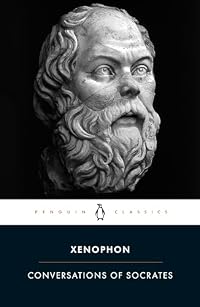
Conversations of Socrates (Penguin Classics)
by Xenophon
On This Page
Description
Xenophon is less speculative than Plato and applies Socratic principles more to everyday life: by reading his book, we not only learn about Socrates and his philosophy but also gain fascinating insights into the daily life of ancient Greece and into the religious, political and moral views of a certain type of Athenian.Tags
Recommendations



Member Reviews
(Original Review, 2002-06-23)
Socrates was also interesting because of his physicality....His routine was to spend the morning exercising then the afternoon in the market place on his mission. He was extremely fit and brave, fighting in three campaigns, the last aged 50, and honoured for his bravery in battle. He was terrifying apparently. Also he had a kind of walk that was unusual, a kind of gait that would strike fear into potential enemies. This is not your usual philosopher as we have come to know them (bookish, lovers not fighters - think Bertrand Russell). It is strange to me that so little is written about Socrates and exercises - what kind of exercises did he do? Surely like many highly spiritual people today, the body was an show more important aspect of spiritual practise (yoga, etc.)
One place that we do hear stuff like this in the Timeaus - in the third section - there is talk that is much like the Chakra system or Chi Kung. As someone who has developed practise over the years in these directions I can recognise it immediately...For example, there is talk of two invisible channels either side of the spine - like water courses. Connected to this is his daimon.....what was it? Well it was a sign (not a voice in the head telling him things - this is not a case of schizophrenia), a sign that he followed in matters big or small. It would stop him mid sentence, and it did not stop him from going to his death...i.e., IT LED HIM TO HIS DEATH.
It was his inner moral guide that he always obeyed. This in itself was not a dangerous thing to Athenian society, what was dangerous was if he also taught others that they too have a daimon, and that all the daimons work together for the good of the whole, and they should ALWAYS be obeyed when they call.
Did he teach this? - Well, Plato doesn't say so but given that this (by hypothesis) was the reason for his execution, then of course Plato wouldn't have been allowed to transmit this teaching in writing.
Anyway there you go! Enough conversation of Socrates. show less
Socrates was also interesting because of his physicality....His routine was to spend the morning exercising then the afternoon in the market place on his mission. He was extremely fit and brave, fighting in three campaigns, the last aged 50, and honoured for his bravery in battle. He was terrifying apparently. Also he had a kind of walk that was unusual, a kind of gait that would strike fear into potential enemies. This is not your usual philosopher as we have come to know them (bookish, lovers not fighters - think Bertrand Russell). It is strange to me that so little is written about Socrates and exercises - what kind of exercises did he do? Surely like many highly spiritual people today, the body was an show more important aspect of spiritual practise (yoga, etc.)
One place that we do hear stuff like this in the Timeaus - in the third section - there is talk that is much like the Chakra system or Chi Kung. As someone who has developed practise over the years in these directions I can recognise it immediately...For example, there is talk of two invisible channels either side of the spine - like water courses. Connected to this is his daimon.....what was it? Well it was a sign (not a voice in the head telling him things - this is not a case of schizophrenia), a sign that he followed in matters big or small. It would stop him mid sentence, and it did not stop him from going to his death...i.e., IT LED HIM TO HIS DEATH.
It was his inner moral guide that he always obeyed. This in itself was not a dangerous thing to Athenian society, what was dangerous was if he also taught others that they too have a daimon, and that all the daimons work together for the good of the whole, and they should ALWAYS be obeyed when they call.
Did he teach this? - Well, Plato doesn't say so but given that this (by hypothesis) was the reason for his execution, then of course Plato wouldn't have been allowed to transmit this teaching in writing.
Anyway there you go! Enough conversation of Socrates. show less
Xenophon was an ancient Greek historian and philosopher who is noted for being a source of information about Socrates. His insights expand upon those found in the Dialogs of Plato.
Ratings
Members
- Recently Added By
Author Information

718+ Works 10,519 Members
Xenophon's life and personality is better known to us, perhaps, than that of any other Greek who lived before Alexander the Great. Much of his considerable output of historical writing and essays is frankly or implicitly autobiographical. He reveals himself as one of those many Athenians and other Greeks who turned to autocratic political models, show more including admiration of Persia, after the excesses of the Athenian democracy led to disaster in the Peloponnesian War. He also reveals himself as much more than a literary man and a critic of his times. A gentleman adventurer and something of a professional soldier, he followed in turn the philosopher Socrates, the Persian prince Cyrus the Younger, and the Spartan king Agesilaus, all of whom he wrote about with an air of close personal knowledge. His works include the autobiographical Anabasis, an account of his service with a mercenary Greek army that marched from Mesopotamia to the Black Sea after the defeat and death of the younger Cyrus. It provides the most detailed single perspective on the military practices and military mentality of Xenophon's age. His Hellenica, by contrast, is an impersonal continuation to the end of the Peloponnesian War of the work of Thucydides and a patchy memoir that concentrates on Sparta's fortunes until the definitive end of its power in 362 b.c. Xenophon's other major works are the Cyropaedia and the rambling Socratic dialogues known as the Memorabilia. The Cyropaedia is a fictional idealization of the career of Cyrus the Great, the only great conqueror known to the Greeks before Alexander. Often regarded merely as a novel, it is a species of a priori historical reconstruction. A retrojection of the military science and political values of the day into a largely unknown Persia of the past, it is intended to explain Cyrus's success on rational principles. The Memorabilia and the Socratic Apology that comes down with them contain nothing of philosophical value but are thought by some scholars to offer a possible corrective to Plato's altogether too Platonic Socrates. Xenophon had a conventional and second-rate mind, but he is a valuable resource because of his mediocrity. He enables us to make contact with an ordinary intellect from a world that often seems dominated by geniuses. (Bowker Author Biography) show less
Some Editions
Series
Belongs to Publisher Series
Work Relationships
Common Knowledge
- Original publication date
- 0370 BCE circa
Classifications
- Genres
- Philosophy, Nonfiction, General Nonfiction, History, Biography & Memoir
- DDC/MDS
- 183.2 — Philosophy and Psychology Ancient, medieval & eastern philosophy Sophistic, Socratic, related Greek philosophies Socrates
- LCC
- B312 .E5 .T74 — Philosophy, Psychology and Religion Philosophy (General) By period Ancient
- BISAC
Statistics
- Members
- 642
- Popularity
- 44,867
- Reviews
- 2
- Rating
- (3.51)
- Languages
- Catalan, English, Finnish, Spanish
- Media
- Paper, Ebook
- ISBNs
- 7
- ASINs
- 1