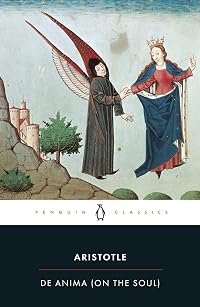
On the Soul
by Aristotle
On This Page
Description
This richly annotated, scrupulously accurate, and consistent translation of Aristotle's De Anima fits seamlessly with other volumes in the series. Sequentially numbered endnotes provide the information most needed at each juncture, while a detailed Index of Terms indicates places where focused discussion of key notions occurs. An illuminating general Introduction describes the book that lies ahead, explaining what sort of work it is and what sorts of evidence it relies on.Tags
Recommendations








Member Reviews
Okay, Aristotle basically came up with this whole "soul" deal, and it's another trophy on his wall, for sure. But better than that: He also came up with the whole five-part division of the senses into visual, aural, olfactory, tactile, and gustatory. In this book!
This was a solid Aristotelian text. I thought that it was quite interesting the way that Aristotle conceptualized the soul and used his owns powers of deduction to explain its occurrence and the meaning behind it. Overall, a satisfying read.
A short but dense text. This work, along with Plato's Republic, have greatly shaped how psychologists have frameworked their understanding of the mind for the past 2000+ years.
A nice review of the literature and then a scientific, but abstract, discussion about the things the soul might be -- parts vs. not, a cause of motion vs. not, a source of deliberation or not.
Acerca del alma se enmarca en el grupo de obras aristotélicas dedicadas a la naturaleza orgánica y a los seres vivos. Aristóteles entiende el alma como principio de vida, lo cual explica que este estudio combine cuestiones de psicología y de fisiología: percepción, memoria, sueños y vigilia, respiración, movimiento. Se trata, sin duda, de una concepción naturalista muy distinta de las espiritualistas propias del platonismo y el cristianismo, sin connotaciones religiosas y apegada a las ciencias particulares. Define el alma como principio vital o animador, que subyace a todas las funciones manifiestas, desde la reproducción hasta la actividad intelectual. Por eso, aunque este tratado no instituye un dualismo ni separa el alma show more del cuerpo, tampoco desustantiviza el alma, que se mantiene irreductible tanto como potencia o posibilidad de vida como acto vital efectivo. La riqueza de Acerca del alma ha alimentado multitud de corrientes vitalistas hasta nuestros días. Ha ejercido una gran influencia tanto en psicología (por su teoría de las facultades) como en teoría del conocimiento. show less
Jun 21, 2022Spanish
De Anima, traité où Aristote cherche, à travers la découverte de la nature, de la substance et des propriétés de l'âme, à cerner le 'comment' de la connaissance.
Sep 24, 2010French
ACERCA DEL ALMA
INTRODUCCIÓN GENERAL
I. VIDA Y ÉPOCA
Aristóteles -que juntamente con Sócrates y Platón
forma el trío estelar de la filosofía ateniense- nació
en Estagira (Tracia) y acabó sus días en Calcis (Eu-bea)
1. No fue ateniense ni de nacimiento ni de ciuda
danía. Tampoco murió en Atenas. Pasó allí dos largos
períodos de su vida: desde los diecisiete a los treinta y
siete años, primero, y desde los cuarenta y nueve a
los sesenta y uno, después. Tras estas dos dilatadas
estancias hubo de marchar de Atenas. Curiosamente,
en una y otra ocasión su marcha estuvo directamente
relacionada con la muerte de los dos hombres más grandes
con que tuvo trato estrecho en su vida: la primera...
1 La fuente fundamental, aunque no única, show more para la biografía
de Aristóteles es DIOGENES LAERCIO, V 1-35. El libro más intere-
sante y completo que puede consultarse en relación con la vida
de Aristóteles es el de I. DÜRING, Aristotle in the ancient
biographical tradition, Gotemburgo, 1957. En esta obra encontrará el
lector una edición crítica -juntamente con comentario- de las
distintas vidas de Aristóteles además de la de DIOGENES LAERCIO
(Vita Marciana, Vita Vulgata, Vita Lascaris, Vita Latina), así
como fragmentos de la tradición biográfica antigua. Es también
interesante la edición de la Vita Marciana por O. GIGON con
comentario, Berlín, 1962. Cf., también, la reciente obra de A. H.
CHROUST, Aristotle. New light on his life and on some of his lost
works, Londres, 1973. show less
INTRODUCCIÓN GENERAL
I. VIDA Y ÉPOCA
Aristóteles -que juntamente con Sócrates y Platón
forma el trío estelar de la filosofía ateniense- nació
en Estagira (Tracia) y acabó sus días en Calcis (Eu-bea)
1. No fue ateniense ni de nacimiento ni de ciuda
danía. Tampoco murió en Atenas. Pasó allí dos largos
períodos de su vida: desde los diecisiete a los treinta y
siete años, primero, y desde los cuarenta y nueve a
los sesenta y uno, después. Tras estas dos dilatadas
estancias hubo de marchar de Atenas. Curiosamente,
en una y otra ocasión su marcha estuvo directamente
relacionada con la muerte de los dos hombres más grandes
con que tuvo trato estrecho en su vida: la primera...
1 La fuente fundamental, aunque no única, show more para la biografía
de Aristóteles es DIOGENES LAERCIO, V 1-35. El libro más intere-
sante y completo que puede consultarse en relación con la vida
de Aristóteles es el de I. DÜRING, Aristotle in the ancient
biographical tradition, Gotemburgo, 1957. En esta obra encontrará el
lector una edición crítica -juntamente con comentario- de las
distintas vidas de Aristóteles además de la de DIOGENES LAERCIO
(Vita Marciana, Vita Vulgata, Vita Lascaris, Vita Latina), así
como fragmentos de la tradición biográfica antigua. Es también
interesante la edición de la Vita Marciana por O. GIGON con
comentario, Berlín, 1962. Cf., también, la reciente obra de A. H.
CHROUST, Aristotle. New light on his life and on some of his lost
works, Londres, 1973. show less
Apr 6, 2018Spanish
Members
- Recently Added By
Lists

Filosofía - Clásicos
217 works; 1 member

Great Books Favorites
71 works; 6 members

How to Read a Book's Recommended Reading List
309 works; 10 members

Book wishlist
78 works; 1 member

Books in the Bibliography of Humans: A Monstrous History by Surekha Davies
346 works; 1 member
Author Information

2,091+ Works 57,636 Members
Some Editions
Series
Belongs to Publisher Series
Work Relationships
Is contained in
Is abridged in
Common Knowledge
- Canonical title
- On the Soul
- Original title
- περί ψυχές (Peri Psychēs) (Peri Psychē | s)
- Alternate titles
- De Anima
- Original publication date
- 350 BCE
- People/Characters
- Aristotle
- Important places
- Ancient Greece; Greece
- Important events
- Classical Antiquity; 4th century BCE
- First words
- Cognition is in our eyes a thing of beauty and worth, and this is true of one cognition more than another, either because it is exact or because it relates to more important and remarkable objects.
- Last words
- (Click to show. Warning: May contain spoilers.)It has hearing in order than information may be conveyed to it, and a tongue, that in its turn it may convey information to its fellow.
- Original language
- Ancient Greek
Classifications
Statistics
- Members
- 1,231
- Popularity
- 20,110
- Reviews
- 8
- Rating
- (3.96)
- Languages
- 17 — Danish, Dutch, English, Finnish, French, German, Greek (Ancient), Greek, Italian, Latin, Multiple languages, Norwegian (Bokmål), Portuguese, Romanian, Slovenian, Spanish, Swedish
- Media
- Paper, Audiobook, Ebook
- ISBNs
- 98
- ASINs
- 20